

A family’s wealth plan needs to reach beyond its investment portfolio. Wealth management for families in Singapore can connect global investment opportunities with family governance, succession planning, trust structures and international tax considerations. The right approach depends on the family’s priorities, assets and plans for the next generation.
Growing and protecting wealth are important, but so are decisions about how assets are managed, who guides them and how they may pass between generations. Singapore’s role as a wealth management centre gives families a setting to consider these questions alongside investment opportunities and regional connections.
This guide explains how families can think through investment access, governance and succession, trust structures and cross-border tax issues. It also outlines how financial planning can bring those priorities together, so you can see what to consider and where to begin.
Key Takeaways
- Consider how regional and global investments fit your family’s goals, risk tolerance and time horizon.
- Set clear family decision-making roles and succession plans to help preserve continuity across generations.
- Understand how trust and fund structures, including Sections 13O and 13U, may fit within qualifying criteria and cross-border tax considerations.
- Compare Singapore’s wealth-management options against your family’s needs and resources before choosing a management approach.
Access to regional and global investment opportunities
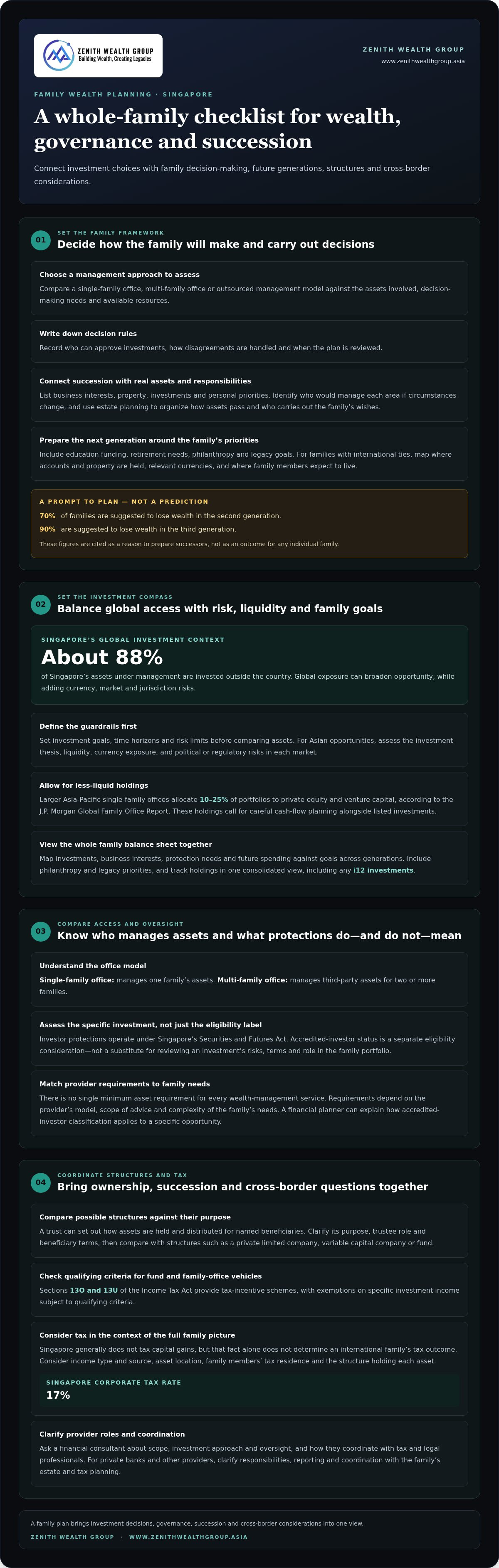
Singapore gives families a base for considering investments beyond the domestic market. About 88% of Singapore’s assets under management are invested outside the country. For wealth management for families in Singapore, global exposure can broaden opportunity, but it also adds currency, market and jurisdiction risks. Set investment goals, time horizons and risk limits before comparing assets.
Family offices can organize investment oversight in different ways. A single-family office manages one family’s assets; a multi-family office manages third-party assets for two or more families. Larger Asia-Pacific single-family offices allocate 10-25% of portfolios to private equity and venture capital, according to J.P. Morgan’s 2026 Global Family Office Report. These less liquid holdings call for careful cash-flow planning alongside listed investments.
Build a whole-family view, rather than judging each holding alone. Map investments, business interests, protection needs and future spending against the family’s goals across generations. Include philanthropy and legacy priorities in that discussion. For Asian opportunities, compare the investment thesis, liquidity, currency exposure and political or regulatory risks in each market. Track holdings in one consolidated view, including any i12 investments, so decisions reflect the wider portfolio.
Investor protections operate under Singapore’s Securities and Futures Act. Accredited-investor status is a separate eligibility consideration, not a substitute for reviewing an investment’s risks, terms and role in the family portfolio. Ask a financial planner to explain how the classification affects the specific opportunity before deciding.
There is no single minimum asset requirement for every wealth-management service. Requirements depend on the provider’s model, the scope of advice and the complexity of the family’s needs. Singapore’s corporate tax rate is 17%, according to the Inland Revenue Authority of Singapore. Treat tax and investment decisions as connected, especially when assets, entities or beneficiaries span jurisdictions.
Family governance, legacy and succession planning
Start by agreeing what you want your family’s wealth to support. Families setting up a family office in Singapore can define their objectives, then consider a single-family office, multi-family office or outsourced management model. Weigh the assets involved, decision-making needs and available resources. Record who can approve investments, how disagreements are handled and when the plan is reviewed. Clear governance gives family members a shared framework for decisions.
Succession planning links those rules to the transfer of assets and responsibilities. List business interests, property, investments and personal priorities, then identify who will manage each area if circumstances change. Experts have suggested that 70% of families lose wealth in the second generation and 90% in the third. Treat these figures as a prompt to prepare successors, not as a prediction for any one family.
Make the plan personal. Parents can connect education funding with long-term investment choices, while pre-retirees can compare desired spending with expected income. Record each generation’s priorities, including philanthropy and legacy goals. Estate planning helps organize how assets should pass and who will carry out the family’s wishes.
For expatriates in Singapore, include assets, income and family commitments across relevant countries in the same planning picture. Note where accounts and property are held, which currencies may support future spending, and where family members expect to live. These details help identify cross-border questions for financial and legal planning, particularly when family ties extend to Indonesia, Malaysia, the Philippines or Thailand.
Retirement planning should connect pension entitlements with savings, investments and planned withdrawals. Set out income sources, expected expenses and the timing of major commitments, then revisit the plan when work, residency or family circumstances change. A financial planner can help bring retirement needs and wider family priorities into one practical framework.
To discuss how governance, retirement and legacy priorities fit together, start a conversation about family planning.
Trust services and international tax considerations
Choose financial structures with ownership, succession aims and cross-border exposure in mind. Ask a financial consultant to explain their scope, investment approach, oversight and coordination with tax and legal professionals. Clarify how decisions are documented and how public and private investments fit the family’s plan.
Singapore’s Sections 13O and 13U of the Income Tax Act provide tax-incentive schemes for fund and family-office vehicles, with exemptions on specific investment income subject to qualifying criteria, according to Singapore Statutes Online.
Trust Services
A trust can set out how assets are held and distributed for named beneficiaries. Clarify its purpose, the trustee’s role, beneficiary terms and how the arrangement supports succession. Compare these details with other possible structures, such as a private limited company, variable capital company or fund. The right choice depends on the assets, intended governance and family’s plans.
Singapore generally does not tax capital gains. That fact alone does not determine the tax outcome for an international family. Review the type and source of income, asset location, family members’ tax residence and the structure holding each asset. A trust’s terms and administration should support the family’s succession aims and be considered alongside relevant tax advice.
Private Banks and Professional Providers
Private banks can provide banking and investment services; banks in Singapore are regulated under the Banking Act. Professional providers may also help coordinate fund administration, trust arrangements and tax advice. Clarify each provider’s responsibilities, reporting process and coordination with other professionals. This can help prevent gaps between investment decisions and estate or tax planning.
Before appointing a financial consultant, compare their experience with your family’s needs, their investment oversight and their approach to international coordination. Ask how they assess risks, explain product terms, report portfolio changes and identify conflicts. Include existing holdings, such as i12 investments, in the discussion so recommendations reflect the wider picture. For regional assets, clarify how currency exposure and different market conditions enter the review.
Singapore’s position as a global wealth management centre
Singapore’s position as a global wealth management centre reflects more than access to private banking. It ranked second globally as an international wealth management centre. For families, this setting can connect portfolio oversight with regional and global investment management. The practical test is whether each opportunity fits family objectives, liquidity needs and risk limits.
Singapore has more than 1,300 licensed fund management companies and more than 40 global and regional private banks. Private banking client assets grew by 19% in 2024. These figures point to a broad service ecosystem, not a ready-made family strategy. Compare advisory, banking and investment management roles, then decide who consolidates reporting and monitors portfolio exposure. Clear ownership helps prevent disconnected decisions across accounts and generations.
Singapore’s family office market had more than 2,000 offices in 2025. The country introduced the Variable Capital Company (VCC) investment fund structure in 2020. Together, these facts show the range of structures and providers in this setting. First, identify whether your family needs a dedicated office, shared support or a fund vehicle. Then compare governance demands, operating resources and investment oversight.
Institutional support has also developed. MAS and Singapore Economic Board jointly established Singapore’s Family Office Development Team in March 2019. Singapore was identified as the fastest-growing cross-border wealth booking centre for CAGR 24-29. For families considering cross-border arrangements, map where assets are held, which advisers cover them, and how tax, succession and portfolio reporting connect. The centre’s growth alone doesn’t determine which structure suits your family.
Turn this ecosystem into a family plan by setting goals, governance and oversight priorities. To discuss aligning investment management with your priorities, speak with a financial consultant.
Zenith Wealth: Retirement Planning
Zenith Wealth Group helps families connect retirement planning with the wider financial decisions shaping their future. Consider this planning when reviewing how retirement income, savings and ongoing family commitments fit together. A personalized plan can help clarify priorities for wealth protection and legacy planning.
Education funding can also affect how a family balances current goals with longer-term plans. Bring these priorities into one conversation rather than treating each decision in isolation. A financial planner can help you consider how retirement goals relate to your family’s needs and plans for the next generation.
Ready to discuss your priorities? Contact Zenith Wealth to start a conversation.
Put Your Family’s Next Chapter in View
A useful next step is to turn your family’s priorities into decisions you can revisit as circumstances change. Consider what you want retirement to look like, how education goals fit alongside it, and what protection could support financial stability. This gives your family a practical starting point for wealth management for families in Singapore, based on your needs rather than a one-size-fits-all plan.
Zenith Wealth Group provides retirement planning, education funding and wealth protection. These services address different stages and priorities in a family’s financial life. Bring your questions, key goals and existing plans to a conversation, then decide which areas deserve attention first. A financial planner can help connect those priorities and clarify possible next steps.
Start a conversation with Zenith Wealth about your family’s needs. A thoughtful plan can begin with one clear discussion.
Frequently Asked Questions
What wealth management services are available to families in Singapore?
Families can consider retirement planning, education funding, wealth protection, legacy planning, investment management, business succession and estate planning together. For example, parents can coordinate education costs with retirement goals, while a business-owning household can align personal assets with succession priorities. A financial planner can help map priorities, review existing arrangements and identify which decisions need attention first.
How much does family wealth management cost in Singapore?
The cost depends on the case and is provided after a quote request. Key factors include whether you need a financial roadmap, ongoing portfolio servicing or product placement. Fee-based comprehensive planning may involve professional fees, while product intermediation can generate commissions from insurers or fund houses. Ask how each payment works and what advice or servicing it covers before agreeing.
How do Singapore private banks compare with financial planners and multi-family offices?
A private bank combines banking and investment services. A financial planner or consultant focuses on advice and aligning decisions with your financial goals. A multi-family office shares wealth-management support across families. Compare who recommends investments, who holds assets, how reporting works and whether services are dedicated or shared. Families with regional ties should also clarify how cross-border holdings are coordinated.
How are investment gains, dividends, and estate transfers taxed in Singapore?
Tax treatment depends on income type, ownership structure and relevant jurisdictions. Distinguish investment gains from dividends, and both from assets transferred through an estate. For each holding, record its location, legal owner and intended recipient. Families with connections to Singapore, Indonesia, Malaysia, the Philippines or Thailand should map each country’s tax exposure before planning asset transfers.
How can Singapore families plan wills, trusts, succession, and inheritance?
Begin by listing accounts, property, business interests and existing estate documents. Record intended beneficiaries, decision-makers and instructions for business continuity. Then identify gaps, such as assets held in different countries or outdated beneficiary details. Discuss how a will, trust or other arrangement fits those circumstances, and coordinate documents so ownership records and family intentions are consistent.
What are the risks and fees of wealth management products offered in Singapore?
Risks vary by product and can include market movements, currency changes, limited liquidity and concentration in one asset or sector. Fees may arise from advice, product placement, fund management or ongoing servicing. Review product documents for risk descriptions, payment terms, withdrawal conditions and potential conflicts. Compare these details with your goals and time horizon before committing funds.


