

Retirement readiness depends on how your whole plan works together, not just your savings balance. If you’re adapting a pre-retirement financial checklist for the Philippines to a retirement in Singapore, begin three to five years before your target date. Review savings, projected spending, investments, income and healthcare needs together, then identify any gap between expected income and the lifestyle you want.
It’s natural to focus on whether you’ve saved enough. But pension choices, estate arrangements and future expenses also shape your retirement income and how well your plan holds up over time.
This checklist helps you assess readiness, identify income gaps, review pension and survivor benefit choices, and coordinate your financial decisions. Work through practical checks for your budget, estate arrangements and retirement income to see what needs attention before you leave work.
Key Takeaways
- Compare expected retirement income with essential and lifestyle spending to reveal where a shortfall may emerge.
- Review your will and beneficiary designations so your estate arrangements reflect your current intentions.
- Weigh pension payout and survivor benefit choices before retirement, including how each option may affect ongoing income.
- Coordinate spending, investments, healthcare needs and debt in one plan, then revisit it as your circumstances change.
Budgeting and identifying retirement income gaps
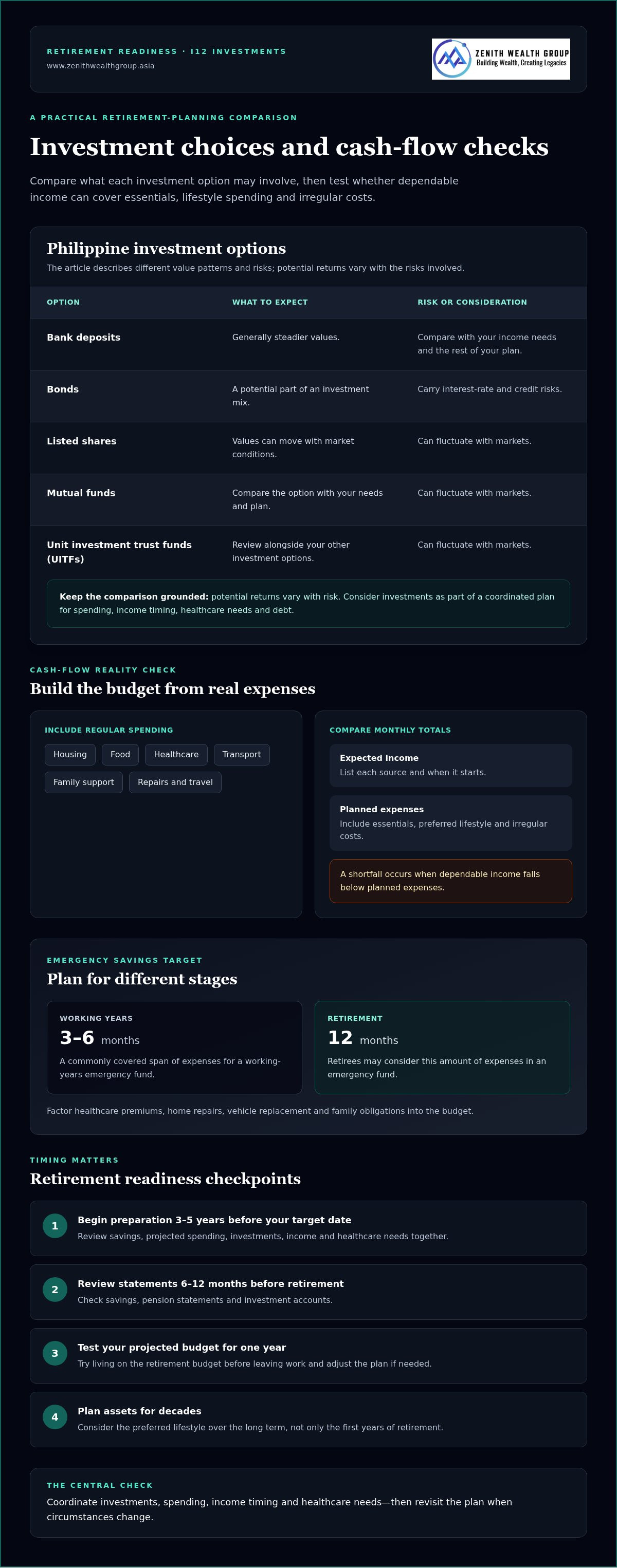
Start five years before retirement by listing expected income, savings, investments and regular expenses. Include housing, food, healthcare, transport, family support and occasional costs such as repairs or travel. Compare monthly totals to check whether income can cover essentials and your preferred lifestyle.
For Philippine investments, compare options such as bank deposits, bonds, listed shares, mutual funds and unit investment trust funds. Deposits generally have steadier values. Bonds carry interest-rate and credit risks, while shares and funds can fluctuate with markets. Potential returns vary with the risks involved.
Before retiring, prioritise high-interest debt, emergency savings, insurance needs, and major upcoming expenses. A working-years emergency fund commonly covers 3-6 months of expenses, while retirees may consider 12 months; include healthcare premiums, home repairs, vehicle replacement, and family obligations in your budget.
- Review savings, pension statements, and investment accounts six to twelve months before retirement.
- Try living on your projected retirement budget for one year before leaving work.
- Plan assets to support your preferred lifestyle for decades, not just the first years.
Create an income schedule showing when each source starts and how often it pays. Include pension payments, investment withdrawals, rental income and any annuity income. An annuity can convert a lump sum into scheduled payments, potentially providing lifetime income. Compare its terms with your need for access to capital and flexibility.
Pension income splitting or sharing can direct eligible pension income between partners, depending on the arrangement and applicable rules. List each partner’s expected income separately, then compare household cash flow across the available payout choices. A shortfall occurs when dependable income falls below planned expenses, particularly after irregular costs are included.
Estate planning and beneficiary designations
Clarify your estate instructions before retirement. Start by listing property, savings, investments, insurance policies, pensions, debts and intended beneficiaries. This inventory helps you see what your will and beneficiary designations need to address.
- Review your will and update it when relationships, assets, or intentions change. Professional legal help when preparing a will can help ensure documents are prepared and witnessed properly.
- Check the beneficiary named on each relevant policy or account and compare it with your current wishes. A mismatch, such as an outdated designation, may create confusion for the people handling your affairs.
- Record where important documents are kept and tell a trusted person how to locate them. Clear access instructions can help someone act if illness or incapacity makes financial tasks difficult.
- Plan for a time when you may be unable to manage money independently. Identify who you trust, list essential bills and accounts, and arrange appropriate legal documentation for your circumstances.
Include retirement withdrawals in your review. For each income source, note the withdrawal conditions, timing and tax treatment. Tax implications vary, so map the order and amount of withdrawals against planned spending. Taking more from one account early, for example, may reduce what remains later. Coordinate withdrawals with your estate intentions rather than treating them as separate decisions.
Keep a dated record of your will, beneficiary choices, account details, and the person you trust to help. Review the record after a major life or financial change, and make sure the relevant documents remain consistent. If you’re organising estate instructions alongside retirement decisions, discuss estate planning as part of a coordinated plan.
Pension payout and survivor benefit options
For GSIS members, retirement benefit options and eligibility depend on the applicable scheme and service record. Before choosing, review your GSIS documents for available payout forms, qualifying conditions, payment timing and survivor provisions.
Start several years before retirement by listing each pension, public benefit and employer plan you expect to receive. Record when payments begin and how they are paid. If you expect a Social Security benefit, assess your filing strategy early, since filing age can affect lifetime benefits.
- Compare pension payouts. Record the amount, payment schedule, and survivor benefit attached to each option, because a choice that supports your income may provide different protection for a spouse.
- Review survivor elections before retirement. Check who qualifies, how a survivor benefit changes your own payout, and whether your current family circumstances match the designation.
- Map application timing. Note each scheme’s application steps and the date benefits should start, so you can plan cash flow between your last salary and first payment.
- Check work and pension compatibility. If you expect to keep working, examine how employment affects the pension under that plan before relying on both income sources.
Compare each available choice side by side. Include household income, essential spending, survivor support and the effect of a lower or delayed payment. A larger payment during your lifetime, for example, may provide less survivor income than another option. Use the comparison to identify which trade-off matters most to your household.
Keep pension statements, election forms and correspondence together. As you prepare your retirement timeline, record questions about eligibility and payment dates. This gives you a clear basis for reviewing choices and coordinating pension income with other sources before you leave work.
Coordinating a retirement financial plan
Start preparing three to five years before retirement, then use the years before your target date to connect decisions. A plan works as a whole: spending depends on income timing, investment choices, insurance coverage, debt, and the support you want to leave family. Update it when one part changes.
- Set one retirement date and timeline. Use the 10 years before that date to track milestones for savings, work, pension elections, and major purchases.
- Match cash flow to spending. Put expected income and regular costs on the same timeline, then mark occasional expenses such as property taxes, insurance premiums, home repairs, vehicle replacements, and vacations.
- Connect investments to withdrawals. Check that the mix of assets supports planned spending and that you know which accounts will fund each stage of retirement.
- Review coverage and family plans. Include healthcare needs, insurance protection, estate instructions, and any education or family support commitments in the same planning document.
- Address high-interest debt. Reducing or eliminating it before retirement can improve financial flexibility, while the right approach depends on your goals and circumstances.
Test your plan against possible changes. If work ends earlier than expected, for example, compare available income with essential expenses and review the effect on withdrawals, coverage and debt payments. This stress test shows which decisions depend on the same funds and where a change could create a gap.
Keep one record of assumptions, account details, key dates and decisions. Review it quarterly with a financial professional to assess investments and possible adjustments. Regular reviews make it easier to update the plan as income, spending or priorities change.
Bring your timeline and current plan to a retirement planning conversation to discuss how the pieces fit together.
Zenith Wealth: Retirement Planning
Zenith Wealth helps bring retirement income, investments, protection and legacy priorities into one financial plan. If you’re approaching retirement, Retirement Planning can help connect expected income with spending needs, pension choices and family commitments.
Use the conversation to identify which decisions need attention first, whether that means reviewing your retirement timeline, considering Education Funding alongside retirement goals, or aligning Wealth Protection and Legacy Planning with your intentions. You can also raise questions about i12 investments as part of your broader investment considerations.
Bring your current budget, pension details, and list of financial priorities. Contact Zenith Wealth to start a conversation about your retirement plan.
Turn your next decision into a clear action
Make your next step practical: choose one open decision and write down what information would help you move forward. A pre-retirement financial checklist for the Philippines is a working document, so adapt it to where you plan to live and the income sources you expect to rely on. Record assumptions, priorities and decisions so you can track what changes when circumstances shift.
You don’t need to settle every detail at once. Start with the decision that could affect the rest of your plan, then note who needs to be involved and when you’ll revisit it. A focused conversation can turn scattered questions into a useful planning agenda. Bring your main priorities and discuss how they fit your retirement goals.
Start a conversation with Zenith Wealth. Take the next step at your own pace, with a clearer direction for what comes next.
Frequently Asked Questions
How do I know if I’m ready to retire?
You’re closer to ready when reliable income can support planned spending without relying on optimistic assumptions. Test your plan against practical changes, such as leaving work earlier or facing higher household costs. For a Singapore household, include family commitments and the lifestyle you expect to maintain. If a gap appears, consider whether timing, spending or income sources need adjustment.
How much money do I need to retire?
There’s no single savings target that suits every household. Estimate the income your retirement lifestyle requires, then account for dependable payments, investment withdrawals, housing, healthcare and family support. A pre-retirement financial checklist Philippines readers can adapt should reflect where they plan to live and the income sources they expect. Someone with housing costs covered, for example, may need a different income plan from someone expecting to pay rent.
Should I pay off debt before retirement?
Prioritise high-interest debt, since reducing or clearing it can improve financial flexibility and ease pressure on retirement income. List each balance, interest cost, repayment schedule and planned large expense. Then compare faster repayment with keeping enough accessible savings for near-term needs. The right balance depends on your goals and circumstances, so don’t use funds needed for essential spending simply to eliminate every debt.
What healthcare costs should I plan for in retirement?
Include more than routine appointments in your retirement healthcare estimate. List insurance premiums, prescription medicines, out-of-pocket treatment, dental and vision care, and possible long-term care. In Singapore, review the coverage you expect to rely on and note which expenses may still need to come from household income or savings. A separate healthcare budget line makes these costs easier to monitor as needs change.
What is the most important part of retirement planning?
The most important part is making the decisions work together. An investment allocation, a pension choice, or an estate instruction can affect the others, so review them as one plan. Write down your priorities, assumptions, and intended next steps in a shared record. If i12 investments are among your considerations, include their intended role in that overall investment review rather than assessing them in isolation.
What should I do five years before retirement?
Use the five-year mark to turn broad intentions into a working plan. Gather account statements, list expected income and spending, review your investment mix and identify healthcare needs. Choose a target retirement date and note decisions to make before then, such as pension elections or changes to work. Treat a pre-retirement financial checklist Philippines readers can adapt as a starting point, then tailor it to your plans in Singapore.


