

What happens to your bills and financial decisions if you can’t manage them yourself? A financial power of attorney explained in Singapore means understanding how you can authorise someone to handle specified financial matters on your behalf. The principal grants that authority; the appointed agent, or donee in an LPA, acts within its scope.
Singapore’s Lasting Power of Attorney (LPA) is a way to plan for a time when you may lack mental capacity to make decisions. You must be at least 21 years old to make an LPA as a donor, according to Singapore Statutes Online, maintained by the Attorney-General’s Chambers.
Choosing someone you trust is only part of the decision. The authority you grant, the tasks it covers, and how you can end it matter too. This guide explains the principal and agent roles, the financial powers a document may cover, and how revocation works, so you can understand your options before making a plan.
Key Takeaways
- Match an agent’s authority to the financial tasks they may need to handle, and understand where the document sets limits.
- Choose someone you trust to act in your interests, and consider how the arrangement can support accountability.
- If you want to change agents, understand when revocation is possible and why clear notice matters.
- Keep authority to act on your behalf distinct from your wider financial plans, including investment planning with i12 investments.
What Is a Financial Power of Attorney?
A financial power of attorney is a legal document that authorises someone to manage specified financial matters for another person. In Singapore, a Lasting Power of Attorney (LPA) lets a donor appoint a donee for decisions if the donor loses mental capacity.
Types of Financial Powers of Attorney
“Durable,” “non-durable,” “springing,” “general,” and “limited” describe when authority begins, how long it lasts, or which matters it covers. A durable POA continues if the principal becomes incapacitated; a non-durable one ends then. A springing POA starts after a stated event. General authority covers broad matters, while limited authority names particular tasks or an end date. These distinctions clarify what authority the document grants.
What an Attorney Can Do
An attorney may handle only the financial tasks authorised by the document, such as paying bills or managing accounts. The principal can limit authority to specific tasks and exclude others. For example, permission to manage accounts doesn’t automatically include permission to sell property. Clear wording helps both the principal and attorney understand the limits.
Unlike a general POA, Singapore’s LPA is designed to support decisions if the donor loses mental capacity. A deputy is appointed by a court, rather than chosen in advance by the donor.
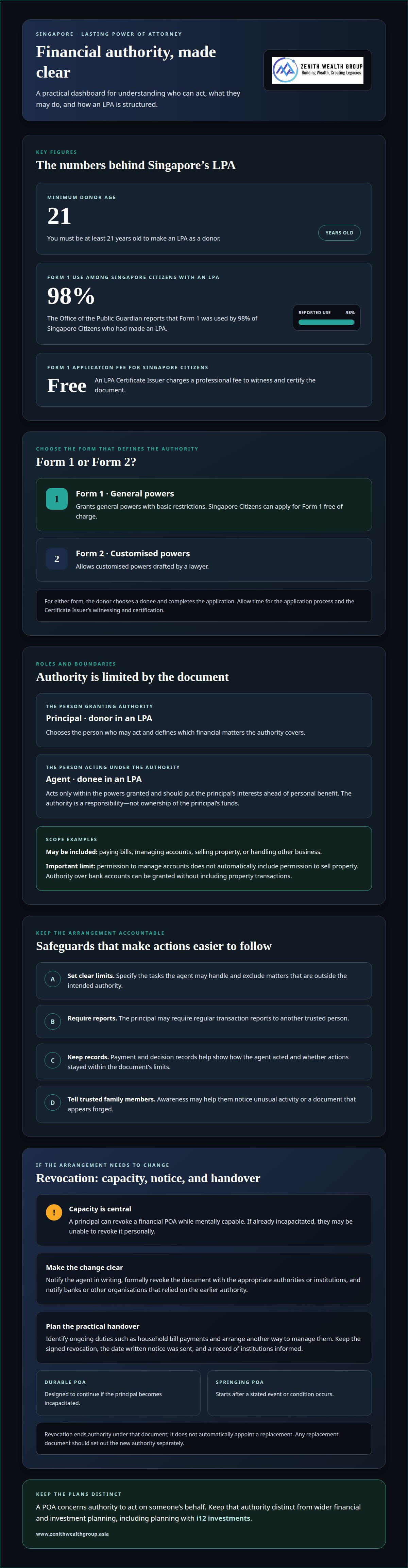
To make an LPA, the donor chooses a donee and completes Form 1 or Form 2. Form 1 grants general powers with basic restrictions; Form 2 allows customised powers drafted by a lawyer. The donor must be at least 21 years old, according to Singapore Statutes Online, Attorney-General’s Chambers. Singapore Citizens can apply for Form 1 free of charge. The Office of the Public Guardian, Singapore, reports that Form 1 was used by 98% of Singapore Citizens who had made an LPA. An LPA Certificate Issuer charges a professional fee to witness and certify it; allow time for the application process.
Principal and Agent roles
The principal grants authority, and the agent acts within the limits set. In Singapore’s LPA, these roles are called donor and donee. Understanding each role clarifies who grants the powers and who may make decisions under them.
Choosing an Agent and Guarding Against Abuse
Choose someone who can manage financial responsibilities reliably and respect your wishes. Consider how they communicate, handle commitments, and approach sensitive decisions. A relative isn’t automatically the best choice simply because they’re family. Think about who could make decisions carefully and explain them clearly to someone else.
Abuse can include an agent using the principal’s money for personal benefit or pressuring them to grant unwanted authority. Reduce the risk by setting clear limits and requiring reports to a trusted person. Telling trusted family members about the arrangement may also help them spot unusual activity or a document that appears forged.
Agent Duties and Fiduciary Responsibilities
An agent should act within the powers granted and put the principal’s interests ahead of personal benefit. The authority is a responsibility, not ownership of the principal’s funds. For example, permission to pay a utility bill doesn’t allow the agent to use that money for personal purchases.
Reporting requirements can make an agent’s decisions easier to follow. The principal may require the agent to report transactions regularly to another person. Records of payments and decisions help show how the agent handled the estate and whether their actions stayed within the document’s limits.
Financial Matters an Agent May Handle
An agent may be authorised to pay bills, manage accounts, sell property, or handle other business. The document defines the scope. For instance, authority over bank accounts can be granted without including property transactions. Clear wording helps financial institutions understand which matters the agent may handle.
A joint account co-owner has account access, while an agent’s authority can be restricted to selected tasks. That difference matters if the principal wants help with specific transactions rather than broader access to their finances. If you’re considering how decision-making authority fits into wider plans, talk through your planning considerations.
Revoking a power of attorney
A principal can revoke a financial power of attorney while mentally capable. A change in trust, a family member’s circumstances, or concerns about spending may prompt that decision. Revocation ends the agent’s authority under that document, but it doesn’t automatically appoint a replacement. If the principal is already incapacitated, they may be unable to revoke it personally, so capacity is central to the decision.
Make the revocation clear and communicate it directly. Notify the agent in writing, then formally revoke the document with the appropriate authorities or institutions. Notify banks or other organisations that relied on the earlier authority, so they know the agent should no longer act. Keep a copy of the notice and any acknowledgement with the original POA records.
Review the wording before sending notice. A durable POA is designed to continue if the principal becomes incapacitated, while a springing POA starts only when its stated condition occurs. These terms describe when authority operates, but they don’t remove the need to communicate a revocation clearly. If the principal wants someone else to act, the replacement document should set out that authority separately.
Plan the practical handover. For example, if an agent has been paying household bills, identify those payments and arrange another way to manage them. Tell the agent which duties are ending, and notify relevant institutions using their required process. This can reduce confusion about transactions after the change and help prevent the former agent from acting on outdated instructions.
Keep a record of each step: the signed revocation, the date written notice was sent, and the institutions informed. If the agent disputes the change or the principal’s capacity is uncertain, obtain legal advice before relying on the revocation. A financial planner can also help place the change within broader estate planning, but the revocation itself concerns the agent’s authority under the POA.
Definition and purpose of a financial power of attorney
A financial power of attorney is a legal document authorising an agent to handle defined financial affairs for a principal. Its purpose is continuity: bills, accounts, and other transactions can be managed if the principal becomes incapacitated or cannot act independently. Authority comes from the document, not from family status or informal trust.
In Singapore, a Lasting Power of Attorney lets a donor appoint one or more donees to make decisions if the donor loses mental capacity. Planning while the donor has capacity gives them a say in who may act and which powers to grant. For example, they can consider whom they would trust to manage payments or other specified financial matters.
A POA can also matter before incapacity. A principal may be unavailable because of travel or other commitments, and an authorised agent can help maintain financial administration. Without a POA, a friend or family member may need to seek a court appointment before acting. This can make practical decisions about accounts or assets harder to address promptly.
A POA does not transfer ownership. The principal remains the person whose assets and interests are involved, while agents act only within the authority granted. The arrangement also has a clear endpoint: a power of attorney ends when the principal dies. It does not replace a will or determine how an estate is distributed after death.
Keep delegated authority separate from decisions about retirement planning and i12 investments. A POA identifies who may act; it does not itself set financial goals or select investments. For help connecting these decisions with estate planning, discuss your planning priorities.
Planning can address dementia, traumatic brain injury, or another impairment affecting mental function that prevents someone from making important financial decisions. Continuity in financial affairs can help keep assets managed according to the principal’s wishes.
Without one, the process of appointing a guardian can be lengthy, expensive, and public.
Zenith Wealth
Zenith Wealth helps connect decisions about financial authority with your wider estate and legacy plans. A power of attorney addresses who may act for you; estate planning considers how your wishes and assets fit together. Reviewing these choices alongside retirement planning can help clarify how financial decisions support your plans across life stages.
Consider discussing your priorities when you’re reviewing who you trust, what authority they may need, or how your plans may change. Contact Zenith Wealth to start a conversation about your planning needs.
Shape your next planning conversation
A financial power of attorney explained in plain language is easier to connect with your broader priorities. Consider how the authority you grant fits alongside changing family responsibilities, retirement goals, and education funding plans. Revisiting these priorities as circumstances change can help keep your financial arrangements aligned with the life you want to support.
Zenith Wealth offers Retirement Planning, Education Funding, and Wealth Protection. These planning areas can help frame a wider conversation about how you want to prepare for future needs and protect your financial wellbeing. Bring your questions and priorities into that discussion, including how decision-making authority fits with your plans. Contact Zenith Wealth today to start a conversation. Take the next step at a pace that feels right for you.
Frequently Asked Questions
What types of financial power of attorney are available in Singapore?
Singapore’s LPA offers two forms: Form 1 for general powers with basic restrictions, and Form 2 for customised powers. Form 2 clauses must be drafted by a lawyer. These are the Singapore LPA forms; labels such as “durable” and “springing” describe when authority applies in other POA terminology and shouldn’t be treated as substitutes for choosing the appropriate Singapore form.
Who can be appointed as an attorney and what are the eligibility rules?
In a Singapore LPA, the person granting authority is the donor, and the appointed person is the donee. The donor must be at least 21 years old, according to Singapore Statutes Online, Attorney-General’s Chambers. Select someone you trust to handle the decisions covered, and be clear about the financial matters they may manage. The donor’s age rule doesn’t itself describe every requirement for a donee.
What duties and legal responsibilities does an attorney have?
An attorney should act within the authority granted in the document and keep the principal’s interests in view. For practical accountability, the principal can require regular reports to another trusted person. For example, reports could help that person understand how an agent handled recurring payments or account transactions. The document’s limits matter: permission for one financial task shouldn’t be treated as permission for unrelated decisions.
What are the risks of granting financial power of attorney and how can abuse be prevented?
The main risk is misuse of access, such as an agent spending the principal’s money for personal benefit. Reduce that risk by limiting authority to necessary matters, requiring transaction reports, and telling trusted family members or financial advisers about the arrangement. For example, if an agent handles bill payments, reports can make unusual transactions easier to spot and raise promptly.


