

A phased retirement plan in Malaysia should bridge work and retirement over a period that fits your income needs. These arrangements typically last one to two years, while Malaysia’s statutory minimum retirement age is 60. Planning for the years beyond that transition matters too: life expectancy in Malaysia is approximately 75 years, according to the Department of Statistics Malaysia.
It makes sense to focus on EPF savings, but they are only one part of the picture. Your intended retirement lifestyle, monthly costs, other income and how long your savings may need to last all shape a practical plan.
This guide explains how to assess whether your EPF savings are adequate, estimate retirement expenses and plan income as you gradually move away from full-time work. It also covers how Malaysia’s retirement-age rules and the length of your retirement affect phased retirement strategies in Malaysia, helping you make decisions with a clearer view of the years ahead.
Key Takeaways
- Build your income plan around essential spending, healthcare and lifestyle needs, then account for how inflation may change those costs.
- Set a gradual work transition that reflects your retirement timeline, rather than treating your final working day as the only milestone.
- Separate Malaysia’s statutory retirement age from the ages when EPF withdrawal options may become available.
- Review how savings, ongoing contributions and other income can work together before deciding how much to draw from retirement funds.
EPF adequacy and alternative retirement income
Key risks include inflation increasing future costs, living longer than expected and savings falling short. Before reducing your work hours, test your income plan against each of these risks.
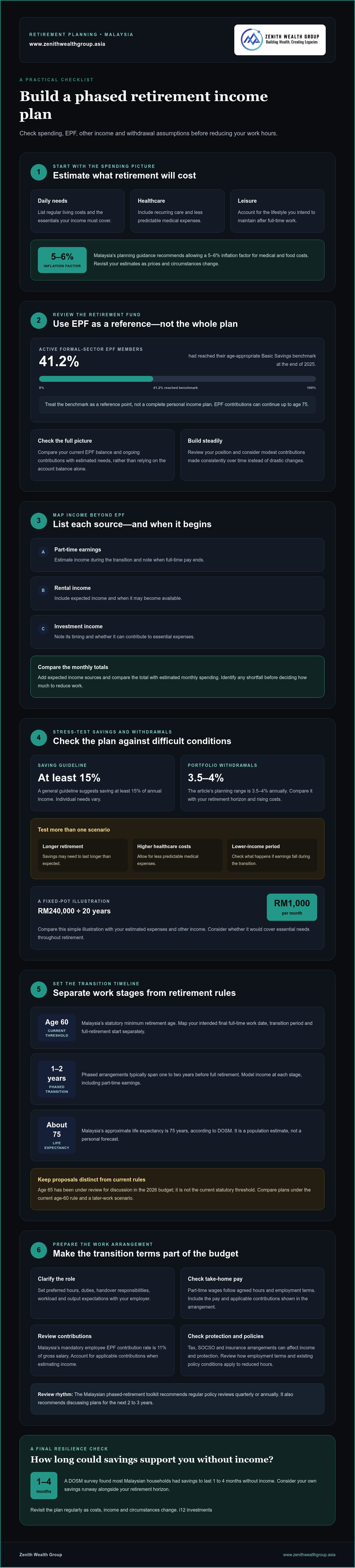
- Estimate retirement spending by category: daily needs, healthcare and leisure. Include regular costs and less predictable medical expenses. Malaysia’s planning guidance recommends allowing a 5-6% inflation factor for medical and food costs. Build phased retirement strategies in Malaysia around costs you expect to face, then revisit estimates as prices and circumstances change.
- Review your EPF balance and contributions against expected needs. At the end of 2025, 41.2% of active formal-sector EPF members had reached their age-appropriate Basic Savings benchmark. Treat it as a reference, not a complete personal income plan. Employees Provident Fund (KWSP) allows contributions to continue up to age 75.
- List income sources beyond EPF, such as part-time earnings during the transition, rental income or investment income. Note when each source may begin and whether it can cover essential expenses. Compare the total with your estimated monthly spending to identify any shortfall before deciding how much to reduce your work.
- Set a sustainable drawdown approach and review it regularly. A general guideline suggests saving at least 15% of annual income, though individual needs vary. For portfolio withdrawals, the planning range is 3.5 to 4% annually. Compare phased retirement strategies in Malaysia against a longer retirement horizon and rising costs. Test a lower-income period and higher healthcare expenses rather than relying on one estimate.
A DOSM survey found that most Malaysian households had savings to last 1 to 4 months without income. This is a reminder to consider how long available savings could support you if earnings stop, alongside the retirement horizon. Estimate monthly expenses for daily living, healthcare and leisure, and allow for inflation to change those expenses over time.
Review current savings and contributions to assess your financial position and whether adjustments are needed. Rather than making drastic changes, build retirement savings through modest contributions made consistently over time. A simple illustration can clarify the limits of a fixed pot: spreading RM240,000 across 20 years would provide RM1,000 per month. Compare that amount with your estimated expenses and other income, and consider whether it would cover essential needs throughout retirement.
Malaysia's retirement age and expected retirement duration
- Compare a gradual exit with stopping work at once. Malaysia’s statutory minimum retirement age is 60, while 65 has been under review for discussion in the 2026 budget. A phased arrangement can typically span 1-2 years before full retirement. Model the income difference across those stages, including part-time earnings and the date full-time pay ends.
- Estimate how long retirement income may need to last. Life expectancy in Malaysia is approximately 75 years, according to the Department of Statistics Malaysia. This is a population estimate, not a personal forecast. Consider your own health, family circumstances and intended retirement date. The 4% withdrawal rule assumes investments last 30 years, so compare that horizon with your likely needs.
- Before accepting part-time work, compare the expected take-home pay and available coverage. Tax, SOCSO and insurance arrangements can affect both your income and protection during the transition. Review how the employment terms and existing policy conditions apply to reduced hours, then account for any changes in pay or coverage in your budget before agreeing to a schedule.
- Plan the transition in practical steps. Set a monthly budget, identify healthcare needs and map income against essential expenses for each work stage. Ask your employer to discuss plans for the next 2 to 3 years. The Malaysian phased-retirement toolkit recommends clear duties and output expectations, plus regular policy reviews quarterly or annually. Use these points to shape a workable schedule. For help aligning retirement timing with income needs, consider a retirement planning discussion.
The toolkit recommends clarifying that performance management applies only for the duration of the phased-retirement arrangement. Expected pre-tax returns greater than 10% are generally unrealistic, even with long-term investing.
Malaysia’s statutory retirement age
- Anchor your timeline to the current legal threshold. Malaysia’s statutory minimum retirement age is 60 years under the Minimum Retirement Age Act 2012. This sets a key point for planning, but it doesn’t tell you when to stop working or how much income you’ll need. Map your intended final full-time work date, any transition period and the start of full retirement separately.
- Keep proposed policy changes separate from current rules. Malaysia’s government has been reviewing the possibility of raising the statutory retirement age to 65, with the matter expected to be discussed in the 2026 budget. Don’t build your income plan around a higher threshold as though it already applies. Instead, compare your plan under the current age-60 rule and a later-work scenario.
- Discuss part-time terms directly with your employer. Part-time work after age 60 depends on the arrangement made, while wages follow the agreed hours and employment terms. Malaysia’s mandatory employee EPF contribution rate is 11% of gross salary. Include the pay and applicable contributions shown in your employment arrangement when estimating take-home income.
- Turn the age threshold into a practical work plan. Write down your preferred hours, duties, income needs and handover responsibilities before discussing a transition. The Malaysian phased-retirement toolkit recommends discussing future plans with employees nearing retirement and setting clear workload and output expectations. If you’re weighing retirement timing against income needs, a retirement planning discussion can help structure those decisions.
How does EPF/KWSP support partial or phased retirement withdrawals, and what are the eligibility rules?
- Separate the withdrawal milestones before planning your cash flow. Under current EPF rules, partial withdrawals start at age 50, while full withdrawals can begin at age 55. These are different access points. A partial withdrawal may support a transition period, while full access changes the amount of savings available to draw on.
- Use age as your first eligibility checkpoint. At age 50, consider whether a partial withdrawal could cover a specific transition need, such as a temporary income gap. At age 55, assess whether full withdrawal access fits your longer-term income plan. Avoid treating either milestone as an instruction to withdraw; match the amount and timing to your expenses.
- Apply the approved-conditions rule to tax treatment. EPF withdrawals are tax-free when made under approved conditions at age 50 or 55. The age milestone alone does not describe every condition. Before building a withdrawal into your budget, identify the applicable condition and keep the withdrawal plan aligned with it.
- Plan withdrawals around your actual spending. First, estimate the monthly income you will need while working reduced hours, then calculate how much EPF money might bridge any gap. Separate essential costs from discretionary spending, and give each withdrawal a clear purpose. This makes withdrawals part of a cash-flow plan rather than a substitute for one.
- Review the plan as work and income change. Recalculate after a change in hours, wages or household expenses, and compare remaining EPF savings with the years they may need to support. A financial planner can help map withdrawal timing to retirement income needs. Discuss your retirement withdrawal plan.
Zenith Wealth: Retirement Planning
Zenith Wealth Group’s Retirement Planning can help organise the decisions involved in moving from full-time work towards retirement. Bring your expected income, spending needs and retirement timeline together in a plan, so you can see how each stage of the transition fits.
Consider this support when EPF withdrawals, part-time earnings and longer-term household needs are difficult to assess as a whole. You can also discuss how Wealth Protection or Legacy Planning may fit your priorities. If i12 investments are part of your wider financial picture, include them in that discussion without treating them as a substitute for a complete income plan.
Contact Zenith Wealth to discuss your retirement planning needs.
Shape Your Next Chapter with a Clear Plan
A phased retirement works best when it reflects the life you want, not just the date you leave full-time work. Turn broad intentions into decisions: how much flexibility matters, what work you want to continue, and which financial priorities need attention first. This gives phased retirement strategies in Malaysia a personal foundation, rather than reducing the transition to dates and withdrawals.
Zenith Wealth Group’s Retirement Planning can bring these priorities into a wider financial picture. Education Funding and Wealth Protection can also be considered alongside retirement needs, keeping family responsibilities in view.
Start with the questions you’re still weighing. Contact Zenith Wealth to discuss retirement and explore a plan that fits the next chapter you have in mind.
Frequently Asked Questions
What is phased retirement and how does it work in Malaysia?
Phased retirement means reducing your work gradually instead of stopping on a single date. In Malaysia, an employee and employer can arrange a transition from full-time duties to reduced hours, then adjust responsibilities and income as it progresses. For example, someone might continue client-facing work while handing over administrative tasks. Before changing the schedule, agree on the hours, duties, basis of pay and handover expectations.
What is Malaysia’s minimum retirement age, and what exceptions apply?
Malaysia’s statutory minimum retirement age is 60 under the Minimum Retirement Age Act 2012. The government has reviewed a possible increase to 65, with the matter expected to be discussed in the 2026 budget. The age threshold doesn’t itself describe every employment arrangement or exception. For a specific case, consider the employee’s employment category and governing terms rather than assuming the same rule applies universally.
How much EPF savings should Malaysians have to fund a gradual retirement?
Set an EPF target by estimating annual retirement costs, subtracting expected income from work and other sources, then assessing the remaining gap over your retirement horizon. Some planners estimate retirement spending at 70-80% of pre-retirement expenses, but this can be inaccurate. Use your own budget, including healthcare and household commitments, to test whether planned withdrawals and other income can cover the difference.
What retirement income options in Malaysia allow flexible or gradual withdrawals?
Current EPF rules allow partial withdrawals from age 50 and full withdrawals from age 55; withdrawals are tax-free under approved conditions at age 50 or 55. You can plan withdrawals alongside part-time wages and investment income, rather than relying on one source alone. For example, use employment income for current costs and schedule EPF withdrawals around any remaining budget gap.
What government or employer programmes in Malaysia support older workers and phased retirement?
The Malaysian phased-retirement toolkit recommends that employers discuss plans with employees nearing retirement, clarify duties and output expectations, and review policies quarterly or annually. These arrangements typically last one to two years before full retirement.


