

What if your investments, insurance and housing plans were working against one another? Financial planning for medical professionals in Singapore brings these decisions together with retirement and CPF planning, so each part supports your wider goals. The aim is a coordinated plan, not a set of disconnected financial choices.
It’s easy to see why you might consider each decision on its own. But buying a home can affect your available savings, while insurance and investment choices shape how you prepare for future needs. This guide explains what financial planning involves and how to approach these priorities as a connected whole.
This guide covers the key areas to coordinate, including housing commitments, wealth protection, investing, retirement and CPF decisions. It also explains how financial education and a clear view of your goals can help shape your plan. Start with the fundamentals, then see how the pieces fit at different stages of a medical career.
Key Takeaways
- Coordinate investment, insurance, housing and retirement decisions so one commitment doesn’t undermine another.
- Understand how CPF contributions and planning tools fit into your broader financial picture, including investment discussions involving i12 investments.
- Assess life and total permanent disability cover in light of your income, dependants and financial commitments.
- Use financial education to connect CPF choices with your longer-term goals and make your plan easier to review as life changes.
1. Coordinating investments, insurance, housing and retirement plans
A sound approach to financial planning for medical professionals in Singapore links retirement savings, insurance, housing and family goals. A diversified portfolio spreads investments across asset types and markets, reducing reliance on any one company, sector or property market. It cannot eliminate market risk, so align investments with your time horizon and capacity for losses.
CPF and the Supplementary Retirement Scheme (SRS) can both support retirement planning. SRS is voluntary and offers tax benefits, while CPF Investment Scheme (CPFIS) investments carry market risk and can lose value. Review the investment choices, fees, time horizon and your comfort with fluctuations. Financial education, including learning about i12 investments, can help you understand options without treating one investment as a complete plan.
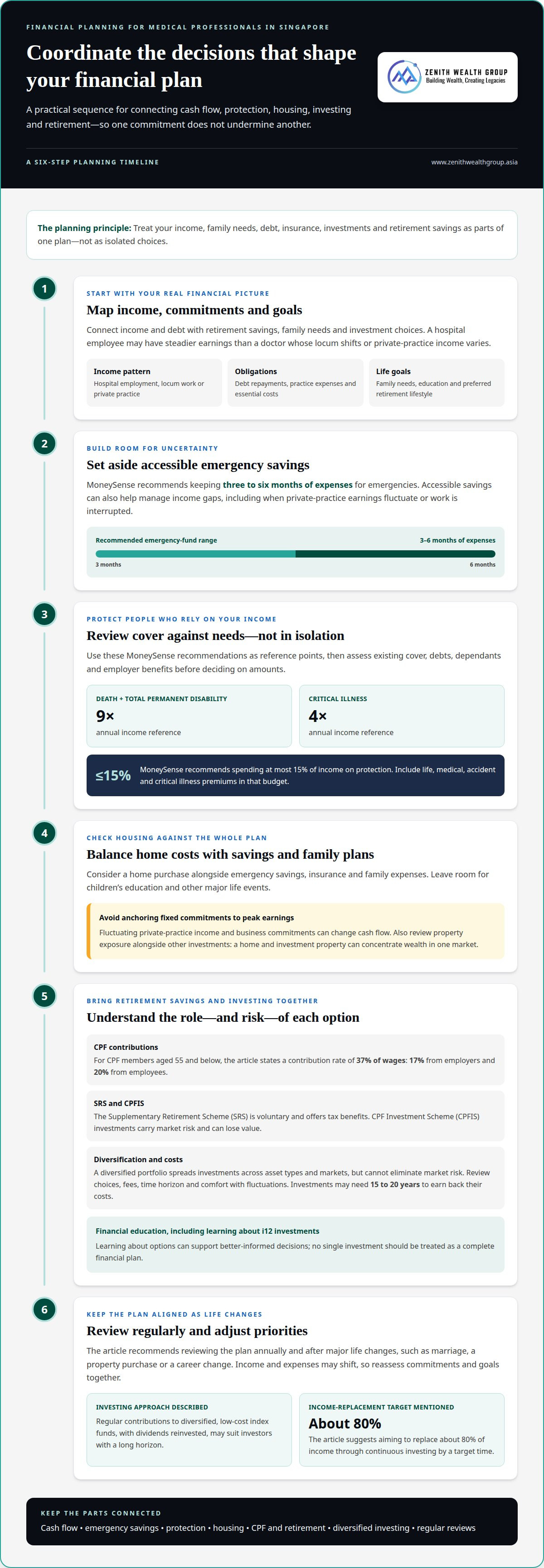
When planning your finances as a medical professional in Singapore, consider a home purchase alongside emergency savings, insurance and family expenses. MoneySense recommends setting aside three to six months’ expenses for emergencies. Children’s education and other major life events also need room in the plan. Revisit priorities after marriage, a property purchase or a career change, as income and expenses may shift.
Private practice can bring fluctuating income and business commitments, while burnout may interrupt your ability to work. Avoid basing fixed housing or investment commitments solely on peak earnings. Accessible savings can help manage income gaps. Review property exposure alongside other investments, since owning a home and investment property can concentrate wealth in one market.
Coordinate life and total permanent disability cover with debt and dependants. The amount of protection should reflect who relies on your income and which obligations would remain. For long-term investing, regular contributions to diversified, low-cost index funds may suit investors with a long horizon. Investments may need 15 to 20 years to earn back their costs. Review your plan annually and after major life changes.
A new CPF investment scheme is expected to start in 2028. The author has seen Singapore housing loans in the millions paired with life cover of around $300,000.
The article recommends low-cost index funds held over a lifetime, with dividends reinvested and investments made regularly. It suggests aiming to replace about 80% of income through continuous investing by a target time.
2. What Is Financial Planning?
Financial planning assesses your current position, sets goals and develops a strategy to work towards them. For a doctor, a financial plan connects income, debt, retirement savings, family needs and investment choices. A hospital employee may have steadier earnings than a doctor whose locum shifts or private practice income varies. Your plan should reflect that difference.
CPF is one part of the picture. According to the Central Provident Fund Board, for Singapore CPF members aged 55 and below, the CPF contribution rate is 37% of wages. Employers contribute 17% and employees contribute 20%. CPF account savings can earn interest, and compound growth can help build balances over time. Consider CPF alongside other assets and retirement income sources.
Compare hospital employment, locum work and private practice by income consistency, business expenses, debt commitments and retirement arrangements. Moving into private practice, whether running an independent clinic or joining specialist centres such as Sincere Healthcare Group, can bring different cash-flow patterns, so account for practice costs and personal obligations when setting savings priorities. For employed and self-employed doctors alike, the plan should connect career choices with longer-term family and retirement goals.
Income tax affects the amount available for savings and debt payments. A financial plan can distinguish taxable income from take-home cash flow and account for applicable reliefs and deductions. The Supplementary Retirement Scheme (SRS) is voluntary and offers tax benefits. Consider how it fits alongside CPF, other retirement assets and investment learning, including resources about i12 investments.
For medical school loans or practice setup debt, map repayments against income and essential expenses. Weigh the repayment terms and interest alongside cash-flow needs, rather than letting debt decisions crowd out every other goal. Set retirement priorities around your preferred lifestyle and family commitments, such as children’s education or supporting relatives. A financial planner can help connect these considerations in a retirement planning discussion.
3. Life and total permanent disability insurance
For doctors, life and total permanent disability (TPD) cover can protect dependants and household finances if death or disability interrupts income. MoneySense recommends death and TPD coverage of 9x annual income, and critical illness coverage of 4x annual income. These are reference points; assess existing cover, debts, dependants and employer benefits before deciding on amounts.
MoneySense also recommends spending at most 15% of income on protection. Include premiums for life, medical, accident and critical illness policies in that budget. Term life insurance can provide protection while dependants rely on your income. Group cover may be a lower-cost layer while you build an investment portfolio, but check how it fits your needs and existing benefits.
For healthcare costs, consider MediShield Life, MediSave and any Integrated Shield Plan as part of your overall protection review. MediShield Life and MediSave are designed to cover hospitalisation and selected medical treatments. Compare an Integrated Shield Plan’s coverage, exclusions and premium path with your likely healthcare needs and available savings. Accident and supplemental insurance can address risks that basic medical arrangements may not cover.
Participating life policies combine insurance protection with participation in an insurer’s fund. Read the policy terms, charges and projected benefits carefully: projected returns are not the same as guaranteed benefits. Compare the policy’s role with simpler term cover and separate investments, especially if retirement planning and long-term expenses are priorities.
Professional indemnity cover addresses practice-related liability, while personal insurance protects against risks to your health, income or family finances. Premiums vary with specialty, work arrangement, cover limits and underwriting details. Include the actual premium in your budget alongside other expenses, then review professional and personal protection when your career or family circumstances change.
Doctors should arrange cover for liabilities arising from their practice and personal policies suited to risks involving their health, income and family finances. Costs depend on specialty, work arrangement, coverage limits and underwriting, so include the actual premium offered in your protection budget.
How financial planners use CPF planning tools and financial education to support medical professionals
A financial planner can use your CPF balances, contribution history and retirement goals to show how Singapore’s CPF system fits into your wider plan. Current account information provides a starting point; projected CPF income can then be compared with expected retirement spending. This is useful when you move between hospital employment, locum work and private practice, because income patterns and savings decisions may change.
The Basic Financial Planning Guide helps frame discussions about savings, insurance, investing, retirement and legacy needs across life stages. MoneySense recommends investing at least 10% of income towards retirement and other financial goals. A planner can use that benchmark to discuss a contribution approach, then explain how it fits alongside CPF savings, investment choices and near-term expenses.
CPF top-ups may also form part of a retirement discussion. Eligible members can receive up to $8,000 in tax relief for cash top-ups to their own Special Account or Retirement Account, subject to the Full Retirement Sum limit. A planner can help assess how a potential top-up fits with your retirement timeline, available cash and other priorities, such as buying a home or funding children’s education.
Financial education turns CPF tools into informed decisions. Understand how CPF Investment Scheme choices differ from CPF savings, and how investment risk relates to your time horizon and ability to absorb losses. Discuss i12 investments as part of broader investment education, while keeping the purpose, risks and place of each investment clear. Research should support understanding, not replace a coordinated plan.
Review the plan annually and after a major change, such as a new hospital role, private practice transition or home purchase. A change in income can affect CPF contributions, cash reserves and retirement saving priorities. A financial planner can bring these moving parts together and explain the trade-offs in plain language. Discuss your CPF and retirement planning in light of your career and family goals.
Zenith Wealth
Zenith Wealth helps medical professionals bring retirement, family and protection priorities into a more coordinated financial plan. Its Retirement Planning, Education Funding, Wealth Protection and Legacy Planning offerings can support different goals across a medical career, from preparing for retirement to considering how wealth may support loved ones.
Consider involving a financial planner when a change in career, family responsibilities or financial priorities makes your existing arrangements harder to manage together. A focused discussion can clarify which goals matter most and how different areas of planning relate, without treating any one decision in isolation.
For a considered conversation about your financial planning needs, contact Zenith Wealth.
Make your next planning decision with clarity
Your next step is to turn broad intentions into priorities that reflect your career, family and preferred future. Decide which upcoming choice needs attention first, whether that’s a work change, a new family commitment or greater clarity about retirement. A focused conversation can help connect that decision to your wider financial picture.
Good financial planning for medical professionals in Singapore should adapt as your circumstances change. Bring your questions and the decisions you’re weighing to a discussion with a financial planner. Together, you can identify what needs attention now and what belongs in a longer-term plan, while keeping your personal goals in view.
Take the next step when you’re ready. Contact Zenith Wealth to discuss your plans. A clear starting point can make future financial decisions feel more manageable.
Frequently Asked Questions
What Is Financial Planning?
Financial planning is the process of understanding your finances, setting goals and choosing actions to work towards them. For a doctor, a practical example is mapping changing income during a move from hospital employment to private practice against family expenses, debt and retirement needs. A financial plan can then set priorities, such as managing cash flow first and adjusting longer-term savings as earnings and responsibilities change.
What CPF contributions, MediSave limits, and retirement benefits apply to employed and self-employed medical professionals?
For Singapore CPF members aged 55 and below, the Central Provident Fund Board states that CPF contributions total 37% of wages: 17% from the employer and 20% from the employee. These wage rates do not describe a self-employed contribution split. The Basic Healthcare Sum is adjusted annually and fixed for an individual from age 65. CPF and the voluntary Supplementary Retirement Scheme, which has tax benefits, can both feature in retirement planning.
How does Singapore income tax affect doctors, including tax reliefs and deductions?
Income tax affects how much of a doctor’s income is available for savings and debt payments, so a plan should distinguish taxable income from take-home cash flow and account for applicable reliefs and deductions. The voluntary SRS offers tax benefits, and eligible CPF cash top-ups to a member’s own Special or Retirement Account may qualify for up to $8,000 in tax relief, subject to the Full Retirement Sum limit.


