

More flexibility doesn’t mean less need to monitor a life insurance policy. Understanding universal life insurance policies starts with this rule: premiums help cover insurance costs and build cash value, and a policy can lapse if its cash value reaches zero unless you pay more. The balance between protection, charges and accumulated value shapes how the policy works over time.
It’s easy to focus on potential savings and overlook what keeps coverage active. Universal life policies offer flexibility in premium payments, but charges and cash value matter: if costs rise and the policy isn’t adequately funded, coverage may be at risk.
Here, you’ll learn how premiums and cash value interact, how traditional, guaranteed, indexed and variable policies differ, and what distinguishes protection-oriented universal life. This context can help you decide whether a policy fits your goals or whether another type of life insurance may be a better match.
Key Takeaways
- See why premium flexibility can help a policy adapt, and what may put coverage at risk over time.
- Understand how traditional, guaranteed, indexed and variable designs differ in their approach to cash value.
- Learn what policy charges and access to accumulated value can mean for long-term protection.
- Consider how protection-oriented cover fits your needs alongside wider financial priorities, including i12 investments.
How do universal life insurance policies work?
Universal life combines life coverage with cash value and allows some policy settings to change. The details depend on the contract, particularly its charges, funding requirements and guarantees.
Flexible Premiums and Death Benefits
Premium flexibility lets policyholders adjust payment amounts or frequency, as long as the policy meets its minimum funding requirements. This can help align payments with changing finances, but reducing or pausing premiums may leave too little cash value to cover charges. Some policies also allow a death benefit increase after a medical exam; a higher benefit may mean higher premiums or a minimum benefit requirement.
Guaranteed Coverage and Traditional Cash Value
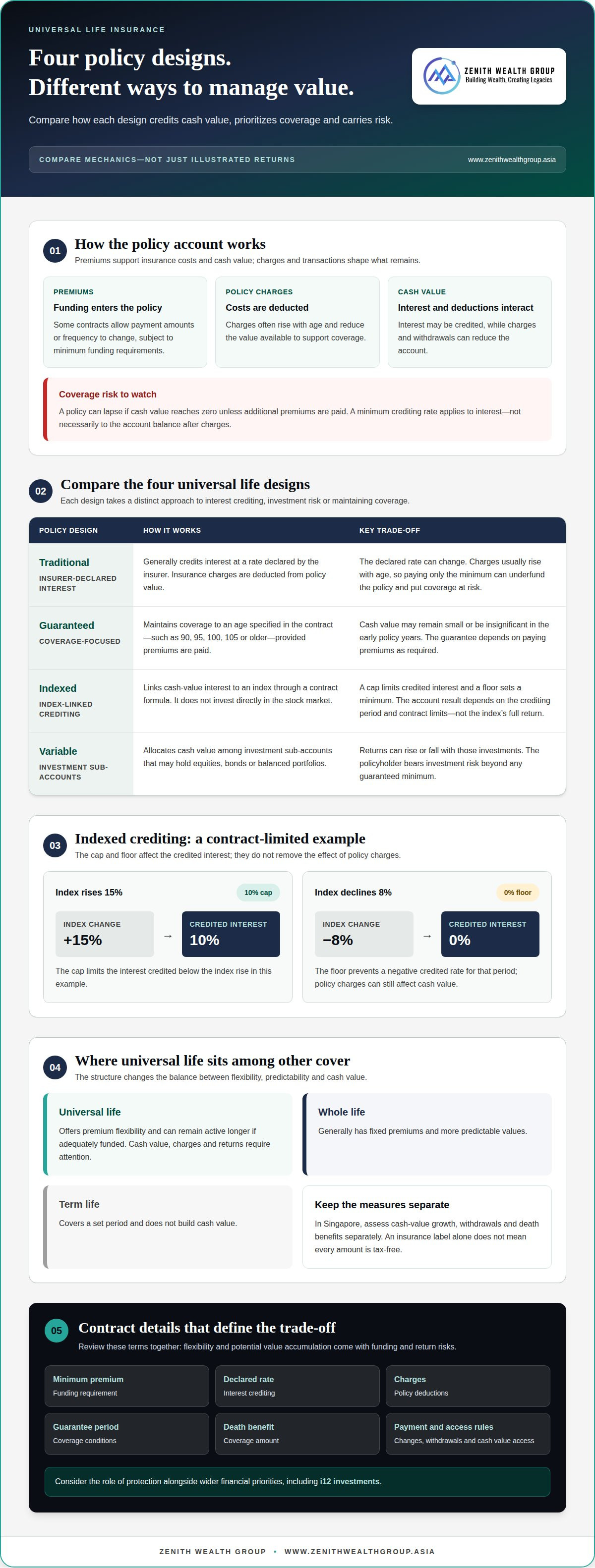
Guaranteed universal life maintains coverage to an age stated in the contract, such as 90, 95, 100, 105 or older, provided premiums are paid. Its cash value may remain small in the early policy years. Traditional universal life generally credits interest at a rate declared by the insurer, while insurance charges are deducted from the policy’s value. Charges usually rise with age, so paying only the minimum can underfund the policy and put coverage at risk.
Policy Funding and Investment Allocation
Premiums go toward insurance costs and cash value, and some contracts let policyholders contribute more or less as circumstances change. Additional payments can build cash value, but the policy must remain adequately funded for coverage to continue. Investment allocation depends on the design: variable universal life uses investment sub-accounts, while indexed universal life links interest crediting to an index without investing directly in the stock market. Returns can affect future account value.
Comparisons, Tax, and Trade-Offs
Whole life generally has fixed premiums and more predictable values; universal life offers more flexibility but requires careful attention to funding. Term life covers a set period and doesn’t build cash value, while universal life can remain active longer if adequately funded. In Singapore, assess cash-value growth, withdrawals and death benefits separately. An insurance label alone doesn’t mean every amount is tax-free.
Before buying, review the minimum premium, declared rate, charges, guarantee period, death benefit and rules for changing payments or accessing cash value. These details define the trade-off: flexibility and potential value accumulation come with funding and return risks.
Traditional, guaranteed, indexed and variable universal life
Universal life designs differ in how they credit interest, manage risk and prioritize protection. Compare each policy’s mechanics, not just its illustrated returns.
Indexed Interest Crediting
Indexed universal life (IUL) links cash-value interest to an index, but doesn’t invest directly in the stock market. The credit depends on contract terms such as a cap, which limits credited interest, and a floor, which sets a minimum. For example, with a 10% cap, a 15% index rise credits 10%; with a 0% floor, an 8% index decline credits 0%. These limits shape potential growth and downside exposure.
Fixed and Index Accounts
A Fixed Account credits interest at a rate set by the insurer, while an Index Account uses an index-linked formula. The two components expose cash value to different crediting methods. An Index Account’s result depends on its crediting period and contract limits, not the index’s full return. A 0% floor can prevent negative index performance from producing a negative credited rate for that period, though policy charges still affect cash value.
Other types of universal life take distinct approaches. Traditional universal life generally credits interest monthly at a rate declared by the insurer, so the credited amount can change when that rate changes. Guaranteed universal life focuses on maintaining coverage to an age specified in the contract, provided premiums are paid; its cash value may be insignificant in the early policy years. These designs serve different priorities.
Variable universal life allocates cash value among investment sub-accounts, which may hold equities, bonds or balanced portfolios. Returns can rise or fall with those investments, so the policyholder bears investment risk beyond any guaranteed minimum. Unlike whole life, universal life can offer greater flexibility, but interest rates and values may be less predictable. Compare guarantees, charges and allocation choices to see which features fit your needs.
For guidance on fitting policy choices into estate planning considerations, start with the role the coverage should play.
Universal life insurance structure and cash value
Cash value is the policy account where interest is credited, less applicable charges and withdrawals. A policy can lapse when its cash value reaches zero unless additional premiums are paid.
Cash Value Growth and Guarantees
Cash value changes as interest is credited and policy charges are deducted, often monthly or annually. Some contracts set a minimum crediting rate, which may be 0%; this floor applies to credited interest, not necessarily the account balance after charges. The difference matters: even with a guaranteed minimum rate, deductions can reduce value. Review the crediting terms and charges together to understand how the account may develop.
Withdrawals and Policy Loans
Some universal life policies let policyholders access cash value through withdrawals or policy loans. A withdrawal removes value from the account and may reduce the death benefit; a loan creates a balance against the policy. Either can affect long-term value and the coverage remaining for beneficiaries. For example, taking funds while charges continue leaves less value available to support the policy. Check the contract’s terms before using the funds.
Policy Mechanics and Lapse Risks
Premiums, credited interest, charges and transactions all affect the funds available to keep coverage active. A policy may lapse if cash value reaches zero and the policyholder doesn’t pay additional premiums. This can happen when charges rise with age, returns are lower than illustrated, or withdrawals and loans reduce available value. Paying only the minimum premium can also leave a traditional policy underfunded as charges increase. Term life doesn’t build cash value, so it has no account-funding mechanism.
For policyholders, the practical risk is a gap between planned payments and changing policy costs. Review the account balance, charges, premium history and any withdrawals or loans together. This helps show whether funding remains sufficient to support coverage, rather than treating a guaranteed minimum interest rate as protection against lapse.
Protection-oriented universal life policies
Protection-oriented universal life prioritizes a larger death benefit over cash-value growth. Its defining feature is the emphasis on coverage rather than accumulation, so the policy’s intended role is central to the decision.
Compared with savings-oriented universal life, protection-oriented designs provide a higher sum assured. Some require a substantial upfront lump-sum premium, so funding needs can be significant. The policy is designed to provide lifelong protection while it remains active, but you still need to understand its funding terms and ongoing charges.
That emphasis distinguishes protection-oriented cover from savings-oriented cover, which gives more attention to cash-value accumulation. It also differs from whole life, which typically emphasizes stability and guarantees. Universal life can offer greater flexibility, but with less predictability. If you need protection for a defined period, term life insurance may be more suitable: it covers a set term and doesn’t accumulate cash value.
Before choosing, match the intended death benefit to the policy’s premium structure, duration and funding requirements. Then consider how the cover fits with existing protection and legacy arrangements. A higher sum assured matters only if you can maintain the policy as intended; its purpose and funding commitment should align.
For support aligning coverage with your broader protection priorities, discuss your wealth protection needs.
Zenith Wealth
Zenith Wealth helps you consider how life insurance fits your wider financial priorities. If you’re weighing universal life coverage, look at its protection role alongside cash-value risk, family needs and longer-term plans. Wealth Protection and Legacy Planning can help frame those priorities, while Retirement Planning and Education Funding may also matter when balancing future commitments. Consider how the policy would sit alongside other financial decisions, including i12 investments, rather than assessing its cash value in isolation.
Turn to Zenith Wealth when you want to connect a policy decision with your broader goals and understand the trade-offs involved. Contact Zenith Wealth to start a conversation.
Make your next decision with purpose
Understanding universal life insurance policies can help you move beyond product features to a more useful question: what role should coverage play in your financial plan? Consider how your priorities may change over time and whether protection needs should be balanced with retirement, education funding or wealth protection plans.
Rather than judging a policy by one projected outcome, consider how its purpose fits your wider goals. This can make conversations about coverage, family needs and future plans more focused. Zenith Wealth Group offers Retirement Planning, Education Funding and Wealth Protection to help bring these considerations together.
Your next step can be a discussion about what you want the policy to achieve and how it fits alongside your other priorities. Contact Zenith Wealth to discuss your options. A thoughtful conversation can help you move forward with greater clarity.
Frequently Asked Questions
What are the key features?
Key features include life coverage, a cash-value account, flexible premium payments and contract terms for changing the death benefit. Details depend on the policy design. For example, a traditional policy credits interest at an insurer-declared rate, while an indexed policy uses an index-linked formula. Consider how each feature affects the policy’s purpose, funding needs and ongoing charges.
What is the difference between indexed universal life and variable universal life?
Indexed universal life credits interest using a formula linked to a market index, while variable universal life puts cash value into investment sub-accounts. An index-linked policy doesn’t invest directly in the index, and caps or floors can affect credited interest. Variable sub-accounts may hold equities, bonds or balanced portfolios, so investment performance directly affects account value. Compare how each design manages risk.
Who are the ideal clients for traditional UL?
Traditional universal life may suit someone seeking permanent coverage with cash value credited at an insurer-declared rate, rather than index-linked crediting or investment sub-accounts. It may appeal to people who value premium flexibility and understand that charges can rise with age. A useful fit test is whether planned funding can support coverage over time, even if the declared rate changes.
What is universal life insurance and how does it work?
Universal life is permanent life insurance that combines a death benefit with a cash-value account. Premiums fund insurance costs and account value, while the policy’s crediting method determines how interest is added. Understanding universal life insurance policies means looking beyond the initial illustration: compare the contract’s funding assumptions with its charges and the coverage you want to maintain.
What are the main features of universal life insurance policies?
The main features are adjustable premiums, a death benefit, cash value and a crediting approach set out in the policy. Some contracts allow changes to payment amount or frequency, subject to funding requirements. Others offer options to increase the death benefit, sometimes with medical underwriting. For a family planning a legacy, consider how those options affect the intended benefit and policy funding.
How do universal life insurance premiums and cash value work?
Premiums go toward insurance costs and cash value, while charges are deducted from the account as specified in the policy. Interest may be credited using a declared rate, an index-linked formula or investment sub-accounts. If you’re considering additional payments or accessing cash value, account for how each transaction changes the funds available to support coverage and the benefit intended for beneficiaries.


