

A sabbatical can be paid, partly funded by an employer, or unpaid, so start by understanding your leave arrangement. To plan how to fund a sabbatical or career break, build a separate, accessible savings pot and keep an emergency fund of 3-6 months of expenses outside it. Then set a savings target based on your time away, essential costs and any income you expect.
It’s understandable to worry about salary and everyday bills while you’re away from work. This guide explains how to estimate your costs, adjust your budget and build savings steadily. You’ll also learn how paid or unpaid leave affects your target, and how to think about keeping your break fund secure and accessible. With a realistic plan and a financial cushion, you can make your next steps with more confidence.
Key Takeaways
- Keep career-break savings accessible, and consider a conservative investment approach if your break is still a few years away.
- Find out whether your employer offers paid leave, unpaid leave or partial funding, then build your savings target around the income you expect.
- Sort spending into essential and flexible costs, and leave room in your budget for unexpected expenses.
- See how education funding and other long-term plans fit alongside your break savings with support from Zenith Wealth.
1. Building a liquid, secure career-break savings fund
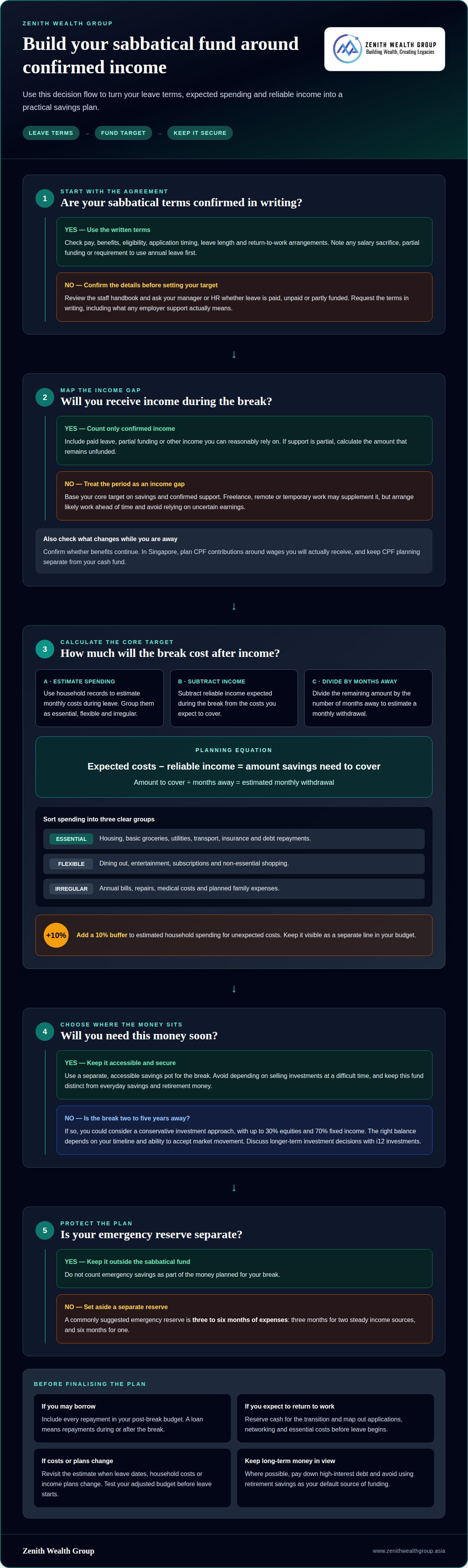
Start with a separate fund for the break, distinct from everyday savings and retirement money. Keep money needed soon accessible and secure; sabbatical plans shouldn’t depend on selling investments at a difficult time. If your break is two to five years away, you could consider conservative investing, with up to 30% equities and 70% fixed income. The right balance depends on your timeline and ability to accept market movement. Discuss longer-term investment decisions with i12 investments.
For a practical target, add up expected monthly costs for your time away, then subtract reliable income during the break. Divide the remaining amount by the number of months you’ll be away to estimate a monthly withdrawal. Keep emergency savings separate: a commonly suggested reserve is three to six months of expenses, with three months for two steady income sources and six months for one. Revisit the estimate when your leave dates, household costs or income plans change.
Start with savings and any confirmed paid or partially funded leave. Unpaid leave creates an income gap. Investments may suit money you won’t need soon, while a loan means repayments during or after the break. Before borrowing, include every repayment in your post-break budget.
In Singapore, plan CPF contributions around the wages you’ll actually receive. Unpaid leave can reduce the income available for contributions, so keep CPF planning separate from your cash fund and account for regular commitments that rely on CPF savings.
Freelance, remote or temporary work can supplement your savings. Arrange likely work before leaving, but base your core target on income you can reasonably rely on. If you plan to return to work, reserve cash for the transition and map out applications, networking and essential costs before your leave begins.
Plan for risks such as unexpected household bills, a longer break or less work income than expected. Where possible, pay down high-interest debt, and avoid using retirement savings as your default source of funding. A clear cash target, accessible savings and a separate emergency reserve make the plan easier to manage.
2. Is sabbatical leave paid or unpaid?
Sabbatical terms depend on your employer’s policy and written agreement. Before setting a savings target, review the staff handbook and ask HR whether leave is paid, unpaid, or partly funded. Confirm eligibility, application timing, leave length, return-to-work arrangements, and whether benefits continue. A 2017 Society for Human Resource Management survey found 5% of companies offered paid sabbaticals and 11% offered unpaid sabbaticals. These figures are a historical survey result, not a Singapore estimate.
Ask your manager or HR directly: “What sabbatical options are available, and how would each affect my pay and benefits?” Request the terms in writing, including any salary sacrifice, partial funding or requirement to use annual leave first. An employer may contribute toward leave without salary sacrifice, so clarify whether support means continued pay, a one-off contribution or another arrangement.
List benefits that could change or end during leave. For example, check whether employer-sponsored health coverage, tuition reimbursement or a discounted gym membership continues. In Singapore, confirm how your medical coverage works during unpaid leave and whether you need another arrangement. Use eligible benefits before your last working day, such as completing approved training or submitting reimbursement claims by the employer’s stated deadlines.
For Singapore tax planning, separate salary earned before leave from income received during it. Having no employment income during a break does not settle tax on income already earned or other taxable income. Keep records of pay, benefits, freelance earnings and any employer contributions, then account for them when planning your cash flow.
Compare the written leave terms with your household budget before deciding. If unpaid leave is the only option, calculate the income gap and decide how much savings must cover. If education costs or other long-term commitments also need attention, discuss how they fit your financial plan before confirming your leave dates.
3. Categorising expenses and adjusting a budget
Build your sabbatical budget from actual household spending, not an idealised estimate. Review recent bank and card statements, then group transactions into essentials, flexible spending, and occasional costs. Five major spending categories can make up 80%-90% of household budgets, so start with the largest recurring outflows. In Singapore, examples might include housing, food, transport, utilities, and insurance. Separate one-off costs, such as annual premiums or home repairs, so they don’t disappear inside monthly averages.
Next, label each expense by how easily you could reduce or pause it during leave. Rent or mortgage payments, utilities and existing debt repayments may continue, while dining out, subscriptions and leisure spending could be adjusted. Keep commitments for dependants and planned education costs visible rather than treating them as optional. This gives you a realistic monthly baseline and shows which changes could make the biggest difference.
- Essential: housing, basic groceries, utilities, transport, insurance, and debt repayments.
- Flexible: dining out, entertainment, subscriptions, and non-essential shopping.
- Irregular: annual bills, repairs, medical costs, and planned family expenses.
Estimate each category using your records, then total the monthly amount you expect to spend during the break. Add a 10% buffer to estimated household spending for unexpected costs. Keep the buffer separate in your worksheet, so you can see the difference between the expected budget and a more cautious target. If costs rise or plans change, update the categories rather than relying on one fixed estimate.
Finally, test your adjusted budget before leave starts. Try living on the amount you expect to have during the break while you’re still earning your regular income, and put the difference into savings. This practical trial can reveal overlooked costs, such as transport for family commitments or bills that continue while you’re away. Refine your plan, then use the revised monthly budget to guide your sabbatical spending.
4. Paid versus unpaid sabbatical leave
Paid leave preserves some employment income, while unpaid leave shifts more of the cost onto your savings. Some employer-sponsored sabbaticals may require 5-10 years of service and last from 4 weeks to 12 months. Treat these as possible arrangements, not standard terms. Your employer’s written policy determines eligibility, pay, duration, and any conditions for returning to work.
Compare arrangements by calculating the income gap across your planned leave. For paid leave, establish how much salary will continue and whether it covers the full period. For partial funding, subtract the employer’s contribution from your expected spending. For unpaid leave, plan to cover the full shortfall with savings or reliable income. Don’t count a benefit until its terms are agreed in writing.
- Paid leave: confirm the salary amount, payment schedule, and duration.
- Partly funded leave: identify the employer contribution and remaining shortfall.
- Unpaid leave: budget for the full period without salary, plus continuing commitments.
Consider more than cash flow. A longer unpaid break may affect workplace benefits, career continuity and the timing of your return. A shorter paid break may offer less time away but reduce how much you need to draw from savings. Weigh the value of time off against the income and benefits you would give up, alongside your plans for dependants and household commitments.
Some employers may offer partial funding without requiring salary sacrifice. Ask how that support is structured and whether it comes with conditions, such as a return-to-work commitment. Compare the written terms with your budget before choosing dates. A clear agreement helps you plan around the actual pay arrangement instead of assuming your salary will continue.
If the choice affects your wider financial commitments, discuss your sabbatical funding plan and how the leave period fits your goals.
Zenith Wealth: Education Funding
Zenith Wealth Group offers Education Funding to help you plan for education costs alongside a career break. This may be relevant if your sabbatical savings goal overlaps with school fees or other family education plans. Separating these goals can help you identify which funds are for time away and which are set aside for future education.
A broader financial plan can also account for competing priorities, including retirement planning and wealth protection. Keep i12 investments in view as part of that wider conversation, rather than treating every financial goal in isolation. This can help you consider how your break fits with longer-term plans.
If you’d like to discuss how education funding fits alongside your career-break plans, contact Zenith Wealth.
Shape a break that fits your wider plans
Use this transition to think about what you want your finances to support after you return. A career break can sit alongside plans for family, education and retirement. Seeing these priorities together can help you make decisions that continue to work beyond your time away.
A clear plan for how to fund a sabbatical or career break should account for more than the months you’ll be away. Consider how your choices connect with future education costs, retirement planning and wealth protection. These goals may rely on the same savings, so placing them in your broader financial picture can help you decide what to prioritise.
When you’re ready to turn your plans into a financial strategy, contact Zenith Wealth to discuss your next steps. Start with the life you want your break to make room for, and build your plan from there.
Frequently Asked Questions
Is sabbatical leave paid or unpaid?
A sabbatical may be paid, partly funded or unpaid, depending on your employer’s policy and the agreed terms. Before deciding, consider how each arrangement affects your plans beyond the break. For example, paid leave may preserve more cash for your return, while unpaid leave may offer a longer period away. Ask how the arrangement affects your role and return date, then include those terms in your decision.
Why take a sabbatical?
People take sabbaticals to make room for goals that are difficult to pursue alongside their usual work. That might mean caring for family, studying, travelling, recovering from sustained work demands or exploring a different direction. A clear purpose can help shape the length and timing of your break. For example, a study plan may have set dates, while a major travel experience—such as exploring game reserves with Zaf Travel—or a career change could call for time to explore and prepare.
How much should I save for a sabbatical or career break in Singapore?
There’s no single target for everyone. To decide how to fund a sabbatical or career break, estimate essential spending during leave, subtract dependable income and include the costs of restarting work. For example, allow for transport to interviews, training or a temporary change in childcare. Your target also depends on the length of leave, household commitments and how much income will continue, so revisit it as those details become clearer.
What expenses should I budget for during a career break in Singapore?
Include costs that continue while you’re away and expenses tied to the break itself. A household in Singapore might plan for housing, utilities, transport, insurance, debt payments and care for dependants. Add any one-off costs relevant to your plans, such as travel, course materials or storage. For instance, if your itinerary includes international destinations, budgeting in advance for ground transfers with providers like JAMALimo can keep travel expenses predictable. Consider bills due just before or after your leave, too, so their timing doesn’t catch your cash flow off guard.


