

A single-stock position may be considered concentrated when it represents more than 10%-20% of your investable assets. The percentage is a starting point, not the whole picture: your goals, time horizon and reliance on that holding also shape the risk. Useful concentrated stock help connects the position to the decisions you’re trying to make, rather than treating a threshold as a rule for everyone.
It’s understandable to want to keep a stock that has helped build wealth while wondering what could happen if its value falls. This article explains how to assess concentration, why a threshold’s source and calculation matter, and how an exchange fund may fit some investors’ plans. It also shows how investment, tax and broader wealth-planning advice can work together, so you can identify the questions to consider before making a change.
Key Takeaways
- Assess a stock’s share of your investments alongside your goals, cash-flow needs and reliance on its future value.
- Interpret concentration thresholds as planning signals, not automatic instructions to sell; the source and calculation behind a threshold matter.
- Consider whether an exchange fund’s eligibility rules and holding period fit your circumstances before weighing its role in diversification.
- Coordinate investment decisions with retirement and estate plans so a diversification strategy supports your wider financial priorities.
1. What Is a Concentrated Stock Position?
A portfolio becomes concentrated when one stock, or a small group, represents a substantial share of invested assets. A common planning signal is a single holding above 10%-20% of investable assets, but the number alone doesn't set the right action. Investors seeking concentrated stock help should also consider the stock’s role in their income, goals, time horizon and other assets. If specific equity holdings form part of your wider financial picture, include them in the same portfolio review alongside guidance from Zenith Wealth.
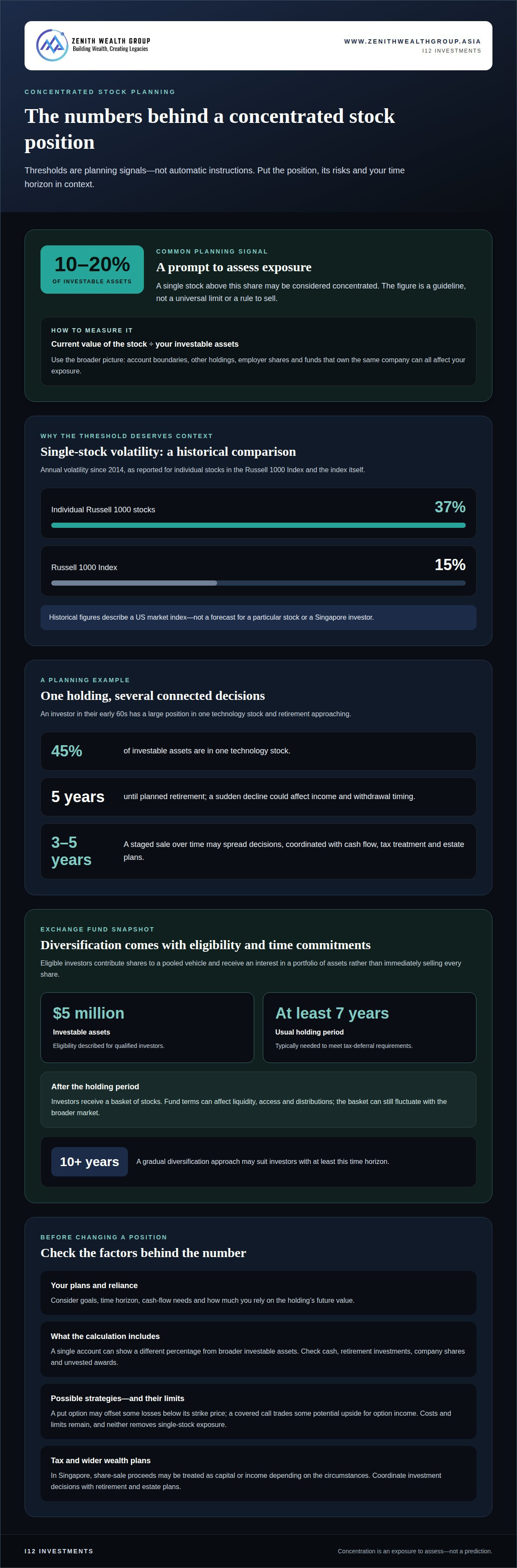
Picture an investor in their early 60s with 45% of investable assets in one technology stock and retirement planned within five years. A sudden decline could affect retirement income and the timing of withdrawals. A staged sale over three to five years can spread decisions over time, while coordinating each step with cash-flow needs, tax treatment and estate plans.
In Singapore, the tax implications of selling shares turn on whether proceeds are treated as capital or income; the classification matters when assessing potential tax. Singapore’s treatment of share-sale gains likewise depends on whether profits are capital in nature or income from trading activity. A sale alone doesn’t establish that classification, so include the circumstances of acquisition and disposal in tax planning.
Employee stock options and RSUs can increase concentration because their value is linked to your employer’s shares. Their tax treatment depends on the award and employment circumstances, so distinguish vesting, exercise and sale when planning. After leaving a company, review any remaining shares alongside your other assets and future income needs, rather than letting stock from a former employer dictate your portfolio.
To reduce concentration without selling immediately, investors may consider options or hedging strategies. A put option, for example, can offset some losses below its strike price, while a covered call trades some potential upside for option income. These strategies have costs and limits, and they do not eliminate single-stock exposure. Concentrated stock help should weigh potential protection against those trade-offs.
An exchange fund may offer another diversification route for qualified investors with $5 million of investable assets. Investors usually need to remain in the fund for at least seven years to meet tax-deferral requirements, then receive a basket of stocks. That commitment can conflict with near-term cash needs, so coordinate it with retirement and estate plans. Gradual diversification may suit investors with at least a 10-year horizon.
2. Concentrated stock position thresholds and sources
A concentrated stock position means one holding carries enough weight to shape your portfolio’s outcome. A common planning signal is a single stock representing more than 10%-20% of investable assets. This is a guideline, not a universal limit or automatic instruction to start selling.
Measure the position by dividing the stock’s current value by your investable assets, then consider how a decline could affect your plans. Include other holdings in the denominator and account for exposure through employer shares or funds that own the same company. Concentrated stock risk is the possibility that one company’s performance has an outsized effect on your wealth. The percentage measures exposure; your reliance on that money and ability to absorb losses provide important context.
The threshold’s source and calculation matter. A percentage based on one account may look different from one based on your broader investable assets. Before comparing figures, check what each measure includes, such as cash, retirement investments or company shares. Unvested awards and shares held outside your main brokerage account can also affect your overall exposure.
Investors may hold a concentrated position because they founded or joined a company, received shares as compensation, inherited stock or held a successful investment. Selling can feel difficult if it raises tax questions, means reducing a familiar holding or seems to forgo future opportunities. Exchange funds are another diversification strategy, but eligibility and holding requirements make them different from direct selling.
Historical volatility illustrates why a single-stock percentage deserves attention. Since 2014, individual stocks in the Russell 1000 Index averaged 37% annual volatility, compared with 15% for the index. These figures describe a US market index, not a forecast for a Singapore investor or a particular stock. Use the threshold as a prompt to assess exposure, not as a prediction.
If you’re weighing a stock position against your wider financial plans, a financial planning conversation can help organise the decision.
3. Exchange funds
An exchange fund lets eligible investors contribute shares from a concentrated holding to a pooled investment vehicle. In return, they receive an interest in a portfolio of assets instead of immediately selling every share. The aim is to spread company-specific exposure across different holdings while deferring an immediate sale. The fund’s holdings and structure determine how much diversification it provides.
Eligibility can be a major hurdle. The strategy described here is available to qualified investors with $5 million of investable assets. Investors usually need to remain in the exchange fund for at least seven years to meet tax-deferral requirements. After that holding period, an executive receives a basket of stocks. A long commitment can limit liquidity, so consider whether you may need those assets sooner.
Exchange funds do not eliminate every risk. The basket may still fluctuate with the broader market, and fund terms can affect access, distributions and when you receive shares. Review what you must contribute, how long your capital will be committed and how the resulting holdings fit your portfolio. Tax treatment depends on your circumstances; a fund’s tax-deferral feature does not determine Singapore tax treatment.
Stock options and collars can also involve transaction costs, complex terms and trade-offs. Options may expire without value, while a collar can limit both downside exposure and potential gains. Exchange funds may restrict liquidity through their holding period and other terms. Understand each strategy’s costs, limits and consequences before using it.
Compare an exchange fund with gradual selling. Selling shares may raise an immediate tax question, while an exchange fund may defer a sale but ties up assets for at least seven years. The better fit depends on your liquidity needs, tolerance for restricted access, existing holdings and plans for the shares. Shares earmarked for near-term spending, for example, may not suit a long lock-up.
Before contributing, compare the fund’s entry requirements, holding period and distribution process with your cash-flow and estate plans. This can help you judge whether a diversified basket is worth the reduced liquidity and commitment.
4. Coordinating investment, tax and wealth-planning advice
A concentrated position affects more than portfolio volatility. It can shape retirement income, a private company’s succession plan and what heirs receive. Coordinate investment decisions with these goals before choosing a sale schedule. Someone approaching retirement may need cash from shares, for example, while another investor may plan to preserve them for family.
Start with a shared plan. An investment professional can model how staged selling changes your exposure and available cash. A tax specialist can assess the consequences of each sale in light of your circumstances, while estate planning addresses ownership and intended transfers. Each perspective matters: a portfolio strategy that ignores future cash needs or estate intentions can create avoidable trade-offs.
Consider a hypothetical retirement plan that aims to reduce one stock position to 15% over three years. The investor can set staged targets, then align each sale with expected spending and other assets. The schedule should also account for whether the shares are personally held or connected to a business. That distinction can change which wealth and succession questions need attention.
Consider how each strategy interacts with the others. An exchange fund may diversify holdings but restrict access during its holding period. Selling shares may raise an immediate tax question. Loss harvesting means realising losses to offset gains where applicable; a tax specialist can assess its relevance under Singapore rules. Neither a paper loss nor a portfolio change automatically creates a tax benefit.
Write down the particular decisions and their owners: investment targets, cash-flow timing, tax review, and estate instructions. Revisit them after a major change, such as retirement, a business sale, or a shift in family plans. Coordinated advice helps connect those moving parts without treating a single stock as an isolated investment. Discuss coordinated wealth planning for your investment and long-term priorities.
Zenith Wealth: Retirement Planning
Zenith Wealth can help connect concentrated stock decisions with your retirement income needs and wider financial plans. Consider Retirement Planning when a large holding could affect when you retire, how you draw income or how much wealth remains for your family. A plan brings investment choices into the same conversation as cash flow and longer-term priorities, instead of treating a stock sale as an isolated decision.
If your plans also involve family goals or passing on wealth, Education Funding, Wealth Protection and Legacy Planning may form part of the wider picture. The focus is on helping you understand how each decision fits your priorities, rather than prescribing one approach for every investor.
Contact Zenith Wealth to discuss your retirement planning.
Make your next decision part of a wider plan
Before changing a stock position, decide what you want the shares to do for you. Are they intended to support future spending, remain invested for growth or pass to family? A clear purpose makes it easier to assess each option against your priorities instead of reacting to market movements alone.
Concentrated stock help is most useful when it turns that purpose into a considered next step. Note what would prompt a review, how much access to cash matters, and which family or business plans could affect your choice. If i12 investments form part of your wider financial picture, include them in the same review so decisions stay connected.
Zenith Wealth can help you consider how your investment choices relate to wider financial goals. Start a conversation when you’re ready to explore your options.
Contact Zenith Wealth to discuss your options. A thoughtful plan can give you a clearer way forward.
Frequently Asked Questions
What Is a Concentrated Stock Position?
A concentrated holding is one whose performance can strongly influence your financial outcome. If your employer shares and salary both depend on the same company, for example, a business downturn could affect your investments and income at once. Look beyond your brokerage account: include vested shares, other company-linked investments and any planned use of the proceeds when assessing exposure.
Which strategies might make sense after you depart from the company?
After leaving a company, review the shares and awards you retain alongside your new income, spending needs and investment goals. You might keep some shares, sell portions over time or consider available diversification options. Someone starting a new role with less employer-linked income, for example, may assess former-company shares differently from someone relying on them for near-term spending.
Why not simply hold and avoid capital gains tax?
Holding shares avoids selling now, but leaves your wealth exposed to the company’s performance and does not settle the tax treatment of a later disposal. In Singapore, do not assume every share gain receives the same treatment. The circumstances surrounding your investment and transactions matter. Weigh retaining the shares against meeting cash needs and managing exposure.
How can I diversify a concentrated stock position?
Start by deciding how much company-specific exposure you want to retain and what your other assets need to support. You could sell shares in stages and allocate the proceeds across investments with different exposures, or assess whether an exchange fund’s terms suit your circumstances. Include cash reserves and planned expenses in your decision, since assets needed soon may call for a different approach.
How do I create a staged plan to sell a concentrated stock position?
Set a target allocation, then define sale amounts or review points that move you toward it. Link each sale to a purpose, such as funding a planned expense or reallocating assets, and decide when to review the plan. A change in employment, income needs or family priorities could prompt a review. Consider tax treatment before making each sale.


