

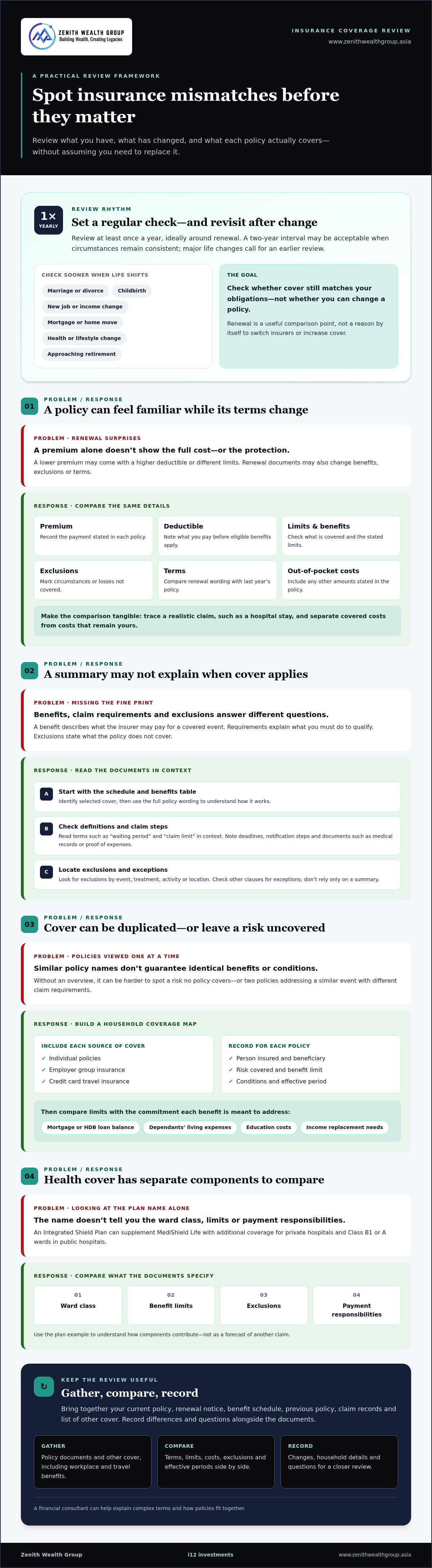
Reviewing my insurance coverage annually doesn’t mean changing your policies every year. In Singapore, review your cover at least once a year, and revisit it after a major change to your family, finances, home or lifestyle. Renewal is a useful time to compare your current cover with last year’s policy.
It’s easy to let familiar policies run on autopilot, but your needs can shift when you take on a mortgage, welcome a child, change jobs or approach retirement. A regular review helps you spot where your cover may no longer match your obligations, as well as benefits or exclusions you may have overlooked.
This guide explains when to review your insurance, how to read key policy terms and exclusions, and how to identify gaps or overlapping cover. You’ll also learn how to compare your policies with current responsibilities, including dependants, housing costs and workplace benefits. Start by listing what you already have, then note what has changed and what needs a closer look.
Key Takeaways
- Set a regular review and revisit your cover when your family, finances, home or lifestyle changes.
- Compare renewal documents with your current policy to spot changes in premiums, deductibles, limits and benefits.
- Read exclusions and claim requirements carefully so you understand when cover applies and where it may not.
- Check whether your policies and workplace benefits leave gaps or duplicate protection you already have.
- Review health, home, vehicle and family cover against your current responsibilities and priorities.
1. How Often Should I Review My Insurance Coverage?
Review your insurance coverage at least once a year, ideally around renewal. Singapore guidance also considers a two-year interval acceptable when your circumstances remain consistent, but major life changes call for an earlier review. Reviewing my insurance coverage annually helps me notice changes without assuming I need to replace a policy.
At renewal, compare the new documents with last year’s policy. Check premiums, deductibles, coverage limits, exclusions, benefits and terms and conditions. Mark each difference, then consider whether it changes what you might pay or receive in a claim. Renewal alone is not a reason to switch insurers or increase cover.
Compare costs on the same basis. Record each premium, the deductible you pay before eligible benefits apply, and any other out-of-pocket amounts stated in the policy. Then consider a realistic claim, such as a hospital stay, and trace which costs the policy covers and which remain yours. A lower premium may come with a higher deductible or different limits, so compare the overall protection, not just the payment.
Whether a premium is affordable depends on your budget and how the policy fits your needs. Check that the annual payment remains manageable alongside housing costs, savings and other commitments. Health insurance renewal is a useful review point because premiums and benefits can change. If costs rise, compare the changes to benefits and payment obligations before deciding whether the cover still offers value.
You can compare policy documents yourself with a checklist and a side-by-side table. A financial consultant can help explain complex terms and how policies fit together. SHARE recommends meeting with a financial consultant when more than a year has passed since your last policy review.
Yes, premiums or benefits can change at renewal in Singapore. Compare the renewal notice with your current policy, record each change and consider its effect on your cover and expected costs before renewing.
For life insurance, check the premium, coverage amount, policy term and whether the premium changes over time. Premiums generally rise as policyholders get older, and they often increase as people approach age 40.
Switching or cancelling can leave a gap in protection if your existing policy ends before replacement cover begins. A new policy may also have different terms, exclusions or costs. Compare the replacement documents and effective dates first. A lower premium alone doesn’t show that switching is better.
2. Understanding policy terms, requirements and exclusions
Start with the policy schedule, benefits table and full wording. The schedule identifies your selected cover, while the wording explains how it works. Find definitions for terms such as “insured person,” “benefit,” “waiting period” and “claim limit,” and read each in context. A familiar word may have a narrower meaning in a specific insurance policy.
Separate benefits from requirements. Benefits describe what the insurer may pay for a covered event; requirements explain what you must do to qualify. Check claim deadlines, required documents, notification steps and conditions attached to a benefit. For example, note whether a claim requires medical records or proof of expenses. Keep each requirement with the relevant benefit.
Exclusions identify circumstances or losses the policy doesn’t cover. Look for exclusions by event, treatment, activity or location, then check whether another clause changes the rule. An exclusion can matter as much as the benefit amount. Record the wording, the situation it affects and any exception stated in the contract. Don’t rely on a summary when the detailed policy wording sets the terms.
For health insurance in Singapore, an Integrated Shield Plan can supplement MediShield Life with additional coverage for private hospitals and Class B1 or A wards in public hospitals. Compare the ward class, benefit limits, exclusions and payment responsibilities shown in your documents. Use the example to understand how separate components contribute, not as a forecast of another claim.
Gather documents before renewal: your current policy, renewal notice, benefit schedule, previous policy, claim records and a list of other cover. Include employer group insurance and credit card travel insurance. Compare each policy’s insured person, benefit, amount, exclusions and effective period. This makes overlapping cover easier to identify. Two policies may address a similar risk but have different terms and claim requirements.
Review again after life changes, such as marriage, childbirth, a new job or a move. Update your household and financial details, then check whether beneficiaries, insured people or stated amounts still reflect your circumstances. Keep a dated record of questions and answers with the policy documents. A financial consultant can help you understand how protection decisions relate to broader plans, including estate planning conversations.
3. Checking insurance gaps and overlaps
Start with a household coverage map. List each person, policy, insured risk, benefit limit and beneficiary. Include individual policies, employer-provided group cover and credit card travel insurance. This overview can reveal a risk nobody covers, or two policies addressing the same event. Record each policy’s conditions too, since similar names don’t mean identical benefits.
Marriage, divorce and childbirth can change who depends on your income. A new job, income increase, mortgage, health change or high-risk hobby can also affect your insurance needs. Review your cover after these events instead of waiting for renewal. For example, a new parent may need to reassess the amount intended to support a child’s living and education costs.
To check whether limits are adequate, compare each benefit with the financial commitment it is meant to address. Write down your mortgage or HDB loan balance, dependants’ living expenses, education costs and income replacement needs. Then compare those obligations with the relevant policy limits. If dependants or debts have increased, an old coverage amount may no longer fit your situation.
Use this practical gap check for each person in your household:
- Match life cover against housing debt, dependants’ expenses and education plans.
- Compare health cover with MediShield Life, any Integrated Shield Plan and available MediSave balances.
- Include workplace group insurance, then note whether it changes with your job.
- Review credit card travel cover alongside any separate travel protection.
Look for overlaps by comparing the same risk across policies. For example, check whether accident coverage from work duplicates benefits in your personal plan. Record the limits, exclusions and claim conditions for both. An overlap doesn’t automatically mean one policy is unnecessary: terms may differ, and one benefit may not replace another. Your comparison should show what each policy contributes.
Consider the type of benefit, not just its label. Critical illness insurance pays a lump sum that the policyholder can use at their discretion, including for expenses conventional health insurance may not cover. A hospital plan, by contrast, addresses eligible healthcare costs under its terms. Comparing purpose and benefit side by side helps distinguish complementary cover from duplicated protection.
Finally, review home and contents limits after a move, renovation or major purchase. Compare the stated cover with your current possessions and housing situation. If you’ve taken on a new financial commitment or added a dependant, update your coverage map and identify which limits need a closer look.
4. Benefits of reviewing insurance coverage
A yearly review turns a collection of policies into a current protection plan. Set aside time once a year to compare your cover with your household’s actual expenses, responsibilities and priorities. The goal isn’t automatically to buy more insurance. It’s to check whether each policy still serves a clear purpose.
A review can help you catch changes before they become costly surprises. Paying down a mortgage over time can change the amount your household needs to protect. A sizeable emergency fund may also affect how much protection you want for certain expenses. Compare outstanding commitments with policy limits, then note where the figures no longer match your situation.
A review can also help you keep premiums manageable. Check the renewal amount alongside the benefits, limits and payment terms, rather than treating the premium alone as a measure of value. If the premium has risen, identify what changed and which benefits matter to you. For someone approaching retirement, this can help assess whether ongoing premiums fit expected income and expenses.
Policy updates can reveal cover that has expired or lost value. Check each add-on against its current benefit and end date. For example, record whether an additional benefit still applies and whether its stated amount remains useful for the expense it was meant to address. This helps you avoid relying on outdated assumptions when planning for a claim.
Major life changes can make an annual review especially useful. A new child, marriage, divorce, job change or move can alter who relies on your income and what expenses your cover should address. After such a change, update your household information and compare relevant policy limits. In Singapore, include MediShield Life and any Integrated Shield Plan in your health cover review.
A review also gives you a clearer record of decisions. Keep a dated summary of each policy’s purpose, premium, key benefit and next review date. Add a short note explaining why you kept, adjusted or cancelled the cover. At the next renewal, that record helps distinguish a deliberate choice from a policy left unchanged simply because it was familiar.
Use these benefits to guide your next review:
- Match cover to current financial responsibilities and major life changes.
- Identify premiums that no longer fit your retirement budget or household expenses.
- Check whether add-ons remain active and useful for their intended purpose.
- Keep a dated record so future renewal decisions have clear context.
A focused review can clarify which questions need attention first. Start with the policy tied to your largest current commitment, such as a housing loan or a dependant’s living costs. Then compare the relevant benefit, premium and conditions. This gives you a practical order for reviewing your coverage without assuming every policy needs to change.
5. Which insurance policies should I review each year?
Start with every policy that protects your health, income, home, vehicle, family or valuables. In Singapore, policies typically renew once per year, making renewal a practical time to review the documents. Include individual policies, employer-provided group cover and credit card travel insurance. Note the renewal date, insured person, key benefit and payment method for each.
Review health cover first. Singaporeans and permanent residents have MediShield Life, administered by CPF Board. Check how it fits with any Integrated Shield Plan and its rider, including the benefits, exclusions and renewal terms in your documents. Review premium affordability alongside your healthcare preferences and current cover.
Next, check life and personal protection policies against your current responsibilities. Confirm the insured person, benefit amount, policy term and named beneficiaries. Consider whether the cover still reflects dependants’ living costs, education needs and housing commitments. If a policy includes critical illness or disability benefits, read the definitions and claim conditions again. Similar benefit names can have different terms.
Review home and contents cover after a move, renovation or valuable purchase. Compare the policy’s stated protection with the property and possessions you currently own. If you rent out a home or switch from owning to renting, check whether the policy details still describe your situation. For vehicle insurance, revisit the insured vehicle, listed drivers and cover selections at renewal. Keep the latest documents beside the previous policy for comparison.
Also include policies that are easy to overlook. Employer group insurance may change when you change jobs, while credit card travel cover may depend on the card’s terms. List each benefit and its conditions, then identify whether it supplements your personal cover or addresses a different risk. This can show where a work benefit may no longer apply or where two policies offer similar protection.
Use a simple annual record to keep the review focused:
- Write down each policy’s renewal date and premium.
- Note changes to benefits, limits, exclusions and conditions.
- Record life changes that affect your household or possessions.
- Mark policies that need closer review before renewal.
Keep the record with your policy documents and update it after a major change, not only at renewal. To discuss how your protection priorities fit your wider financial plans, start a conversation about your priorities.
Zenith Wealth: Retirement Planning
Zenith Wealth can help you connect insurance decisions with your retirement plans. Turn to Retirement Planning when reviewing premiums, expected income and protection needs raises questions about affordability after work ends. The discussion can also consider how insurance fits alongside Education Funding, Wealth Protection or Legacy Planning, where relevant.
Keep protection and investment choices distinct as you review your financial picture. If you’re also considering i12 investments, assess those decisions separately from the terms, benefits and exclusions of your insurance policies. A clear view of each helps you understand how different choices relate to your priorities.
Bring your policy documents and a summary of your retirement goals to start a focused discussion. Contact Zenith Wealth to talk through your Retirement Planning priorities.
Make Your Next Review a Clear Starting Point
Use your next review to create a useful record of the choices you want to revisit, not just a set of renewal reminders. Note which financial priorities have changed and what you want your cover to support. That record can make future decisions more deliberate. Treat reviewing my insurance coverage annually as part of keeping your wider financial plans aligned, not a task that ends when a policy renews.
Zenith Wealth’s Retirement Planning, Education Funding and Wealth Protection can support conversations about how protection relates to these priorities. If you’re also considering i12 investments, keep investment decisions distinct while considering how they fit your overall plans. The next step is a focused discussion about what matters to you now and what you want to prepare for.
Contact Zenith Wealth today to start that conversation. Take one practical step at a time, and give your plans room to move forward with confidence.
Frequently Asked Questions
How Often Should I Review My Insurance Coverage?
Review your insurance at least once a year in Singapore, then revisit it sooner after a major change. Set a calendar reminder before each renewal and keep a short record of any questions. If nothing has changed, the review may simply confirm that your existing arrangements still fit. Reviewing doesn’t automatically mean changing a policy or insurer.
How often should you change your coverage?
Change your coverage when your needs or financial responsibilities shift, not simply because another year has passed. For example, a new mortgage may increase the protection your household wants, while paying down debt may change that need. Use each renewal to consider whether an adjustment makes sense, then check how it affects benefits, exclusions and payments before deciding.
Should You Change Your Insurance Policy Every Year?
No. An annual review is a chance to assess your policy, not a requirement to replace it. Switching may alter the cover, terms or exclusions you rely on. For example, replacing a health policy based only on a lower renewal premium could mean different benefits. Compare the existing and proposed terms carefully before making a change.
When Is the Best Time to Review Your Policy?
Review it before renewal, while you have time to read the documents and understand any changes. For health insurance, renewal is especially useful because premiums and benefits can change. Also review after milestones such as marriage, childbirth, a new job or a home move. A calendar reminder tied to renewal can help you avoid rushing decisions.
Why should I review my insurance coverage annually?
Reviewing my insurance coverage annually helps me notice when a policy no longer reflects current priorities. It also creates a record of decisions, such as why a benefit was kept or a limit reconsidered. For example, after a child starts school, a parent can reassess family commitments and the purpose of existing cover without assuming every policy needs an update.
How can I compare insurance premiums and benefits at renewal?
Put the renewal terms beside your current policy and compare like with like. Note the premium, deductible, benefit limits, exclusions and claim conditions. Then consider a realistic situation, such as a hospital admission, and identify which costs each policy addresses. A useful comparison shows both the payment and the protection attached to it, not just the premium.
What exclusions, deductibles, and policy terms should I check?
Check what events or treatments are excluded, what deductible applies, and which conditions must be met for a claim. Read definitions and limits alongside the relevant benefit. For a health policy, look for terms that affect hospital or treatment cover; for life insurance, check the insured person, term and benefit conditions. Keep notes on clauses that affect your own circumstances.
What documents and information should I prepare for an annual insurance review?
Gather each current policy, renewal notice, benefit schedule and previous policy version. Add a list of household commitments, such as loan balances, dependants’ needs and major changes to income or employment. Include employer group cover and credit card travel protection. Keeping these records together helps you compare policy terms with your actual arrangements and identify questions that need attention.


