

Start with a written plan that balances support for your spouse with clear provision for each child. If a non-Muslim person dies intestate with a spouse and children, the spouse generally receives half the estate and the children share the other half, according to Attorney-General’s Chambers (Singapore Statutes Online). Financial planning for blended families in Singapore should also account for assets that may pass through nominations rather than under a will.
It’s understandable to want to protect your current partner while giving children from an earlier relationship clarity about their future. But outdated beneficiaries, an old will or uncoordinated asset ownership can lead to an outcome you did not intend. A thoughtful plan makes your choices explicit and brings family wealth succession into the conversation.
This guide explains how to balance a surviving spouse’s needs with children’s interests, review CPF and insurance nominations, and coordinate wills, inheritance and longer-term wealth plans. It also covers practical trade-offs, including how a trust or life-interest arrangement may support a spouse while preserving assets for children. Use this framework to decide what to review and when to seek professional guidance.
Key Takeaways
- Write down how you want your spouse and children from different relationships to be supported, then align your estate documents with those intentions.
- Review life insurance and other beneficiary designations after major family changes so they reflect your current wishes.
- Coordinate your will with CPF nominations, insurance arrangements and property ownership, since different assets may pass through different channels.
- Discuss the practical trade-offs of trusts and other succession arrangements, including how they can support a spouse while preserving assets for children.
- Include investment arrangements, including i12 investments, in the wider conversation about family wealth succession and future needs.
1. Protecting a surviving spouse while providing equitably for children from different unions
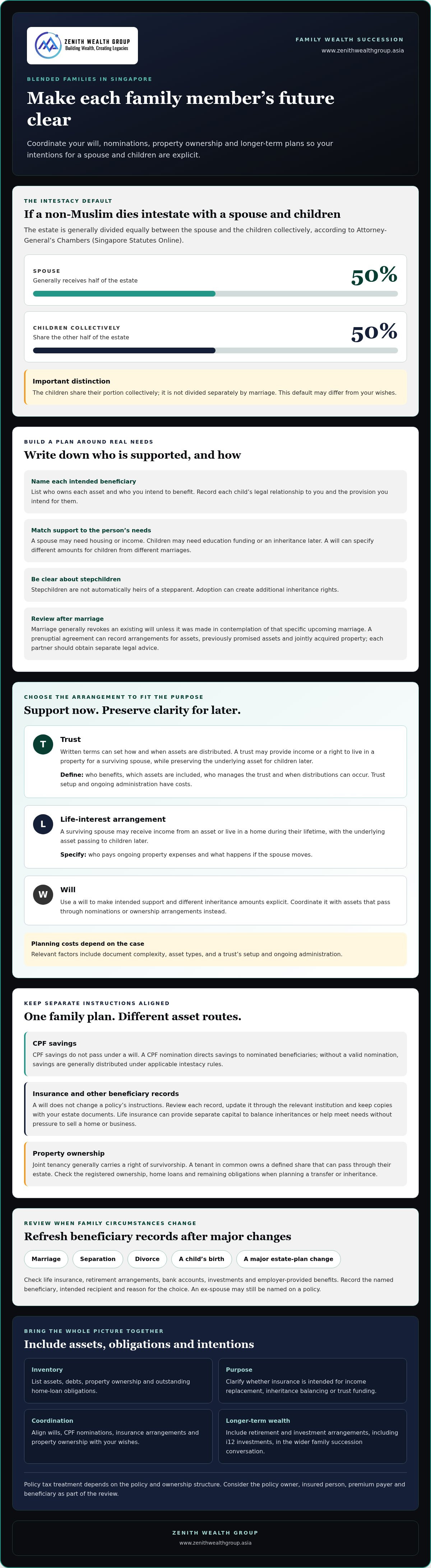
Start by listing who owns each asset and who you intend to benefit. In Singapore, a non-Muslim person who dies intestate with a spouse and children generally leaves half the estate to the spouse and the other half to the children collectively, according to Attorney-General’s Chambers (Singapore Statutes Online). The children share their portion; it isn’t divided separately by marriage. This default may differ from your wishes, so record how you want your spouse and each child to be supported.
A will lets you specify different amounts for children from different marriages and provide for a surviving spouse. Consider when support is needed as well as how much: a spouse may need housing or income, while children may need education funding or an inheritance later. Stepchildren aren’t automatically heirs of a stepparent. Adoption can create additional inheritance rights, so include each child’s legal relationship and intended provision in your plan.
Discuss expectations before marriage, especially if either partner has assets or commitments to children from an earlier relationship. A prenuptial agreement can record how assets should be divided if the relationship ends and clarify arrangements for previously promised assets and jointly acquired property. Each partner should obtain separate legal advice so both interests are represented. Review the will after marriage, too: marriage generally revokes an existing will unless it was made in contemplation of that specific upcoming marriage.
For HDB flats, private property and home loans, the outcome after remarriage or a spouse’s death depends on ownership, title arrangements and loan obligations. Record who owns the home, how it is held, and what repayments or other obligations remain. Include these details when planning a transfer or inheritance.
A trust can specify how and when assets are distributed. For example, it may provide a surviving spouse with income or the right to live in a property during their lifetime, while preserving the underlying asset for children later. Set clear terms for who benefits, which assets are included and when distributions can occur. This may reduce uncertainty, but the trust structure should reflect your family’s priorities and responsibilities.
The price depends on the case and is given after a quote request; factors include document complexity, asset types, and a trust’s setup and ongoing administration. To prepare, list assets and debts, identify intended beneficiaries, write down support priorities, and have the will or trust drafted to reflect them.
2. Updating retirement plan and life insurance beneficiaries
Review each beneficiary record after marriage, separation, divorce, a child’s birth or a major change in your estate plan. List life insurance policies, retirement arrangements, bank accounts, investments and any employer-provided benefits. Record the named beneficiary, the intended recipient and the reason for your choice. An ex-spouse may still be named on a policy, so don’t assume a will changes the policy’s instructions. Update each record through the relevant institution and keep copies with your estate documents.
Ask what each beneficiary will receive and how the proceeds will be managed. Naming a child directly may not suit a young beneficiary who depends on adults to manage money. Naming a spouse may support them but leave children from an earlier relationship without the intended share. Life insurance can provide separate capital to balance inheritances, especially when family wealth is concentrated in a home or business. That liquidity may help meet beneficiaries’ needs without putting pressure on the family to sell an asset.
A family trust can receive insurance proceeds and distribute them under written terms. For example, its terms might allocate funds for a child’s education or provide support to a surviving spouse. If that is the intended outcome, the policy must direct proceeds to the trust rather than individuals. Consider who manages the trust, when payments can be made and how the arrangement fits with other assets. Trust setup and ongoing administration have costs, while property transfers involve other considerations. These arrangements need careful coordination.
Life-interest arrangements address a different need: a surviving spouse may receive income from an asset or live in a home during their lifetime, while the underlying asset passes to children later. Specify who pays ongoing property expenses and what happens if the spouse moves. For jointly owned property in Singapore, joint tenancy generally carries a right of survivorship; a tenant in common owns a defined share that can pass through their estate. Check the registered ownership before deciding how the home fits into your family plan.
Tax treatment depends on the policy and ownership structure, so include those details in your review instead of assuming every payout receives identical treatment. Compare the policy owner, insured person, premium payer, and beneficiary. Then check whether the policy’s purpose is income replacement, inheritance balancing, or trust funding. A financial planner can help align protection needs with retirement and investment arrangements, including i12 investments. For help connecting these decisions with your wider estate plan, discuss beneficiary and estate planning.
3. Where Do CPF, Wills and Nominations Fit In?
Map each asset to the document or nomination that directs it. In Singapore, CPF savings do not pass under a will. A CPF nomination directs savings to nominated beneficiaries; without a valid nomination, CPF savings are generally distributed under applicable intestacy rules. A will cannot replace a CPF nomination. Keep both documents aligned with your intended support for your spouse, children and other loved ones.
Check your CPF nomination after marriage. A nomination made before marriage is revoked when the member marries, so review and make a new nomination if it reflects your wishes. In February 2025, 36% of CPF members aged 16 to 64 had a valid nomination, compared with 86% of members aged 65 and above. These figures show why it’s useful to include nomination status in a regular estate-planning review.
Next, compare your will with beneficiary records for insurance policies and other accounts. A beneficiary designation on an insurance policy or retirement account can supersede an inconsistent provision in a will or trust. For example, a will might leave an asset to children while an older policy still names a former spouse. List each account, its named beneficiary and the intended recipient. Update the relevant nomination or policy record directly, then keep a copy with your estate papers.
Insurance can provide separate capital for a specific beneficiary or purpose. In a blended family, this may help provide for a child without dividing a property or business interest. It can also provide cash for family needs when much of the wealth is tied up in those assets, reducing pressure to sell. If your plan includes a family trust, coordinate the policy’s beneficiary instructions with the trust terms and intended distribution.
Bring CPF records, insurance documents, property ownership and business interests into one asset inventory. Add your will, beneficiary details, policy ownership and relevant investment records, including i12 investments. Then discuss how each part fits your estate plan and the family’s tax planning needs. Don’t assume one document controls every asset. Review the inventory after marriage, a new child, a separation, or a change in ownership. This practical step helps loved ones understand which instructions apply to each part of the family’s wealth.
4. How a partner’s marital status affects inheritance rights
In Singapore, legal relationship status matters when deciding who may inherit. A spouse has a different position from a live-in partner, and children from a partner’s earlier relationship are not automatically heirs of the new spouse. Record each person’s relationship to the asset owner, including whether a child is biological or adopted. This helps identify who your documents need to provide for.
Marriage can change existing estate documents. In Singapore, marriage generally revokes an existing will unless it was made in contemplation of that specific upcoming marriage. Divorce does not automatically revoke a will. After either change, review the will’s date, intended beneficiaries, executor and guardianship provisions. A will made before remarriage, for example, may no longer reflect the parent’s wishes, even if its named beneficiaries still seem appropriate.
Stepchildren and biological children may have different inheritance positions. Children from a first union are not considered heirs of their parent’s new spouse in a subsequent union. Adoption can give a stepchild additional rights. If you want a stepchild to benefit without adoption, state that intention clearly in your estate plan and align the relevant documents. Don’t rely on family terms such as “our children” to show who should receive particular assets.
Fairness doesn’t always mean equal amounts. A parent might leave a larger share to a child with greater support needs while providing a spouse with access to income or housing. Record the reason for each decision, the asset involved and the intended recipient. Discuss the plan with your partner and adult children where appropriate. A prenuptial agreement can clarify how assets should be divided if the couple separates, while a will addresses distribution after death. Each partner should obtain separate legal advice about the agreement.
Include life insurance in the same review. Record the policy owner, insured person, premium payer and named beneficiary, then compare those details with your will and any agreement. This helps identify where a policy may provide support to a spouse or child separately from other inheritance. For tax planning, include the policy and ownership structure in the overall estate review rather than assuming all assets receive identical treatment. Consider how property, business interests and i12 investments fit the intended distribution, and document any decisions for the people who will manage the estate.
5. Family wealth succession and intergenerational planning
Succession planning involves more than deciding who receives each asset. Decide how family wealth should support people over time, who will manage it and what should happen if circumstances change. For example, one family may want education funds protected for younger children while making capital available for an adult child’s business venture. Write down each goal, intended beneficiary and decision-maker. This creates a practical framework rather than leaving future relatives to interpret general wishes.
A Singapore family trust can structure support for education, housing, business ventures and medical needs. Its terms can specify when funds may be used and who makes distribution decisions. For example, a trustee could consider a request for education costs separately from a request for business funding. Trusts can involve setup and ongoing administration fees, so weigh those costs against the value of the structure and your family’s needs. A trust is not automatically the right fit for every household.
Check the assets before transferring property into a trust. In Singapore, consider stamp duty, existing loans and the property’s ownership type as part of the decision. A jointly held home, a property with an outstanding loan and a business interest each raise different practical issues. Make an asset schedule recording ownership, related obligations and the intended future recipient. This helps identify which assets can support family goals and which need more careful succession planning.
Plan for decision-making as well as distributions. List who should manage financial affairs if a family member loses mental capacity, and record health and care wishes in the appropriate documents. A Lasting Power of Attorney can form part of this planning. Set a review trigger, too: a new child, a change in relationship, a business sale or a major change in family responsibilities. Update the plan and related documents to reflect the current situation, not an earlier family structure.
Lifetime gifts need the same care as inheritances. Before helping an adult child with housing or another large expense, consider whether you can still meet your own future living and care costs. Record whether support is a gift or a loan, and whether repayments may return to a family trust for another relative. Discuss the plan with loved ones, including how i12 investments and business interests fit into future needs. For help connecting these decisions into a succession plan, discuss your family wealth planning.
Zenith Wealth: Retirement Planning
Zenith Wealth Group can help connect retirement goals with the needs of a blended family. Turn to its Retirement Planning when weighing your future income alongside education funding or wealth protection for family members. Legacy Planning can also bring your intentions for family wealth into the wider plan.
Bring a current list of assets, beneficiaries, CPF nomination details and family priorities to a discussion with a financial planner. Include investments, including i12 investments, so your retirement and legacy decisions fit together. This gives you a practical starting point for reviewing how your plan supports your spouse and children across different life stages.
To discuss your next steps, contact Zenith Wealth.
Give your family plan room to grow
A blended family’s needs can change as children become adults, relationships evolve and priorities shift. Treat your plan as a living family decision, not a document to put away and forget. Set a time to revisit it and make space for each family member’s questions. Clear communication can help loved ones understand the intentions behind future decisions.
Financial planning for blended families in Singapore can also connect long-term family goals with everyday priorities. Zenith Wealth offers Retirement Planning, Education Funding and Wealth Protection to help you consider these needs together. Bring your current priorities and the decisions you’re still weighing to a conversation with a financial planner.
Take the next step at a pace that feels right for your family. Contact Zenith Wealth to discuss your plans and start shaping a plan around the people and goals that matter to you.
Frequently Asked Questions
Are there any risks or drawbacks?
Yes. A plan can create costs, administrative work or unexpected outcomes if its documents conflict. A trust may involve setup and ongoing administration fees, while transferring property into one requires considering stamp duty, existing loans and ownership type. A mismatch between a will and beneficiary instructions can also redirect an asset from its intended recipient. Make a document inventory, identify who maintains each record and schedule reviews after major family changes.
Can I leave different amounts to children from different marriages?
Yes. A Singapore will can specify different amounts for children from different marriages. Before drafting, list each child, the assets intended for them and any support already provided during your lifetime. For example, you may want one child to receive education support while another receives a different asset. Explain the reasoning to your executor and keep the instructions consistent with beneficiary designations that operate outside the will.
Does divorce revoke my will in Singapore?
No. In Singapore, divorce does not automatically revoke a will. Review it after divorce to see whether its beneficiaries, executor, guardianship choices and asset instructions still reflect your wishes. For example, a former spouse may remain named in a role or provision you no longer intend. Check related insurance and account nominations separately, since a will may not control how those assets are distributed.
How will my CPF savings be distributed if I do not make a new nomination after remarriage?
A CPF nomination made before marriage is revoked when the member marries. If you don’t make a new valid nomination, your CPF savings are generally distributed under the applicable intestacy rules. They do not pass under your will. After remarriage, review the nomination and decide who should receive the savings. Consider how that choice fits alongside other provisions for your spouse and children.
What happens if there is no longer a valid will?
For a non-Muslim person who dies intestate with a spouse and children, the estate is generally divided equally between the spouse’s half and the children’s collective half, according to Attorney-General’s Chambers (Singapore Statutes Online). The children share their portion collectively. This default may not match a family’s intended arrangements, particularly where children come from different relationships. Review whether a valid will reflects your current family and asset situation.
Where Do CPF, Wills and Nominations Fit In?
They direct different parts of your estate, so treat them as connected but distinct records. CPF savings do not pass under a will, and insurance or account beneficiary instructions may direct assets to someone other than the person named in the will. Create a single record of each asset, its governing document and its intended recipient. After a change, update the relevant record and tell the person responsible where the current copy is kept.
What financial planning issues are unique to blended families in Singapore?
Financial planning for blended families in Singapore must account for obligations across relationships, including a spouse, children from earlier relationships and stepchildren. Their legal relationships to each other can affect inheritance arrangements, while shared property or business interests create decisions about ownership and future control. Discuss education funding, household responsibilities and support for adult children. Include investments, such as i12 investments, in the family’s overall asset picture.
How does Singapore intestacy law distribute assets in blended families with children from previous marriages?
For a non-Muslim person who dies intestate leaving a spouse and children, the spouse generally receives half the estate, and the children share the other half, according to Attorney-General’s Chambers (Singapore Statutes Online). The distribution is not automatically divided by marriage. Children from earlier relationships remain children of the deceased parent, while stepchildren are not automatically heirs of their stepparent. Clear estate instructions are especially relevant to blended households.


