

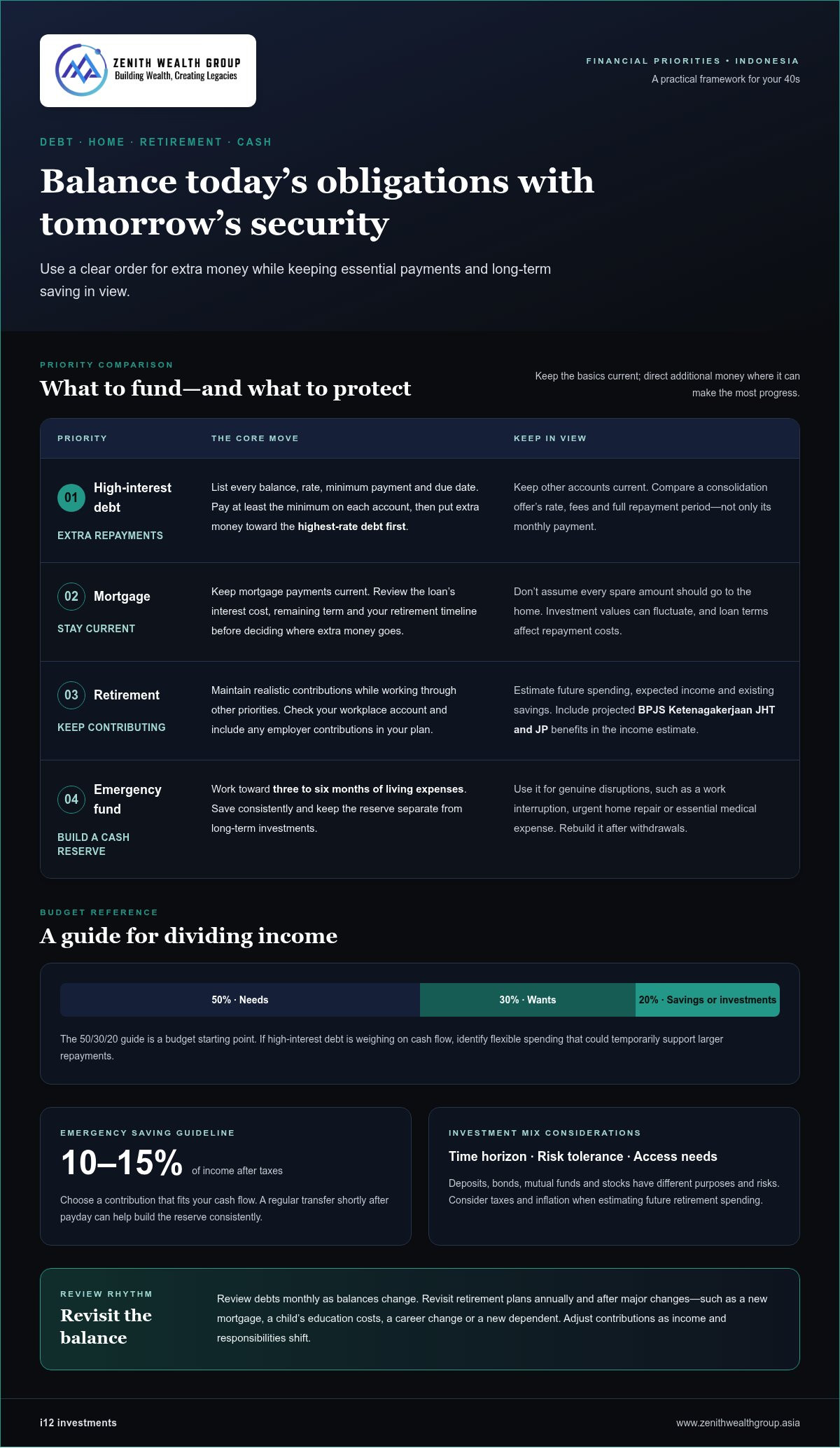
Start by paying down high-interest debt while keeping mortgage payments current, then build an emergency fund of three to six months of living expenses. Keep retirement contributions going as you work through these priorities. When setting financial goals for my 40s in Indonesia, the next step is to balance today’s obligations with the savings you’ll rely on later.
It can be difficult to decide whether extra money should go toward debt, your home, retirement or cash savings. A clear order can help you make progress without treating every goal as equally urgent. This guide explains how to prioritise high-interest debt, mortgage payments, retirement savings and an emergency fund, and how to adjust the balance to fit your income and responsibilities. You’ll have a practical starting point for deciding what to fund next and a way to revisit your priorities as circumstances change.
Key Takeaways
- List each debt, its interest rate and minimum payment, then focus extra repayments on the highest-rate balance while keeping other payments current.
- Balance mortgage payments with retirement saving by reviewing your current contributions and deciding where extra money can make the most progress.
- Build an emergency fund toward three to six months of living expenses, using a regular savings amount that fits your budget.
- Revisit your priorities as income, family needs and responsibilities change, so short-term resilience and long-term plans stay aligned.
1. Paying down high-interest debt
Start with a complete debt list, not an estimate of your monthly total. Record each balance, interest rate, minimum payment and due date, including every credit card and instalment plan. Keep paying at least the minimum on each account, then direct extra money to the debt with the highest rate. This targets the costliest debt first while keeping your other accounts current.
For example, if a credit card has a higher interest rate than a personal loan, pay the card first after covering both minimums. Don’t split extra repayments evenly unless the rates are equal: the higher-rate balance generally costs more to carry. Pay credit card bills and instalments on time to avoid interest and penalties. Set recurring payment reminders or calendar alerts for each due date, then review the list monthly as balances change.
Before consolidating debt, compare the new rate with the rates on your existing debts. Include fees and the full repayment period, not just the new monthly payment. A lower payment can still mean a higher total cost if you take longer to repay. Avoid using assets or taking on new borrowing to clear a balance unless the full terms fit your repayment plan.
For a budget starting point, the 50/30/20 guide assigns 50% of income to needs, 30% to wants and 20% to savings or investments. If high-interest debt is weighing on your monthly cash flow, identify which flexible spending can temporarily fund larger repayments. Keep regular contributions realistic, so the plan doesn’t depend on borrowing again for routine bills.
For health cover, compare public schemes, employer benefits and private health insurance, focusing on your hospital and outpatient needs. Costs depend on factors such as age, health history, benefits and exclusions, so compare policy details rather than choosing by premium alone.
2. Balancing mortgage payments and retirement savings
Keep your mortgage payments current, then weigh the loan’s interest cost against the value of building retirement savings. Don’t assume every spare amount should go toward your home: investment values can fluctuate, while mortgage terms affect repayment costs. Review your budget, remaining loan term and retirement timeline together. If children’s education costs compete for cash, set a separate contribution instead of quietly drawing from retirement savings.
Check your workplace retirement account and understand how your contributions affect its balance. Include any employer contributions in your plan before redirecting money elsewhere. Increase your own contributions gradually when your income rises or a regular expense ends. Starting or maintaining contributions earlier gives investments more time to grow, although returns aren’t guaranteed. Review your plan annually and after major changes, such as a new mortgage or a child’s education expenses.
There’s no single retirement savings figure that suits every Indonesian in their 40s. Estimate future spending, expected retirement income, existing savings and the age you want to stop working, then calculate the gap your contributions need to address. BPJS Ketenagakerjaan JHT and JP belong in that income estimate; review their respective projected benefits alongside personal and workplace savings.
Deposits, bonds, mutual funds and stocks serve different purposes. Deposits can offer a more predictable balance; bonds carry interest-rate and issuer risks; mutual funds spread investments across holdings according to their mandate; and stocks can fluctuate sharply. Choose a mix based on your time horizon, risk tolerance and need for access, not recent performance alone. Investing earlier gives your money more time to grow, but doesn’t remove market risk.
Indonesian taxes affect the amount you keep from investment returns, while inflation reduces what savings can buy over time. Include both when estimating future retirement spending, and compare investments by their after-tax return and purchasing power. A retirement priorities discussion can help connect mortgage decisions, contributions and your target income.
3. Emergency savings
Set an emergency-savings target of three to six months of income. Treat this reserve as protection against disruptions, not as money for planned purchases. List essential spending, including housing, food, transport, utilities and required payments. Compare these costs with take-home income to estimate what your household would need during a work interruption. An income-based reserve has a clear purpose: covering essentials if earnings pause or fall. Revisit the target after a career change, a new dependent or a mortgage adjustment.
Keep emergency savings in a separate, accessible place, apart from money invested for long-term goals. Use it for an unexpected gap in employment, urgent home repair or essential medical expense. Don’t rely on a credit card as your safety net: borrowing can add interest just as income becomes uncertain. Put planned costs, such as a holiday or annual insurance payment, in a different budget category. This helps preserve the reserve for genuine emergencies.
To build the balance, save a portion of income consistently. A simple guideline is 10% to 15% of income after taxes. Pick a contribution that fits your current cash flow, then automate a transfer for shortly after payday. For example, someone paid monthly can schedule one transfer each payday rather than waiting to save whatever remains. If income varies, set a manageable baseline contribution and add more after stronger earning months. Increase the transfer when a regular expense ends.
Track progress toward your target, not an arbitrary deadline. Each month, compare the reserve with essential spending and note any withdrawals. If you use savings for a car repair, restart transfers and rebuild the balance before increasing optional spending. Keep spending below income so the difference can support savings and other priorities. This routine makes emergency funding a practical part of financial planning, even when mortgage payments, retirement contributions and family needs compete for income.
4. Building an emergency fund
For a family in Indonesia, a practical emergency-fund target is three to six months of living expenses. Calculate the amount using essential monthly costs, not gross income. Include housing, food, transport, utilities, healthcare and debt payments. This gives your household a clearer target than choosing an arbitrary savings balance.
Base the calculation on the people who rely on your household income. A family member with ongoing medical needs may increase essential costs; a child’s education fees may be planned expenses rather than emergencies. Keep predictable school costs in a separate savings goal. Reserve emergency money for an unexpected loss of income, urgent repairs or necessary care, so one expense doesn’t derail another priority.
Build the fund in manageable stages. Start by directing regular savings into a separate account that you can access when needed. Compare its balance with your household’s essential monthly expenses and keep contributing until it reaches the target range. If money is tight, review recurring spending and redirect a realistic amount. Increase contributions when income rises or a major expense ends.
Set simple withdrawal rules before an emergency happens. Use the fund for urgent, necessary costs, not routine shopping or planned travel. After making a withdrawal, adjust the next budget to replenish the balance. A household budget that lists essential expenses, education costs and debt payments makes these choices easier. It can also help protect long-term wealth from being sold or borrowed against during a short-term shock.
Review the target after a change in household income, dependants or housing costs. A family’s needs can shift as children grow, a member changes career, or monthly payments change. Put the current expense total and savings target in your financial plan, then revisit them as circumstances evolve. Discuss your household’s financial priorities as part of planning for future needs.
Zenith Wealth: Retirement Planning
Zenith Wealth Group can help you turn retirement priorities into a financial plan, especially when mortgage payments, savings and family needs compete. Its Retirement Planning service can help you review your target retirement income, current savings and contribution priorities. If education funding or protecting family wealth also affects your decisions, include those goals in the discussion rather than planning for retirement in isolation.
Use this stage to bring together your current budget, expected retirement income and the decisions you’ve identified, including how i12 investments fits your broader priorities. A financial planner can help you assess the trade-offs and shape a plan around your circumstances. Start the conversation when you’re ready to connect your retirement goals with the rest of your financial picture.
Contact Zenith Wealth to discuss your retirement priorities.
Make your next decision with purpose
Your financial plan should evolve as your priorities change. A career shift, a growing family or a move between Indonesia, Malaysia, Singapore, the Philippines and Thailand can alter what matters most. Schedule time to review your goals, decide what needs attention next and write down one practical action to take. A clear next step makes a long-term plan easier to put into action.
For financial goals for your 40s in Indonesia, Zenith Wealth offers Retirement Planning, Education Funding and Wealth Protection to help connect future income, family needs and financial resilience. These areas can be considered together, so a decision about one goal doesn’t sit apart from the rest of your financial picture. Bring your questions and priorities to a conversation, and explore which planning steps fit your situation.
Contact Zenith Wealth to discuss your goals. Start with one conversation and take the next step at a pace that feels right.
Frequently Asked Questions
What are realistic financial goals for people in their 40s in Indonesia?
Realistic goals fit your household cash flow, responsibilities and timeline. I’d make financial goals for my 40s in Indonesia specific to a clear outcome, such as reducing a balance, estimating retirement income or preparing for a planned expense. If income varies, base regular commitments on dependable earnings and direct additional income toward one priority. Review your goals after a job change, move or new family responsibility.
How much should I contribute to retirement savings in Indonesia in my 40s?
Estimate a contribution by comparing your expected retirement income with likely spending, then account for current savings and your time horizon. There isn’t one contribution amount that suits every household. Revisit the estimate as your income, retirement date or expected expenses change. If your pay rises, consider increasing contributions while keeping essential commitments manageable.
How should Indonesians in their 40s plan for children's education costs?
Start with the likely study destination and the time remaining before your child enrols. List expected costs such as tuition, books, accommodation and transport, then subtract education savings already set aside. Parents who begin when a child is young may have 15-20 years to prepare for university fees. Update the estimate as school plans and family circumstances become clearer.
How can I pay off debt and manage a mortgage in Indonesia in my 40s?
Keep a clear record of your mortgage balance, repayment schedule and other borrowing. Read your loan documents to understand how payments are applied and whether early-repayment terms affect your choices. Include mortgage payments in your monthly cash-flow plan before committing extra money elsewhere. If your income changes, revise your budget promptly and contact your lender about available repayment options.
What steps should I take to review my finances and set goals in my 40s in Indonesia?
Gather recent account statements, loan balances, income records and household expenses. For financial goals for my 40s in Indonesia, compare what you own with what you owe, then choose goals using the SMART principle: Specific, Measurable, Achievable, Relevant and Time-bound. Write down one next action for each goal, such as adjusting a transfer or updating a forecast. Revisit your plan after major life changes.
How does Indonesia's pension system work, including BPJS Ketenagakerjaan JHT and JP?
Include projected benefits from BPJS Ketenagakerjaan JHT and JP in your retirement-income estimate, alongside personal and workplace savings.


