

What if the most useful long-term care plan isn’t built around one price, but around several possible care needs? Planning for long-term care costs in Malaysia can feel uncertain because the type of support, how long it’s needed and where it’s provided all affect the amount a family may need to fund.
A published price may not reflect the level of support a person needs, and setting money aside for care can raise questions about retirement income and other family goals. You don’t need to know exactly what the future holds to begin planning.
This guide explains what shapes care spending, how to compare different scenarios and how to spot potential funding gaps. You’ll also learn when to revisit your plan as care needs and family circumstances change. Retirement planning, wealth protection and investment decisions, including consideration of i12 investments, can fit into a wider financial plan. Start by clarifying the choices, then build a plan that can adapt.
Key Takeaways
- Planning for long-term care costs in Malaysia starts with preparing for different support needs, settings and durations, rather than relying on one headline estimate.
- Compare home and residential care by support pattern, flexibility and what each budget assumption includes.
- Use a repeatable estimate: outline care scenarios, review quotations, consider duration, map available resources and update the figures over time.
- Consider care funding alongside retirement income, wealth protection and legacy priorities so one goal doesn’t overshadow the others.
- Review investment planning, including i12 investments, as part of a wider financial plan that can adapt when care needs or family circumstances change.
Early Planning for Long-Term Care Costs in Malaysia
Planning for long-term care costs in Malaysia means preparing for possible support needs and considering how paying for that support could affect household finances. The need may arise gradually or after a change in health. Someone may need help with everyday tasks at home, while another person may need nursing support or residential care.
A useful estimate depends on care needs, setting and duration. One figure can’t represent every situation. The type and frequency of support, where it’s provided and how long it continues can all change the spending involved.
Keep care spending distinct from ordinary retirement living expenses. Housing, food and everyday bills form one part of a household budget. Paid assistance, nursing or rehabilitation can add other costs. Separating these categories helps you see what care might add without assuming everyone will need the same level of support.
What counts as long-term care in Malaysia?
Long-term care can include personal support at home, nursing care, rehabilitation or residential care. These are different kinds of help, not one standard package. A person recovering from illness, for example, may need therapy for a period, while someone with ongoing daily-living needs may require regular assistance. Malaysia’s healthcare system includes public and private sectors, as outlined in Healthcare in Malaysia, but the care arrangement and its financial implications depend on the individual situation.
Medical treatment and ongoing daily-living support are separate planning considerations. A hospital visit or course of treatment is not the same as recurring help with activities such as bathing, dressing or moving around the home. A care plan may involve one type of support or several over time, so identify the need before estimating its financial impact.
Why a single care-cost figure can mislead
Location can affect the options a family considers, while support intensity determines how much help may be needed. Frequency matters too: occasional visits and daily assistance create different spending patterns. Duration adds another variable. A short recovery period and a longer-term need shouldn’t be treated as interchangeable scenarios.
A quotation describes a particular arrangement and its stated scope. A personal planning assumption is different: it estimates what a household might need to fund under a chosen scenario. Don’t treat one quotation as a universal price or assume it covers every service. Compare current, like-for-like quotations, noting the care setting, support provided, frequency, duration and stated inclusions or exclusions.
Start with a few clearly described possibilities rather than aiming for false precision. For instance, compare regular help at home with a residential arrangement, then consider how the estimate changes if assistance becomes more frequent or lasts longer. Record the assumptions behind each scenario. This gives your household a practical basis for budgeting and discussion while leaving room for circumstances to change.
Care planning can sit alongside retirement income, wealth protection and investment decisions. A financial planner can help you consider these priorities together, including investment planning that references i12 investments, without treating care needs as fixed or separate from the rest of your financial life.
Which factors shape long-term care costs in Malaysia?
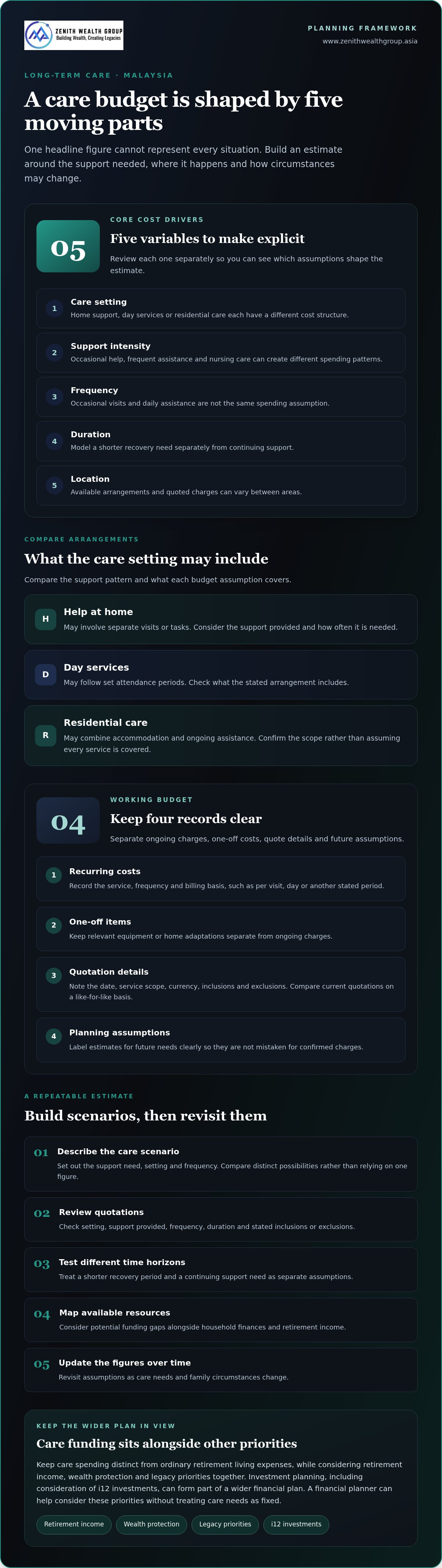
A useful care budget is built from several moving parts, not a single rate. Setting, support intensity, frequency, duration and location are the main variables behind a personalised care budget. Reviewing them separately helps you see which assumptions drive the estimate and which may need updating as circumstances change.
Care setting, support level and duration
Start by comparing distinct scenarios: scheduled help at home, day services or residential care. Each arrangement has a different cost structure. Home support may involve separate visits or tasks; day services may follow set attendance periods; residential care may combine accommodation and ongoing assistance. The details depend on the arrangement, so don’t assume a quoted fee includes every type of support.
Support intensity affects how often help is needed and what it involves. Someone who needs occasional assistance with daily tasks may have a different spending pattern from someone who needs frequent support or nursing care. Location also matters: available arrangements and quoted charges can vary between areas. Compare options in the place where care is likely to be received rather than applying a figure from another location.
Duration is uncertain, not a prediction about any one person. Instead of choosing one fixed period, test different time horizons in your estimate. For example, model a shorter recovery need separately from a continuing support scenario. This shows how duration assumptions affect the overall plan without claiming to know how long care will be needed.
What to include in a working care budget
Look beyond the main care charge. Depending on the arrangement, a household may also need to consider transport, equipment or home adaptations. Keep recurring charges separate from one-off expenses, and include each item only when it applies to the scenario. This makes the budget easier to adjust if care moves from scheduled visits to more frequent help.
- Recurring costs: Record the service, frequency and billing basis, such as per visit, day or another stated period.
- One-off items: Note relevant equipment or home changes separately, rather than blending them into ongoing charges.
- Quotation details: Record the date, service scope, currency, inclusions and exclusions for each quotation.
- Planning assumptions: Label estimates for future needs clearly so they aren’t mistaken for confirmed charges.
If a quotation is in Malaysian Ringgit, retain the original amount and label it as a Malaysia-based estimate. If you track your wider financial plan in Singapore dollars, show that planning amount separately and record the conversion basis and date. Don’t mix currencies or compare different billing periods. Update the estimate when needs, location or service arrangements change.
To connect these care assumptions with retirement income and wealth-protection priorities, consider discussing your financial planning priorities with a financial planner.
Comparing Home vs Residential Care in Malaysia
Home-based and residential care are different ways to organise support, not automatic cheaper-versus-costlier choices. A fair comparison considers the person’s needs, the support available from family and the services included in each arrangement. Care may also be transitional: someone might need rehabilitation after a hospital stay, then move to home support or another arrangement as needs change.
Use the same criteria for each scenario. The table is a planning framework, not a price comparison. Examples of care arrangements in Malaysia can illustrate service types, but they don’t establish market-wide prices or rankings.
| Care setting | Support pattern | Flexibility | Budget assumptions to examine |
|---|---|---|---|
| Home-based support | Scheduled visits or more regular assistance at home | May be arranged around the person’s routines, with coordination needed across services | Consider visit frequency, service scope, transport and any relevant home adaptations |
| Day services | Support during specified attendance periods, with the person returning home afterward | Depends on the schedule and the family’s ability to manage care outside service hours | Clarify attendance pattern, included support and travel arrangements |
| Residential care | Accommodation alongside daily support, with scope varying by arrangement | Support is organised in a residential setting, while the person’s preferences and needs still guide suitability | Separate accommodation and care charges where possible; identify services included and any additional costs |
| Transitional arrangement | Time-limited or changing support, such as rehabilitation followed by another setting | May change as recovery or ongoing needs become clearer | Model each stage separately instead of assuming one arrangement continues throughout |
When home-based support may fit a care scenario
Home support can preserve familiar routines and surroundings. Scheduled help may suit a scenario where assistance is needed at particular times, while family members provide other support. Keep that role realistic: consider availability, coordination and how care could affect relatives’ own responsibilities. Occasional visits and regular daily assistance are different scenarios, even when both take place at home.
Support may involve several care professionals or services. Track who provides each type of help, when it’s scheduled and how the arrangements fit together. The budget should reflect the actual pattern of assistance, not just one visit or service in isolation.
When residential care may enter the comparison
Residential care can bring accommodation and daily support into one setting, but the exact scope varies. Compare the person’s support needs with the services described, and distinguish included assistance from optional or separately billed items. A marketing description alone doesn’t show whether an arrangement suits a particular person. Use consistent assumptions when assessing this setting alongside home or transitional support.
As part of planning for long-term care costs in Malaysia, record why each scenario might fit, what family support it assumes and which costs remain uncertain. A financial planner can help place these scenarios within broader retirement and wealth-protection priorities through financial planning discussions.
How to estimate and prepare for future care spending
A useful estimate is a working plan, not a forecast. Build it in stages so you can see what each scenario assumes, where funds might come from and which details still need to be confirmed. Keep Malaysia-based care estimates in Malaysian Ringgit (MYR). If you track household assets or retirement income in Singapore dollars, show those amounts separately in SGD rather than blending currencies.
Create scenarios from current care information
Start with three possibilities: lower-support care, increased support at home and residential care. These are comparison scenarios, not predictions about what any person will need. Describe the support pattern for each, such as scheduled help, more frequent assistance or care alongside accommodation.
Then use a five-step process:
- Define scenarios. Write down the setting, type of support and frequency assumed for each possibility.
- Review quotations. Use current, comparable quotations. Record the date, currency, service scope, billing basis, inclusions and exclusions. A quoted amount applies only to the arrangement described.
- Estimate duration. Test more than one time horizon rather than treating one duration as certain. Keep the assumptions visible so you can see how they affect the overall estimate.
- Map resources. List relevant savings, income, insurance arrangements and any family contributions you’re willing to include. Don’t assume an insurance arrangement covers a particular service or that a resource will be available until its terms and circumstances are understood.
- Review the plan. Update the scenarios when care needs, finances, arrangements or quotations change.
Before relying on a quotation, compare its scope with the scenario. Note what support is included, how charges are billed and what may be treated separately. Keep confirmed charges distinct from future assumptions and one-off expenses. Mark any detail that could materially change the plan for follow-up in your financial planning.
Map resources, currency and review points
For a cross-border household, track the care estimate in MYR and the resources intended to fund it in their original currencies. Show any SGD assets or income in a separate column, with the exchange-rate basis and date if you convert them for comparison. Currency movements can change the amount available when funds are converted, so don’t present a converted figure as fixed.
Set a practical review point, then revisit the estimate after a change in health, household finances, family support, care arrangements or quotation. Keep a simple record of what changed and why. This ensures a revised figure reflects updated information rather than silently replacing earlier assumptions.
Care assumptions can affect retirement income, protection and legacy priorities. Discuss your care-funding assumptions with a financial planner as part of your wider financial plan.
Fit Malaysia long-term care planning into your wider financial plan
A care estimate becomes more useful when it sits alongside your other financial priorities. Planning for long-term care costs in Malaysia may involve setting aside resources for future support, but reserving too much too early can limit flexibility for retirement income, family needs or other goals. Consider care funding as part of the whole plan, rather than treating one uncertain scenario as a fixed obligation.
Balance care funding with retirement and family goals
Think of a care reserve as a planning allocation, not automatically a separate account or an amount that can never be used elsewhere. Consider how much flexibility you want for day-to-day retirement needs, unexpected expenses and family commitments. Then weigh those preferences against the care scenarios you have modelled.
Care funding can also affect wealth-protection and legacy priorities. For example, resources set aside for potential support may influence what remains available for other plans. Review these aims together as part of a wider retirement strategy, rather than making a care decision in isolation.
Turn an estimate into a plan that can evolve
Use review triggers to keep the plan relevant. Revisit it when health or support needs change, household finances shift, family members’ ability to contribute changes or new quotations alter your assumptions. A review doesn’t mean the original plan failed. It gives you a chance to adjust the balance as circumstances become clearer.
A financial consultant or financial planner can help organise assumptions, identify competing priorities and consider how care funding fits with retirement income, protection and legacy goals. Investment planning, including consideration of i12 investments, can be part of that broader discussion without assuming a particular outcome. Keep estimates, confirmed resources and unresolved questions distinct so decisions reflect what’s known as well as what remains uncertain.
For households with financial commitments across Malaysia, Singapore, Indonesia, the Philippines or Thailand, keep each country’s care estimates and financial resources clearly labelled in their original currencies. For example, record Malaysian care estimates in MYR and Singapore-dollar resources in SGD. If you compare amounts using a conversion, note the rate and date. This makes currency exposure easier to see and avoids treating a converted amount as a fixed future value.
Preparedness and flexibility can work together. Start with a reasonable reserve based on current assumptions, preserve room for other financial goals and update the plan as care needs and family circumstances change. A measured approach supports clearer decisions without promising a particular funding result or care outcome.
Discuss a tailored care-funding plan with a financial consultant and consider how it fits your wider financial priorities.
Give your future plan room to adapt
A care-funding plan doesn’t need to answer every future question today. Its value lies in giving you a thoughtful starting point and making it easier to respond as priorities or circumstances shift. Keep the assumptions visible and revisit them when life changes.
At Zenith Wealth, retirement planning is the primary focus, alongside financial planning that considers wealth protection and legacy goals. Investment planning, including i12 investments, can be considered in the context of your wider priorities, without assuming a particular outcome. Zenith Wealth operates as an authorised representative group under finexis advisory Pte Ltd.
Planning for long-term care costs in Malaysia is personal, especially when care arrangements and household finances cross borders. A financial planner can help you organise the questions, weigh care funding against other goals and decide what to review next.
Discuss your long-term care planning with a financial planner. A clear next step can make the future feel more manageable.
Frequently Asked Questions
How much does long-term care cost in Malaysia?
There isn’t one figure that applies to everyone. Cost depends on the care arrangement, level of support, location, duration and services included. For planning for long-term care costs in Malaysia, use current quotations in Malaysian Ringgit (MYR) and compare arrangements with similar scopes. Record the quotation date and exclusions, then treat the amount as a working estimate, not a guaranteed future bill. Update it as circumstances change.
What factors affect the cost of elderly care in Malaysia?
The main factors are care setting, type and frequency of assistance, location and expected duration. Transport, equipment or home changes may add expenses in some situations. Separate recurring charges from one-off items in your records. For example, listing transport separately from regular care makes it clearer which assumptions drive the estimate. Compare quotations using the same service needs and billing period, rather than comparing headline amounts alone.
Is home care cheaper than a nursing home in Malaysia?
Not necessarily. Home care may involve separate services and more coordination, while residential arrangements may combine accommodation with some daily support. The balance depends on the person’s needs, family assistance, duration and the specific scope of each arrangement. Compare complete scenarios, including relevant transport or home adaptations, rather than just one fee. A home arrangement with occasional help may look very different from one requiring frequent assistance.
Can I use retirement savings to plan for long-term care?
Retirement savings can be considered as one possible source of care funding, but avoid committing resources based on a single uncertain scenario. First consider the income you may need for regular living expenses and other priorities. Then assess how different care assumptions could affect what remains available. A financial planner can help organise these trade-offs alongside protection and legacy considerations, without treating any estimate as a fixed future requirement.
How should I plan if I may pay for care in Malaysia using Singapore-dollar assets?
Keep Malaysian care estimates in MYR and Singapore-dollar assets in SGD, with each amount clearly labelled. If you convert currencies for comparison, record the exchange rate and date used. For instance, distinguish the original value of an SGD asset from its estimated MYR equivalent so a change in exchange rates doesn’t go unnoticed. Review the conversion assumptions alongside retirement income, cash needs and other cross-border commitments.
When should I start planning for long-term care costs?
Start when you’re able to explore possibilities and record assumptions, even if no care decision is currently needed. Begin by noting preferred care settings, likely sources of support and questions to resolve, without choosing a fixed budget. Revisit the plan after a change in health, finances or family support, or when new information changes your assumptions. A plan can develop over time rather than needing every answer upfront.
Does insurance cover long-term care in Malaysia?
It depends on the specific policy wording, covered events, exclusions and benefit limits. Don’t assume that cover for medical treatment or hospitalisation automatically pays for ongoing daily-living support, home assistance or residential care. Review the policy documents and note which benefits are confirmed, what conditions apply and what remains uncertain. A financial consultant can help you consider existing protection as part of your broader financial priorities.


