

What happens to your child’s care plan if the person providing support can no longer do so? For families, financial advice for families with special needs children in Singapore is about more than meeting today’s expenses. It means planning for continuity of care while keeping the needs of the whole household in view.
It’s understandable to feel unsure how care costs and support needs may change over time, or how to balance them with education, retirement and other family goals. A practical plan can help you organise these priorities and consider how protection, savings and legacy arrangements may work together.
This guide covers future funding, wealth protection and estate planning, as well as Singapore resources such as the CPF Special Needs Savings Scheme and the Special Needs Trust Company. These resources can help you identify useful questions for a financial planner. If your family has ties to Indonesia, Malaysia, the Philippines or Thailand, include those family circumstances in your planning discussions too. Investment discussions, including i12 investments, are best considered in the context of your wider plan, not in isolation. Use the steps below to clarify what your family may need now and in the years ahead.
Key Takeaways
- Record known care expenses and family priorities, then separate them from future needs that are still uncertain.
- Use financial advice for families with special needs children in Singapore to consider protection, accessible savings, long-term investing and legacy planning together.
- Compare financial choices by purpose, access and time horizon, and consider i12 investments only as part of a wider investment discussion.
- Document key contacts, account information, caregiving responsibilities and family preferences so others can understand the plan if circumstances change.
- A financial planner can help organise your existing arrangements and concerns into practical next steps for protection, future funding and legacy planning.
Financial planning for a child with special needs in Singapore: where to begin
Start with the whole picture. Financial planning means organising your resources, priorities and decisions to support your family now and in the future. For a child with special needs, that may involve care and education today, alongside questions about future support and who could help provide it. The right plan depends on your child’s needs, your household finances and the people involved in caregiving. There isn’t one financial pathway that suits every family.
Keep two connected tasks distinct: finding support for a specific need and planning how your household will manage over time. Assistance enquiries may address immediate circumstances. Household planning also considers savings, protection, education funding and legacy arrangements. This distinction helps you identify what needs attention now without losing sight of the wider family picture.
How financial planning differs from applying for financial assistance
Financial assistance resources focus on particular forms of support and eligibility. The Ministry of Social and Family Development’s (MSF) financial assistance page is a starting point for exploring help for eligible households. Check scheme details and eligibility with the relevant official source, as these may change.
A financial plan takes a broader view. It considers how current needs fit alongside household commitments, savings, protection and future decisions. Treat assistance enquiries and longer-term planning as related but distinct steps.
Map your child’s needs and your family’s priorities
Write down what your family is managing now. Include care, education, daily living and support needs. Separate expenses you know from needs that may change, and note what you still need to find out. You don’t need to forecast every future expense to make a useful start.
Then add the rest of the household picture: other dependants, regular commitments, caregiver responsibilities and the people who may share decisions or provide support. This first map is for clarity, not perfect prediction. It gives you a practical basis for deciding which questions to address first.
For Singapore-specific information, begin with official resources such as MSF and SG Enable, which brings together disability and caregiver support information. You can also learn about community support through organisations such as Movement for the Intellectually Disabled of Singapore (MINDS). Keep assistance research separate from decisions about household savings, wealth protection and legacy planning, then bring those strands together as your family’s priorities become clearer. If your family has connections across Singapore, Indonesia, Malaysia, the Philippines or Thailand, include where family members live and provide support when organising your questions. A financial planner can help structure wider priorities, including future funding and investment considerations such as i12 investments, without assuming one solution suits every family.
Build a Singapore family financial plan around changing care needs
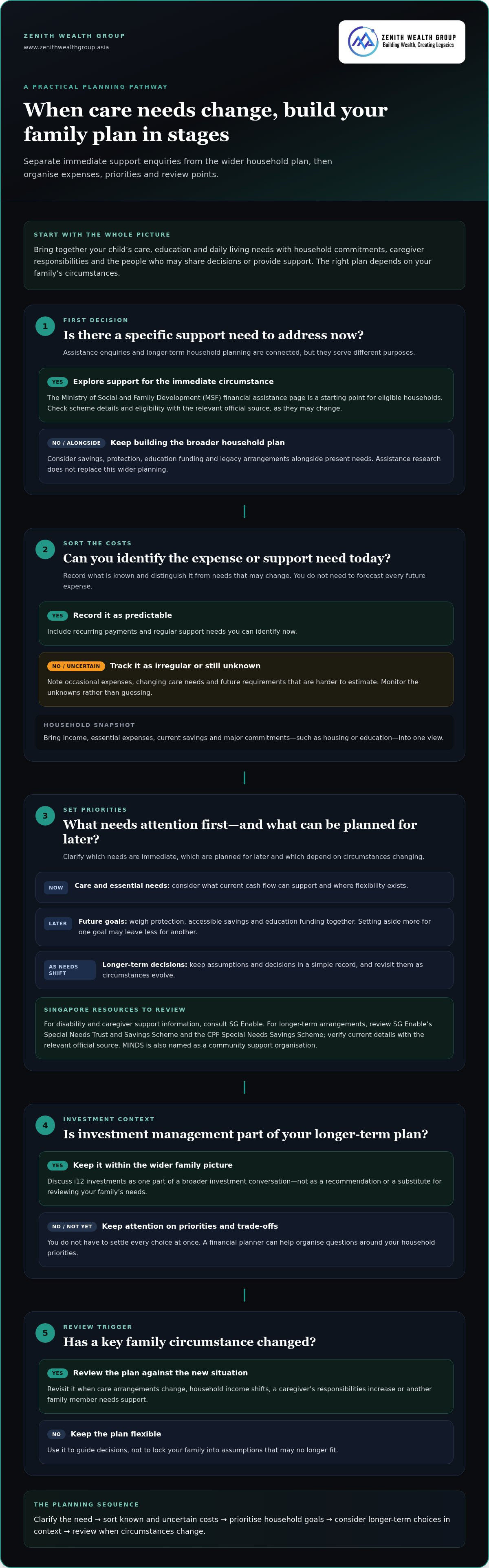
Once you have a clearer picture of your family’s needs, build the plan in stages: understand care requirements, review household finances, prioritise resilience, then consider future goals. This sequence connects day-to-day decisions with longer-term planning without assuming every family needs the same arrangements.
A flexible plan isn’t a sign that you’re unprepared; it’s how you stay prepared as your family’s needs evolve. Review it when care arrangements change, household income shifts, a caregiver’s responsibilities increase or another family member needs support. A plan should guide decisions, not lock your family into assumptions that no longer fit.
Review cash flow, savings, and family commitments
Map household finances in one place. Note income, essential expenses, current savings and major commitments, such as housing or education. Then divide expenses into two groups:
- Predictable: recurring payments and regular support needs you can identify today.
- Uncertain or irregular: occasional expenses, changing care needs and future requirements that are harder to estimate.
You don’t need to guess future costs. The aim is to see what current cash flow can support, where flexibility exists and which unknowns need monitoring. For Singapore-specific information about tools that may support longer-term arrangements, review SG Enable’s Special Needs Trust and Savings Scheme and verify current details with the relevant official source.
Set priorities for protection and future funding
Next, consider how wealth protection, accessible savings and education funding fit together. Setting aside more for one goal may leave less for another, so clarify which needs are immediate, which are planned for later and which depend on circumstances changing. You don’t have to settle every choice at once. A financial planner can help you organise the trade-offs around your household’s priorities.
If education is part of your plan, the existing Education Funding in 2026 guide can help you consider that goal alongside other family commitments. Investment management may also form part of a longer-term plan. Treat references to i12 investments as one part of a wider investment discussion, not as a recommendation or a substitute for reviewing your needs.
Keep a simple record of your assumptions and decisions, then revisit it as your family’s circumstances change. To turn those priorities into a coordinated plan, discuss your family’s financial planning priorities.
Compare protection, savings, and investment choices for your family
Each part of a family’s financial plan has a different job. Comparing purpose, access and time horizon can help you decide which questions to discuss first. This isn’t a product recommendation: suitability depends on your household circumstances, goals and comfort with risk. Good financial advice for families with special needs children in Singapore considers how these choices fit together, rather than treating them as isolated decisions.
| Approach | Purpose | Access and time horizon | Uncertainty it may help address |
|---|---|---|---|
| Protection | Review how existing arrangements relate to the family’s financial responsibilities. | Access depends on the terms of each arrangement; review it against current needs. | Financial strain if circumstances affect a family member’s ability to provide or earn income. |
| Liquid savings | Keep funds available for planned or unexpected household needs. | Generally intended to be accessible, subject to account conditions; often serves nearer-term needs. | Irregular expenses or changes that require funds sooner than expected. |
| Long-term investing | Support goals with a longer time horizon. | Values can fluctuate, and access may involve selling investments; consider the intended timeframe. | Uncertainty about how to build resources for goals further ahead. |
| Legacy planning | Clarify future intentions for family arrangements and assets. | Concerns future arrangements; timing and access depend on the choices made. | Uncertainty about how your intentions may be understood or carried forward. |
When protection and accessible savings deserve attention
Review existing insurance and other protection arrangements alongside your household’s responsibilities. Note what you have, what each arrangement is intended to address and whether that purpose still reflects your circumstances. Individual terms differ, so don’t assume a particular level of cover or benefit suits your family.
Keep the purpose of savings clear, too. Funds set aside for near-term needs are different from money intended for a goal years away. Balancing access with future funding can help you avoid treating every dollar as available for the same purpose.
How to assess long-term investments and legacy planning
For long-term investments, start with the goal and the time available. Consider how diversification and your comfort with risk fit your circumstances, and remember that investment values can rise or fall. If discussing i12 investments, treat the name as a contextual reference, not as a performance claim or recommendation.
Legacy planning is a conversation about future arrangements and what matters to your family. Explore the existing Wealth Protection and Legacy Planning guides as you consider these topics. A financial planner can help connect them with your wider priorities.
Plan caregiver continuity and important family decisions in Singapore
A family plan is more useful when trusted people can understand the essentials if a caregiver’s circumstances change. You don’t need to predict every possibility. Instead, make key information easier to find, discuss responsibilities early and record what matters to your family.
Organise information and discuss responsibilities
Start with a continuity checklist. Keep information organised and accessible only to appropriate people, while respecting your family’s privacy.
- Contacts: List key family members, caregivers and relevant care or education contacts, with their roles.
- Responsibilities: Note who currently handles appointments, daily support, payments and important decisions.
- Financial information: Record where key account and insurance information can be found, without sharing access more widely than needed.
- Preferences: Write down your child’s routines, support needs and family priorities that you’d want others to understand.
- Questions and next steps: Capture unresolved concerns and identify who should join future family discussions.
Then talk with the people involved. Clarify who may take on particular responsibilities if a caregiver becomes unavailable, and what might need to change if a family member’s health, work or living arrangements shift. These conversations can reveal gaps while there’s time to consider them together.
Understand Singapore support and estate-planning conversations
For disability-related information and caregiver resources, SG Enable is a useful starting point. Its resources can help you explore support options, while your family’s continuity plan sets out how responsibilities and financial information can be understood in your circumstances.
Estate planning can be part of this discussion. Consider what you want future arrangements to reflect and which questions need professional input. Legal and administrative arrangements depend on individual circumstances and current Singapore requirements. Before acting, verify legal details with an appropriately qualified Singapore legal professional. A financial planner can help organise related financial priorities, while legal advice should address legal questions.
Good financial advice for families with special needs children in Singapore can connect caregiver continuity with protection, future funding and legacy planning. If investments such as i12 investments are part of your wider financial picture, include them in the discussion without assuming they resolve care or legal arrangements.
Bring your checklist and questions into a planning conversation. Discuss your family’s continuity planning and the financial priorities you want to organise.
How a financial planner can help your family take the next step
After gathering information about your family’s needs, a financial planner can help connect priorities that may otherwise feel separate. Protection, future funding and legacy planning each serve a different purpose, but decisions in one area can affect the others. A planning conversation can help you review what’s already in place, identify questions and decide which steps deserve attention first. It won’t predict every change in your child’s needs, but it can give your family a clearer framework for decisions as circumstances evolve.
What to prepare for a financial planning conversation
You don’t need a perfect set of records. A high-level overview is enough to begin. Consider bringing:
- A household budget showing income, regular commitments and savings priorities.
- Details of existing policies and financial arrangements, so you can discuss their purpose and how they fit your current responsibilities.
- A short list of family goals, concerns and questions about future care, education funding or caregiver continuity.
Include caregivers who should be part of the discussion, where appropriate. The first conversation is a chance to organise priorities and agree on practical next steps, not to forecast every outcome or settle every decision at once.
How Zenith Wealth can support broader planning goals
Zenith Wealth is based in Singapore and provides personalised financial planning across life stages. Its representatives operate as authorised representatives of finexis advisory Pte Ltd. For families, a planning discussion can bring relevant areas into one view, including wealth protection, education funding, investment management and legacy planning.
This joined-up perspective matters. For example, a family may want to consider how current protection arrangements relate to future funding goals, while also thinking about how its intentions can be carried forward. The right priorities depend on your circumstances, goals and comfort with risk. If investments such as i12 investments come up, consider them within the wider financial plan, not as a standalone answer to care or legacy questions.
Financial advice for families with special needs children in Singapore should make room for the child’s needs and the resilience of the whole household. A financial planner can help you turn the information you’ve gathered into questions, compare priorities and map out a considered next step.
Ready to organise your family’s financial priorities? Speak with Zenith Wealth about your planning goals.
Take the next step toward a plan that can adapt
A clearer plan starts with understanding your family’s current needs, household finances and caregiving responsibilities. From there, weigh protection, accessible savings, future funding and legacy priorities without assuming every need can be predicted in advance. Reviewing those decisions as circumstances change can help keep the plan relevant.
Thoughtful financial advice for families with special needs children in Singapore considers the child’s long-term care alongside the wellbeing and goals of the whole household. A financial planner can help organise those priorities, including how wealth protection, education funding, investment management and legacy planning fit together. Any discussion of i12 investments belongs within that broader context.
Zenith Wealth Group is based in Singapore, and its representatives are authorised representatives of finexis advisory Pte Ltd. To discuss your family’s financial priorities and possible next steps, connect with Zenith Wealth Group. Start with the questions you have today. A considered conversation can help you move forward with greater clarity.
Frequently Asked Questions
How can I financially plan for a child with special needs in Singapore?
Start by mapping your child’s current care, education, daily living and support needs, then review household income, expenses, savings, protection and other dependants. Separate known recurring needs from uncertain future ones. Financial advice for families with special needs children in Singapore should consider the whole household, not just one expense or scheme. Revisit priorities when care arrangements, income or caregiver responsibilities change, and verify scheme details with official Singapore sources.
What financial assistance is available for families with special needs children in Singapore?
Singapore families can explore MSF’s financial assistance information, including ComCare Assistance schemes administered by Social Service Offices. SG Enable provides disability-related support information, while the Special Needs Trust Company and CPF Special Needs Savings Scheme relate to longer-term financial arrangements. Support and eligibility depend on the scheme and individual circumstances. Check current details and application steps directly with the relevant official organisations.
How much should I save for my child’s future care?
There isn’t one savings amount that suits every family. Begin by listing known recurring expenses, such as current care or education commitments, alongside irregular costs and needs that remain uncertain. Then review what your household can set aside without overlooking essential expenses, other dependants or accessible savings. Treat the figure as a working estimate, not a prediction. Update it as your child’s needs, family income and caregiving arrangements change.
Can I use insurance and investments to support my child’s future?
Insurance and investments may form part of a broader plan, but their suitability depends on your circumstances, goals and comfort with risk. Review existing policy terms and intended purposes rather than assuming what a policy will cover. For investments, consider the time horizon, diversification and the possibility that values can fluctuate. i12 investments may be discussed as a contextual investment reference, not as a guaranteed outcome or recommendation.
What happens if a parent or caregiver can no longer provide support?
Prepare by recording key contacts, caregiving responsibilities, important financial information and your family’s preferences. Discuss who may need to be involved if a caregiver’s circumstances change, and identify questions about future support or decision-making. Families may also explore arrangements such as the CPF Special Needs Savings Scheme or a Special Needs Trust. The right approach depends on individual circumstances, so verify current scheme details and seek Singapore-specific professional guidance on legal arrangements.
When should I speak with a financial planner about my child’s future?
You can speak with a financial planner when you’re organising priorities, reviewing existing arrangements or responding to a change in care, income or caregiver responsibilities. Bring a high-level household budget, relevant policy details and questions about future needs. The conversation can help connect protection, education funding, investment management and legacy planning, without requiring you to predict every outcome. Zenith Wealth Group is based in Singapore, and its representatives are authorised representatives of finexis advisory Pte Ltd.


