

Supporting your parents shouldn’t mean putting your own future on hold. If you’re asking how to financially support aging parents in Indonesia, the answer isn’t simply to send more money each month. Start by understanding what they need and what you can sustainably contribute.
That can feel difficult when daily expenses shift, healthcare needs change, and siblings have different capacities to help. You want your parents to feel secure, but regular support can also compete with your savings and retirement plans.
This guide will help you build a monthly plan around your parents’ needs, agree on family contributions, and protect your long-term financial resilience. You’ll also see how parent support can fit into a wider financial plan alongside retirement planning, wealth protection, and conversations involving i12 investments. The aim is to make support predictable, shared, and sustainable.
Key Takeaways
- Learn how to financially support aging parents in Indonesia by understanding their income, essential spending, and care needs.
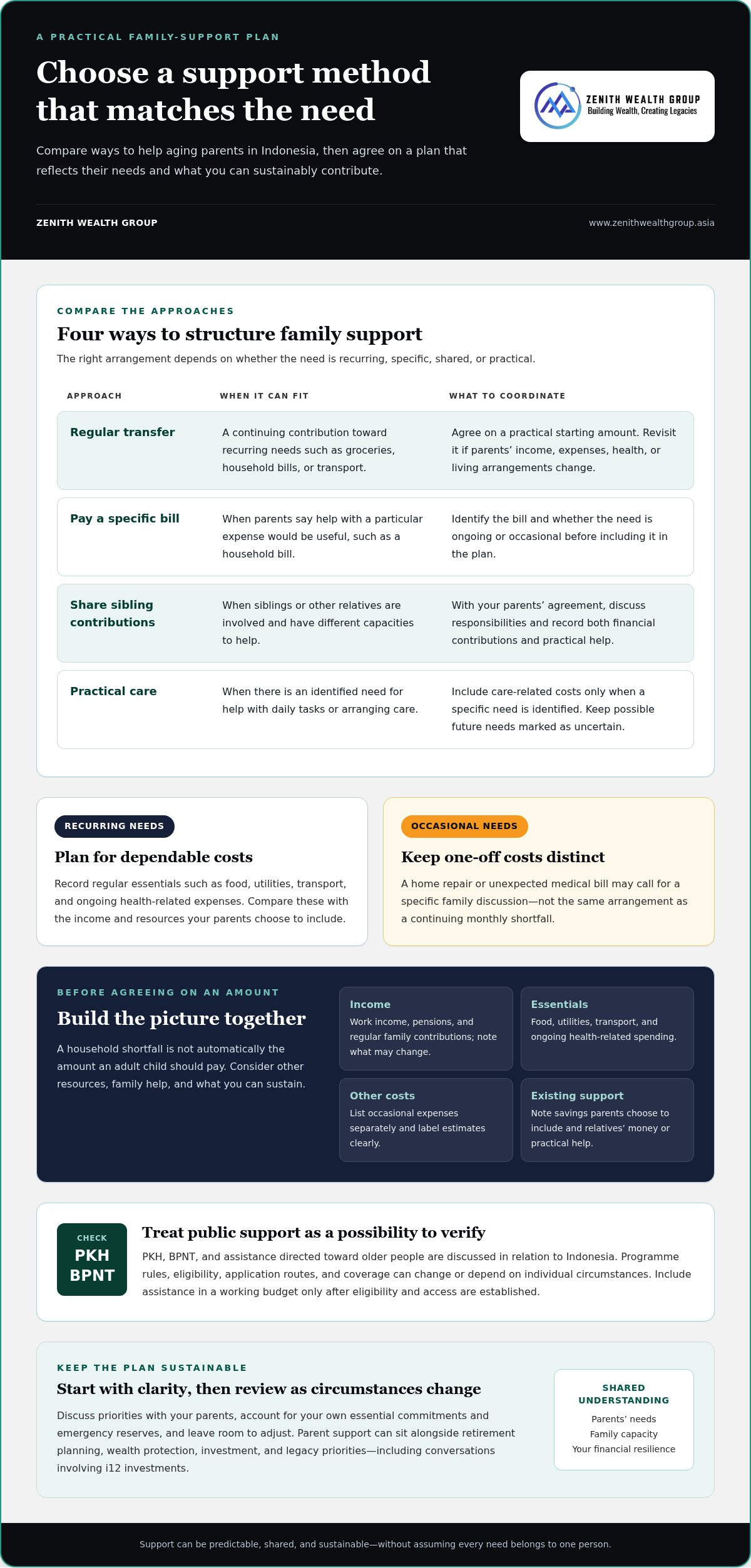
- Compare regular transfers, direct bill payments, shared sibling contributions, and practical care to find an approach your family can coordinate.
- Choose a sustainable support amount that accounts for your own essential commitments and emergency reserves, then review it as circumstances change.
- Connect family support with your wider retirement, wealth protection, investment, and legacy priorities, including discussions involving i12 investments.
- See how a financial consultant or financial planner can help you consider parent support within your broader financial plan.
Why Financially Supporting Aging Parents in Indonesia Needs a Plan
Wanting to help a parent is natural. Working out what they need, how often they’ll need it, and what you can afford is less straightforward. A regular transfer may cover groceries this month, while a change in health or living arrangements could alter the budget. That uncertainty doesn’t mean you should avoid helping. It means support works better when it’s discussed and planned.
A sustainable contribution reflects your parents’ actual needs and fits alongside your essential commitments. Leave room for housing, dependants, savings goals, and financial resilience. You don’t need to promise the same amount forever. Agree on a practical starting point and revisit it when circumstances change.
Family involvement may be part of the plan, but families don’t have to assume they’ll meet every need alone. Public support may also be relevant. Start by understanding your parents’ circumstances and what support they can access, rather than assuming family must cover everything or that outside assistance will meet every need.
What financial support can include
Separate regular living costs from occasional expenses. Recurring items might include groceries, household bills, or transport. Less predictable needs could include medical expenses or home repairs. Add practical care costs only when you’ve identified a specific need, such as help with daily tasks. This distinction makes it easier to see what requires dependable monthly support and what calls for a separate family discussion.
Needs can change with health, income, or living arrangements. Review the plan periodically, and sooner if there’s a major change. Don’t budget for a possible future care expense as if it were already certain. Note it as a possibility to discuss and plan for if it becomes relevant.
Start with a respectful conversation about needs
With your parents’ agreement, ask about their priorities, regular income, savings, and any support they already receive. Then ask what kind of help would feel useful. They may prefer assistance with a specific bill, help arranging practical care, or a contribution they can manage themselves. Listen before suggesting a solution: support based on assumptions can miss what matters most to them.
Money can be sensitive, so you don’t have to settle everything in one conversation. Begin broadly, then return to details when everyone is ready. If siblings or other relatives are involved, invite them into the discussion with your parents’ agreement. A shared understanding of needs gives everyone a clearer basis for discussing responsibilities.
If you’re considering how to financially support aging parents in Indonesia, start with clarity rather than a fixed promise. Write down what’s known, what still needs discussion, and what your parents say would help. That gives the family a respectful foundation for deciding what’s practical while leaving room to adapt.
Assess Your Parents’ Income, Care Needs, and Support Options in Indonesia
Before deciding what to contribute, build a clear picture of your parents’ household finances. A shortfall is the difference between their available income and resources and the expenses they need to meet. It isn’t automatically the amount an adult child should pay. Consider any gap alongside other family contributions, possible public support, and what you can sustainably afford.
Build a clear picture of the household cash flow
With your parents’ agreement, make a simple record of money coming in and going out. Group items so regular commitments don’t get mixed up with occasional needs:
- Recurring income: Record sources such as work income, pensions, or regular family contributions. Note whether each is stable or may change.
- Essential recurring spending: List regular costs, including food, utilities, transport, and ongoing health-related expenses.
- Occasional expenses: Note costs that arise irregularly, such as a home repair or unexpected medical bill. Keep these separate from monthly spending.
- Care-related needs: Include practical or paid care when there’s an identified need. Mark possible future needs as uncertain rather than treating them as current expenses.
- Savings and existing support: Discuss savings your parents are comfortable including in the plan. Record what siblings or other relatives already contribute, in money or practical help.
Compare the resources your parents choose to use with their essential expenses. If their income covers regular needs but not an occasional cost, that calls for a different conversation than a continuing monthly gap. For example, a one-time home repair may require a specific family contribution, while a recurring shortfall calls for a sustainable arrangement that can be reviewed. Different households may need different solutions.
Use actual records where available, and label estimates clearly. For expenses in Indonesia, work in rupiah when the figures are reliable rather than filling gaps with generic “typical” costs. A clear record is more useful than a precise-looking budget built on guesses.
Consider public support without relying on assumptions
Public assistance may be one part of the household picture, alongside your parents’ own resources and family help. Programmes discussed in relation to Indonesia include PKH, BPNT, and assistance directed toward older people. Programme names, eligibility rules, application routes, and coverage can change or depend on individual circumstances. Establish the current details before including any benefit in a working budget.
Don’t treat a programme name as proof that your parents qualify, have applied, or will receive support. Include assistance in the budget only once eligibility and access are established. This helps you avoid building a family contribution plan around money that may not arrive. Public support and family planning can coexist; identifying one doesn’t mean the other is unnecessary.
Once you’ve organised the figures, you’ll have a stronger basis for discussing the gap and possible responsibilities. If you’d like to connect family commitments with your wider financial priorities, you can discuss your financial planning priorities.
Compare Ways to Support Parents Without Straining Your Own Finances
Once you understand what help is needed, choose a contribution method that suits the expense and your parents’ preferences. A reliable arrangement should be clear to everyone involved, but it doesn’t have to look the same for every family. Some parents may value a regular transfer they can manage themselves. Others may prefer a specific bill to be paid or practical help with appointments and daily tasks.
Use predictable recurring support for ongoing needs and one-off help for occasional expenses. Don’t let an exceptional payment quietly become a permanent commitment. Keeping these categories distinct helps you avoid expecting a regular contribution to cover every unexpected cost.
Choose a contribution method that fits the need
Match the method to the purpose. If your parents have a clearly identified, continuing shortfall, a recurring contribution can make household planning more predictable. Agree on what it is intended to cover and when you’ll review it. A set transfer is straightforward, though it gives your parents discretion over how to use the money.
Paying an agreed expense directly can make its purpose easier to track. It may suit a family that wants to cover a particular bill, but it’s less flexible if your parents would rather decide how to use the support. Ask what works for them, and clarify whether the payment replaces or supplements other help.
Practical care can also be a meaningful contribution. Helping with errands, transport, or appointments may address a real need without adding a cash transfer. But time has value too: be realistic about what you can reliably provide alongside work, caregiving, and your other commitments. Treat a specific one-off payment or task separately from any ongoing promise.
Agree on a fair and workable family arrangement
Fair doesn’t always mean equal. Siblings may have different incomes, responsibilities, locations, or capacity to provide hands-on help. Discuss what each person can sustain instead of setting identical cash amounts by default. One relative might contribute financially while another handles a practical task, if your parents are comfortable with that arrangement.
Make the agreement concrete. Record who is contributing, what each contribution covers, when it will be provided, and when the family will review the plan. A shared note can prevent misunderstandings, especially if one person pays a bill directly while another provides a regular transfer.
Agree on how to raise changes, too. If someone’s income or responsibilities shift, invite an early conversation rather than letting a missed contribution become a source of blame. Keep your parents involved in decisions about support that affects them. The aim is a workable arrangement, not a scorecard.
If you’re weighing family support against other financial priorities, a conversation about your broader financial planning can help put those responsibilities in context.
Create a Sustainable Parent-Support Budget and Review It Regularly
A family support plan needs two budgets in view: what your parents need and what you can provide without putting your own finances under pressure. Treat the first contribution as a starting point, not a permanent promise. A clear process can help you adjust support as circumstances change while keeping your other priorities in view.
Work through these steps:
- Define the need: Separate ongoing essentials from occasional expenses and possible future care needs. Base the plan on what’s known today.
- Set a sustainable amount: Decide what you can contribute after accounting for your own cash flow, commitments, and reserves.
- Agree responsibilities: Clarify which relatives will provide money or practical help, and what each contribution covers.
- Choose a review point: Agree when you’ll revisit the arrangement and what changes should prompt an earlier conversation.
Set a support amount that fits your own cash flow
Start with your take-home resources, then account for essential obligations such as housing, debt repayments, dependants, and regular bills. Set aside money for near-term needs and emergency reserves before deciding what remains available for parent support. Your contribution should reflect your actual capacity, not an amount chosen out of guilt or pressure.
Be cautious about borrowing to maintain a commitment you can’t sustain from your regular cash flow. If your circumstances change, discuss an adjustment early rather than letting an unrealistic promise weaken your financial resilience. Your parents’ needs matter, as do your essential obligations and long-term goals. If retirement is one of those goals, consider how ongoing family support affects your savings plan and timeline.
For support sent from Singapore to parents in Indonesia, plan around your budget in Singapore dollars and your parents’ expenses in rupiah. Decide how often you’ll send support and how you’ll account for timing or exchange-rate changes. Don’t assume a particular transfer cost or rate; focus on the amount you can commit to and how you’ll keep the arrangement manageable. Families with ties across Singapore, Indonesia, Malaysia, the Philippines, and Thailand can use the same principle: plan in the currency and context of the household receiving support.
Build review points into the family arrangement
Choose a regular time to review the plan, and revisit it sooner if your parents’ health, income, care needs, or household circumstances change. Keep a simple record of what was contributed, what it covered, and any responsibilities family members agreed to take on. This helps everyone see whether the arrangement still matches current needs and capacity.
A review isn’t a sign that support has failed. It’s a chance to make a thoughtful adjustment. Your contribution may increase, decrease, or change form as circumstances evolve. Include your own long-term priorities, including retirement planning, so support for your parents sits within a broader financial plan rather than displacing it.
If you’d like to discuss how family responsibilities fit with your financial priorities, speak with a financial consultant.
Bring Parent Support Into Your Wider Financial Plan
Helping your parents is one part of your family’s financial picture, not a reason to set aside every other goal. A contribution that feels manageable now can become harder to maintain if it grows without a clear purpose or review point. An open-ended promise may also compete with retirement savings, protection needs, or responsibilities to other dependants. Plan support alongside these priorities so you can see how they affect one another.
Balance family responsibilities with long-term goals
Review parent support when you assess your own retirement planning and wealth protection. Ask whether the contribution leaves room for essential commitments, emergency reserves, and longer-term needs. If you have dependants, include their needs in the same conversation. This isn’t about ranking one generation above another; it’s about understanding what you can sustain and making commitments with care.
Investment and legacy priorities also belong in the wider discussion. Consider how regular support fits with your plans, but don’t assume an investment will produce a particular return or be suitable for funding family expenses. i12 investments can form part of a broader financial conversation without being treated as a guaranteed solution or a substitute for a clear household support plan.
A financial consultant or financial planner can help you consider these responsibilities together. The discussion can include how parent support relates to retirement, wealth protection, investment management, and legacy planning. The goal is to understand the trade-offs and make informed choices, not to promise a particular outcome.
Turn a family decision into a practical next step
Put the family arrangement into a short written summary. Include:
- Your parents’ current needs and any uncertainty that still needs attention.
- The chosen form of support, such as a recurring contribution, a specific expense, or practical help.
- Who is responsible for each agreed contribution or task.
- The date or circumstances for reviewing the arrangement.
This record gives everyone a shared reference point. It can also help you see whether the commitment still fits your financial plan when your income, responsibilities, or parents’ needs change. Keep the plan flexible enough to adapt, but clear enough that no one has to guess what was agreed.
Understanding how to financially support aging parents in Indonesia means considering both the help your parents need and the future you’re working to protect. If you’re ready to put those responsibilities in context, discuss your financial-planning priorities with a financial consultant or financial planner.
Make Your Next Step a Clear One
A family support arrangement can evolve as your parents’ needs and your own responsibilities change. Treat it as a continuing conversation, not a decision you have to get perfect today. Bring your family commitments into the same view as the goals you’re building for yourself.
If you’re weighing how to financially support aging parents in Indonesia, consider how that responsibility fits alongside your longer-term priorities. Zenith Wealth serves clients across Indonesia and other Asian markets, with planning that includes retirement, wealth protection, investments, and legacy planning. A financial consultant or financial planner can help you explore how these priorities relate, without assuming one approach suits every family.
Take the next step at your own pace. Discuss how family responsibilities fit your financial plan and bring your questions to a broader planning conversation. With a thoughtful plan, you can support your parents while continuing to build a resilient future for yourself.
Frequently Asked Questions
How much should I give my parents each month in Indonesia?
There’s no standard amount that suits every family. Start with your parents’ essential monthly needs, their available resources, and any existing help. Then decide what you can contribute after accounting for your own commitments. If you earn and budget in Singapore dollars while your parents spend in rupiah, consider the amount they’ll receive after currency conversion. Choose a figure you can maintain, not one based on comparison or guilt.
Can I financially support my parents while saving for my own retirement?
Yes, if the support fits alongside a realistic retirement-saving plan. Treat both as commitments in your personal cash flow. For example, decide what retirement contribution you can maintain, then assess what remains for parent support after essential expenses and reserves. If the figures don’t fit, discuss a different support method or shared arrangement with family. A financial planner can help you consider these priorities together without assuming a particular outcome.
What government assistance may be available to older people in Indonesia?
PKH, BPNT, and assistance directed toward older people are programmes discussed in relation to Indonesian support, but current names, eligibility, application routes, and coverage need to be established. Don’t count a possible benefit as household income until your parents’ eligibility and access are confirmed. If they receive support, record what it covers and whether it is regular, so the family can plan around verified resources rather than assumptions.
How can siblings share the cost of supporting ageing parents?
Agree on contributions by discussing each person’s capacity and the kind of help your parents value. Equal cash shares may not reflect differences in income, caregiving time, or other responsibilities. For example, one sibling might cover an agreed expense while another provides practical help, if that suits the family. Write down each person’s role and how changes will be raised. Include your parents in decisions that affect their care and independence.
What is the best way to send regular financial support to parents in Indonesia?
The best method is one your parents can access reliably and that your family can track. Agree on the recipient account, timing, and purpose, then keep a record of each transfer. If you’re sending money from Singapore, compare the amount your parents receive after currency conversion and any applicable charges using the terms available to you. Don’t assume exchange rates or fees will stay constant, and revisit the method if access or circumstances change.
Should I pay my parents’ bills directly or send them money?
Pay a bill directly if your parents prefer that and the expense is clearly agreed. It can make the payment’s purpose easy to document. Send money if they value flexibility and want to decide how to allocate it. Either option can work. Before choosing, discuss their preference, how the contribution fits with help from other relatives, and how you’ll confirm that the intended need is covered without making your parents feel monitored.
How often should we review a financial support plan for ageing parents?
Set a review date that works for the family, then bring the discussion forward if there’s a meaningful change. A parent’s health, income, living arrangement, or access to care may affect what support is useful. Your own finances can shift too, such as after a change in work or household responsibilities. Keep a brief record of decisions and update it after each review so everyone knows which arrangement is current.


