

Financial peace of mind doesn’t come from knowing exactly what the future holds. It comes from being clearer about what matters now and how your choices support it. That’s the idea behind peace of mind financial planning Malaysia: uncertainty won’t disappear, but a considered plan can help you connect decisions with your priorities.
It’s understandable to wonder whether your spending, saving and investment choices are moving you towards the future you want. Retirement, family needs and legacy goals can feel like separate concerns, especially when professional advice seems complex or product-focused. A useful plan starts with your circumstances and priorities, not assumptions about what you should choose.
This article explains how to organise financial decisions around your goals, consider Malaysia-related factors and identify a practical next step. You’ll see how retirement planning, education funding, wealth protection, investment management and legacy planning can fit into a broader picture, including where i12 investments may come into the investment discussion. The aim isn’t certainty. It’s a clearer way to assess your options and begin a grounded conversation with a financial consultant, whether your financial life is centred in Malaysia or connected to Singapore, Indonesia, the Philippines or Thailand.
Key Takeaways
- Peace of mind financial planning Malaysia begins with linking money decisions to personal priorities, not trying to remove every uncertainty.
- Identify which planning areas matter to you, from retirement and education funding to protection, legacy and investment management.
- Clarify the scope of financial advice and the questions you want answered so discussions stay focused on your goals.
- Prepare for a practical review by listing your priorities, organising key financial information and choosing one next step.
- Learn how Zenith Wealth’s authorized Financial Consultants representing finexis advisory Pte Ltd [Reg No 200408660G] can help you begin the conversation.
How Peace of Mind Financial Planning in Malaysia Starts With Clarity
Financial uncertainty can make future decisions hard to organise. You may be weighing family needs against longer-term goals, or wondering whether today’s choices still fit the life you want. Peace of mind financial planning Malaysia is less about predicting what will happen and more about seeing your priorities clearly enough to decide what deserves attention first.
Financial planning is the process of organising money decisions to support personal goals over time. It can bring different priorities into one view and help you consider how they affect one another. For a foundational overview of what financial planning involves, see the general explanation of its scope and purpose. A plan can offer direction, but it can’t remove uncertainty or guarantee a particular outcome. It should guide choices, not pretend to predict the future.
What does peace of mind mean in financial planning?
Clarity starts with naming what matters. Is your main focus supporting your family, preparing for retirement, protecting what you’ve built, or making progress on several goals at once? Once you’ve listed your priorities, it becomes easier to identify which decision needs attention now and which can wait.
Confidence grows from understanding your options, their trade-offs and the next step you can take. For example, setting aside more for one goal may affect how quickly you progress towards another. A useful plan makes that choice easier to discuss and review. It doesn’t promise that every setback can be prevented. Instead, it helps you respond thoughtfully when circumstances or priorities change.
Why financial planning matters at different life stages
Your financial priorities can shift as life changes. During a period of career growth, you might focus on building savings and deciding how to manage investments. If family responsibilities grow, education funding or wealth protection may become more pressing. Later, your attention may turn to retirement income, legacy wishes or whether existing arrangements still reflect your plans.
These stages aren’t a fixed sequence, and your goals may overlap. Reviewing them together matters because a decision in one area can affect another. If you’re focused on later-life goals, a retirement planning guide can help you explore the questions to consider as you prepare.
Start with a simple personal check-in: write down the goals that matter, note any decisions you’ve been postponing and mark what has changed since you last considered them. If investment management is part of the picture, include i12 investments in the discussion without assuming that one approach suits everyone. This gives you a clearer starting point for assessing whether your current choices still reflect your priorities.
The Financial Planning Areas That Can Support Greater Confidence
Financial planning isn’t a checklist everyone needs to complete in full. Start by identifying the areas that connect to your circumstances and goals. For one person, that may mean working out how current cash flow supports longer-term plans. For another, it could mean reviewing debt commitments, preparing for retirement or thinking about how to provide for family.
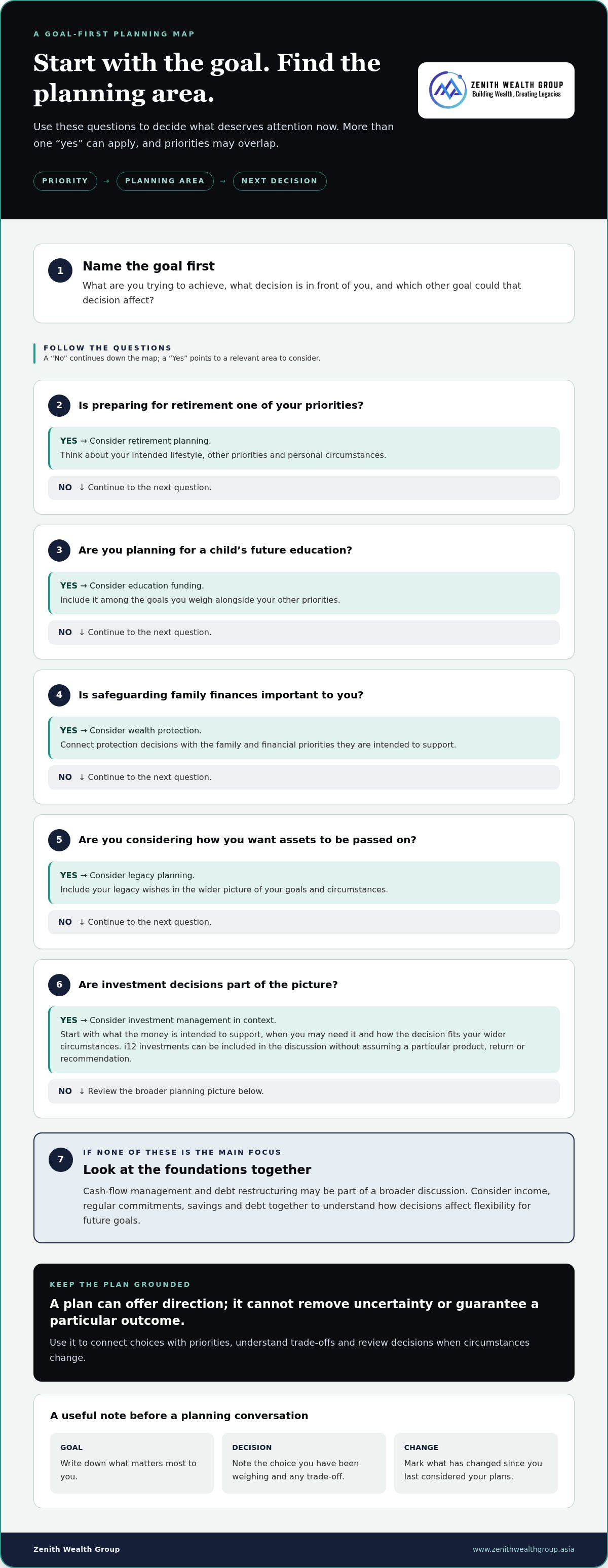
Cash-flow management and debt restructuring can also be part of a broader planning discussion. Looking at income, regular commitments, savings and debt together can help show how much flexibility you have for future goals. The point is to understand how decisions affect one another, not to assume every planning area applies to every reader.
Match planning areas to the goals that matter now
Begin with the goal, then consider which planning area may support it. Retirement planning, for instance, depends on your intended lifestyle, other priorities and personal circumstances. Parents may put education funding on the list as they think about a child’s future. Wealth protection may matter if safeguarding family finances is a priority, while legacy planning may be relevant if you’re considering how you want assets to be passed on.
These areas can overlap, but they don’t all need equal attention at once. To focus, ask yourself: What am I trying to achieve? What decision is in front of me? Which other goal could this decision affect? Your answers help distinguish an immediate priority from a topic to revisit later.
Map each goal to the planning area, decisions and next steps most relevant to your circumstances.
Connect investments with the rest of the plan
Investment decisions are easier to assess in context. Consider what the money is intended to support, when you may need it and how the choice fits your wider circumstances. A decision linked to a distant goal may raise different questions from one connected to a nearer-term need. Avoid judging an investment choice in isolation from the purpose it is meant to serve.
Where investment management is part of your priorities, i12 investments can be included in the discussion without assuming a particular product, return or recommendation. You can also explore an investment management guide to consider how portfolio decisions relate to your goals and time horizons.
To make the conversation clearer, note the goal behind each financial decision and any trade-off you’re weighing. If you’d like to discuss how these planning areas relate to your priorities, you can start a financial planning conversation.
How to Assess Financial Advice and Address Common Concerns
Advice can feel product-led if a conversation moves to a recommendation before your goals and the scope of the discussion are clear. Set the agenda first. Name the decisions you’re weighing, the goals you hope to support and any constraints or concerns you want considered. That gives you a basis for understanding whether the discussion is addressing your needs or moving into a different area.
In peace of mind financial planning Malaysia, suitability means considering how an option relates to your goals, time horizon and personal circumstances. It isn’t a promise that an option will deliver a particular result. Ask what a recommendation is intended to address, what trade-offs it involves and how it fits with your wider plan.
What should you understand before beginning a planning relationship?
Clarify what you want the conversation to cover: perhaps retirement planning, education funding, wealth protection or a decision involving investments. Zenith Wealth Group offers fee-based comprehensive financial planning and commission-based product intermediation. These are different service arrangements: one centres on comprehensive planning for a fee, while the other involves product intermediation with commission-based compensation. Understand which arrangement applies to the discussion and how its terms work before proceeding. Don’t assume a particular fee or product term.
Use questions that make the scope and next steps concrete:
- Which goals and decisions will the planning discussion cover?
- Is the conversation about comprehensive planning, product intermediation, or both?
- How does the service arrangement work, and when might product-related compensation apply?
- How will my circumstances, including Malaysia-related considerations, be taken into account?
- What options and trade-offs should I understand before deciding?
Clear answers help you follow the process without needing to know every technical term in advance.
Can financial planning help if you are not wealthy or near retirement?
Planning can start with the decision that matters at your current life stage. A parent might want to explore education funding; someone else may be thinking about wealth protection or how to begin preparing for retirement. There’s no single wealth threshold or life stage that makes these questions relevant. The right focus depends on your priorities and circumstances.
Use this comparison to shape a focused conversation. It’s a starting point, not a checklist that every reader needs to complete.
| Planning need | Possible financial consultant discussion | Question to clarify |
|---|---|---|
| Education funding | How a child’s future education goal fits alongside other priorities | What decisions need attention now? |
| Wealth protection | Which personal or family priorities you want to protect | What circumstances should the discussion account for? |
| Retirement planning | How your later-life goal relates to your current plans | What assumptions or trade-offs should I understand? |
Bring your questions and take time to understand the scope before making a decision. Whether you’re based in Malaysia or managing financial priorities across Singapore, Indonesia, the Philippines or Thailand, a clear process helps you assess advice by its relevance to your circumstances, not by promises of certainty.
A Practical Financial Planning Review for Malaysia-Based Readers
A useful review doesn’t need to begin with complex forecasts. Start with a clear snapshot of your finances and the decisions you want to make. This can help you spot what needs attention, what information is missing and which questions to bring into a planning conversation.
List your priorities, organise your financial information, identify gaps, choose one next action and set a point to review your choices.
- List your priorities. Write down near-term and longer-term goals in your own words. Keep the focus on what matters to you, such as supporting family plans, protecting your finances or preparing for retirement.
- Organise a current overview. Gather a general picture of income, regular commitments, savings, debt, existing protection and other financial arrangements. You don’t need to share sensitive personal information to begin reflecting on your finances.
- Identify gaps. Notice where details are unclear. You might need to understand how an existing arrangement relates to a goal, or whether a decision depends on current rules or eligibility details.
- Choose one next action. Pick a manageable step, such as clarifying an assumption, reviewing a commitment or preparing a question for a financial consultant. Focus on what you can investigate or decide now.
- Set a review point. Choose a time to revisit your priorities and information, especially if your circumstances or goals change. A review keeps the plan connected to your life rather than treating it as a one-time document.
What information helps you see your financial picture?
Keep your preparation practical. Note broad income sources, regular commitments, savings, debt, protection arrangements and the financial goals you’re working towards. Record goals in plain language, then distinguish those you hope to address sooner from those that sit further ahead. This overview is for your own review; avoid putting account numbers, identity details or other sensitive information into an article comment or public form.
Look for connections, too. A regular commitment may affect how much flexibility you have for another goal. An existing arrangement may already relate to a priority you’ve listed. The aim is to prepare useful context, not to reach conclusions before you understand your options.
Which Malaysia-related details deserve careful checking?
Rules, tax treatment, residency circumstances and retirement arrangements can depend on current requirements and personal details. Before relying on information about EPF (KWSP), check the relevant current guidance from EPF itself. For financial-sector or investment-related rules, consult official information from Bank Negara Malaysia or the Securities Commission Malaysia where relevant. Verify rules, products and eligibility with current official sources rather than relying on an outdated summary.
If your circumstances involve more than one country, flag that for discussion. Cross-border details may shape which questions deserve attention, but don’t assume a particular legal or tax result without checking the applicable facts. If your financial priorities span Malaysia, Singapore, Indonesia, the Philippines or Thailand, identify where each relevant arrangement is based and what you need to clarify. This helps make peace of mind financial planning Malaysia more grounded in your actual situation.
Ready to organise your questions around your goals? Start a financial planning conversation with Zenith Wealth Group.
How Zenith Wealth Helps You Begin Financial Planning
Starting a financial planning conversation can feel simpler when it begins with your priorities, not assumptions about what you should do. Zenith Wealth Group is a Singapore-based financial advisory firm serving individuals across regional markets, including Malaysia. Its representatives are authorized Financial Consultants representing finexis advisory Pte Ltd [Reg No 200408660G].
For readers considering peace of mind financial planning Malaysia, an initial conversation is a way to explore whether the planning relationship fits their needs. You don’t need to have every goal or question perfectly organised before taking that step. Begin with what matters to you and the decisions you’re considering. Planning can offer clearer direction, but no conversation can promise a particular financial result or remove every uncertainty.
What happens in the free discovery session?
The free discovery session lasts 30 minutes and is intended to help match you with a consultant. It’s an opportunity to begin the conversation and consider who may be a suitable fit for your planning needs. Its purpose is matching, not a promise that a complete financial plan or specific outcome will be delivered during the session.
To make the time useful, reflect beforehand on what prompted you to explore planning. Perhaps you’re thinking about retirement, a family goal, wealth protection or another financial decision. Bring the question that feels most important. It’s fine if your priorities are still taking shape; the session is an approachable first step, not a test of how much you already know.
The next step is yours to consider. A discovery conversation lets you begin without requiring you to have settled every decision in advance. Keep your expectations grounded: the session is intended to match you with a consultant, while planning choices and outcomes depend on your individual circumstances.
Continue learning about long-term financial goals
If you’d rather explore a resource at your own pace, Zenith Wealth Group offers the free, practitioner-written guide “THE W.E.A.L.TH. SYSTEM: How To Build Generational Wealth Without Affecting Your Current Lifestyle”. It can be a starting point as you reflect on longer-term goals and the questions you’d like to discuss.
Amanda Lee, a 42-year-old Marketing Manager in Singapore, praises the guide for offering simple, practical steps to build wealth without changing lifestyle. Her comment reflects her experience with the resource; it isn’t a promise that every reader will have the same experience or achieve a particular outcome.
You can take either step at your own pace: prepare a question for a conversation or spend time with the guide. If you’re ready to begin, book your free 30-minute discovery session with Zenith Wealth Group.
Take the Next Step With Your Priorities in View
You don’t need to resolve every financial question before beginning. Choose one decision that matters to you and use it as the starting point for a thoughtful conversation. As your circumstances shift, your priorities may change too. A useful plan can be revisited and adjusted, helping you make decisions with greater intention without treating the future as certain.
That’s the practical value of peace of mind financial planning Malaysia: not a guarantee that everything will go to plan, but a clearer way to connect your choices with what matters to you. Bring the question you’ve been carrying, even if you’re still working out how to phrase it.
Zenith Wealth Group’s representatives are authorized Financial Consultants representing finexis advisory Pte Ltd [Reg No 200408660G]. If you’re ready to explore a conversation, book your free 30-minute discovery session, which is intended to match you with a consultant. Take the first step at your own pace. A clearer direction can begin with one honest question.
Frequently Asked Questions
Is financial planning only for wealthy people in Malaysia?
No. Financial planning can help you think through decisions at different income and life stages; you don’t need to meet a wealth threshold to start. For example, someone early in their career might want to understand how current commitments affect a future goal, while a parent may be considering education funding. Peace of mind financial planning Malaysia can begin with one practical question, not a large portfolio or a fully formed plan.
Can financial planning help if my income or goals change?
Yes. A plan can be revisited when your circumstances change, such as moving into a new role, starting a family or taking on a new financial commitment. Note what has changed and which goals it may affect. For example, if income becomes less predictable, you could review whether the timing of a planned expense still feels manageable. A financial consultant can help you consider adjustments in light of your priorities.
How often should I review my financial plan?
There’s no single review schedule that suits everyone. Set a reminder that feels manageable, and revisit your plan when a major life or financial change occurs. You might review it after a change in work, family responsibilities or a significant goal. At each check-in, ask whether your priorities still feel right, whether any assumptions have changed and whether your next action remains practical. Update the plan when the answers point to a change.
What should I prepare before speaking with a financial consultant?
Bring a short list of questions and a broad picture of your finances, such as income sources, regular commitments, savings, debt and existing arrangements. Add a note about what you hope to decide, such as whether to prioritise a family goal or retirement preparation. You don’t need to share account numbers or identity documents in an initial discussion. If a detail is uncertain, mark it as a question rather than guessing.
Can financial planning cover Malaysia and overseas financial considerations?
A planning discussion can include circumstances connected to more than one country, but the relevant rules depend on individual details and should be checked with current official sources. If you have financial ties across Malaysia, Singapore, Indonesia, the Philippines or Thailand, note where each relevant arrangement is based and what question you need answered. Don’t assume one country’s tax, residency or retirement rules apply in another.
Does financial planning guarantee investment returns or a stress-free future?
No. Financial planning can help you examine choices and prepare for decisions, but it can’t guarantee investment returns or prevent every setback. Treat projections and expectations as assumptions to understand, not promises. Before acting, make sure you understand what a proposed choice is intended to do, what uncertainty remains and how it relates to your goal. A financial consultant can help you discuss those considerations without promising a specific outcome.
What is the difference between financial planning and choosing an investment?
Financial planning considers how different money decisions relate to your goals, while choosing an investment is a decision within that broader picture. For example, a portfolio choice should be considered in light of the goal it is meant to support and when you may need the money. You can include i12 investments in an investment-planning discussion without assuming any particular product or recommendation is right for you.


