

What if the right education fund isn’t a fixed savings target, but a plan that can change as your child’s options become clearer? Working out how to build an education fund in Singapore can feel difficult when the future study route is uncertain and household priorities compete for each dollar.
That uncertainty is normal. You don’t need to predict every detail today. You need a starting target based on your family’s assumptions, a contribution amount that fits your budget, and a routine for reviewing the plan as circumstances change.
This guide walks through those steps. You’ll learn how to estimate a funding goal, compare saving and investing approaches, and set a manageable review rhythm without relying on guaranteed outcomes. It also considers how options such as i12 investments may fit into a broader plan, while keeping your family’s timeline, priorities and comfort with uncertainty in view.
Key Takeaways
- Learn how to build an education fund in Singapore around your family’s goals, rather than relying on a one-size-fits-all target.
- Map possible study routes and timelines, then separate tuition estimates from living and other education-related costs.
- Compare savings, investments and education endowment plans by access, risk, time horizon and complexity.
- Turn your target into a contribution that fits your cash flow, and set a routine to review it as family needs change.
- See how personalized guidance can help bring your assumptions, funding approach and wider priorities into one plan.
How to build an education fund in Singapore around your family’s goals
An education fund isn’t a specific account or product. It’s money set aside toward future education-related goals, based on a family’s current plans and assumptions. That definition matters: a fund can support a goal, but it can’t guarantee that every future cost will be covered. To decide how to build an education fund in Singapore, start by describing what you hope the money will help pay for, not by choosing a product or copying a savings figure.
Also distinguish your family’s education savings goal from MOE’s Education Fund. The latter supports broader education causes; it isn’t the name for money you set aside for your own child. Keeping the two meanings separate makes it easier to focus your plan on your household’s needs.
Start with the goal, then map the timeline, consider a suitable funding approach, set contributions and review the plan periodically. This order keeps decisions connected. For example, there’s little value in settling on a contribution before you’ve considered when the funds may be needed and what they’re intended to cover.
Which education goals should a Singapore family include?
Write down the routes your family is considering: local or overseas study, public or private institutions, and the education stages that may require funding. Families comparing options in Singapore with study possibilities in Indonesia, Malaysia, the Philippines or Thailand can record each destination as a separate scenario. Separate known preferences from open possibilities. A child’s current interest may be a useful planning assumption, but it isn’t necessarily a final course or destination. For context, the Education in Singapore overview describes the system’s structure and levels.
List expenses only when you have reliable, current information. Depending on the route, these may include tuition, accommodation, living costs or travel. Keep each category visible rather than combining everything into one unexplained total. If a cost is still uncertain, label it as an assumption instead of presenting it as a confirmed figure.
Why start with a flexible target rather than one fixed figure?
The eventual funding need can change with the destination, course, education stage and timing. A local study plan and an overseas possibility may involve different expense categories and timelines. A single figure can hide those differences, while a flexible target shows which assumptions matter most and what may need updating as your family learns more.
You can use scenarios, provided you state what each one assumes. For instance, describe one as a current preferred route and another as a possibility under consideration. Avoid treating an illustrative estimate as a personal recommendation. It may use different dates, costs or circumstances from your own.
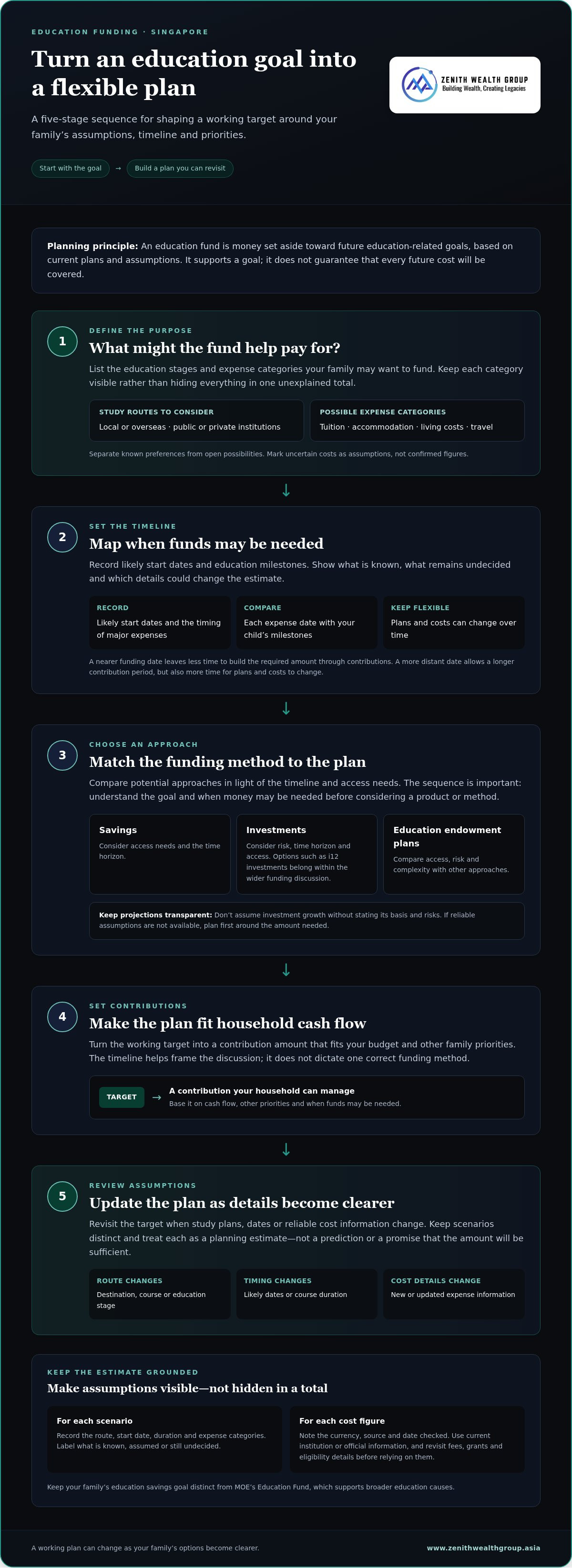
Once the goal is clear, use this sequence to turn it into a working plan:
- Define the purpose. Note the education stages and expense categories the fund may cover.
- Set the timeline. Record likely start dates, while marking what remains undecided.
- Choose an approach. Consider how the timeline and access needs shape the funding method.
- Set contributions. Base them on your household’s cash flow and other priorities.
- Review assumptions. Revisit the target when study plans, dates or available cost information change.
Keep the plan adaptable. References to options such as i12 investments belong within a wider funding discussion, after the goal and timeline are understood. A clear set of assumptions gives your family a practical starting point, without pretending that today’s estimate can settle every future decision.
Set an education-funding target using Singapore study options and a clear timeline
Turn broad possibilities into a working estimate by recording the route, likely education stage and approximate date when funds may be needed. In Singapore, a family might consider local university study, overseas study, or more than one route while a child’s interests develop. You don’t need to settle every choice now. You do need to show which details are known, which are assumptions and what information could change the estimate.
Build the target from separate expense categories. Record tuition separately from accommodation, living costs, travel and other relevant expenses. For each figure, note the currency, source and date checked. Use current information from the institution or relevant official source, and revisit fees, grants and eligibility details before relying on them. For example, the MOE Tuition Grant Scheme may be relevant to tuition assumptions, but eligibility and conditions should be assessed using MOE’s latest guidance.
How to estimate a target when your child’s study plans are undecided
Create a small set of plausible scenarios rather than forcing an early decision. One might reflect the family’s current preference, while another captures a realistic alternative, such as a different destination or education stage. For each, record the assumptions about start date, duration and expense categories. Leave unknown amounts blank or mark them for research; don’t fill gaps with unsupported estimates.
Then identify which assumptions could shift the total most. A change in destination, course length or accommodation needs may matter more than a minor adjustment to a less significant expense. Treat each scenario as a planning estimate, not a prediction or a promise that the amount will be sufficient.
How the time horizon changes the planning conversation
Compare the likely date of each major education expense with your child’s milestones. A nearer funding date leaves less time to build the required amount through contributions, while a more distant date allows a longer contribution period but also more time for plans and costs to change. The timeline helps frame the conversation; it doesn’t determine a single correct funding method.
Keep projections transparent. Don’t assume investment growth without stating the basis and risks. If you don’t have reliable assumptions, plan first around the amount you can contribute and revisit any projection with suitable guidance.
Use a simple record to keep the estimate useful:
- Study pathway: destination, institution type and education stage.
- Timing: approximate start date and when payments may be due.
- Expense assumptions: tuition and other relevant costs listed separately.
- Evidence: source, date checked and any eligibility conditions to verify.
- Open questions: details that could change the target, with a date to review them.
Update the record when a preferred route becomes clearer or official information changes. If you’d like help aligning your assumptions and timeline with a wider household plan, you can arrange an education-funding planning conversation.
Compare education-fund approaches by access, risk and time horizon
Once you have a target and likely funding dates, compare approaches by how they behave, not by their labels. Ask when you can access the money, whether its value can change, how flexible contributions are and how much complexity you’re comfortable managing. The best fit depends on your family’s needs and timeline, not on a universal ranking.
In plain terms, saving usually means setting money aside in a place intended to hold its value, while investing means putting money into assets whose value can rise or fall. Neither description guarantees a particular outcome. Product terms, eligibility, risks and access conditions vary, so review current official product documents before deciding.
What should parents weigh when comparing savings and investment approaches?
Start with timing. Money needed soon may call for a different discussion from funds intended for a longer-term goal, because a temporary fall in value can matter more if you need to withdraw during that period. Consider contribution flexibility too: would you need to pause, change or increase contributions as household expenses shift?
Then assess your comfort with fluctuations and the effort involved in understanding and monitoring the approach. If considering i12 investments, apply the same criteria without assuming a particular outcome.
| Approach | Access and time horizon | Value movement and complexity |
|---|---|---|
| Savings-focused approach | Review when funds can be accessed and whether that timing suits the education milestone. | Understand how the balance is treated under the specific account terms. The structure may be simpler to follow, but check its conditions and any applicable limits. |
| Investment approach | Match the expected withdrawal date to the investment time horizon and access terms. | Values can fluctuate. Understand the risks, how contributions are handled and what ongoing attention the approach may require. |
| Education endowment plan | Check the stated term, withdrawal conditions and how these align with the expected funding date. | Read the official documents for charges, risks and any stated benefits or guarantees. Terms differ between plans. |
Where might an education endowment plan fit?
An education endowment plan is one category to compare, not a default choice for every family. Read its official materials carefully, including the policy term, charges, access conditions, risks and any stated benefits or guarantees. Check how these terms relate to your goal and compare them with other approaches on the same basis.
For a fair comparison, write down what matters most: access by a particular education milestone, flexibility to adjust contributions, comfort with possible value changes and the level of detail you’re willing to manage. This makes it easier to see trade-offs without treating a product description as a personal recommendation.
That comparison is a practical part of how to build an education fund in Singapore. Revisit it if your expected funding date or household priorities change, and use current documents rather than relying on assumptions that may no longer apply.
Turn your education-fund goal into a contribution and review plan
A target becomes useful when you connect it to a routine your household can sustain. Set a contribution only after considering current cash flow, essential expenses, existing commitments and other family priorities. The aim is not to stretch the budget around an estimate. It’s to choose a starting pace you can review and adjust.
Use this sequence to turn your draft goal into an ongoing plan:
- Choose a working target. Record the education goal, the assumptions behind it and when funds may be needed.
- Set a contribution. Decide what fits your current budget without crowding out other priorities.
- Automate where suitable. If the chosen arrangement allows it and automation works for your cash flow, set contributions to follow a regular income cycle.
- Track progress. Keep a simple record of contributions, the current amount set aside and the remaining timeline.
- Schedule reviews. Choose a recurring point to revisit the plan, and review it sooner if circumstances change.
How can you make contributions manageable and consistent?
Choose a cadence that reflects how your household receives income and manages bills. A regular contribution may suit predictable cash flow; a different cadence may be more practical if income varies. Avoid selecting an amount simply because an online example uses it. Your starting contribution should come from your own budget and assumptions.
Record the date and amount of each contribution, along with any changes to your target or timeline. This doesn’t require a particular account or product. A clear record helps you distinguish money contributed from changes in the value of any funds held through an investment approach. Keep the tracking method simple enough to maintain.
When should you review an education-funding plan?
Review after a meaningful change to study preferences, household income or expenses, or the expected date funds will be needed. At each review, compare the target, the amount accumulated and the time remaining. If the plan no longer lines up, consider which assumption has changed before adjusting the contribution or approach.
Market performance isn’t predictable, so don’t treat a recent rise or fall as a reliable forecast. Instead, revisit the goal and timeline, check current information and consider whether the plan still fits your family’s circumstances. If a contribution has become difficult to maintain, reassess it against cash flow rather than letting the routine lapse without a review.
Keep a short review note: what changed, which assumptions remain useful and what action you’ll take next. This turns “how to build an education fund in Singapore” into a practical household process, not a decision you make once and leave untouched.
If you’d like support aligning your education target, contribution routine and wider financial priorities, discuss your education-funding plan.
Get personalized education-funding guidance from a Singapore financial consultant
A plan can look clear on paper and still leave practical questions: which study pathway should shape the target, how much can your household contribute, and how should education funding sit alongside other financial priorities? A financial consultant can help you work through those assumptions together. Personalized guidance can make the trade-offs clearer, but it can’t remove investment risk or guarantee that a particular amount will cover future costs.
Zenith Wealth’s Education Funding offering supports individuals and families as they consider these questions within a personalized financial plan. The team members are authorized Financial Consultants representing finexis advisory Pte Ltd [Reg No 200408660G]. The discussion can help bring your goals, anticipated funding dates, contribution capacity and wider household priorities into one planning conversation.
What can a financial consultant help you work through?
Bring the assumptions you’ve made so far, including possible study routes, likely milestones and the cost information you’ve gathered. A financial consultant can help you examine how those details affect the funding timeline and whether your proposed contributions fit alongside other needs. If you’re still weighing alternatives, make the undecided points explicit rather than treating one route as settled.
This can also help connect education funding with broader priorities such as household cash flow and other financial goals. The purpose is to build a plan around your circumstances, not to suggest that one approach suits every family or that outcomes are certain.
What to prepare for a first education-funding conversation
You don’t need a perfect spreadsheet. A concise summary is enough to make the conversation more focused. Bring notes on:
- Possible study pathways: destinations, institution types or education stages you’re considering.
- Timing: approximate dates when funds may be needed, including any milestones that remain uncertain.
- Current research: cost information you’ve collected, with its source and the date you checked it.
- Household priorities: other commitments that affect how much you can set aside.
- A manageable contribution: a starting level that feels realistic for your current cash flow, rather than an amount based on someone else’s example.
These notes give you a useful starting point. You can also bring questions about the trade-offs you’ve considered, such as access to funds, changing values or the terms of an education endowment plan. A clear discussion should help you understand which assumptions need more attention and what you may want to review as family circumstances evolve.
A free 30-minute discovery session is available to help match you with a consultant. Book a free discovery session to start a conversation about your education-funding priorities.
Give your education plan a clear next step
Your first plan doesn’t need to answer every question. It needs to give your family a practical place to begin and a way to respond as choices become clearer. Pick one open assumption to work on next, such as the likely study route, a funding date or what your household can comfortably set aside. A small, considered step can make a broad goal feel more manageable.
That’s the value of learning how to build an education fund in Singapore around your own circumstances. The plan should reflect the choices your family is weighing, not a figure borrowed from someone else. As new information comes in, you can revisit your assumptions and make adjustments without treating any estimate as a promise.
If you’d like a conversation about how education funding fits your family’s wider financial priorities, connect with Zenith Wealth Group about your next planning step. You can move forward at a pace that feels right, with a clearer starting point for the decisions ahead.
Frequently Asked Questions
How much should I save for my child’s education in Singapore?
There’s no single savings target that fits every family. To work out how to build an education fund in Singapore, decide which expenses you intend to cover and use current information for the study routes you’re considering. A parent planning to fund tuition only will have a different goal from one who also wants to help with accommodation or living costs. Mark estimates clearly and update them as plans become more definite.
When should I start building an education fund?
Start once you have a reasonable sense of the education goals you want to support, even if the destination or course is undecided. Beginning earlier gives you more time to contribute gradually, but don’t delay until you have a perfect forecast. For example, you can begin with a modest amount that fits your current budget, then adjust it as your income, priorities and your child’s plans develop.
Can I invest money set aside for my child’s education?
Yes, investing can be one way to set aside education money, but its value can rise or fall, and returns aren’t guaranteed. Consider when you may need the funds and how you’d respond to a fall in value near that date. Money needed soon calls for a different risk discussion from money intended for a more distant goal. Review the investment’s official documents before deciding.
Is an education endowment plan the same as an education fund?
No. An education fund is your family’s savings goal; an education endowment plan is a product category that may be considered as one way to work toward it. Don’t assume a plan automatically matches your target. Check whether its term and access conditions fit your likely funding dates, and review its official documents for charges, risks and stated benefits before comparing it with other approaches.
Can I use CPF or SRS savings to fund my child’s education?
CPF savings may be usable through the CPF Education Loan Scheme for eligible education expenses, subject to current CPF rules. The scheme involves repayment in cash, so consider the future repayment commitment as well as the immediate tuition need. SRS savings have separate conditions and tax treatment. Don’t assume they can be used in the same way as CPF; check current guidance from CPF, IRAS and your SRS operator.
How often should I review my child’s education-funding plan?
Set a regular review point, such as during your yearly household-finance check-in, and revisit the plan sooner after a major change. A new course preference, a different likely start date or a shift in household income can all affect the plan. Check whether the amount set aside and the remaining time still fit the goal. If something has changed, update the assumptions before deciding whether contributions need to change.
Should I prioritize education savings over retirement planning?
Not automatically. Education is important, but committing more than your household can sustain may put other long-term needs under pressure. Look at education contributions alongside retirement saving, essential expenses and financial commitments, then decide what balance is workable. If the expected education cost is beyond your current capacity, consider whether the target, the expenses you plan to cover or the funding timeline needs another look. A financial planner can help you weigh these priorities.


