

What if the best time to prepare for a market crash is when markets still feel calm? If you’ve caught yourself asking, “how to protect my portfolio from a market crash,” you’re not alone in worrying that a sudden drop could undo years of progress. Selling everything may feel like the safest move, but a decision made in fear can create new risks.
A portfolio plan can’t prevent losses or predict when markets will fall. It can help you understand the risks you’re taking and make thoughtful choices that reflect your goals, time horizon and comfort with volatility. This guide explains practical ways to review your investments before a downturn and what to focus on if markets become unsettled.
We’ll look at diversification, cash, defensive assets and portfolio adjustments, then outline a calm checklist for volatile periods. You’ll also find questions to discuss with a financial consultant, including how individual holdings and references such as i12 investments fit into your overall plan. Whether you invest in Singapore, Indonesia, Malaysia, the Philippines or Thailand, the aim is the same: prepare before the pressure hits so you can make decisions with greater clarity.
Key Takeaways
- Learn how to protect my portfolio from a market crash by matching your investment choices to your goals, time horizon and need for cash.
- Compare diversification, cash reserves, defensive allocations and hedging, while recognising that assets may respond differently as conditions change.
- Use clear decision triggers to distinguish a reaction to market fear from a reason to sell, hold or rebalance.
- Prepare a before-and-during checklist to map holdings, assess liquidity, review investments and document decisions.
- See how a financial consultant can help align portfolio decisions with your circumstances, including how references such as i12 investments fit into your review.
What a Market Crash Can Mean for Your Portfolio, and What Protection Can Do
A market crash is a sharp, severe fall in the value of a market or major group of investments over a relatively short period. It’s more than the day-to-day rises and falls investors expect: routine volatility can be unsettling, while a crash is a pronounced decline that can affect many holdings at once. There’s no single percentage that defines every crash. For background on the term and its historical context, see Understanding Stock Market Crashes.
A portfolio drawdown is a decline in the value of an investment portfolio from a previous high to a later low. The size of that decline matters, but so does its timing. A fall may be easier to tolerate when you have time before using the money than when you need to withdraw it soon. That distinction is central to understanding how to protect my portfolio from a market crash: protection starts with the purpose of the money, not a promise to avoid every loss.
How a downturn can affect different investors
Someone building wealth over a long horizon may have more time to stay invested through a downturn, provided the portfolio still fits their goals and capacity for risk. Someone nearing retirement, already drawing income or preparing for a major expense may have less flexibility. If they need to sell investments while prices are down, they may need to sell more units or shares to raise the same amount of cash, leaving less invested for a possible recovery.
Selling after a decline turns an unrealised fall in value into a realised loss on the investments sold. That doesn’t mean holding is always the right choice: a changed goal, an urgent cash need or a portfolio risk level that no longer feels manageable may justify a decision. Connect any action to the goal and its timeframe rather than treating every market drop as a signal to sell.
What portfolio protection can realistically achieve
Protection is about managing exposure, not eliminating risk. Spreading investments across different holdings may reduce the impact of relying too heavily on one company, sector or market. Other defensive choices may help manage volatility or provide money for near-term needs. But assets can fall together, and their responses to market conditions can change. No allocation, asset or strategy can guarantee protection from every downturn.
There are trade-offs. Holding more cash may mean less money invested for potential growth, while strategies designed to limit losses may also restrict gains or bring their own costs and complexity. The right balance depends on goals, time horizon, liquidity needs and tolerance for fluctuation. When reviewing information about investments, including references to i12 investments, consider each item in the context of the full portfolio rather than assuming any single choice can prevent losses.
A practical plan can reduce concentration, prepare for withdrawals and help you respond more deliberately. It can’t control market movements or guarantee when an investment will recover. Set that expectation first, then assess whether your portfolio’s risks match the purpose of each part of your money.
How Diversification, Cash, and Other Defensive Choices Work
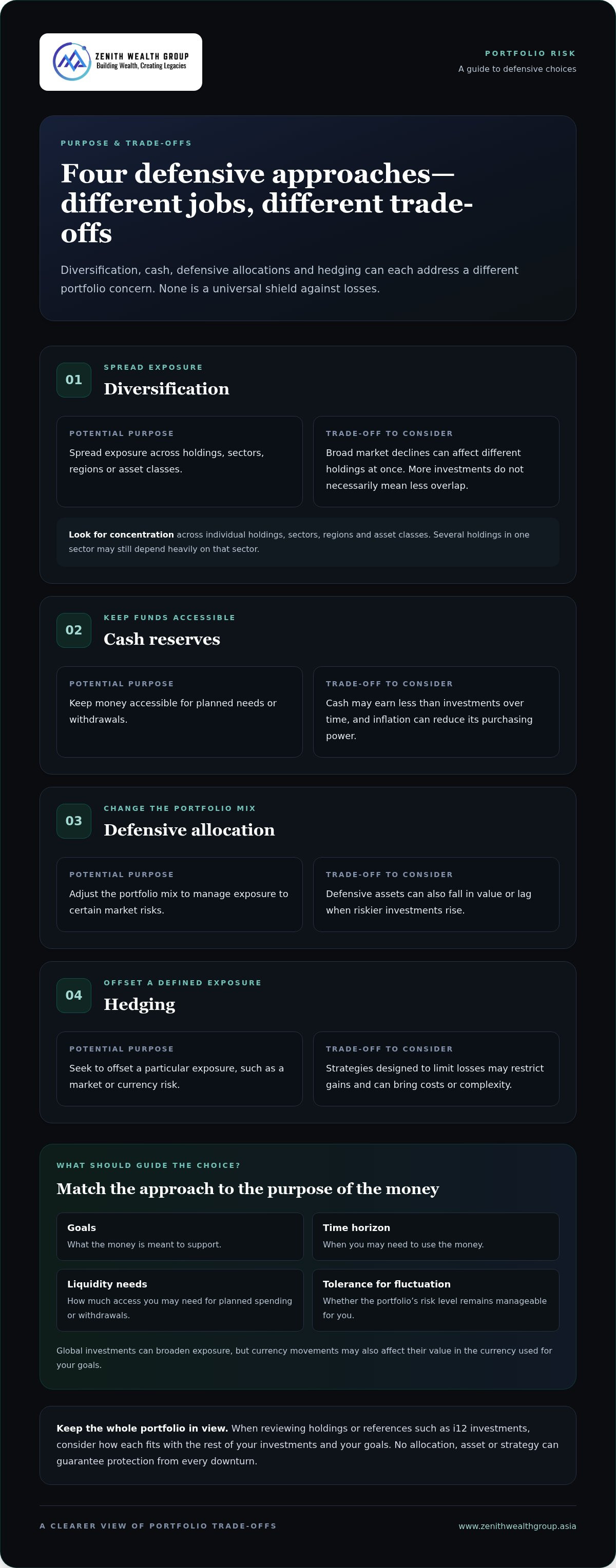
These approaches do different jobs. Diversification spreads exposure across investments; cash can provide ready funds; defensive allocations aim to change how a portfolio responds to certain conditions; and hedging seeks to offset a specific risk. None works as a universal shield, and each has trade-offs to weigh against your goals.
Diversification can reduce the harm caused by overreliance on one area, but it cannot prevent every investment from losing value. Investments that have moved differently in the past may react similarly under new conditions. Their relationship can change as markets and economic pressures shift.
Diversification across holdings and asset classes
Review concentration across individual holdings, sectors, regions and asset classes. Owning more investments doesn’t automatically create better diversification if they share similar exposures. For example, holdings spread across several names in one sector may still depend heavily on that sector’s performance. Incorporating distinct asset classes such as commercial real estate can help balance equity risk, and specialists such as Cornerstone Real Estate Investment Services provide structured property solutions for investors looking to diversify their holdings.
Global investments can broaden exposure, but they also introduce currency movements. For a Singapore-based investor, an overseas holding’s value translated into SGD may rise or fall partly because of exchange-rate changes, even if its local-market price moves differently. Investors in Singapore, Indonesia, Malaysia, the Philippines and Thailand can consider how foreign-currency exposure affects the value of their holdings in the currency they use for their goals. Assess both the underlying investment and the currency exposure when reviewing the portfolio as a whole.
Comparing cash, defensive assets, and hedging
Use this comparison to clarify the purpose of each approach before deciding whether it fits. The right choice depends on which risk you’re trying to manage and what you may give up in return.
| Approach | Potential purpose | Trade-offs to consider |
|---|---|---|
| Diversification | Spread exposure across holdings, sectors, regions, or asset classes. | Broad market declines can affect different holdings at once; more holdings don’t necessarily mean less overlap. |
| Cash reserves | Keep funds accessible for planned needs or withdrawals. | Cash may earn less than investments over time, and inflation can reduce purchasing power. |
| Defensive allocation | Adjust the portfolio’s mix to manage exposure to certain market risks. | Defensive assets can also fall in value or lag when riskier investments rise. |
| Hedging | Offset a defined exposure, such as a particular market or currency risk. | It can involve costs and complexity, and may not offset losses as intended. |
Cash is most useful when its purpose is clear, such as covering an upcoming expense without having to sell investments at an unfavourable time. Holding more than your needs require may leave less invested for potential growth. Defensive allocations aren’t interchangeable either: an asset intended to reduce one kind of portfolio risk may introduce another, including price or interest-rate risk.
Hedging is more targeted than diversification. It aims to offset a defined exposure, not protect the entire portfolio from every source of loss. For an investor with global assets, currency movements may be one risk to assess. Before considering a hedge, understand which exposure it addresses and how it could behave if conditions change.
A useful starting point for how to protect my portfolio from a market crash is to name the risk each choice is meant to manage, then assess its downside as carefully as its potential benefit. A personalised discussion can help connect those trade-offs to your circumstances, including any holdings or references to i12 investments. Discuss your portfolio approach in light of your goals and risk tolerance.
Should You Sell, Hold, or Rebalance During a Market Crash?
A sharp market fall can make every choice feel urgent. But selling, holding and rebalancing serve different purposes, and none is automatically right for everyone. Start by asking whether something has changed in your financial plan or whether the pressure to act comes mainly from seeing prices fall.
| Choice | Potential purpose | Drawback | A reason to consider it |
|---|---|---|---|
| Hold | Stay aligned with a plan built for a longer time horizon. | Inaction may leave a portfolio misaligned with changed goals or concentrated risk. | Your goals, cash needs and ability to tolerate risk remain broadly the same. |
| Sell | Raise cash, reduce an exposure, or reflect a genuine change in your plan. | Selling solely from fear can lock in a loss and leave you uncertain about when to reinvest. | You have a defined cash need or your circumstances or risk capacity have changed. |
| Rebalance | Bring holdings back toward an allocation you chose in advance. | It may involve selling some holdings and buying others while prices are unsettled. | Market movements have shifted your portfolio away from its intended mix. |
The risks of panic-selling and doing nothing automatically
Selling because a decline feels frightening can turn a fall in portfolio value into a realised loss on the investments sold. It may also mean missing a recovery if markets rise after you exit. Yet holding without review isn’t a complete plan either. Your goals may have changed, you may need funds sooner or one part of your portfolio may now represent more risk than you intended.
Neither action is universally correct. The question is whether your decision has a clear reason beyond the latest market move. If you’re asking how to protect my portfolio from a market crash, focus on the purpose of each holding and the role it plays in your plan before deciding what to change.
When a portfolio review may be warranted
Review your plan if a goal changes, your time horizon shortens, you expect to make withdrawals or your comfort with investment risk shifts. These are meaningful reasons to reassess, even if markets are calm. A falling market can also prompt you to check your portfolio, but it isn’t by itself proof that your strategy no longer fits.
Rebalancing is a way to restore a chosen allocation, not a method for predicting the market bottom. For example, if one asset class has grown to a larger share of your portfolio than planned, rebalancing may bring it closer to your intended mix. That process may require selling some holdings and adding to others. It can’t tell you whether prices will fall further or recover next.
Before making a change, write down the reason, the goal it supports and what would lead you to review the decision again. This pause can help separate a considered response from an attempt to time short-term market moves. If the reason is unclear, revisit your goals, liquidity needs and risk capacity before acting.
A Before-and-During Checklist for Managing Market-Crash Risk
A clear process is easier to follow before headlines and price swings make decisions feel urgent. Use this checklist to prepare your portfolio plan in calmer conditions, then return to it if markets decline. The aim isn’t to predict what comes next. It’s to know what you’ll review and why.
Prepare your portfolio plan before volatility
Work through these steps in order. Keep the notes somewhere you can revisit, and update them when your circumstances change.
- Clarify each goal. Record what the money is for, when you expect to use it and whether you anticipate withdrawals. Retirement, education funding and a near-term home purchase may each have different timelines and cash needs.
- Map your holdings. Group investments by asset class, sector, region and individual exposure. Look for areas where holdings may depend on similar market factors. For global assets, include currency exposure and consider how changes against the Singapore dollar could affect the value you see in SGD.
- Assess liquidity. Identify funds intended for upcoming expenses and distinguish them from long-term investments. Knowing what you may need to access can help you evaluate whether a market decline changes your practical options.
- Set review triggers. Choose conditions that would prompt a portfolio review, such as a change in your goal, a shorter time horizon, a planned withdrawal or holdings moving away from your intended allocation. A useful review trigger is a plan-based condition that prompts you to reassess, not a prediction about where markets will go.
- Document your decisions. Note the reason for your chosen allocation, what each part of the portfolio is meant to support and the circumstances that would lead you to revisit it. Include a date for your review, without treating it as a forecast.
Use a deliberate process when markets fall
During a decline, pause before acting on a headline or short-term price move. A practical answer to how to protect my portfolio from a market crash starts with checking whether your plan or circumstances have changed, rather than responding automatically to falling prices.
- Return to your notes. Compare the current situation with the review conditions you set in advance. Check whether your goals, withdrawal needs, time horizon or ability to tolerate risk have changed.
- Review the full picture. Look at your holdings, liquidity and currency exposure together. Avoid making a decision based on one investment or one day’s market movement alone.
- Understand the risks before adding complexity. Borrowing to invest, using leverage or employing complex hedges can create additional risks. Don’t use them unless you understand how they could affect your finances in different conditions.
Write down the reason for any proposed change before you make it. If your plan still fits, the review may help you stay deliberate. If circumstances have shifted, a financial consultant can help you consider how portfolio decisions align with your goals and risk tolerance. Discuss your portfolio plan with a consultant.
Build a Personalised Portfolio-Protection Plan with a Financial Consultant
General strategies become more useful when they’re matched to your circumstances. A plan should reflect what you’re investing for, when you’ll need the money, what you currently hold and how much fluctuation you can tolerate. It should also account for liquidity needs, such as planned withdrawals, so you can consider which funds may need to remain accessible and which have a longer-term purpose.
This is a more practical way to approach how to protect my portfolio from a market crash than trying to predict the next fall. A financial consultant can help you review how your holdings relate to your goals and risk tolerance. That discussion can inform investment management and wealth protection decisions, but it can’t guarantee that your portfolio will avoid losses.
What to bring to a portfolio-planning conversation
Bring a current overview of your investments, including the types of assets, regions and currencies represented. Add the goals each part is meant to support and any expected cash needs or withdrawal timing. If you have information that refers to i12 investments, include it as a discussion reference without assuming a particular role or affiliation.
Be candid about how losses affect you. Would a sharp decline make you want to sell, or could you stay with your plan if your goals and circumstances were unchanged? You don’t need to arrive with perfect answers. These concerns can help shape a plan that feels realistic to follow, rather than one based on a market forecast or a promise of protection.
What the Zenith Wealth discovery session offers
Zenith Wealth offers a free 30-minute discovery session to match clients with a consultant. It’s an opportunity to begin a conversation about your circumstances and the kind of planning support that may suit your needs. Zenith Wealth’s representatives are authorized Financial Consultants representing finexis advisory Pte Ltd [Reg No 200408660G].
Bring your questions and an overview of your goals, holdings and expected cash needs. Use the conversation to explore how investment management and wealth protection can be considered in relation to your priorities and risk tolerance. The focus is a personalised plan, not a prediction of market movements or a guarantee against losses.
Make Your Next Portfolio Decision with Greater Clarity
Preparation isn’t about knowing what markets will do next. It’s about having a personal decision-making framework you can return to when uncertainty rises. Take one practical next step: write down the goal your portfolio needs to serve and the circumstances that would make you review your plan. Keep that note alongside your investment records, and revisit it as your life changes.
If you’re still wondering how to protect my portfolio from a market crash, focus on a plan that reflects your own time horizon, cash needs and comfort with risk. A conversation with a financial consultant can help you consider those factors in relation to investment management and wealth protection, without treating any approach as a guarantee against losses.
Use your next planning conversation to bring one clear question about your portfolio’s role in your wider financial life. A focused discussion can help you think through your priorities and the decisions you may want to revisit as your circumstances change.
Book a free 30-minute discovery session and take a thoughtful first step toward feeling more prepared.
Frequently Asked Questions
Can any investment portfolio be completely protected from a market crash?
No. A portfolio can be designed to reduce exposure to particular risks, but a broad decline can affect different investments at the same time. Choices intended to soften fluctuations may also limit growth or carry risks of their own. Rather than seek complete safety, consider what level of loss your goals can withstand, when you need the money and whether your plan gives you room to respond without disrupting essential needs.
What does portfolio drawdown mean?
A portfolio drawdown measures how far its value has fallen from a previous high to a lower point. It describes the size of a decline over a period, not whether the loss is permanent or when recovery may happen. Tracking drawdowns can help you see how different parts of a portfolio have changed during a difficult period, but the measure alone can’t explain why values fell or what they’ll do next.
Can bonds lose value during a stock-market crash?
Yes. Bonds aren’t automatically immune to losses during a stock-market crash. Their prices can respond to changing interest rates, concerns about an issuer and wider market conditions, so different bonds may behave differently. Avoid assuming they’ll always rise when shares fall. Reviewing what each bond holding is intended to contribute, and how it may respond to changing conditions, can help you assess its place in a diversified portfolio.
How can currency movements affect a Singapore investor's global portfolio?
Exchange-rate movements can change the Singapore-dollar value of an overseas investment, even if its price in the local market is unchanged. For example, if the foreign currency weakens against SGD, the holding may be worth less when converted into Singapore dollars; a strengthening currency can have the opposite effect. The total return may therefore reflect both the investment’s local price movement and currency changes. Include this exposure in portfolio reviews.
Should I stop regular investing when markets become volatile?
There’s no automatic answer to how to protect my portfolio from a market crash by stopping or continuing regular investments. Consider whether contributions still fit your goals, cash needs and comfort with risk. For instance, a new expense or reduced income may change what you can reasonably invest, while volatility alone may not mean your plan has changed. Review your circumstances and the purpose of each contribution before deciding.
What should I discuss with a financial consultant about crash risk?
Discuss your goals, investment time horizons, current asset allocation, liquidity needs, concentrated holdings and comfort with potential losses. You can also describe the decisions that feel hardest during a downturn, such as whether to adjust contributions or how often to review your holdings. Use the conversation to clarify which risks matter most to your circumstances and what trade-offs you’re prepared to accept, without expecting a promise that losses can be avoided.


