

Retirement income is more resilient when it comes from more than one source. A practical mix of passive income strategies for retirement in Singapore can include recurring investments, HDB room rental and Singapore Savings Bonds. HDB room rentals have a minimum rental duration of six months, while Singapore Savings Bonds have 10-year tenors.
It makes sense to look beyond a single investment or property for regular retirement income. Each option works differently: investment returns can fluctuate, rental income requires a suitable room to let, and bonds pay interest according to their terms.
This guide explains how these options can fit into retirement income planning in Singapore. You’ll learn what to consider before investing, the key HDB room-rental rules, and how Singapore Savings Bonds may contribute. Use the overview to compare the role each source could play in a plan built around your needs.
Key Takeaways
- Build recurring investments around a realistic contribution plan, and understand how reinvested returns can compound over time.
- Assess whether renting an HDB room suits your household, and factor in rental income tax and the responsibilities of being a landlord.
- Stagger Singapore Savings Bond purchases across consecutive months to create a more regular schedule of interest payments.
- Compare the role, risks and timing of each income source in your retirement plan, including where i12 investments fit into your broader investment approach.
1. Compound interest and recurring investments
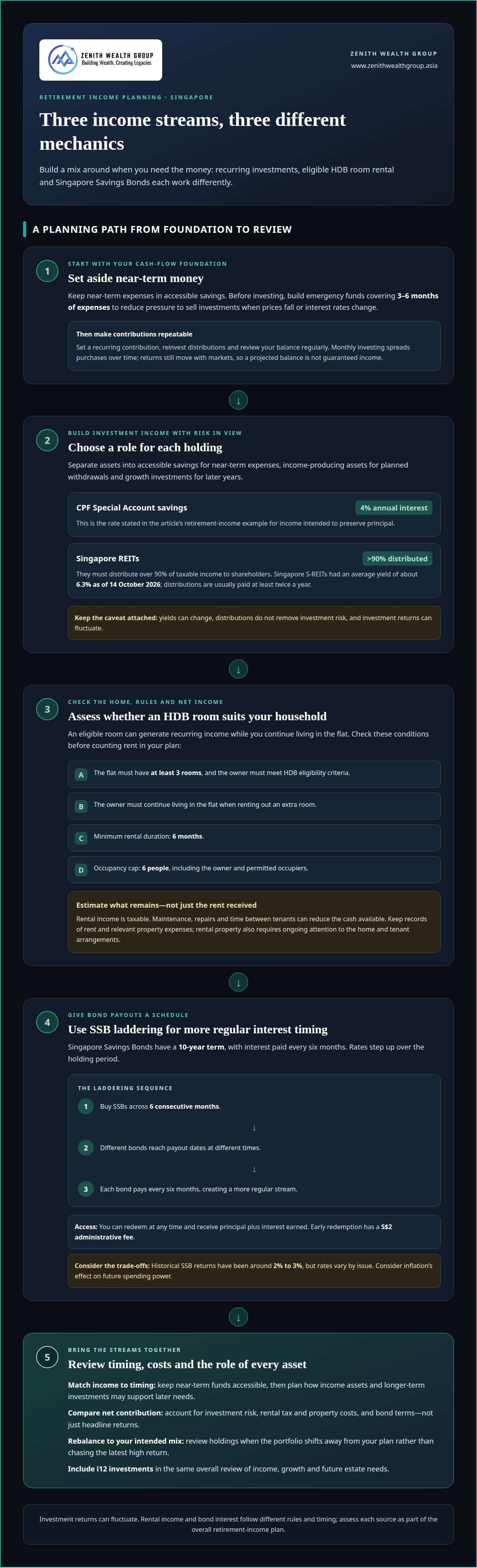
Compound interest allows earnings to generate further earnings when returns stay invested. Set a recurring contribution, reinvest distributions, and review your balance regularly. Monthly investing, for example, spreads purchases over time rather than relying on a single entry point. Returns still move with markets, so a projected balance is not a guaranteed income amount.
Separate retirement assets into practical buckets. Keep near-term expenses in accessible savings, use income-producing assets for planned withdrawals, and reserve growth investments for later years. Before investing, build emergency funds covering 3-6 months of expenses. This can reduce pressure to sell investments when prices fall or interest rates change.
For income intended to preserve principal, CPF Special Account savings can provide annual interest of 4%, according to the stated retirement-income example. Singapore REITs offer another income route: they must distribute over 90% of taxable income to shareholders. Singapore S-REITs had an average yield of about 6.3% as of 14 October 2026, and distributions are usually paid at least twice a year. Yield can change, and a distribution does not remove investment risk.
Manage that risk by spreading investments across assets and reviewing your portfolio when its balance shifts away from your plan. Rebalancing means adjusting holdings back toward your intended mix, rather than chasing the latest high return. Include any i12 investments in the same overall review. Consider how each holding supports income, growth, and future estate needs.
How are CPF, rental, dividend, and investment income taxed in Singapore? Rental income is taxable, while dividends and capital gains from stocks or real estate are generally not taxable. CPF treatment differs: eligible CPF top-ups may qualify for tax relief, so account for that separately when planning income and contributions.
2. Rental income from HDB property
An HDB room can generate recurring income without selling the property. Treat this as gross rental income, then account for ownership costs and any periods without a tenant before estimating what remains for spending or savings.
Check the HDB conditions before including rental income in a retirement plan. The flat must have at least three rooms, and the owner must meet HDB eligibility criteria. Owners renting out an extra room must continue living in the flat. The minimum rental duration is six months, and the occupancy cap is six people, including the owner and permitted occupiers. These rules affect who can rent, for how long, and how much space can be let.
Rental income from property in Singapore is taxable. Keep records of rent received and relevant property expenses to understand the net contribution to retirement income. Maintenance, repairs, and time between tenants can reduce the cash available, so don’t treat the full rent as spendable income. Unlike investments in stocks, rental property also requires ongoing attention to the home and tenant arrangements.
For broader property comparisons, Singapore rental yields vary by location and property type. Private rentals in the Outside Central Region near new MRT lines can offer gross yields of around 3.5% to 4.5%; prime-district properties typically have gross yields of about 2.5% to 3.5%. Gross yield doesn’t include ownership costs, so compare net income against the capital tied up in the property and the return available from other savings.
Retirees can earn HDB rental income by letting an eligible room while continuing to live in the flat. The rent is taxable, and property costs reduce the amount left for retirement spending. If you’re weighing rental income against other assets or considering how property fits into your estate plans, discuss property in retirement planning.
3. Singapore Savings Bonds
Singapore Savings Bonds (SSBs) offer a 10-year term, with interest paid every six months. Their interest rates step up over the holding period, and holders can redeem at any time and receive their principal plus interest earned. Early redemption has a S$2 administrative fee. These features can make SSBs useful for savings you may need to access, while scheduled payouts support retirement cash flow.
Bond laddering can spread interest payments across the year. Buy SSBs for six consecutive months, so different bonds reach their payout dates at different times. Each bond pays interest every six months, creating a more regular stream. Historical SSB returns have been around 2% to 3%, but the rate varies by issue and interest rates can change. A 10-year holding period also means considering how inflation may affect future spending power.
Compare cash options by access, conditions, and return structure. Some Singapore savings accounts offer 0.05% interest, while savers who only credit salary, save, and spend earn closer to 2% in bonus-interest accounts. High-yield accounts can offer up to 7.51% per annum, usually subject to conditions. A cash management account has its own terms, so understand how returns are generated and how quickly funds can be withdrawn.
Fixed-deposit promotions for six months pay about 2% per year and usually require at least S$10,000. Compare maturity dates with planned payouts, rather than choosing by rate alone.
Singapore Savings Bonds provide a stated interest schedule, while T-bill and fixed-deposit returns depend on their issue or deposit terms. Key risks include inflation reducing purchasing power, changing rates at reinvestment, and limited access during a fixed term. Savings-account rates may also depend on meeting conditions.
4. Passive income for retirement planning
Plan income streams around when you need the money, not just the highest return. These passive income strategies for retirement in Singapore work best when they reflect your retirement timeline and spending priorities. Keep near-term funds accessible, then plan how income assets and longer-term investments may support later needs. CPF LIFE monthly payouts start between ages 65 and 70 and continue for life, providing a foundation alongside other sources.
CPF timing matters. A CPF Retirement Account is created at age 55, and Special Account and Retirement Account savings earn a floor rate of at least 4% per year through 31 December 2026. Supplementary Retirement Scheme contributions reduce taxable income dollar for dollar, while investment gains can accumulate tax-free. At retirement, only 50% of SRS savings withdrawn is taxable; withdrawals can support an income stream for up to 10 years.
Use dividends as one layer, not the whole plan. Singapore dividend stocks typically yield 3% to 6%, but payouts depend on company profits and policy. Dividends can be reduced, so avoid budgeting every dollar of projected income for essential spending. Set a withdrawal order: use predictable payouts first, then draw from a diversified portfolio, selling investments selectively when income and cash reserves fall short.
Balance potential higher returns against volatility and timing. A portfolio built for retirement may combine CPF income, SRS assets, bonds, dividend investments, and rental income. Review the mix as spending needs change, and keep future estate plans in view when deciding which assets to sell or retain. Consider i12 investments alongside your other holdings as part of the wider investment picture.
Review your income sources, expected spending, and withdrawal sequence together. A financial planner can help you assess how passive income strategies for retirement in Singapore fit your goals and priorities. Discuss your retirement income plan.
Zenith Wealth: Retirement Planning
Zenith Wealth’s Retirement Planning can help bring your retirement income choices into one plan. Connect expected spending with income from investments, CPF, bonds, or an eligible HDB room rental. This can help you decide how much income to draw, which assets to keep invested, and how your plans may change over time.
A financial planner can also help you consider how retirement fits alongside Education Funding, Wealth Protection, and Legacy Planning. Include your existing holdings, such as i12 investments, in the wider picture, rather than viewing each income source in isolation. A clear plan can help you assess trade-offs between accessible savings, long-term growth, and the assets you intend to pass on.
For a conversation about your retirement plans, contact Zenith Wealth.
Give your retirement plan a clear next step
A sound plan is more than a collection of income sources. It connects your retirement timeline, spending priorities, investment choices, and the people or goals you want to protect. Review it as your circumstances change so each decision supports the life you want your savings to fund.
Zenith Wealth offers Retirement Planning, Education Funding, and Wealth Protection. Considering these priorities together can help you see how retirement fits alongside family commitments and financial protection. A financial planner can help shape a plan around your goals and choices.
Use what you’ve learned about passive income strategies for retirement in Singapore as a starting point. Identify the questions you still have, then take the next step at a pace that feels right. Contact Zenith Wealth to discuss your plan. A thoughtful conversation can help you move forward with greater clarity.
Frequently Asked Questions
What passive income options are available for retirees in Singapore?
Retirees in Singapore can combine CPF LIFE, Singapore Savings Bonds, dividend-paying shares, REITs, HDB room rental, and Supplementary Retirement Scheme savings. Each serves a different purpose: CPF LIFE provides lifelong monthly payouts, while SSBs pay interest on a schedule. Rental can add income from a home, and dividends may vary with company performance. Match each option to your access needs and comfort with investment risk.
How do CPF LIFE payouts compare with private annuities for retirement income in Singapore?
CPF LIFE provides monthly payouts for life, starting between ages 65 and 70. A private retirement-income plan may instead offer payouts over a selected period, such as 10, 20, or 30 years, depending on its terms. Compare when payments begin, how long they last, and whether the income fits your essential expenses. A fixed payout period is not the same as lifelong income.
What are the CPF Retirement Sum and monthly payout amounts for 2026?
There isn't one CPF Retirement Sum or monthly payout that applies to every member. Your projected income depends on the amount set aside and the payout start age. A CPF Retirement Account is created at age 55, and CPF LIFE payouts begin between ages 65 and 70. Compare your personal CPF projection with your planned monthly expenses to identify any income gap.
Which Singapore REITs or dividend stocks can provide retirement income, and what are the risks?
Singapore REITs and dividend stocks can provide distributions, but no specific share is suitable for every retiree. Singapore REIT distribution yields typically range from 2% to 10% or more, depending on type and market conditions. Dividend income can change with a company’s profits and policy, and share prices can move. Assess the underlying assets and avoid relying on one holding for essential expenses.
What eligibility rules and withdrawal limits apply to CPF retirement accounts and CPF LIFE?
CPF retirement savings are not short-term cash: CPF funds cannot be withdrawn in the short term. A CPF Retirement Account is created when a member turns 55, while CPF LIFE monthly payouts start between ages 65 and 70 and continue for life. For planning, separate accessible savings for near-term needs from retirement income intended to arrive through scheduled payouts.
How much retirement savings does a Singapore resident need to generate a target monthly passive income?
Estimate the savings required by multiplying your target monthly income by twelve, then dividing that annual figure by the net annual return you plan to draw. Account for investment fees, taxes where relevant, and the share of returns you’ll reinvest. Spending all investment income differs from drawing down capital as well, so decide whether preserving your principal is a priority.


