

The better choice may be to do both, rather than put every spare dollar into one option. If you’re asking whether it is better to pay off your mortgage or invest in Singapore, compare your home-loan interest rate with the potential after-tax return on investments. When the mortgage rate is below 4-5%, investing extra funds may be worth considering, depending on your goals and comfort with risk.
It’s natural to value the certainty of reducing debt while wondering how your money might grow over time. If you’re asking, “Is it better to pay off my mortgage or invest in Singapore?”, compare the interest you could save with potential investment growth. Your mortgage rate, time horizon, cash needs, and comfort with market risk all matter. For many homeowners, a mix of repayment and investing is worth considering.
Key Takeaways
- Compare the interest your extra mortgage payments could save with potential investment returns after tax, not headline returns alone.
- Check how your loan’s repayment structure affects the benefit of paying down principal earlier.
- Consider your investment time horizon and ability to stay invested through market ups and downs before choosing where extra money goes.
- Explore how compounding and options such as i12 investments fit alongside your wider financial goals.
Should I pay off my home loan or invest?
Compare the interest saved by reducing your mortgage balance with potential investment returns after tax and fees. The better fit depends on your loan rate, investment time horizon, need for accessible cash, and tolerance for market risk.
Mortgage Interest Savings and Investment Returns
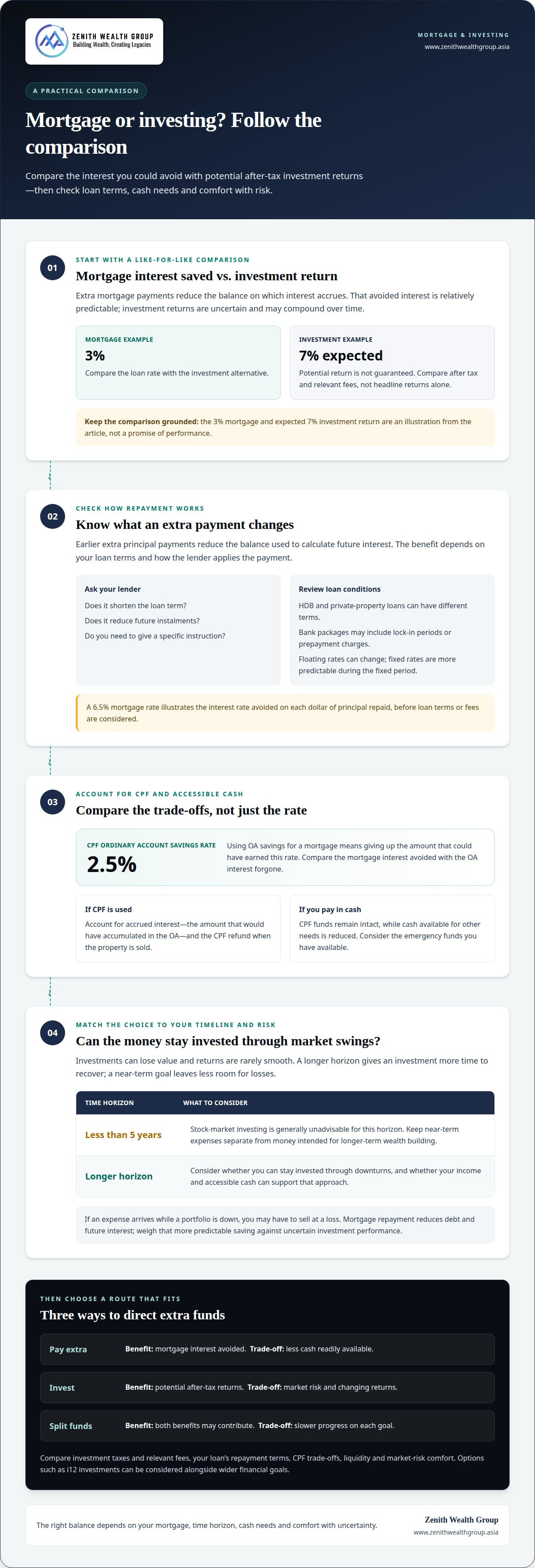
Paying extra off your mortgage reduces the balance on which interest accrues. The interest avoided is a relatively predictable benefit; investing offers uncertain returns that may compound over time. A 3% mortgage rate compared with an expected 7% investment return could favour investing, but that return is not guaranteed. Singapore mortgage rates were above 3.5% in the market context described for 2026.
Compare rates on the same basis, including investment taxes and relevant loan terms. A financial planner can help you consider how your loan package treats extra repayments. HDB and private-property loans have different terms, so early repayment conditions can vary. Bank packages may include lock-in periods or prepayment charges; review your loan terms before directing cash toward principal.
Tax on Investment Gains and Income
Singapore’s tax treatment depends on the type of investment and income. Capital gains, dividends, and rental income should not be treated as one category: rental income can have tax implications, while the treatment of investment gains and dividends depends on the circumstances. Compare after-tax returns, not headline yields, before deciding whether investing could outweigh your mortgage interest.
CPF Housing Funds and Mortgage Interest
The CPF Ordinary Account (OA) savings rate is 2.5%. Using OA savings for a mortgage reduces the amount earning that rate, so compare the mortgage interest avoided with the OA interest forgone. CPF housing use also involves accrued interest, the amount that would have accumulated in the OA; account for the CPF refund when the property is sold.
CPF savings can be used for eligible housing payments, but this ties retirement savings to your property. Paying in cash preserves CPF funds, while using CPF preserves cash for other needs. Compare both choices with your mortgage rate and the emergency funds you have available.
| Option | Interest or return | Main trade-off |
|---|---|---|
| Pay extra | Mortgage interest avoided | Less cash readily available |
| Invest | Potential after-tax returns | Market risk and changing returns |
| Split funds | Both benefits may contribute | Slower progress on each goal |
Compare after-tax investment returns with mortgage interest, then weigh liquidity, CPF trade-offs, and your loan’s repayment terms.
When is it better to pay off your mortgage early?
Early repayment can suit borrowers who value predictable interest savings, particularly when their mortgage rate is high. First, find out how an extra payment reduces your principal, then compare that benefit with the cost of other debts and your cash needs.
Mortgage Amortisation and Principal Payments
Each scheduled payment covers interest and reduces principal, but the split changes as the balance falls. Extra principal payments reduce the balance used to calculate future interest, so earlier overpayments can save more over the remaining loan term.
Ask your lender how extra payments are applied. Confirm whether they shorten the loan term, reduce future instalments, or require a specific instruction.
Guaranteed Interest Savings and Market Returns
Paying down principal avoids future mortgage interest at the loan’s rate, while investment returns can rise or fall. A 6.5% mortgage rate makes each dollar of principal repaid equivalent to avoiding interest at that rate, before considering loan terms or fees. Paying off a mortgage may therefore appeal to someone prioritising certainty over potentially higher returns.
With a floating-rate loan, future interest costs can change when the rate resets. A fixed-rate loan offers more predictable payments during its fixed period. Compare the current rate, remaining term, repayment conditions, and your ability to manage possible payment changes.
Prioritise expensive credit-card debt before making extra mortgage payments. Paying down that balance can address a higher borrowing cost while keeping cash available for essential expenses. Then compare your mortgage rate with the potential return from investing, allowing for risk and taxes.
U.S. tax rules differ from Singapore’s. In the United States, mortgage interest on qualifying loans of up to US$750,000 may be deductible on a federal return, subject to rules; married taxpayers filing separately have a US$375,000 limit. This treatment requires qualifying use of loan proceeds and itemised deductions, so it should not be assumed for a Singapore home loan.
Before making a large overpayment, weigh the interest saved against liquidity and any applicable loan conditions. A mortgage repayment decision can also be considered alongside your wider financial priorities.
When might it be better to invest instead?
Investing may suit money you can leave invested through market swings. Match your time horizon to the investment’s risks and your need for access to the funds.
Investment Time Horizon and Market Volatility
A longer time horizon gives an investment more time to recover from downturns, while a near-term goal leaves less room for losses. Investing in the stock market is generally unadvisable when your time horizon is less than 5 years. Before investing, separate money for near-term expenses from funds intended to build wealth over a longer period.
Money needed soon for a home renovation has a different role from monthly savings for a distant goal. Consider the stability of your income and how much accessible cash you need before investing funds that could otherwise reduce your mortgage balance.
Market Risk and Investment Losses
Investments can lose value, and market returns are rarely smooth. A portfolio may fall just when an expense arises, forcing you to sell at a loss. Mortgage repayment, by contrast, reduces debt and future interest. Weigh that more predictable saving against the possibility that investments underperform or take time to recover.
Keep liquidity in view. If extra mortgage payments leave too little cash for monthly costs, investing some funds may preserve flexibility, but it also adds market risk.
Stock Market Investing
Stock market investing can support long-term wealth building, but equity investments are exposed to price swings. A diversified approach spreads exposure across investments instead of relying on one company. Compare the expected holding period, level of risk, and access to funds with the more predictable benefit of reducing your mortgage principal.
Don’t base your decision on a headline return alone. Consider how a downturn could affect your plans and whether you could keep investing without selling at an unfavourable time.
Singapore Investment Options and Fees
In Singapore, investors may compare Singapore Savings Bonds (SSBs), Treasury bills (T-bills), exchange-traded funds (ETFs), and CPF top-ups. These options differ in purpose, access to funds, risk, and how returns are earned, so they are not interchangeable with mortgage prepayments.
Before choosing, check each option’s stated charges, such as transaction or fund-management fees where applicable, alongside its liquidity and risk. Compare the net amount available for your goals with the interest you could avoid by paying down your home loan.
Compounding and investment growth
Compounding lets investment returns generate further returns when gains remain invested. Over 10 years, the effect can widen the gap between different average-return assumptions. The examples here compare 2%, 5%, 7%, and 10% average annual returns. They show why a long horizon can matter, but they aren’t forecasts or promised outcomes.
Consider the S&P 500, whose average annual return over several decades has been roughly 10%. That historical figure illustrates compounding’s potential, not a return to expect from every portfolio. Actual performance varies, and a weaker period can reduce growth. Compare realistic after-tax returns with your mortgage interest, rather than treating a long-run market average as a guaranteed result.
Time and consistency matter. Reinvesting returns allows later growth to build on earlier gains, while withdrawing them interrupts that process. If you invest regularly, review the plan against your income, expenses, and retirement timeline. A projection using a 5% average return will differ from one using 7%, and actual returns may fluctuate along the way.
Paying off your mortgage early can reduce interest and build home equity, but that equity is less readily accessible than cash or investments. Investing may offer more liquidity, but it exposes your assets to market declines. Consider when you’ll need the money, whether you can stay invested during a downturn, and how mortgage payments fit your finances. The balance may change as retirement approaches or your priorities shift.
Use a simple comparison: estimate mortgage interest avoided, assess investment growth over the same period, then account for taxes, risk, and access to funds. A financial planner can help align those assumptions with your goals. Discuss your long-term investment approach as part of that decision.
Zenith Wealth: Retirement Planning
Zenith Wealth Group can help you consider mortgage decisions as part of a broader retirement plan. Look at how repayments, investment choices, and future income needs fit together, rather than treating your home loan as an isolated decision. This can be especially useful if paying down debt could affect funds for retirement, education funding, or wealth protection.
A financial planner can help you organise these priorities and consider how i12 investments fits your wider financial plan. The aim is to make a clear choice that reflects your goals, cash needs, and comfort with investment risk. Legacy Planning may also matter when you’re considering how your home and other assets support your family over time.
For a conversation about your financial priorities, contact Zenith Wealth.
Make your next decision with purpose
Whether it is better to pay off your mortgage or invest in Singapore is best considered as part of your wider financial plan. Your choice can affect how much flexibility you have for future goals, so think about how you want your money to support the life you’re building, not only the loan you’re repaying.
Set out your priorities, the resources you can commit, and the outcomes that matter most. A financial planner can help turn those priorities into a clear plan and consider how they fit together over time. You don’t need to settle every detail before starting the conversation.
Contact Zenith Wealth to discuss your options and take a considered next step toward your financial goals.
Frequently Asked Questions
Is it better to pay off your mortgage or invest?
For a Singapore homeowner, whether it is better to pay off your mortgage or invest in Singapore depends on cash flow, loan terms, and personal priorities. Compare the cost of carrying the loan with the role investments play in your wider plans. For example, someone with variable income may value accessible savings more than someone with stable income and a longer investment horizon.
Can you do both?
Yes. You can split surplus cash between mortgage repayments and investments rather than committing everything to one choice. First set aside money for regular expenses and planned costs. Then choose a sustainable allocation, such as making occasional extra payments while investing a set amount regularly. Review the split if your income, family responsibilities, or financial goals change.
How Much Interest Will You Save?
The amount depends on your remaining balance, mortgage rate, repayment timing, and loan terms. Ask your lender for an updated repayment schedule showing how an extra payment affects the loan. Compare the projected interest with and without that payment. Also clarify how the lender applies additional funds, since the calculation depends on whether they reduce the principal immediately.
When does paying off your mortgage make more sense?
Extra payments may suit you if reducing debt is a priority or you want lower required payments as retirement approaches. Consider other expensive debts first, since paying down a costly credit-card balance may be more urgent. Keep enough accessible savings for household needs and planned expenses before directing spare cash toward your home loan.
How do I compare mortgage interest savings with expected investment returns in Singapore?
To decide whether it is better to pay off your mortgage or invest in Singapore, compare both choices over the same period using the same amount of money. Estimate the mortgage interest you could avoid, then compare it with potential investment returns after relevant taxes and charges. Consider investment risk and access to funds, not just projected growth.
What are the risks of investing instead of paying down a mortgage?
Investment values can fall, and a downturn may coincide with a need for cash. Selling then can turn a temporary decline into a realised loss. A portfolio concentrated in a narrow range of assets also carries greater exposure to those investments. Match your approach to when you’ll need the money and keep near-term funds accessible.


