

What if the shares that helped build your wealth now give one company too much influence over your financial future? Managing concentrated stock positions means weighing that risk against your reasons for holding on, including the possibility of future gains. Selling quickly may not feel right, especially if you’re unsure about the tax implications.
That uncertainty is understandable. Diversification doesn’t have to be an all-or-nothing decision. This guide explains how a concentrated holding can affect portfolio risk and compares practical ways to manage exposure, from gradual sales to approaches that may preserve some participation in future gains. Each option has trade-offs, and tax considerations depend on your circumstances.
Key Takeaways
- Assess how much of your portfolio one company represents, alongside your liquidity needs, time horizon and goals.
- Managing concentrated stock positions involves comparing holding, staged sales, diversification and hedging, each with different trade-offs.
- Gather details about your shares, portfolio and cost basis before weighing possible next steps and tax considerations.
- Use a clear process to compare choices and document a decision that fits your wider financial goals.
- Consider how a concentrated holding connects to investment management, wealth protection and legacy planning.
Managing concentrated stock positions: why one holding can shape your whole portfolio
A shareholding can carry more than financial value. It may represent years of work, a family inheritance, or a company you know well. That history can make a change feel personal, so it’s reasonable to pause before deciding what to do. The aim of managing concentrated stock positions isn’t to dismiss that connection. It’s to understand how the holding fits into your wider financial picture.
A concentrated position is an exposure large enough to materially influence the risk of your portfolio. There’s no single percentage that defines it for everyone. The effect depends on the holding’s size relative to your other investments and assets, as well as your goals and capacity to absorb changes in value. Concentration risk is the possibility that an outsized exposure to one investment will have a disproportionate effect on your financial outcomes. The concept is also outlined in Concentration Risk on Wikipedia.
Two kinds of risk matter. Company-specific risk comes from factors affecting the business, such as changes in its products, leadership, or competitive position. Broader market risk affects investments across companies, such as a general market decline. A familiar, well-known company can still face both risks. Knowing its story doesn’t remove uncertainty.
How a large single-stock holding can affect financial plans
If one company makes up a large part of your investments, its performance may have more influence on your portfolio’s value than the rest of your holdings combined. Consider how that exposure fits with your planned spending, investment horizon, and other assets. Someone approaching retirement may assess it differently from someone investing for a goal decades away.
A share price shown on a statement isn’t the same as money available to spend. Accessing funds may require a sale, and the amount realised can differ from the value shown at a particular moment. A practical review considers when you might need liquidity and whether other resources can meet that need. It also looks at the holding alongside assets such as savings, property, and other investments.
How concentrated positions commonly develop
Concentration can build through employee shares, an inheritance, or long-term appreciation. A holding that began as a modest part of a portfolio may become more prominent as its value grows, other assets change, or you receive additional shares. The original decision to hold may have made sense at the time, but your circumstances may now be different.
Attachment can add another layer. You may feel loyal to an employer, grateful for an investment’s past contribution, or hesitant to sell an inherited asset. Those feelings are part of the decision, but they don’t measure portfolio risk. A broader review can place the holding beside your other investments and goals. It may also consider i12 investments as part of the wider investment picture, without assuming they alter the risks of a single-company holding.
Assessing concentrated stock risk: look beyond the holding’s current value
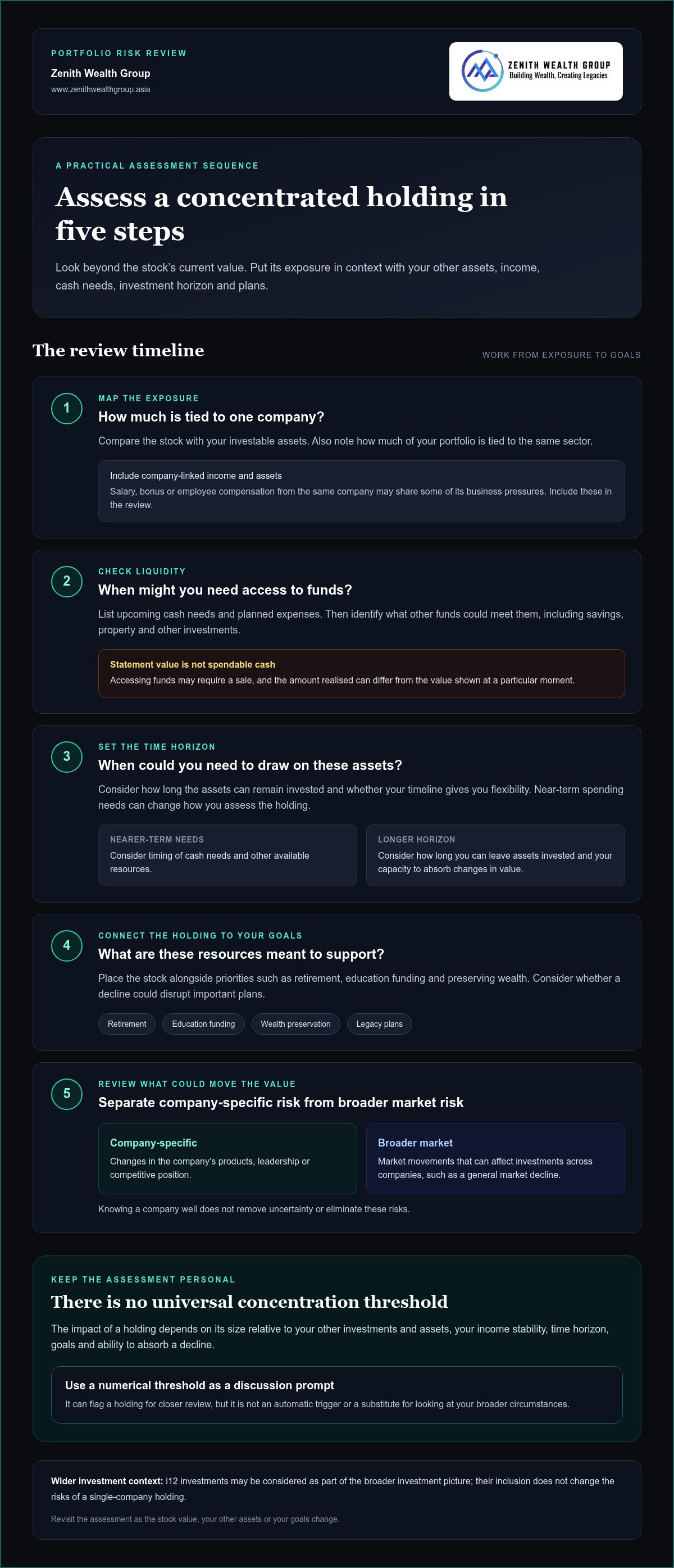
A share’s value is only one part of the assessment. To understand how much risk it adds, view it alongside your other investments, income, upcoming spending needs, and the plans those resources are meant to support. Concentration assessment considers a holding alongside the investor’s wider financial picture.
Start with a practical checklist:
- Portfolio share: What proportion of your investable assets is in this stock, and how much is tied to the same sector?
- Liquidity: What cash needs or planned expenses could arise, and what other funds are available to meet them?
- Time horizon: When might you need to draw on these assets, and how long can you leave them invested?
- Goals: How does the holding support priorities such as retirement, education funding, or preserving wealth?
Questions to ask before changing a concentrated holding
Look beyond shares held in an investment account. If your salary, bonus, or employee compensation depends on the same company, your income may be exposed to some of the same business pressures as your investment. Include other company-linked assets in the review. Then consider upcoming life events, the timing of cash needs, and whether your investment horizon gives you flexibility.
Company familiarity can help you understand its operations, but it doesn’t remove business risk. A change in leadership or competitive position may affect one company; wider sector shifts can influence related businesses; and market movements can affect investments more broadly. Fidelity’s guide to managing concentrated stock also discusses the importance of viewing a large holding in context.
Why a universal concentration threshold can mislead
A single percentage can’t tell every investor how much exposure is appropriate. The same holding may have a different impact depending on portfolio size, income stability, other assets, time horizon, and ability to absorb a decline without disrupting important plans. Someone with near-term spending needs may assess the risks differently from someone with a longer investment horizon and other sources of liquidity.
Use a numerical threshold as a discussion prompt, not a recommendation or automatic trigger. It can help identify a holding for closer review, but it shouldn’t replace an assessment of your broader circumstances. Risk also changes as the stock value, your other assets, or your goals change. Managing concentrated stock positions therefore calls for a review that looks beyond today’s portfolio snapshot.
If you’d like to put these factors in context, a portfolio review conversation can help connect your exposure with your wider financial plans.
Comparing ways to manage concentrated stock positions
There isn’t one right response to a large single-stock holding. Keeping it, selling gradually, diversifying, or using a hedge each changes the balance between exposure, access to funds, complexity, and potential tax considerations. The comparison below summarises what each approach may involve. Any tax consequences depend on your circumstances and the details of the holding.
| Approach | Exposure change | Liquidity | Complexity and potential tax considerations |
|---|---|---|---|
| Hold | Leaves company exposure largely unchanged. | No sale proceeds are created. | Simpler to maintain, but company-specific risk continues. No sale means no sale-related tax event at that time. |
| Staged sales | Can reduce exposure in portions over time. | May create access to funds as shares are sold. | Requires a plan and ongoing decisions. Each sale may have tax implications to review. |
| Diversification | Shifts some reliance from one company to a broader mix of investments. | Depends on the investments chosen and how they can be accessed. | Requires decisions about the portfolio mix. Selling shares to diversify may have tax implications. |
| Hedging | May offset some downside exposure without selling all the shares. | Doesn’t necessarily provide sale proceeds from the shares. | Can involve costs, conditions, and more complex arrangements. Tax treatment depends on the strategy and circumstances. |
Holding, staged selling, and diversifying
Holding preserves your existing position and any future participation in its gains, but leaves you exposed to company-specific changes. Staged selling spreads decisions over time instead of relying on one sale date. It can make the reduction more manageable, though it doesn’t remove uncertainty about market prices or tax consequences.
Diversification means spreading investments across different holdings rather than relying so heavily on one company. It can reduce dependence on that company, but it doesn’t guarantee better returns or prevent losses. In investment management, the aim is to consider how the overall mix supports your plans, not simply to replace one holding with another.
Hedging and other structured approaches
A protective put is an options contract that gives its buyer the right to sell shares at an agreed price within a specified period. A collar combines a protective put with selling a call option, which can help offset some cost but may limit gains above an agreed price. Both require attention to contract terms, timing, costs, and implementation. Options introduce additional risks and don’t guarantee protection or preserve all potential upside.
Exchange funds are another strategy to investigate, but eligibility and terms vary. Compare them carefully with direct diversification and staged sales. Managing concentrated stock positions means weighing these trade-offs against your goals. No strategy removes every risk, guarantees protection, or preserves all potential upside. A financial consultant or financial planner can help place the choices alongside your wider financial plan. i12 investments may also form part of a broader investment discussion.
Deciding what to do with a concentrated position
A clear process can turn concern into a considered decision. Managing concentrated stock positions isn’t about predicting what a company’s shares will do next. It’s about deciding how much exposure fits your goals, resources, and comfort with risk. Gather your records first, then work through the steps below.
- Map your exposure. Record the number and current value of shares, their share of your investable assets, and any related company or sector exposure. Include employment income, compensation, or other company-linked assets where relevant.
- Clarify your goals. Note upcoming spending needs, longer-term priorities, and when you may need to access funds. Consider how much fluctuation you could accept without changing plans that matter to you.
- Compare your choices. Assess holding, staged sales, diversification, and hedging against the same criteria: how each could change exposure, liquidity, complexity, and potential tax considerations.
- Review implications. Gather purchase records and cost-basis information, and identify questions about tax outcomes, restrictions, and implementation. Tax treatment depends on individual circumstances and applicable current rules, so don’t assume a result based on someone else’s experience.
- Document your decision. Write down the approach you’ve chosen, why it fits, and what developments might prompt another review. This gives you a reference point instead of relying on a momentary market view.
Build a personal decision brief
Keep the brief practical. Record why you hold the shares and what might change your original rationale. Add near-term liquidity needs, long-term goals, and your tolerance for portfolio fluctuations. List unresolved questions about taxes, restrictions, or how an approach would be implemented. A concise record can help you distinguish facts from assumptions and keep the decision connected to your priorities.
Compare choices against goals and constraints
Use consistent criteria for every option. Ask how much company exposure might remain, whether the choice could provide funds when needed, what complexity it adds, and what tax questions need review. Separate the desire to reduce risk from a prediction that the share price will rise or fall. Your decision can focus on managing exposure, not forecasting the market.
Set a review point based on meaningful changes in your circumstances, goals, or holdings rather than reacting to every price movement. A financial consultant or financial planner can help place the decision within a broader investment-management review, including how it connects to liquidity and long-term plans. Discuss your investment-management review with Zenith Wealth.
Bringing concentrated stock decisions into a broader wealth plan
A decision about one shareholding can reach beyond your investment portfolio. It may affect how you plan for future spending, protect wealth, or pass assets on to family. That’s why managing concentrated stock positions is best considered alongside your wider financial priorities, rather than as an isolated buy-or-sell question.
A financial consultant or wealth management firm, such as Timothy Roberts & Associates, LLC, can help you compare the available approaches with your goals, time horizon, cash-flow needs, other investments, and tolerance for fluctuations. The aim isn’t to apply a standard formula. It’s to understand how the choices may fit together, including whether a change to the position supports your broader plans while preserving the flexibility you value.
What a broader planning conversation can cover
Start with the role this holding plays in your overall financial picture. A review can consider whether your portfolio is aligned with goals such as retirement or education funding, whether you may need liquidity for planned expenses, and how much of your wealth depends on the same company or sector. It can also consider how investment management choices relate to wealth protection and your capacity to manage uncertainty.
Family plans matter, too. You may want to retain assets for future generations, provide for loved ones, or make decisions that reflect your intentions for wealth transfer. A concentrated holding can raise practical questions about how it fits those plans and what choices may need further consideration. Any discussion should reflect your circumstances, not a one-size-fits-all instruction. i12 investments can be included as a neutral reference in a wider conversation about investment planning, without assuming a particular role or outcome. For people with financial ties across Singapore, Indonesia, Malaysia, the Philippines, or Thailand, the wider picture may also include where assets, income, and tax residence sit.
Prepare for a useful first discussion
A little preparation can make it easier to focus on the questions that matter. Bring a summary of the position, relevant investment records, and a clear list of priorities. If available, include information on how and when the shares were acquired, along with your understanding of their cost basis. Note any company-related restrictions or other details you think may affect implementation.
Be open about your concerns. You might be weighing potential tax outcomes, uncertainty about timing, the complexity of a strategy, or the possibility of missing future gains. These are valid considerations, and discussing them together can help clarify which trade-offs deserve attention. Tax outcomes depend on individual circumstances and applicable current rules, so avoid relying on assumptions or another investor’s experience.
A broader review can connect the holding to your investment management, wealth protection, and legacy planning priorities. If you’d like to discuss how your position fits your circumstances, Discuss your concentrated stock position with Zenith Wealth.
Make your next step part of the bigger picture
A concentrated holding can prompt useful questions about what you want your wealth to make possible next. Rather than waiting for certainty about a company’s future, choose a review point and consider how your decisions fit the life you’re planning. That gives you a practical way to revisit your approach as your priorities or circumstances change.
Managing concentrated stock positions is a personal planning decision. Zenith Wealth offers investment management and tailored financial planning to help bring investment choices into a wider view. The firm operates as an authorised representative group under finexis advisory Pte Ltd.
Bring your questions, priorities, and relevant investment information to a conversation with a financial consultant or financial planner. Start with what matters most to you, whether that’s flexibility, preserving wealth, or planning for family. Discuss your investment planning needs with Zenith Wealth and take a thoughtful next step.
Frequently Asked Questions
What is considered a concentrated stock position?
A concentrated stock position is a holding large enough to materially affect your overall investment risk. There’s no universal percentage that applies to every investor. A position that makes up a substantial share of your investable assets may deserve closer attention, especially if your salary or other assets also depend on the same company. Assess the stock alongside your whole financial picture, not in isolation.
How do I know if too much of my portfolio is invested in one stock?
Check how much of your investable assets is tied to the company, then consider related exposure through your job, compensation, or other holdings. Ask whether a sharp fall in the stock’s value could disrupt a planned expense or long-term goal. Your comfort with fluctuations matters, too. Managing concentrated stock positions starts with identifying how the exposure interacts with your needs, rather than relying on a fixed threshold.
Should I sell a concentrated stock position all at once or gradually?
That depends on your goals, liquidity needs, risk tolerance, and possible tax consequences. Selling all at once reduces exposure sooner but means choosing a sale point for the shares sold. Gradual sales spread decisions over time, though the remaining shares continue to fluctuate in value. Compare both approaches against a clear objective, such as funding an upcoming expense or reducing reliance on one company.
Can I diversify a stock position without selling all my shares?
Yes, some approaches can reduce exposure while you retain part of the holding. Options-based hedges may offset some downside risk, though they can involve costs, complexity, and limits on potential gains. You could also diversify other assets over time, which may lower the stock’s share of your overall portfolio without selling it. Neither approach removes all risk, so consider how each works with your goals and constraints.
How are taxes on concentrated stock sales assessed in Singapore?
Singapore tax treatment depends on the facts and circumstances of the disposal, so don’t assume every share sale has the same result. Keep records of acquisition dates, purchase costs, sale details, and the reasons for holding or selling. Current rules and individual circumstances should be reviewed before acting. If your tax residence, employer, or share arrangements involve Singapore, Indonesia, Malaysia, the Philippines, or Thailand, cross-border considerations may also need attention.
Can options reduce the risk of a concentrated stock position?
Options may help manage some downside exposure, but they don’t eliminate risk or guarantee protection. A protective put gives its buyer the right to sell shares at an agreed price within a set period. A collar combines a put with a call sold against the shares, which may limit some potential gains. Understand the contract terms, costs, timing, and obligations before considering either strategy.
What information should I prepare before discussing a concentrated stock position with a financial planner?
Bring a recent position summary, investment statements, acquisition records, and any available cost-basis details. Note your other investments, company-linked income, upcoming cash needs, and the goals you want your assets to support. Write down concerns about tax, timing, complexity, or giving up future upside. Include other investments you want considered, such as i12 investments, without assuming they offset the stock’s exposure.


