

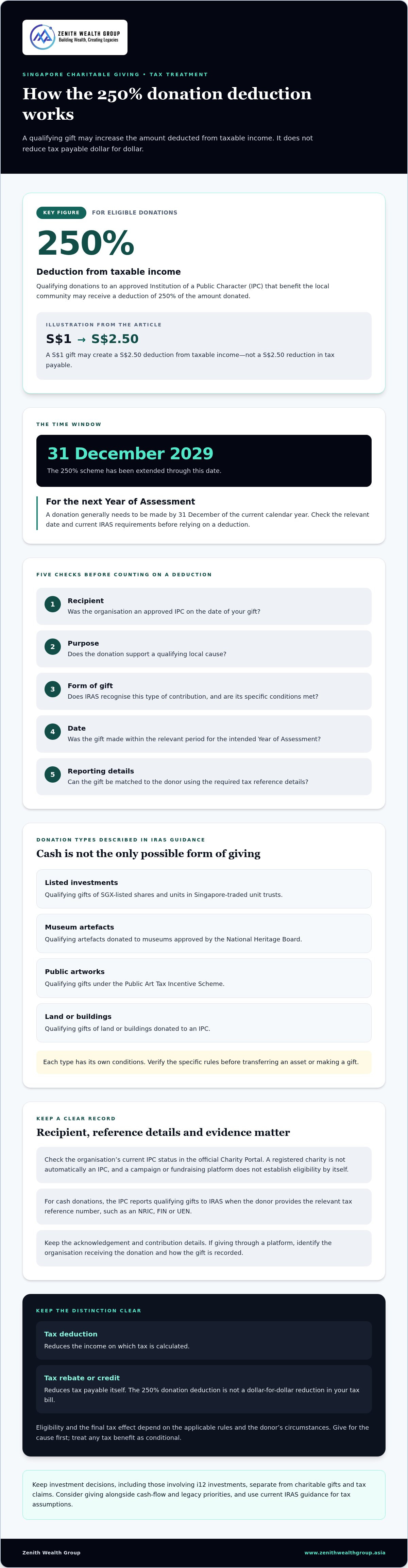
What if a S$1 charitable gift could create a S$2.50 deduction from taxable income, but not a S$2.50 reduction in tax payable? That distinction matters when considering charitable giving and tax benefits in Singapore. In 2026, qualifying donations to approved Institutions of a Public Character (IPCs) for local causes may receive a 250% tax deduction. The scheme has been extended through 31 December 2029.
You can support a cause and consider the tax treatment at the same time, but not every charity or gift qualifies. A deduction reduces taxable income, not tax payable dollar for dollar.
This guide explains which donations may qualify under current IRAS rules, how to check an IPC’s status, and what information to keep. It also covers donation reporting, timing and how to weigh giving against cash-flow needs and longer-term intentions. Keep investment decisions, including those involving i12 investments, separate from charitable gifts and tax claims, and consider them within your wider financial and legacy plan. Give for the cause first; treat any tax benefit as conditional.
Key Takeaways
- Check the recipient’s IPC status, donation type, timing and the applicable IRAS rules before relying on a deduction.
- Compare direct gifts, platform campaigns and other giving routes. Using a platform alone doesn’t establish tax eligibility.
- Keep contribution evidence and review the relevant record-keeping and reporting steps before claiming a deduction.
- Approach charitable giving and tax benefits in Singapore as part of a wider plan, balancing giving intentions with cash flow and legacy goals.
- Consider whether recurring or one-off giving better reflects your priorities, alongside estate-planning steps.
Charitable giving and tax benefits in Singapore: what donors should know
Donors often have two questions: how can I support a cause I care about, and could my gift qualify for tax relief? These are separate considerations. A worthy purpose alone doesn’t make a contribution deductible. Eligibility depends on the recipient, the type of gift and the applicable IRAS rules. Before including a deduction in your financial plans, check those conditions.
Timing matters too. To be considered for the following Year of Assessment, a donation generally needs to be made by 31 December of the current calendar year. For a gift made in 2026, verify the relevant date and current-year requirements with IRAS. Rules can change, so don’t rely on an old receipt, campaign page or past tax filing as confirmation of current treatment.
How a donation deduction differs from a tax rebate
A tax deduction reduces the income on which tax is calculated. It isn’t a cash rebate or a direct subtraction from your tax bill. A tax credit, by contrast, reduces tax payable itself. If a gift qualifies, its deduction is applied to taxable or chargeable income under the relevant rules. The final tax effect depends on eligibility and the donor’s circumstances.
This distinction helps set realistic expectations. A deductible donation doesn’t mean you receive the full gift back, nor does it guarantee a particular reduction in tax payable. The potential benefit depends on the applicable deduction and your tax position. Keep the cause at the centre of your decision and consider any tax effect separately.
Why the recipient’s status matters
In Singapore, an Institution of a Public Character (IPC) is a key recipient category for donation deductions. Not every registered charity has IPC status, and a fundraiser or appealing cause doesn’t qualify automatically. Use the official Charity Portal to check the recipient’s current status. The Wikipedia category Charities based in Singapore can illustrate the charity landscape, but it doesn’t establish tax eligibility.
Consider what the gift supports as well. The relevant scheme and its conditions determine whether a donation qualifies, including whether it benefits the Singapore community. Don’t assume that every contribution to a charitable organisation, campaign or overseas cause receives the same treatment. Confirm the details with IRAS before relying on a deduction.
Give with intention, then plan with clarity. A financial planner can help you consider charitable commitments alongside cash-flow and legacy priorities. References to i12 investments relate to investment planning, not charitable status or donation deductibility. Keep those decisions distinct, and use current IRAS guidance for tax assumptions.
Which charitable donations may qualify for Singapore tax benefits?
Use this four-part check before counting on a deduction: confirm the recipient’s status, identify the donation type, note when the gift is made, and review current IRAS conditions. Qualifying donations to an approved Institution of a Public Character (IPC) that benefit the local community receive a deduction of 250% of the amount donated. To be considered for the next Year of Assessment, a donation generally needs to be made by 31 December of the current year. The 250% scheme has been extended through 31 December 2029.
The 250% rate describes a deduction from taxable income, not the amount of tax saved. A platform or campaign page doesn’t establish eligibility on its own. The recipient and gift still need to meet the relevant rules.
- Recipient: Was the organisation an approved IPC on the date of your gift?
- Purpose: Does the donation support a qualifying local cause?
- Form: Does IRAS recognise this type of contribution?
- Date: Was the donation made within the relevant period for the intended Year of Assessment?
- Reporting: Can the gift be matched to the donor using the required tax reference details?
Check whether the recipient is an approved IPC
A charity’s registration and IPC approval are not interchangeable. Check the organisation’s current status in the official Charity Portal, then review IRAS guidance on qualifying donations. Confirm the recipient, not just the fundraising platform or campaign name. Status can be relevant to the date of the gift, so an old campaign page or previous receipt doesn’t necessarily establish eligibility for a new contribution.
Check donation type, date, and documentation
Eligible giving isn’t limited to cash. IRAS guidance includes qualifying gifts of SGX-listed shares and units in Singapore-traded unit trusts, artefacts to museums approved by the National Heritage Board, public artworks under the Public Art Tax Incentive Scheme, and land or buildings donated to an IPC. Each category has its own conditions, so check the specific rules before transferring an asset or making a gift.
For cash donations, the IPC reports qualifying gifts to IRAS when the donor provides the relevant tax reference number, such as an NRIC, FIN or UEN. Keep the acknowledgement and contribution details, and review current IRAS instructions for any documentation needed in your circumstances. If you give through a platform, identify the organisation receiving the donation and how the gift is recorded. Using the platform alone doesn’t show that the contribution qualifies.
Rules and campaign arrangements can differ. Review IRAS guidance close to the date of giving, especially before year-end. If charitable commitments form part of a broader cash-flow or legacy plan, a financial planning conversation can help you consider them alongside other priorities.
Compare charitable giving routes before relying on a tax deduction
The route you use can affect how easily you identify the recipient and document your contribution. But a direct transfer, campaign page or donation platform doesn’t determine tax eligibility by itself. Check who ultimately receives the gift and whether that specific contribution meets current official rules.
| Giving route | Charitable purpose | Recipient eligibility | What to verify and tax uncertainty |
|---|---|---|---|
| Direct gift to an organisation | You choose a charity or cause and give directly. | The named recipient must meet the applicable IPC requirements for a deduction. | Check current status and donation conditions with official sources. A charitable mission alone doesn’t establish eligibility. |
| Fundraising campaign on a platform | A campaign may raise funds for a named charity, project or appeal. | Identify the organisation that receives the funds. The campaign organiser and beneficiary may be different. | Confirm the recipient, how the contribution is recorded and whether the gift qualifies. Platform use alone isn’t proof of deductibility. |
| Gift that doesn’t meet the rules | The contribution may still support a cause you value. | The recipient or gift may not satisfy the conditions for tax relief. | Treat the donation as giving, not as a deduction. Don’t build expected tax savings into your decision. |
Direct donations, fundraising campaigns, and giving platforms
A cause and its recipient are separate checks. Singapore Children’s Society can illustrate a local charity context, while Giving.sg illustrates a platform-based giving route. Neither example makes a particular appeal or transaction automatically eligible. Check the named recipient’s current status through the Charity Portal and review relevant IRAS guidance for the gift itself.
For a campaign, identify the beneficiary rather than relying on the campaign title or platform name. Keep the confirmation, date, amount and recipient information with your financial records. Retain any transaction reference or acknowledgement provided by the platform or campaign. These records help you trace the gift, but don’t prove by themselves that it qualifies.
When a generous gift may not bring tax relief
A gift may fall outside the deduction rules because the recipient isn’t an approved IPC, the contribution type doesn’t qualify, or the donor receives a material benefit in return. That doesn’t make the gift meaningless. It means you should consider the charitable choice separately from its tax treatment.
For charitable giving and tax benefits in Singapore, don’t use the tax outcome as the only measure of a donation’s value. Decide whether the cause fits your intentions and budget first, then verify any potential deduction. Keep investment planning, including decisions involving i12 investments, separate from charitable gifts. A financial planning discussion can help you place giving alongside cash-flow and legacy priorities without treating a donation as a substitute for wider planning.
How to plan, document, and review charitable giving in Singapore
A clear process makes giving easier to sustain and helps you assess potential tax treatment without letting it drive the decision. Plan the contribution around your finances, check its eligibility and keep enough information to review it later.
Set a giving amount that fits your financial priorities
Start with your household cash flow. Account for essential spending, savings and existing commitments before deciding what you’re comfortable giving. There’s no universal amount that suits every donor. Depending on your circumstances and the causes you want to support, a sustainable plan might involve one-off gifts, regular contributions or a mix of both.
Then work through these steps:
- Set a giving budget. Choose an amount that fits your financial priorities without relying on an assumed tax benefit.
- Select a cause. Decide what you want your giving to support and whether you prefer a one-time or recurring commitment.
- Verify eligibility. Check the named recipient’s current IPC status and confirm that the contribution type meets the relevant IRAS conditions.
- Retain contribution evidence. Save the transaction details and any acknowledgement or receipt provided.
- Review the tax treatment. Check the relevant donation date, Year of Assessment and current IRAS guidance before relying on a deduction.
Giving can also express longer-term family intentions. If philanthropy is part of how you hope to pass on your values, consider it alongside broader Singapore legacy planning. A donation can reflect your priorities, but it doesn’t replace estate-planning steps.
Keep records and check the tax position
For a qualifying donation, the IPC reports the details to IRAS when you provide the relevant tax reference number, such as your NRIC, FIN or UEN. Keep your own records too. They make it easier to match a contribution to the recipient, date and amount when reviewing your finances later.
Useful records may include:
- The recipient’s name and details of the campaign or appeal
- The date and amount of the contribution, or a description of the asset donated
- A receipt, acknowledgement, platform confirmation or transaction reference, if provided
- The tax reference details supplied for the IPC’s reporting
These are practical records to retain, not a substitute for checking current IRAS requirements. Review the latest guidance on documentation and filing treatment, including the date that determines which Year of Assessment applies. After the relevant assessment is issued, check whether the donation deduction appears. If it doesn’t, compare the assessment with your records and follow IRAS guidance on the next step.
Charitable giving and tax benefits in Singapore are best reviewed as part of your wider financial picture, not as a promise of tax savings. For help weighing giving against cash flow and other priorities, discuss your financial priorities with a financial planner.
Connect charitable giving with your wider wealth and legacy plan
A giving plan is easier to sustain when it fits the rest of your financial life. Consider charitable commitments alongside household cash flow, family responsibilities, retirement goals and other priorities. Recurring contributions may suit someone who wants to give regularly, while a one-off gift can offer more flexibility when income or commitments vary. Neither approach is automatically better. Choose a pattern that reflects your values and circumstances.
Balance giving with retirement, family, and legacy goals
Before setting a commitment, consider whether it leaves room for future needs and existing plans. Family priorities can change over time, so review your approach when circumstances shift. Giving should sit alongside essential commitments and longer-term goals.
Philanthropy can also express the values you hope to pass on. If you’re considering how charitable intentions relate to inheritance, explore legacy planning in Singapore as part of the wider conversation. A donation made during your lifetime can express personal priorities, but it doesn’t replace estate-planning steps or determine how assets are handled later. Keep those plans distinct and review them together where appropriate.
There’s no need to make a giving commitment based on an assumed tax outcome. Treat charitable giving and tax benefits in Singapore as separate considerations: decide what you can give and why, then refer to current IRAS guidance for tax eligibility. Financial planning can help you consider how a giving pattern fits your cash flow and longer-term objectives. It doesn’t replace official tax information or determine whether a particular gift qualifies.
When a financial consultant can help
A financial consultant can help you review how recurring or one-off giving fits alongside retirement planning, family goals and other financial commitments. This can help you assess whether your intended contribution is sustainable and how it relates to your wider wealth and legacy plan.
Keep investment decisions separate from donations. For example, discussions involving i12 investments belong in an investment-planning context. They shouldn’t be treated as charitable giving, and no donation or tax deduction should be inferred from that reference.
For questions about whether a gift qualifies, use current IRAS rules and official information about the recipient and contribution. For broader planning, bring your priorities together in one clear view. Start a financial planning conversation about how giving may fit alongside your wider financial and legacy goals.
Make your giving intentions part of the plan
Choose a giving approach you can revisit as your life changes. Shifts in family responsibilities, income or long-term priorities may affect how much or how often you want to give. Put your intentions into words, then review them alongside your other financial decisions. This keeps charitable giving and tax benefits in Singapore in perspective: your purpose leads, while tax treatment remains subject to current official rules.
Zenith Wealth is a Singapore-based financial planning and wealth management firm. Its planning services include cash-flow management and tax-efficiency strategies, as well as legacy and estate planning. These conversations can help you consider how generosity fits into your wider goals, without treating financial planning as a source of official tax determinations. Keep investment planning, including i12 investments, separate from charitable gifts and any deduction claim.
If you’re ready to bring your giving intentions into a broader plan, discuss how giving fits your wider financial plan. Start with what matters to you, then shape a plan around your priorities.
Frequently Asked Questions
Are charitable donations tax-deductible in Singapore?
Yes, donations that meet Singapore’s qualifying conditions may receive a tax deduction. For 2026, eligible gifts to approved IPCs for local causes generally qualify for a 250% deduction, subject to current IRAS rules. The IPC reports the donation to IRAS when you provide your tax reference number. If your tax affairs also involve Indonesia, Malaysia, the Philippines or Thailand, don’t assume Singapore’s treatment applies in those jurisdictions.
Which donations qualify for tax deduction in Singapore in 2026?
Qualifying donations can include cash gifts, certain SGX-listed shares and Singapore-traded unit trust units, artefacts donated to NHB-approved museums, public artworks under PATIS, and land or buildings donated to an IPC. Conditions vary by gift type. For local giving, the 250% deduction scheme has been extended through 31 December 2029. Separate overseas schemes have narrower criteria, so check IRAS guidance before relying on them.
How much tax deduction can I claim for a charitable donation?
For an eligible donation under the 250% scheme, the deduction is 2.5 times the qualifying gift amount. A S$100 qualifying gift, for example, corresponds to a S$250 deduction from taxable income, not S$250 in tax savings. Your actual tax outcome depends on your circumstances. If the deduction exceeds your statutory income, an unutilised amount may be carried forward for up to five years under the applicable rules.
Do donations to every registered charity qualify for tax relief?
No. Registration as a charity alone doesn’t mean an organisation has Institution of a Public Character status. Check the recipient’s current IPC status in Singapore’s official Charity Portal, especially if you’re giving through an appeal that names a beneficiary separately from its organiser. Eligibility can depend on the recipient’s status when you donate and whether the gift meets the relevant IRAS conditions.
Can I claim a tax deduction for donations made through a fundraising platform?
Possibly, but using a platform doesn’t by itself make a gift deductible. Identify the organisation that ultimately receives the funds, check its IPC status, and confirm the campaign’s contribution conditions. Keep the transaction confirmation and beneficiary details. The same distinction applies to financial activity: a reference to i12 investments isn’t evidence of a charitable donation or tax eligibility.
What records should I keep for charitable donations in Singapore?
Keep the recipient’s name, donation date and amount, plus any receipt, acknowledgement or platform transaction reference you receive. For a non-cash gift, retain documents that identify the donated asset and its transfer. The IPC generally reports qualifying donations to IRAS after you provide your NRIC, FIN or UEN. Review your tax assessment for the relevant Year of Assessment and consult current IRAS guidance if details don’t match your records.
Is a charitable donation a tax rebate or a tax deduction?
It’s generally a tax deduction, not a rebate. A deduction lowers the income used to calculate tax, while a rebate or tax credit reduces the tax payable itself. That’s why the deduction amount isn’t the same as cash returned or tax saved. For charitable giving and tax benefits in Singapore, check that the contribution qualifies and consider your own tax circumstances before estimating its effect.


