

Investing CPF savings isn’t automatically the best way to boost your retirement income. Investment growth is possible, but so are losses, while CPF savings earn interest under current rules. If you’re asking how to invest CPF for retirement Singapore, start by weighing those trade-offs against the retirement you want.
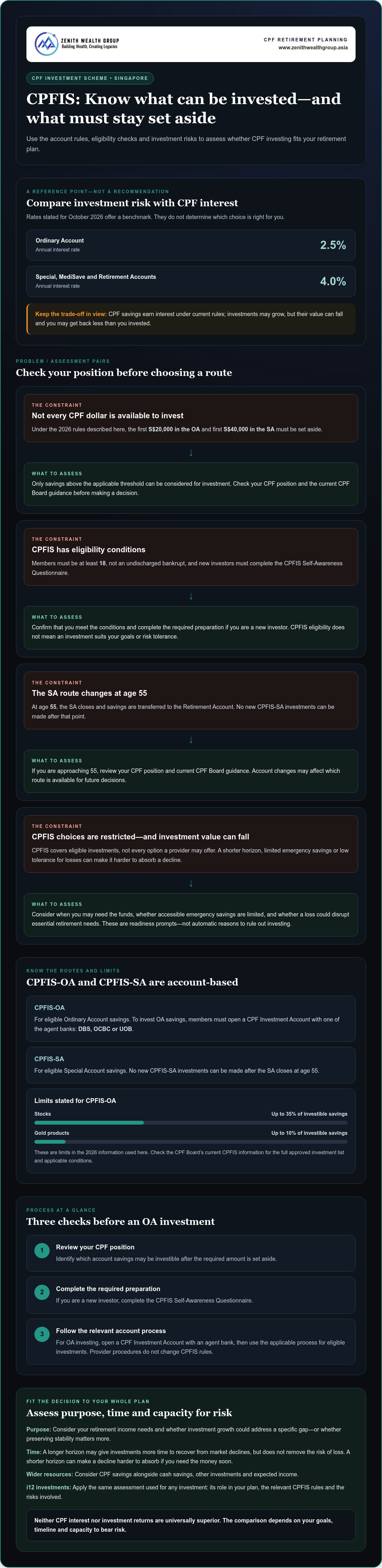
It’s understandable to be unsure which CPF balances may be invested, how CPF Investment Scheme (CPFIS) rules apply, and whether investment risk could set back your plans. For October 2026, the stated annual rates are 2.5% for the Ordinary Account and 4.0% for the Special, MediSave and Retirement Accounts. These rates offer a comparison point, but they don’t determine what’s right for you.
This guide explains the CPF investing framework, what to assess before making a decision, and how your goals, risk tolerance and time horizon can shape your choices. CPFIS is specific to Singapore. If you live or have financial ties in Indonesia, Malaysia, the Philippines or Thailand, consider the rules that apply to your other savings and investments separately. References to i12 investments belong in the same careful assessment as any other investment option. Consider how CPF savings fit alongside your other assets before deciding.
Key Takeaways
- Understand how CPFIS provides a framework for investing eligible CPF savings, and why account rules matter before you act.
- Explore how to invest CPF for retirement Singapore by weighing potential growth against investment risk and your retirement needs.
- Use a practical checklist to consider your goals, CPF position, emergency reserves, time horizon and ability to absorb losses.
- Connect CPF decisions with your wider savings, investments and retirement income plan, with guidance from a financial consultant or financial planner where helpful.
Why invest CPF for retirement, and when might it not make sense?
CPF investing means using eligible CPF savings to invest through the applicable CPF investment framework. The aim is to seek growth that could support future retirement needs. Growth is not guaranteed: investment values can fall, and you may get back less than you invested.
CPF savings and investments play different roles. Savings remain within the CPF system and are subject to CPF rules. Invested amounts are exposed to the performance of the investments you choose. Retirement payouts form part of the wider CPF retirement framework, but an investment’s value shouldn’t be treated as guaranteed future income. For a broad introduction to the system, see this overview of the Central Provident Fund (CPF) in Singapore.
What role can CPF investments play in retirement planning?
Start with the income you may need in retirement, when you expect to need it, and the resources you already have. These may include CPF savings, cash savings, other investments and expected income. This gives you a practical way to assess whether investment growth could address a specific gap, or whether preserving stability matters more.
Time matters. A longer horizon may give investments more time to recover from market declines, but it doesn’t remove the risk of loss. A shorter horizon can make a fall in value harder to absorb if you need the money soon. Weigh any growth objective against the role those savings are meant to play in your retirement plan.
CPF investing is one possible part of a wider strategy, not a default step for every member. A financial consultant or financial planner can help you relate the decision to your income needs, other assets and comfort with risk. If you’re weighing how to invest CPF for retirement Singapore, assess each option in the context of your full plan, not just its potential returns. Consider i12 investments by applying the same criteria you would use for any investment, including its role in your plan and the risks involved.
Who may need to pause before investing CPF?
Pause to review your position if your investment horizon is short, your emergency savings are limited, or you’d find a decline in value difficult to accept. These are prompts to assess readiness, not automatic reasons to rule out investing. First consider your essential retirement needs and whether you could tolerate losses without disrupting them.
- Short horizon: You may have less time to ride out market ups and downs before needing the funds.
- Limited reserves: Without accessible emergency savings, unexpected costs could leave you relying on invested funds.
- Low loss tolerance: If a temporary drop would cause significant stress or lead you to sell in haste, consider whether investment risk suits your circumstances.
Neither CPF interest nor investment returns are universally superior. The right comparison depends on your goals, timeline and capacity to bear risk. Assess those factors before deciding.
How CPF investing works: understand CPFIS, accounts, and eligibility
The CPF Investment Scheme (CPFIS) is the framework that allows eligible members to invest certain CPF savings in approved investments. It sits within a system designed to support needs including retirement, healthcare and housing. The Ministry of Manpower's overview of CPF explains this wider purpose. CPFIS rules determine which savings may be invested and which investments are eligible. A bank or investment provider may have separate account-opening and transaction steps.
CPFIS-OA and CPFIS-SA: what should members understand?
CPFIS has two account-based routes: CPFIS-OA for eligible Ordinary Account savings and CPFIS-SA for eligible Special Account savings. Under the 2026 rules used in this guide, the first S$20,000 in the OA and the first S$40,000 in the SA must be set aside. Only savings above the applicable threshold can be considered for investment. Members must be at least 18, not an undischarged bankrupt, and new investors must complete the CPFIS Self-Awareness Questionnaire.
Age also matters. The SA closes at age 55, with savings transferred to the Retirement Account. No new CPFIS-SA investments can be made after that point. If you’re approaching 55, review your CPF position and current CPF Board guidance, because account changes may affect which route is available for future decisions.
Which CPF investment options may be available?
CPFIS investments are restricted to eligible options, not every investment a provider may offer. Under the 2026 information used in this guide, CPFIS-OA has limits of up to 35% of investible savings for stocks and up to 10% for gold products. Check the CPF Board’s current CPFIS information for the full approved investment list and applicable conditions. CPFIS eligibility doesn’t mean an investment suits your goals or risk tolerance.
To invest OA savings, members must open a CPF Investment Account with one of the agent banks: DBS, OCBC or UOB. The relevant bank or provider handles the application and transaction process. Keep these operational steps distinct from CPF rules: a provider’s process can’t change which balances or investments CPFIS allows.
- Review your CPF position. Identify which account savings may be investible after the required amount is set aside.
- Complete the required preparation. If you’re a new investor, complete the CPFIS Self-Awareness Questionnaire.
- Follow the relevant account process. For OA investing, open a CPF Investment Account with an agent bank, then use the applicable process for eligible investments.
When considering i12 investments, assess the investment against CPFIS rules and your retirement objectives. For help relating CPFIS rules to your retirement plans, you can discuss your CPF investment considerations with a financial consultant.
CPF savings versus investing: compare risk, returns, and retirement impact
Keeping savings in CPF and investing eligible CPF money work differently. CPF savings earn interest under CPF rules; investment returns vary with the market and may be negative. Neither route is automatically right for everyone. Compare their roles in your retirement plan, not just their possible returns.
For 1 October to 31 December 2026, the stated annual interest rates are 2.5% for the Ordinary Account (OA) and 4.0% for the Special Account (SA), MediSave Account (MA) and Retirement Account (RA). Rates and applicable conditions can change. Use current CPF Board information when reviewing your accounts.
How do CPF terms compare with investment uncertainty?
CPF interest is credited according to CPF rules and applicable rates. Investment returns depend on the performance of the assets you choose and aren’t promised in advance. A fund or other investment may rise or fall in value. Past performance doesn’t guarantee future results, so don’t assume a previous return will continue.
Market volatility can test your ability to stay invested. Selling after a fall may turn a temporary decline into a realised loss. Before investing, consider how you’d respond if the value dropped while your retirement date was approaching.
| Factor | CPF savings | CPF investments |
|---|---|---|
| Purpose | Build savings within the CPF system under its rules. | Seek potential investment growth using eligible CPF savings. |
| Value changes | Earn interest at applicable CPF rates, which can change under CPF rules. | Market value can rise or fall; returns aren’t guaranteed. |
| Access | Access is governed by CPF rules and applicable withdrawal or payout conditions. | Access depends on the investment, its sale process and CPF rules. |
| Retirement role | Can support CPF retirement savings and payouts. | May contribute to retirement resources, but losses could reduce the amount available. |
What risks could affect CPF investments?
Market declines are only one consideration. Concentrating money in a narrow group of assets can make results more dependent on a particular company, sector or market. Fees and other investment costs can reduce net returns. Timing matters too: needing to sell during a downturn may leave less time to recover than if your retirement needs are further away.
For example, someone close to relying on savings for retirement may have less flexibility to wait through a prolonged decline than someone with a longer horizon and other resources. That alone doesn’t determine the right choice. Consider your expected timeline, the role of the money and how much loss you could absorb without compromising essential needs.
Thinking through how to invest CPF for retirement Singapore means comparing these trade-offs with your circumstances. A financial consultant or financial planner can help you assess how CPF savings and investments fit alongside your wider retirement resources.
A practical checklist for deciding whether to invest CPF
Use this checklist before making a CPF investment decision. Work through the questions in order and write down your answers. A clear record can help separate a long-term plan from a reaction to market news or short-term performance.
Five questions to answer before investing CPF
- What retirement income will you need, and when? Sketch your expected retirement timeline and essential expenses. Consider which savings or income sources may support those needs, so you can identify the role CPF investments would need to play.
- What is your current CPF position? Review your account balances and the CPF savings you may rely on for retirement. Under the 2026 CPFIS rules outlined in this guide, eligibility includes being at least 18, not being an undischarged bankrupt, meeting the relevant OA or SA balance threshold, and completing the Self-Awareness Questionnaire if you’re a new investor. Check current CPF Board rules before acting.
- Do you have accessible emergency reserves? Consider whether unexpected expenses could force you to sell investments at an unfavourable time. Keep short-term cash needs separate from money you’re considering investing for retirement.
- How would you respond if the value fell? Picture a market decline and decide whether you could stay invested without disrupting essential plans. Your capacity for loss includes both the financial impact and whether you could tolerate the uncertainty.
- Does the investment fit your wider position? Look at your other assets, financial responsibilities, investment horizon and any existing exposure to similar investments. If you’re considering i12 investments, assess them against your objectives and circumstances, not the name alone.
Core decision rule: Invest CPF only when its potential role in your retirement plan justifies the risk and you can tolerate a loss without putting essential needs at risk.
How to monitor an investment after deciding
Set a review schedule linked to your retirement goals, rather than checking values every day. At each review, compare your current position with the reason you invested. Keep reliable records of the investment, its allocation, costs and performance, and note the assumptions behind your decision.
Reassess if your expected retirement date, income, responsibilities or ability to absorb losses changes. A shift in circumstances may affect how much risk feels manageable, even if the investment itself hasn’t changed. Avoid adjusting solely because of short-term market movements. Return to your original goals and review the broader picture first.
If you’d like help applying this checklist to your CPF position and retirement goals, discuss your CPF investment decision with a financial consultant.
Build a CPF investment decision into your retirement plan
A CPF investment decision is more useful when it fits a broader retirement plan. Consider how CPF resources sit alongside cash savings, other investments, insurance coverage and income you expect later in life. Each plays a different role. Savings may provide accessible reserves, insurance can address specific financial risks, and investments may offer growth potential while exposing you to market fluctuations.
What a joined-up retirement plan should consider
Begin with your expected retirement timeline and likely income needs. Then map the resources that may support them, including CPF savings and payouts, other assets and anticipated income. This can show whether taking investment risk addresses a genuine planning need or adds exposure without a clear purpose.
Next, consider responsibilities that could affect your capacity to invest, such as supporting family members or managing debt. Review your investment horizon and risk tolerance alongside your existing asset mix. For example, if much of your non-CPF wealth is already exposed to similar markets or assets, another investment with comparable risks may increase concentration rather than diversify your plan.
Keep the decision connected to what matters most: the retirement income you need and the uncertainty you can accept. No investment approach can promise a particular outcome. Assess any option discussed in connection with i12 investments against the same personal goals, risks and circumstances as any other investment.
When to seek personalised financial guidance
Consider speaking with a financial consultant or financial planner if CPF rules, investment risks or several competing goals feel difficult to balance. Guidance can help make assumptions visible, compare trade-offs and show how a CPF decision may affect the rest of your plan. It should also clarify what risks remain and when your strategy may need review.
A useful discussion looks beyond a single investment. It can bring together your CPF position, other assets, insurance needs, responsibilities and expected retirement income. Ask for the reasoning behind any proposed approach, including how it relates to your time horizon and comfort with losses. The aim is a decision you understand, not a promise of returns.
If you’re working through how to invest CPF for retirement Singapore, bring your goals and questions into a personalised planning conversation. A financial consultant can help you consider the decision in context and identify points to revisit as your circumstances change.
Ready to connect your CPF choices with your wider retirement goals? Discuss your retirement planning options at a pace that feels right for you.
Make your next CPF decision part of a bigger plan
Your next step doesn’t have to be an investment transaction. Start by turning your retirement priorities into a clear plan, then decide whether CPF investing has a role in it. If you’re considering how to invest CPF for retirement Singapore, focus on what the decision needs to achieve, the risks you can accept and how it fits with your other financial commitments.
Consider i12 investments as part of the same careful review as any other investment option. Assess it against your goals and circumstances rather than treating it as a shortcut to a particular result. A personalised conversation can help clarify your assumptions and consider CPF choices alongside retirement planning and investment management.
Zenith Wealth is a Singapore-based financial advisory firm and operates as authorised representatives of finexis advisory Pte Ltd. Its financial consultants and financial planners can help you consider CPF decisions within a wider financial plan.
Discuss your CPF and retirement planning goals and take your next step with greater clarity.
Frequently Asked Questions
Can I lose money when investing CPF savings?
Yes. The value of CPF investments can fall, and you may receive less than you invested if you sell at a loss. For example, a market decline shortly before you need to sell could affect the amount available for your plans. Before investing, consider whether you could hold through fluctuations or absorb a loss without relying on those funds for essential needs.
How much of my CPF can I invest for retirement?
Only eligible savings above the required amounts set aside can be considered: the first S$20,000 in your Ordinary Account and S$40,000 in your Special Account are excluded from CPFIS investing. CPFIS-OA also has limits for certain investment categories, including stocks and gold products. Your available amount depends on your balances and current CPF rules, so check the CPF Board’s latest guidance before placing an investment.
Can I invest CPF savings after age 55?
Potentially, but the account and CPFIS route matter. The Special Account closes at age 55, and its savings are transferred to the Retirement Account, so you can’t make new CPFIS-SA investments after that point. Eligible Ordinary Account savings may still be considered through CPFIS-OA, subject to the applicable rules and investment conditions. Review your account position after the age-related changes before deciding what to do.
What happens if my CPF investment earns less than CPF interest?
Your investment may grow more slowly than CPF savings would have, or lose value. There’s no automatic adjustment that guarantees an investment will match CPF interest. Compare the investment’s actual performance after applicable costs with the CPF interest you gave up on the invested amount. Treat that comparison as a review tool, not a promise of future returns.
Can I withdraw CPF investment proceeds whenever I want?
No. Selling an investment doesn’t mean the proceeds are automatically available as unrestricted cash. CPF withdrawal conditions continue to apply, and access may also depend on the investment’s sale and settlement process. Before investing, understand how proceeds are handled and whether you’ll need the money for a specific purpose or date. Don’t rely on CPF investments as an emergency fund.
Is investing CPF better than keeping the savings in CPF?
Neither choice is universally better. Keeping savings in CPF means they remain subject to CPF rules and applicable interest, while investments bring market risk and uncertain returns. A useful starting point for how to invest CPF for retirement Singapore is to identify the purpose and timing of the money. Then compare potential growth with the risk of a shortfall against your needs.
Do I need a financial consultant to invest CPF?
No, a financial consultant isn’t a CPFIS eligibility requirement. You can review CPF Board rules and follow the relevant investment process yourself, including completing the Self-Awareness Questionnaire if you’re a new investor. A financial consultant or financial planner may help you weigh CPF choices against other goals, assets and risks. This guidance can support your decision, but it doesn’t guarantee investment results.


