

If you’re asking what to do with a large bonus or windfall in Singapore, the smartest first move may be to pause, not invest. A lump sum can ease pressure and open new possibilities, but it can also make competing priorities feel urgent. Start by reviewing your existing commitments before making major decisions.
This guide offers a practical sequence for deciding what deserves attention first. Consider immediate needs, outstanding obligations, family priorities and longer-term goals without relying on a one-size-fits-all formula. The aim is to connect the money to what matters in your life, not rush to find somewhere to put it.
Your time horizon can shape decisions about savings, retirement and investing, including how i12 investments may fit into a wider conversation about investment choices. You’ll also want to consider personal priorities, wealth protection and legacy planning. A thoughtful plan can help turn a sudden sum into a clearer path forward.
Key Takeaways
- Before deciding what to do with a large bonus or windfall in Singapore, clarify when the money will arrive and how certain the amount is.
- Build a simple snapshot of your assets, debts, regular commitments, accessible reserves and upcoming goals before assigning the funds.
- Compare debt reduction, reserves, protection, family goals, retirement and investing based on your circumstances, rather than following a fixed formula.
- Give each part of the windfall a purpose, record why you chose that allocation and decide what would prompt you to review it.
- Zenith Wealth Group offers a free 30-minute discovery session to match clients with authorized Financial Consultants representing finexis advisory Pte Ltd [Reg No 200408660G].
What Counts as a Large Bonus or Windfall in Singapore, and Why Pause First?
A large windfall isn’t defined by a universal dollar amount. It’s a one-off sum substantial enough to affect your choices, whether it comes from an employment bonus, an inheritance or proceeds connected to a business. The right way to plan depends not only on how much you receive, but also on where it came from, when it will arrive and whether it comes with expectations or existing commitments.
A windfall is an event, not a financial plan. Receiving money creates new options, but it doesn’t automatically show which option should come first. The phrase windfall profit is commonly used for an unexpected gain. For personal planning, start by understanding the circumstances around your particular lump sum.
Bonus, inheritance or other lump sum: what changes?
An employment bonus is connected to work and may be part of your expected income. An inheritance or business-related payment may involve family, estate or commercial considerations. Don’t assume that every sum has the same tax or legal treatment. Identify the source and review relevant paperwork or conditions before deciding how to use the money.
Ask yourself:
- Has the sum been received, or is it expected? Is the timing or amount certain?
- Does anyone expect the money to be used for a particular purpose?
- Are there existing commitments, family discussions or conditions attached to it?
A bonus that has already been paid is different from proceeds you’re still waiting to receive. You can make preliminary plans for expected money, but don’t treat it as available until the amount and timing are clear. This helps prevent today’s decisions from relying on funds that may arrive later or differ from your expectations.
Why a deliberate pause can prevent rushed decisions
A sudden sum can bring excitement, requests from people close to you or an investment pitch that seems to demand a quick answer. Pressure can make it harder to distinguish a genuine priority from a decision that simply feels urgent. You don’t need to settle every question immediately.
Write down what you know, what remains uncertain and what you need to understand before making a major commitment. Take particular care with choices that are difficult to reverse. If an investment conversation involves i12 investments, consider it within your wider financial picture rather than letting the pitch alone dictate your next step.
A pause isn’t the same as ignoring essential obligations. Keep up with bills and commitments already due while reviewing larger decisions. You can also set aside a reasonable amount for something personally meaningful. A thoughtful plan can include enjoyment alongside the responsibilities and goals you’ll weigh next.
How to Assess Your Financial Position Before Allocating a Windfall
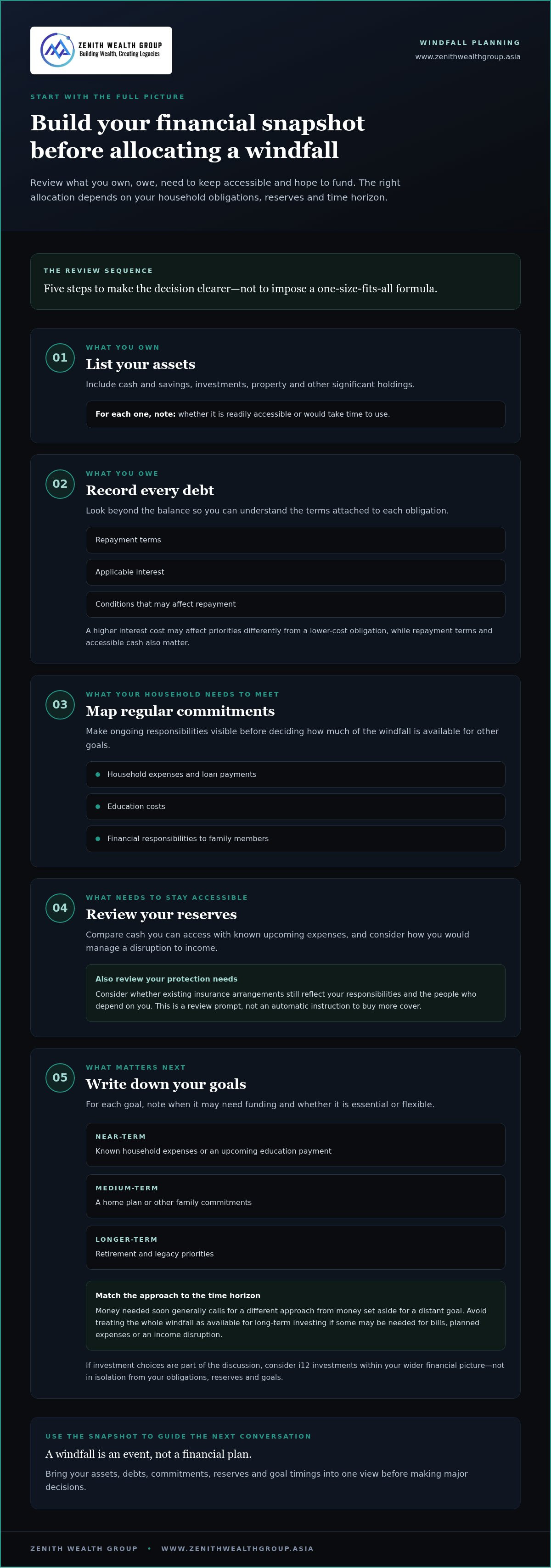
Before deciding where the money should go, build a clear snapshot of your household finances. A large sum can feel substantial on its own, but its role becomes clearer beside your existing assets, debts, regular commitments, reserves and upcoming goals. The right allocation depends on your household’s obligations, reserves and time horizon.
Use this sequence to make the review manageable:
- List your assets. Include cash and savings, investments, property and other significant holdings. Note whether each is readily accessible or would take time to use.
- Record every debt. For each balance, note repayment terms, applicable interest and any conditions that affect repayment. This makes it easier to identify obligations that may need earlier attention.
- Map regular commitments. Include household expenses, loan payments, education costs and financial responsibilities to family members.
- Review accessible reserves. Compare cash you can access with known upcoming expenses. Consider how you would manage a disruption to income.
- Write down goals. Include planned purchases, home plans, education funding, retirement and family priorities. Estimate when each may require money.
Map debts, cash reserves and financial commitments
Don’t look at debt balances in isolation. A loan with a higher interest cost may affect your priorities differently from a lower-cost obligation, but repayment terms and your need for accessible cash matter too. Check what savings are available without disrupting essential spending, then compare them with expenses you can already anticipate.
Review your insurance needs as part of the household picture. Consider whether existing arrangements still reflect your responsibilities and the people who depend on you. This is a prompt to assess your situation, not an automatic instruction to buy additional cover.
Sort goals by timing, importance and flexibility
Sort goals by when the money may be needed. Near-term goals could include known household expenses or an upcoming education payment. Medium-term plans may involve a home or other family commitments. Longer-term goals can include retirement and legacy priorities. Mark each goal as essential or flexible, and note whether its timing could change.
Money needed soon generally calls for a different approach from money set aside for a distant goal. Avoid treating the whole windfall as available for long-term investing if some may be needed for bills, planned expenses or an income disruption. For a deeper look at retirement considerations, consult The Complete Guide to Retirement Planning in Singapore (2026 Edition).
If you’re unsure how these pieces fit together, a financial planning conversation can help put your obligations and goals in context. Zenith Wealth Group offers a free 30-minute discovery session to match clients with a consultant. Details are available on the financial planning contact page.
Which Windfall Priorities Should Come First: Debt, Goals or Investing?
There’s no universal order for using a windfall. The right choice depends on what your household needs the money to do, how soon it may be needed and what trade-offs you’re comfortable making. You may also divide the sum across several priorities rather than choosing only one.
Use this comparison to frame the decision. A priority that matters urgently for one household may be less pressing for another.
| Priority | When it may matter | Key trade-off | Questions to resolve |
|---|---|---|---|
| Debt reduction | When repayment costs or terms are weighing on your cash flow | Lowering debt may reduce future costs, but paying it down can leave less cash accessible | What are the balance, interest and repayment terms? Would repayment affect money needed soon? |
| Accessible reserves | When savings may not cover known expenses or a disruption to income | Cash offers flexibility, while funds held back aren’t available for other goals | What expenses are coming up? How stable is household income? |
| Protection review | When family responsibilities or circumstances have changed | Reviewing existing arrangements takes attention; changes should reflect actual needs | Who relies on your income? Do current arrangements still fit your responsibilities? |
| Family goals | When education, home plans or other commitments have a defined timeline | Funding one goal may reduce the amount available for others | When will the money be needed, and how flexible is the goal? |
| Retirement | When longer-term income needs are part of the plan | Setting money aside for later may limit access for nearer-term priorities | How does this fit your broader retirement plan, including relevant CPF considerations? |
| Investment | When immediate needs and planned commitments have been considered | Investing involves uncertainty and may not suit money needed soon | What is the time horizon, and how would fluctuations affect your plans? |
When debt reduction or a cash reserve may take priority
Compare the potential benefit of reducing debt with the value of keeping funds accessible. The answer depends on your repayment terms and cash flow, not a standard interest-rate rule or reserve target. If paying down a balance would leave you short for an upcoming bill or an unexpected income gap, retaining some liquidity may matter. If debt costs are a greater strain, repayment may deserve more attention.
When family, retirement or investment goals may deserve attention
Education costs may arrive sooner than retirement needs, while legacy planning may involve longer-term family intentions. CPF and the Supplementary Retirement Scheme (SRS) can be relevant to Singapore retirement planning, but review current rules before making decisions. For further reading, see Mastering the SRS Account: A 2026 Strategic Guide to Tax Savings.
Investment decisions need the same context. Consider the time horizon, how much uncertainty you can accept and whether the funds are genuinely available for longer-term goals. For investors interested in quantitative strategies and machine-learning portfolio advisory, rebellionresearch.com provides insights into AI-driven investing. If you’re exploring options or discussions involving i12 investments, assess them within your overall plan, not as a stand-alone answer. Strategic Investment Management in 2026: A Guide to Growing Wealth in Singapore offers a deeper investment discussion.
To decide what to do with a large bonus or windfall in Singapore, compare the trade-offs, then choose a mix that fits your actual obligations and goals. A split allocation can address more than one priority without relying on a fixed percentage formula.
A Practical Windfall Plan: Turn Your Priorities Into Clear Next Steps
A sound plan should be clear enough to follow and flexible enough to revisit. Record your decisions before the money gets absorbed into everyday spending. This makes it easier to see what each portion is meant to do and why.
Create a written allocation and review plan
Work through the steps in order and keep the record simple. Use Singapore dollars throughout, and distinguish money reserved for near-term needs from funds intended for longer-term investing.
- Document the sum. Record the amount received or expected, its source, when it will be available and any uncertainty that remains.
- Review commitments. Note upcoming bills, debt repayments, family responsibilities and other obligations that could affect how much is available.
- Rank your goals. Identify which goals are time-sensitive, essential or flexible. Consider what could be delayed if another priority needs attention.
- Assign each portion a role. In a planning table, record each goal, the intended amount in S$, its time horizon and the next action. Leave a portion unallocated if you need more information before deciding.
- Set a personal review point. Choose a time to revisit the plan, and note what changes would prompt an earlier review, such as a shift in income, family needs or a goal’s timing.
For each allocation, write one sentence explaining your reason. For example: “This amount is reserved for a planned education expense because it may be needed before my longer-term investment goals.” Add a trigger for reassessment, such as a change in the expected cost or timing. This record helps distinguish a deliberate decision from a later impulse.
Keep one-off choices separate from ongoing financial decisions. A windfall allocation is a decision about a particular sum. Regular household cash flow, recurring savings and future investment contributions are ongoing choices that need to fit your income and expenses over time. Don’t assume a one-time amount should automatically become a recurring commitment.
Check Singapore-specific considerations before committing
Tax, CPF, Supplementary Retirement Scheme (SRS) and estate considerations depend on your circumstances and the current rules. For people with financial ties to Singapore, Indonesia, Malaysia, the Philippines or Thailand, the relevant tax, retirement and estate rules may differ by jurisdiction. Check current information with authoritative Singapore sources, such as IRAS for tax matters and the CPF Board for CPF matters. For individuals managing windfalls or holdings in digital assets, specialized crypto tax and accounting firms such as Block3 Finance can help ensure proper reporting. For estate questions, consider obtaining legal advice suited to your situation. Treat general guidance as a starting point, not personal tax, legal or investment advice.
If the windfall forms part of a family transfer plan, consider how your intentions connect with wider legacy goals. Legacy Planning in Singapore: The 2026 Guide to Protecting Generational Wealth explores that topic in more depth.
For an overview of Zenith Wealth Group’s financial planning, visit the financial planning contact page.
How Zenith Wealth Group Can Help You Put a Windfall in Context
A windfall can affect several parts of your financial life. It may bring debt decisions, family commitments, retirement plans and investment questions into focus at the same time. A financial consultant can help you consider the sum alongside your existing commitments and wider goals, so the discussion isn’t limited to choosing one place to put the money.
Zenith Wealth offers a free 30-minute discovery session to match clients with a consultant. The session is an introductory conversation, not a promise of a particular recommendation or outcome. Zenith Wealth’s financial planning is provided by authorized Financial Consultants representing finexis advisory Pte Ltd [Reg No 200408660G].
What to prepare for a first conversation
Keep preparation simple. Note where the windfall came from, whether it has arrived or is expected, the priorities you’re weighing and the questions you want answered. A high-level overview of debts, accessible reserves and upcoming commitments can help set the context. You don’t need to share sensitive personal or account details in an article or public setting.
It may also help to note what feels most uncertain. Are you weighing a near-term family need against retirement planning? Do you want to understand how a potential investment decision fits with other goals? Bring those questions to the discovery session. Its stated purpose is to match you with a consultant, so treat it as a starting point rather than an assurance that one meeting will resolve every decision.
Continue learning about long-term wealth priorities
Windfall planning can prompt broader questions about the financial future you want to build. Zenith Wealth also offers the free, practitioner-written guide THE W.E.A.L.T.H. SYSTEM: How To Build Generational Wealth Without Affecting Your Current Lifestyle. Its themes include retirement security, financial stress, legacy, financial control and personal dreams.
Use those themes to reflect on what matters to you and your family. A goal may be to create greater retirement security, ease financial stress or support a legacy you value. The guide can provide another starting point for that reflection, while your circumstances determine how those priorities fit together.
For anyone deciding what to do with a large bonus or windfall in Singapore, a first conversation can help bring the questions into focus. More information about the free discovery session is available from Zenith Wealth.
Give Your Next Financial Chapter a Clear Starting Point
A windfall can change what feels possible, but the most useful outcome isn’t a perfect decision made all at once. It’s a plan you understand, can explain to the people it affects and can revisit as circumstances shift. Let your priorities guide the pace. You don’t need to settle every future question today.
Deciding what to do with a large bonus or windfall in Singapore is personal. Your next step could be clarifying a family goal, exploring how a financial decision fits your longer-term plans or getting another perspective on the choices ahead. A conversation with a financial consultant can help you consider those questions in the context of your wider financial life.
Zenith Wealth Group offers planning across investments, wealth protection, retirement and legacy goals. Take a considered next step and start a conversation about your financial priorities.
Make room for what matters to you, and let a thoughtful plan carry that intention forward.
Frequently Asked Questions
Should I pay off debt or invest a large bonus first?
Neither should automatically come first. Compare the debt’s actual repayment terms with your investment time horizon and capacity for uncertainty. For example, if a bonus could clear a costly balance but you’ll soon need funds for a confirmed expense, using the entire sum for repayment may create pressure elsewhere. Keep required repayments current, then weigh the cost of debt against the purpose and accessibility of the money. That comparison is central to deciding what to do with a large bonus or windfall in Singapore.
How much of a windfall should I keep in cash?
There’s no single cash amount that suits every household. Start with expenses that have a clear due date, such as a home deposit, tuition payment or planned family support. Consider how a temporary income disruption would affect your ability to meet them. Keep the amount tied to those needs accessible, then assess the rest against longer-term goals. Revisit the figure if your plans or household income change.
Can I use a bonus to top up my CPF or SRS account?
Potentially, if you’re eligible and the contribution suits your goals. Check current CPF rules with the CPF Board and SRS contribution and tax-relief details with IRAS before acting. For 2026, the annual SRS contribution limit is S$15,300 for Singapore Citizens and Permanent Residents, and S$35,700 for foreigners. Contributions must be made by 31 December to qualify for tax relief in the respective Year of Assessment, subject to applicable rules.
Do I need to invest an inheritance or large bonus immediately?
No. Take time to understand the sum’s source, any relevant conditions and when you may need the funds. Avoid investing money simply because it’s sitting in an account or someone presents a time-sensitive opportunity. If you’re considering investing in stages, first clarify the purpose of each portion and the risks you can accept. Make sure near-term spending needs don’t depend on selling investments at an inconvenient time.
How can I avoid spending a windfall too quickly?
Give the money a temporary structure before making discretionary purchases. You could keep funds for planned commitments separate from everyday spending and write down an amount you’re comfortable using for a personal reward. For purchases that aren’t urgent, choose a waiting period and review the decision against your written priorities before buying. This creates room to enjoy part of the money without letting unplanned spending determine the whole allocation.
Does receiving an inheritance or bonus affect Singapore tax or estate planning?
It can raise different questions depending on the source and circumstances, so don’t assume a work bonus and an inheritance receive identical tax treatment. Check current tax guidance with IRAS, and seek advice suited to your situation if the sum involves an estate, shared family intentions or transfer plans. An inheritance may also prompt you to review your own estate arrangements and record how you want your assets handled in future.


