

What happens when a busy project run is followed by a quieter month? For Singapore’s creative professionals, income can shift between commissions, clients and career stages, making it harder to plan beyond the next payment. A financial advisor for creative professionals in Singapore should offer guidance that fits the way you work, not just a regular monthly salary.
When earnings vary, balancing cash flow, savings and long-term goals can feel difficult. A flexible plan can connect today’s needs with priorities such as wealth protection, investment management and retirement planning, then adapt as your circumstances change.
This article covers what to organise first, how to plan around uneven income and what to discuss with a financial consultant. It also considers investment management, including i12 investments, as part of a wider financial plan. Zenith Wealth offers a free 30-minute discovery session to match you with a consultant.
Key Takeaways
- Map income across projects, list essential commitments, rank your goals and review your plan as your work changes.
- Use a flexible financial plan to connect day-to-day cash flow with priorities such as protection, investment management and retirement planning.
- When comparing guidance, assess how clearly it addresses your goals, changing income and review conversations.
- Prepare by noting your commitments, protection concerns, priorities and questions. Singapore-specific considerations depend on your residency and personal circumstances.
- Zenith Wealth Group’s free 30-minute discovery session is designed to match you with a consultant. Zenith Wealth Group operates as authorized Financial Consultants representing finexis advisory Pte Ltd [Reg No 200408660G].
Why creative professionals in Singapore need a financial plan that can flex
Financial planning aligns your resources and decisions with the goals that matter to you. For creative professionals, it should reflect how work actually arrives. A designer may have several active client projects, then face a gap before the next brief. A photographer may move between commissioned work and a salaried role. A financial advisor for creative professionals in Singapore should recognise that a fixed monthly-pay template may not fit every career or every season of work.
The aim isn’t to predict exactly what you’ll earn or promise a particular result. It’s to make decisions with your current commitments, changing income and future priorities in view. The principles of financial planning provide a broad foundation, but how you apply them depends on your circumstances.
A flexible plan connects changing income to changing priorities, without losing sight of what matters over the long term.
How creative careers can shape financial priorities
Work patterns vary. One creative may receive regular monthly pay, while another balances retainers with one-off projects. Someone else may be building a portfolio or moving into a different specialism. Project gaps and changing workloads can affect when income arrives, while a career change may alter what feels urgent. Start with your actual pattern, not the assumption that every month looks the same.
A salaried-worker template may leave important questions unanswered. Consider which expenses continue during a quiet period, which can be adjusted and whether a planned work change could affect your priorities. These details don’t make your career impossible to plan around. They help make a plan relevant.
What a financial plan can help bring into focus
Start by separating immediate cash-flow needs from goals that may take longer to reach. Cash flow concerns money coming in and commitments due soon. Longer-term discussions may include wealth protection, investment management, retirement planning, education funding or legacy planning. These are topics to organise and discuss, not automatic recommendations for every reader.
Your priorities depend on your life stage, responsibilities, work arrangement and personal goals. A financial consultant can discuss your circumstances before exploring what may be relevant. If i12 investments is on your list of investment topics, consider it in the context of your wider goals rather than treating a name alone as a financial plan.
For a first pass, write down:
- Income sources and any periods when payments may vary.
- Essential commitments and expenses you can adjust.
- Near-term needs and future goals you want to keep in view.
- Questions about protection, investments or career changes.
This gives you a clearer starting point for connecting day-to-day decisions with longer-range priorities. It also keeps a planning conversation grounded in your circumstances, rather than in financial language designed for someone else’s working life.
How to organise irregular creative income around financial goals
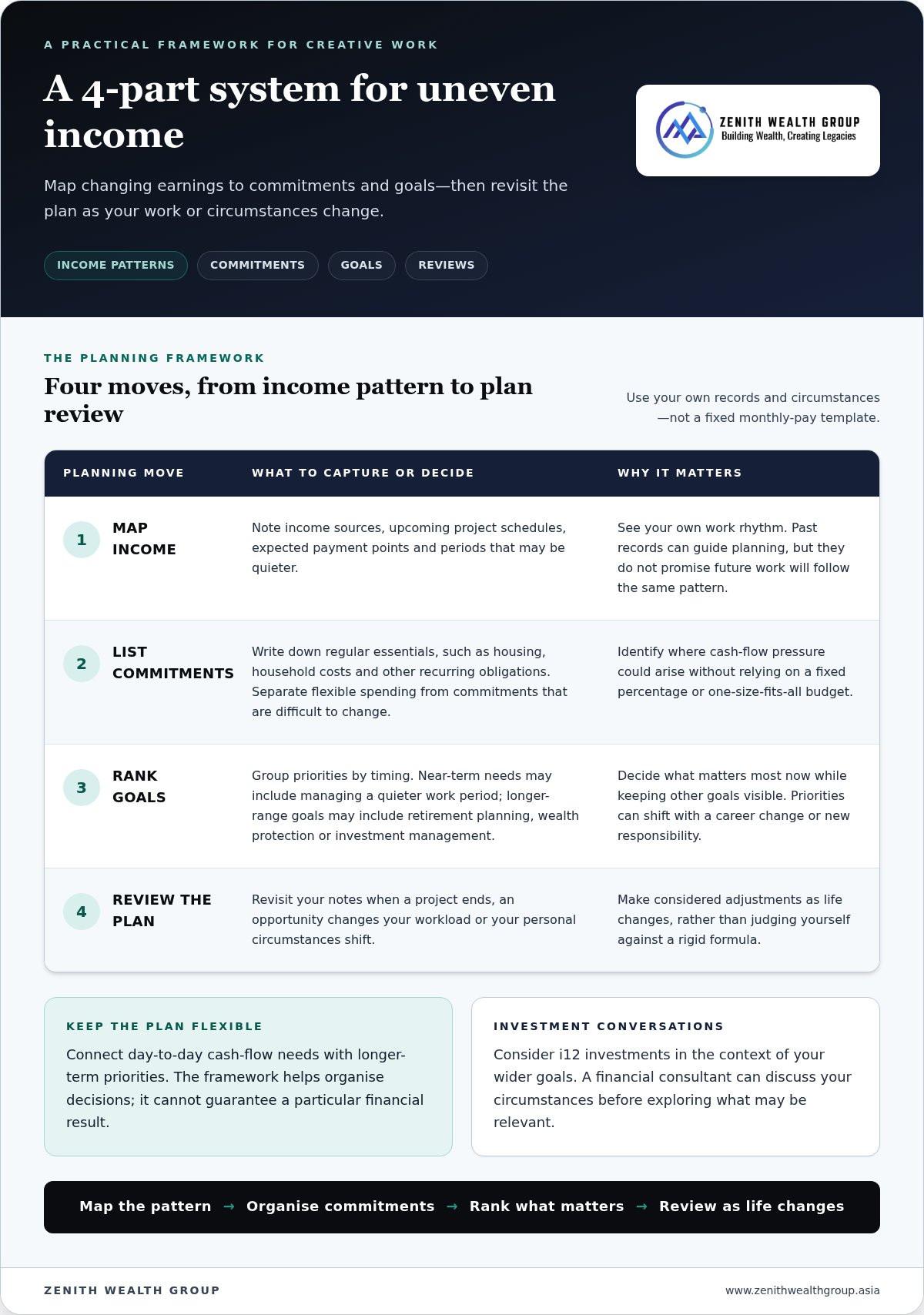
A useful plan doesn’t depend on every month looking alike. It gives you a clear way to decide what incoming money needs to cover, which goals deserve attention and when to revisit those choices. Use this four-step framework as a starting point, then adjust it to fit your work and personal circumstances.
- Map income. Look at your income pattern and note upcoming project schedules, expected payment points and periods that may be quieter. Use your own records as a guide, not as a promise that future work will follow the same pattern.
- List commitments. Write down regular essentials, such as housing, household costs and other recurring obligations. Separate flexible spending from commitments that are difficult to change. This helps you see where cash-flow pressure could arise without relying on a fixed percentage or one-size-fits-all budget.
- Rank goals. Group priorities by timing. Near-term needs might include managing a quieter work period; longer-range goals could involve retirement planning, wealth protection or investment management. Decide what matters most now while keeping other goals visible.
- Review the plan. Revisit your notes when a project ends, a new opportunity changes your workload or your personal circumstances shift. Use the review to make considered adjustments, not to judge yourself against a rigid formula.
Map the pattern, organise commitments, rank what matters, then review as life changes. This framework can make decisions easier to discuss, but it can’t guarantee a particular financial result.
Map income patterns and regular commitments
Start with information you already have: past income, current commitments and the project schedule ahead. You might notice that payments tend to cluster after a delivery milestone, or that a planned break follows an intense stretch of work. Another creative professional may have a steady retainer alongside occasional commissions. The aim is to understand your own rhythm. The National Arts Council’s financial planning for arts freelancers in Singapore resource can offer a locally relevant reference point.
Prioritise goals without losing flexibility
Give each goal a place, even if you can’t address every one at once. Distinguish commitments that need attention soon from longer-term aims, then note what might change their order. A busier project period, a career transition or a new family responsibility can all shift priorities. Keep the categories clear, but leave room to adapt.
As you consider investments, connect the discussion to your wider needs and the role investment management may play in your plan. A financial consultant should be able to discuss your goals and circumstances in plain language, without assuming a standard income pattern. If you’d like to explore how your priorities fit together, you can start a conversation about your financial goals.
What to weigh when comparing financial guidance for creative professionals
Look beyond whether a financial conversation sounds polished. Ask whether the guidance takes your work, goals and circumstances seriously, and whether its reasoning is clear. Use these areas to compare how a financial consultant approaches your needs, rather than relying on a label or a one-size-fits-all promise.
| Area | What to consider |
|---|---|
| Communication | Are explanations clear and jargon-light? Can you comfortably raise questions about project-based income or career changes? |
| Planning scope | Does the conversation make space for your stated goals, such as protection, investments and retirement planning? |
| Changing income | Does the discussion account for your actual work pattern, including variable workloads or shifts between freelance and salaried work? |
| Review conversations | Can you discuss how your plan might be revisited if your income, priorities or personal circumstances change? |
Use the table as a prompt, not a scorecard. A financial consultant should discuss your goals and circumstances without assuming that every creative career follows the same path. Notice whether the conversation helps you understand the choices in front of you, including what remains uncertain. For general financial education, the Institute for Financial Literacy Singapore, a collaboration between MoneySense and Singapore Polytechnic International, offers free and unbiased financial education programmes.
Questions that make a planning conversation useful
Bring questions connected to your working life. For example: “How would you learn about the way my projects and income vary?” and “How could we revisit priorities if my workload or career plans change?” You can also ask how different goals fit into the discussion. Clear answers should help you understand the conversation without implying a particular process or review schedule.
How to think about investment and protection topics
Investment management and wealth protection are related parts of a broader financial picture, but they address different concerns. Investment management focuses on investment choices in relation to goals and circumstances. Wealth protection considers how you think about safeguarding your financial position. Discussing one doesn’t automatically settle the other, and neither topic alone defines a complete plan.
Zenith Wealth Group includes investment management and wealth protection in its planning scope. If i12 investments is a name you’re considering, assess any discussion against your own goals rather than assuming a particular relationship or feature. Zenith Wealth Group operates as authorized Financial Consultants representing finexis advisory Pte Ltd [Reg No 200408660G].
How Singapore creatives can connect cash flow, protection, and future plans
A financial plan is more useful when it connects what you need now with what you want to protect and work towards later. For creative professionals, that means looking at current commitments alongside project timing, personal responsibilities and longer-term goals. You don’t need a universal budget formula. Start with a clear snapshot, then consider how each part of your financial life affects the others.
Use this checklist to prepare:
- Review commitments. Note essential expenses, recurring payments and upcoming costs, including those that may coincide with a gap between projects.
- Identify protection concerns. Consider which responsibilities or parts of your financial position you want to safeguard, based on your personal situation.
- Rank goals. Separate priorities that need attention sooner from future aims such as retirement, family needs or legacy planning.
- Note open questions. Write down what you want to understand about cash flow, protection, investments or Singapore-specific planning considerations.
Keep short-term resilience visible
Look beyond fixed bills. Variable expenses, a delayed project payment or several commitments landing close together can affect how comfortable your cash flow feels. Note when these pressures tend to arise in your own work cycle. Your approach should reflect your income pattern, obligations and circumstances, rather than a savings target or spending ratio applied to everyone.
This snapshot can show where short-term needs meet longer-term aims and make a conversation with a financial consultant more focused. A financial advisor for creative professionals in Singapore should discuss the relationship between changing work, protection concerns and future plans in the context of your priorities, without assuming that every creative has the same financial pattern.
Connect today’s work with later-life goals
Retirement, family priorities and legacy planning don’t have to sit in separate conversations. Consider what each means to you, how soon it matters and what changes in your work or personal life could affect its place in your plan. For high-income professionals managing multiple moving parts across wealth, tax, and lifestyle management, virtual family office practices like Kotini & Kotini demonstrate how holistic planning can bring these elements together. Your priorities may shift as your career develops, so leave room to reconsider them rather than treating today’s ranking as permanent.
Singapore-specific topics, including CPF and tax considerations, can depend on your residency, work arrangement and personal circumstances. Avoid making assumptions based on someone else’s situation; check current details against relevant Singapore authorities before you act. Keep a note of questions that may need individual attention.
If you’re ready to discuss how cash flow, wealth protection and longer-term goals fit together, start a conversation about your financial priorities.
What to expect from Zenith Wealth's first planning conversation
Knowing the purpose of a first conversation can make it easier to begin. Zenith Wealth Group’s free 30-minute discovery session is designed to match you with a consultant. You can share what matters to you, explain how your creative work is structured and raise the questions you’d like to explore. The discussion can provide context for a next step, but it doesn’t promise a particular recommendation or financial outcome.
Your career doesn’t need to fit a standard pattern for the conversation to be useful. You might be employed full time, freelance or moving between different types of creative work. Share what applies to you. A financial consultant can learn about your goals and circumstances, including how changing workloads or career plans affect the priorities you want to discuss.
What to prepare before the discovery session
You don’t need a finished financial plan to begin. A few personal notes can make it easier to explain your situation and use the conversation well. Focus on the context you want to share.
- Your career structure: Note whether your work is salaried, project-based, freelance or a combination, and mention changes you’re considering.
- Your broad priorities: Identify what you’d like to focus on, such as cash flow, wealth protection, investments or retirement planning.
- Your open questions: Write down what feels unclear or difficult to balance. You can raise one priority first and add others as the discussion develops.
Zenith Wealth Group operates as authorized Financial Consultants representing finexis advisory Pte Ltd [Reg No 200408660G]. Use this introduction to share your perspective and discuss what matters to you, rather than assuming one approach suits every creative professional.
Choose a next step that fits your priorities
If you’d prefer to read first, THE W.E.A.L.TH. SYSTEM is a free, practitioner-written guide with practical wealth-building steps. Treat it as a starting point for reflection, not a promise of a specific level of wealth, retirement outcome or lifestyle. Note any ideas or questions you want to consider in light of your own goals.
If a conversation feels like the right next step, bring the priorities you’ve identified and explain what you’d like help thinking through. You don’t need to have every detail settled before you begin. A clear account of your work, concerns and goals is a helpful place to start. You can book a free discovery session with Zenith Wealth Group.
Take the next step at your own pace
Your financial plan can evolve alongside your creative career. You don’t need to predict every project or settle every future decision before taking a first step. Start with one priority that feels relevant now, then consider how it connects to the life and work you want to build over time.
A financial advisor for creative professionals in Singapore should understand your goals and circumstances, including how your priorities may change as your career develops. Bring the questions that matter most to you and focus on getting clear, useful guidance in language that feels accessible.
Ready to talk through your priorities? Book a free 30-minute discovery session with Zenith Wealth Group to be matched with a consultant.
Frequently Asked Questions
Can a financial consultant help me plan around irregular creative income?
Yes. A financial consultant can help you discuss how changing income fits your circumstances and goals. For example, distinguish confirmed project payments from work that’s still being negotiated, then consider how each affects upcoming decisions. This doesn’t make future earnings certain, but it gives the conversation a more realistic starting point than treating every possible commission as guaranteed income.
What should I prepare for a free 30-minute discovery session?
You don’t need a polished financial plan to begin. Think about one recent change in your work and one decision you’re weighing, such as whether to take on a longer contract or preserve flexibility for other projects. Explaining what you’re considering, and why, can make the conversation more focused than bringing a long list of disconnected financial terms.
Is the discovery session with Zenith Wealth Group free?
Yes. Zenith Wealth Group offers a free 30-minute discovery session designed to match you with a consultant. Use it to explain the kind of support you’re exploring and the questions that matter to you. The discussion doesn’t commit you to a particular recommendation or outcome. It can help you decide what you’d like to explore next, based on your goals and circumstances.
How can Singapore-based freelancers organise financial goals when project income changes?
Separate confirmed income from work that’s still uncertain, then consider what each can reasonably support. If a client postpones a project, for instance, revisit decisions that relied on that payment rather than treating the original timing as fixed. Keep a record of the assumptions behind your plans, too. That makes it easier to see what needs reconsideration when a project schedule or personal priority changes. For creative professionals working across Singapore, Indonesia, Malaysia, the Philippines or Thailand, also note where each project is based and where the income is earned, since the relevant planning considerations may differ.
Can financial planning include retirement and wealth protection in one conversation?
Yes. You can raise both topics together and explain how you see them fitting into your life. For example, you might want to understand how planning for later life relates to responsibilities you have now. A financial consultant can discuss the topics in the context of your stated goals and help clarify questions to explore, without assuming the same priorities or approach suit everyone.
What is the difference between a financial consultant and a financial planner?
These titles can be used in related financial-planning contexts, but the wording alone doesn’t tell you exactly what a particular conversation will cover. Focus on how the professional explains their role and whether the discussion addresses your circumstances and goals. You can ask what topics are within the conversation and how they relate to the decisions you’re considering, rather than relying on the title to define the full scope.
Can an international creative professional in Singapore discuss financial planning with Zenith Wealth Group?
Yes. International creative professionals living in Singapore can discuss their circumstances and goals with Zenith Wealth Group. If your work or financial life spans more than one country, explain where you live and work, where your income comes from and which questions you want to address. Those details help establish which planning considerations are relevant to your situation, without assuming another person’s arrangements apply to you.


