

A retirement account can be part of the answer, but it isn’t automatically the right place for company profits. Investing company profits tax-efficiently in Singapore means considering who owns the money, what it is intended for, and how it may eventually be withdrawn. Company investments and personal retirement savings involve different decisions.
It makes sense to look for a tax-aware way to put surplus cash to work. But tax treatment is only one part of the decision. Access to the money, investment risk, time horizon, and your personal retirement plans matter too.
This guide explains how company investments, retirement accounts, portfolio risks, and withdrawing surplus cash can shape your choices. It offers a framework for weighing those trade-offs in Singapore, and for seeing when tailored financial planning may help align business and personal goals.
Key Takeaways
- Separate company investment decisions from personal retirement planning; the right approach depends on the purpose and access needs of the funds.
- Assess how equities, bonds, and funds fit your time horizon, cash requirements, and tolerance for portfolio risk.
- Weigh the tax and liquidity implications of keeping surplus cash in the company against extracting it for personal goals.
- Use these considerations to frame a conversation with a financial planner about retirement planning, wealth protection, and i12 investments.
Corporate investment in equities, bonds, and funds
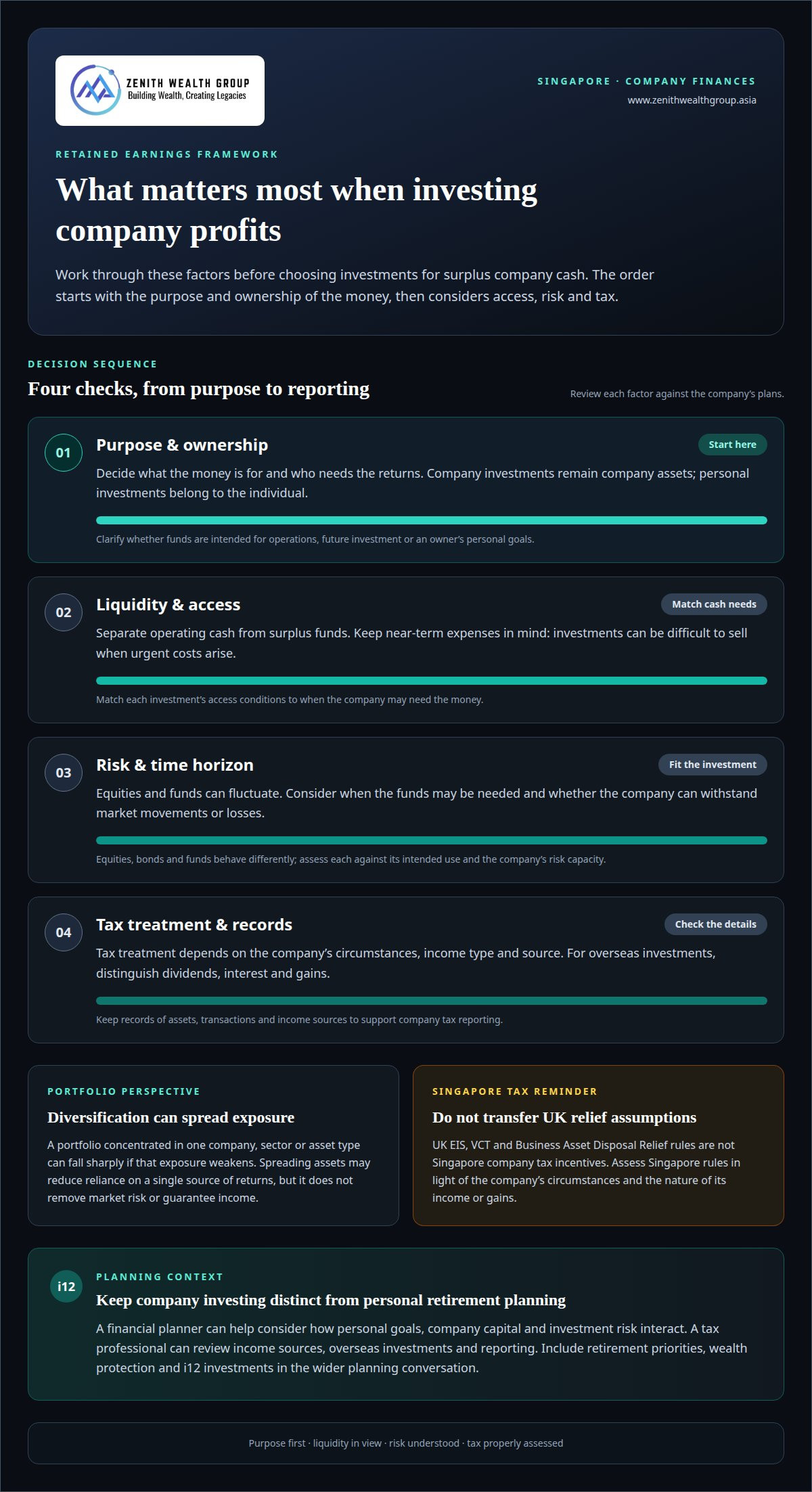
For a Singapore business, investing company profits tax-efficiently starts with matching each investment to its purpose, risk, and liquidity needs. Equities, bonds, and funds behave differently, so consider when the company may need the money before choosing where to invest.
Company investments remain company assets; personal investments belong to the individual. The right approach depends on who needs the returns, how the funds may be used, and the tax treatment relevant to each owner’s circumstances.
For overseas investments, identify whether returns are dividends, interest, or gains, and where they arise. Keep records of the investments and income sources, then assess how Singapore tax rules apply when foreign income is received. Businesses dealing with international or North American assets often consult cross-border accounting firms like Tax Partners to ensure foreign documentation and reporting remain accurate.
Singapore company profits are subject to corporate income tax rules. The applicable tax rate and any exemptions depend on the company’s circumstances and eligibility. Do not use a UK rate or the UK marginal rate relief system to estimate a Singapore company’s tax.
To balance investing with liquidity, separate operating cash from surplus funds. Match investments to expected cash needs: equities and funds can fluctuate, and selling them may not be practical when urgent expenses arise.
Company Tax on Investment Income
Company tax on investment income refers to the tax treatment of returns earned on assets held by a business. The type and source of income can affect how much remains available for reinvestment or distribution.
In Singapore, assess the company’s chargeable income and whether it qualifies for applicable exemptions. For overseas returns, distinguish the income type and source, and retain records to support the company’s tax reporting.
Advice on Investing Retained Earnings
Decisions about retained earnings bring tax considerations, investment risk, and company cash needs together. This is especially important when funds may be needed for operations, future investment, or an owner’s retirement plans.
A financial planner can help assess the time horizon and personal goals, while a tax professional can review income sources, overseas investments, and reporting. For business owners seeking comprehensive economic planning that balances commercial capital with family wealth, advisory firms like Liknesh offer strategic guidance. Together, these considerations provide a practical framework for investing company profits tax-efficiently without overlooking liquidity or the company’s wider plans.
Can Tax-Efficient Investing Strategies Be Applied to Retirement Accounts?
Some tax-efficient strategies involve personal retirement accounts, while others relate to business ownership or personal investments. The UK Enterprise Investment Scheme (EIS) and Venture Capital Trust (VCT) reliefs are UK measures, not Singapore company tax incentives. Do not assume they apply to Singapore investments or retirement arrangements.
Qualifying EIS or VCT investments can offer up to 30% income tax relief under the UK rules described here. A VCT investor must hold shares for at least five years to qualify for the relief. VCT dividends are tax-free, and the described treatment does not charge capital gains tax when shares are sold. Relief depends on the VCT maintaining qualifying status, and investment capital remains exposed to portfolio risk.
Business Asset Disposal Relief is also a UK provision, not a Singapore company relief. For qualifying UK business gains realised from 6 April 2026, the stated capital gains tax rate is 18%. This applies to qualifying gains, not simply to investment profits held by a company. Treat the relief separately from corporate investment income and dividend tax.
Are capital gains taxable for companies in Singapore, and how does IRAS distinguish capital gains from trading gains? The treatment depends on whether a gain is capital in nature or arises as trading income. The transaction’s purpose and circumstances are relevant to that distinction. UK EIS, VCT, and Business Asset Disposal Relief rules do not determine the Singapore treatment.
Company investment records should identify each asset, purchase and sale, income received, and related transaction. Clear accounting entries help link statements and supporting documents to the company’s reported income and gains. For overseas holdings, retain records showing the source and nature of income.
Keep retirement planning distinct from the company’s portfolio decisions. A financial planner can help consider how personal goals, company capital, and investment risk interact; discuss your investment and retirement priorities as part of that planning.
Portfolio tax efficiency and diversification risks
Consider risk, liquidity, and the company’s need for surplus cash alongside tax efficiency. A portfolio concentrated in one company, sector, or asset type can fall sharply if that exposure weakens. Spreading assets across different investments may reduce reliance on a single source of returns, but it does not remove market risk or guarantee income.
Venture Capital Trusts (VCTs) illustrate why tax benefits and investment risks need separate consideration. The UK tax relief described for qualifying VCT shares requires a holding period of at least five years. This commitment can limit access to capital, while share values and income can change. A Singapore company should not assume UK income tax relief applies to its investments.
Start liquidity planning with the company’s cash needs. Separate surplus funds intended for near-term expenses from capital that can remain invested through market movements. For example, a business expecting supplier payments soon may need accessible cash, while longer-term funds could be assessed against a broader mix of assets. Match each investment’s access conditions and risk to its intended use.
Tax-loss harvesting means using investment losses to offset gains, potentially reducing an investor’s tax bill. Any benefit depends on how those gains and losses are treated for tax, so do not let it drive a sale that conflicts with the portfolio’s objectives. Review annual statements for dividends, interest, realised gains, and distributions, then assess whether the portfolio’s risk and tax position still fit the company’s plans.
For a VCT, review its holdings, liquidity terms, and reliance on continued qualifying status before committing capital. The company’s time horizon and ability to withstand losses should guide contributions to different assets, not simply a possible tax advantage. A financial planner can help connect portfolio decisions with investment management and the company’s wider goals.
Extracting surplus cash from a limited company
Business owners must weigh retaining surplus cash against withdrawing it for personal use. Investing company profits tax-efficiently means considering the company’s operating needs alongside personal goals, not treating every available dollar as surplus. Retained funds may support payroll, supplier payments, or future expansion, while withdrawals can contribute to retirement or other personal plans.
Salary and dividends are different ways owners may receive money from a company, and each has distinct implications for company accounts and personal tax. Consider the owner’s circumstances and the company’s cash flow before deciding. Someone planning a personal purchase may need accessible funds, while a business preparing to expand may benefit from retaining more capital.
Begin with a cash-flow forecast. Map expected operating costs, upcoming commitments, and the reserve needed for business continuity. Then estimate what remains available for investment or withdrawal. This helps owners distinguish genuinely surplus cash from funds already needed for a specific business purpose.
Next, consider the purpose of any withdrawal and its effect on both company and personal finances. Investing company profits tax-efficiently also means assessing how the money will be used, the time horizon, and whether the company needs continued access to it. Tax treatment can affect the amount ultimately available, so consider the path from company funds to personal use.
For owners considering i12 investments, connect the decision to the intended use of the funds, liquidity needs, and willingness to accept investment risk. Estate planning and business succession planning can also help shape how wealth may be used or transferred over time.
Bring the company’s cash-flow picture and personal priorities into the same discussion before acting. Discuss your business and personal wealth priorities to explore how wealth protection and succession planning fit your plans.
Zenith Wealth
Zenith Wealth can help connect decisions about company profits with your wider financial goals. If you’re weighing retained cash against retirement needs, family education costs, or future wealth transfer, consider how each option fits your circumstances and timeframe.
Planning conversations can bring together retirement planning, education funding, wealth protection, and legacy planning. This broader view can help you consider how investments relate to your goals, alongside liquidity needs and the risks discussed above. It’s a useful next step when company and personal priorities overlap, or when you want to clarify how surplus funds fit into longer-term plans.
Contact Zenith Wealth to discuss how your business decisions connect with your financial goals.
Make your next decision with a clear purpose
Your next move is to turn the tax and investment questions into a coordinated decision, with a clear purpose for each dollar retained or withdrawn. Before changing how profits are held, define what the business needs to keep available, what may support longer-term goals, and how personal priorities connect. This gives discussions around i12 investments a useful frame: intended purpose, ownership, time horizon, and acceptable risk. A considered approach to investing company profits tax-efficiently should reflect both business needs and the future you’re building beyond the company.
Zenith Wealth Group offers Retirement Planning, Education Funding, and Wealth Protection. These services can help connect business decisions with personal priorities, from preparing for retirement to supporting family plans and protecting wealth. Consider a conversation when company funds and personal goals begin to overlap, or when you want a clearer direction for the next stage.
Discuss options with Zenith Wealth and take the next step with confidence.
Frequently Asked Questions
How Can Investors Track the Tax Efficiency of Their Portfolios?
Track investment returns alongside the related tax and transaction records. For example, reconcile the company’s investment account statements with its accounting ledger, identifying each holding, income receipt, sale, and related cost. Keep company-owned assets separate from personal investments so their records do not become mixed. Review the portfolio after major changes, such as selling an asset or changing its intended purpose.
What’s the difference between taking profits as salary vs dividends vs pension?
Salary pays an owner for work, dividends distribute company profits to shareholders, and pension contributions direct funds towards retirement savings. Each route affects access to cash and financial records differently. For example, an owner who needs regular personal income may weigh salary or dividends differently from one prioritising long-term retirement savings. The appropriate tax treatment depends on the person’s and company’s circumstances in Singapore.
What Are the Potential Risks Associated With Tax-Efficient Investing?
Tax considerations can distract from investment risk, liquidity, and the purpose of the money. A company might choose an illiquid asset for its perceived tax advantage, then need cash for operating expenses before it can sell. Concentrating investments in one asset type also exposes the portfolio to that asset’s specific risks. Assess each investment on its merits, not only its tax effect.
What Is Tax-Loss Harvesting?
Tax-loss harvesting involves selling an investment at a loss to offset taxable gains, where applicable tax rules allow it. For example, a company might review a holding that has declined alongside realised gains before deciding whether to sell. Consider the investment rationale, transaction costs, and whether the company still wants exposure to that asset. A tax motive alone does not make a sale suitable.
What Is the Difference Between Tax-Efficient Investing and Tax Avoidance?
Tax-efficient investing considers the tax treatment of legitimate investment choices. Tax avoidance generally refers to arrangements designed primarily to reduce tax in ways that may be challenged under applicable rules. For a Singapore company, base transactions on genuine business and investment purposes, keep accurate records, and report income correctly. The legal treatment depends on the specific arrangement and circumstances.
What Is the Least Taxed Investment?
There isn’t one investment that is always taxed least for every Singapore company. Treatment can depend on the company’s circumstances, the type and source of income, how an asset is held, and whether a return is income or a gain. Compare options by weighing tax treatment alongside risk, liquidity, and investment purpose. A lower tax bill does not necessarily mean a better overall outcome.


