

A partner’s exit can change who owns and runs a business. Knowing how to set up a buy-sell agreement for a business partnership means agreeing in advance on what triggers a buyout, who can purchase the departing partner’s share, how it will be valued, and how payment will work. In Singapore, the agreement can cover events such as death, disability, retirement, or voluntary exit.
Plan for these possibilities while the partners can still discuss terms together. Clear provisions reduce uncertainty about ownership and give the business a defined process to follow through a difficult transition.
This guide explains what a buy-sell agreement does and why partners may need one. It covers funding options such as insurance and instalments, compares cross-purchase and entity-redemption arrangements, and outlines the decisions to make before an ownership change occurs.
Key Takeaways
- Define the events that can trigger a buyout, such as a partner’s death, disability, retirement or exit.
- Set out who can buy the departing partner’s share, how its value is determined and how payment will be made.
- Compare insurance funding with instalments to understand how each approach can support a buyout.
- Consider whether a cross-purchase structure fits the number of partners and the way ownership may change over time.
What is a buy-sell agreement?
A buy-sell agreement sets out how an owner’s share will transfer after an agreed event. It identifies who may buy the interest, how its value will be determined, and how payment will be made. If you’re considering how to set up a buy-sell agreement for a business partnership, begin by agreeing on these terms before an ownership change arises.
Triggers may include a partner’s death, incapacity or disability, retirement, resignation, or another agreed exit. Define each event precisely. For disability, specify when a condition prevents the partner from fulfilling their responsibilities. Clear trigger wording gives the business a basis for starting the transfer process and helps partners understand when a buyout may occur.
How do you choose a business valuation method and set the buyout price? When deciding how to set up a buy-sell agreement for a business partnership, choose a fixed value, a formula based on business performance, or an independent appraisal. Explain when the valuation will take place and how it will account for changes in the business, so the method can guide the buyout price. Many businesses turn to independent professional firms, such as Coombs Chartered Accountants, to evaluate performance metrics and ensure that financial records support a fair valuation.
Should the agreement sit within the partnership agreement or be drafted separately? A buy-sell agreement can form part of the partnership agreement or be drafted separately. If it is separate, align its valuation, transfer, and payment provisions with the partnership agreement. Consistent documents help prevent conflicting instructions about who can buy an interest and how it transfers.
What steps are involved in drafting and implementing the agreement? Agree on the triggers, eligible buyers, valuation method, transfer process, and payment terms. Align the wording with related partnership documents and arrange the intended funding. A clear sequence gives partners a practical process to follow when an event activates the agreement.
How much does it cost to prepare a buy-sell agreement in Singapore? Cost depends on factors such as the ownership structure, drafting complexity, and valuation arrangements. Request a quote to establish the fee for the work.
What are the tax implications of a partnership buyout in Singapore? Tax treatment depends on the transaction structure, the interest transferred, and how any insurance proceeds are received. Account for these factors when planning the buyout’s funding and payment terms.
Funding a buyout with insurance or instalments
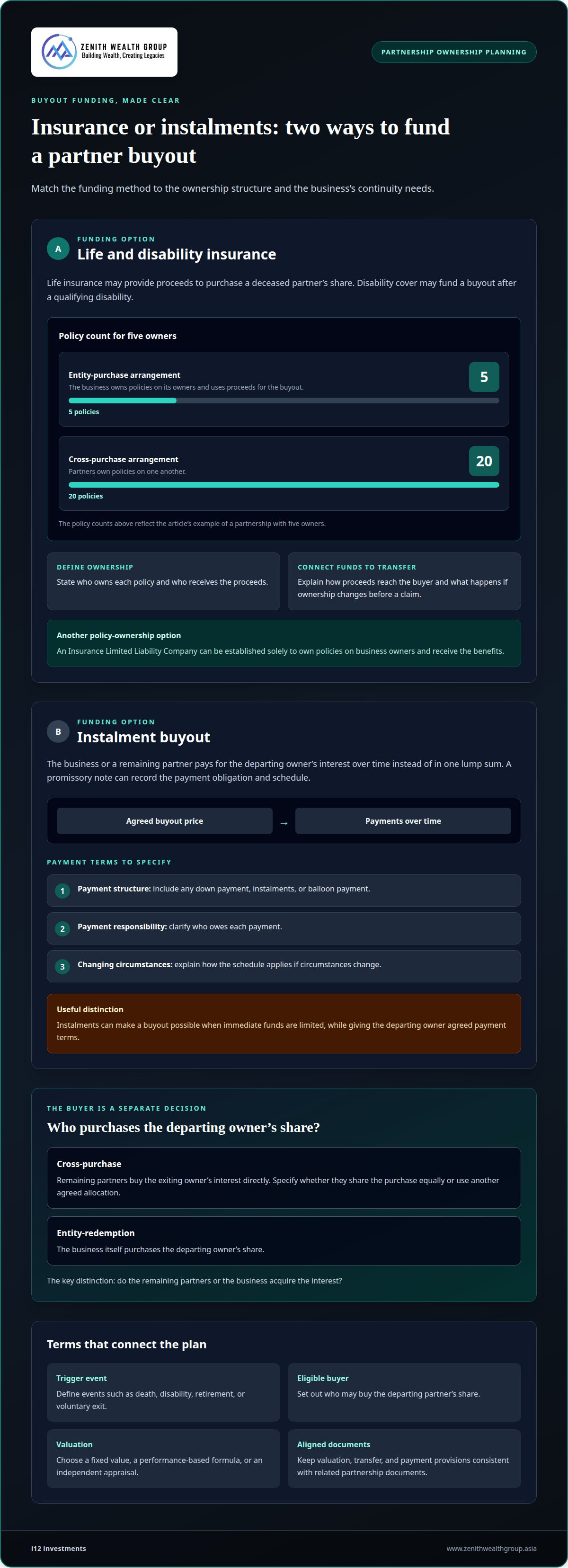
Insurance may provide funds after a covered death or qualifying disability, while instalments spread payment over time. Match the funding method to the ownership structure and the business’s continuity needs.
Life and Disability Insurance Funding
Life insurance may provide proceeds to purchase a deceased partner’s share, while disability cover may fund a buyout after a qualifying disability. This gives the remaining partners a potential funding source beyond available business cash. Specify who owns each policy, who receives the proceeds, and how the funds will support the transfer.
In an entity-purchase arrangement, the business owns policies on its owners and uses proceeds for the buyout. With five owners, this structure requires five policies. A cross-purchase arrangement instead has partners own policies on one another; the stated example for five owners requires 20 policies.
An Insurance Limited Liability Company can be established solely to own policies on business owners and receive the benefits. This separates policy ownership from the partners themselves. Explain how the proceeds will reach the buyer and what happens if ownership changes before a claim. Clear terms link insurance funding to continuity planning.
Instalment Buyout Funding
An instalment buyout allows the business or a remaining partner to pay for the departing owner’s interest over time instead of in one lump sum. A promissory note can record the payment obligation and schedule. This can make a buyout possible when immediate funds are limited, while giving the departing owner agreed terms for payment.
Set out the payment structure, including any down payment, instalments, or balloon payment. Clarify who owes each payment and how the schedule applies if circumstances change. These terms help both sides understand how the ownership transfer relates to the payment obligation.
To discuss how buyout funding connects with wider plans, start an estate planning conversation.
Cross-purchase agreements
A cross-purchase agreement lets remaining partners buy an exiting owner’s interest directly. Each participating buyer acquires a portion of that interest. When deciding how to set up a buy-sell agreement for a business partnership, specify whether buyers share the purchase equally or use another agreed allocation.
This structure can suit a partnership where owners want control to remain with existing partners. Specify who may participate, how they notify the seller, and what happens if a partner declines. Without an allocation process, willing buyers may disagree about who can acquire the available interest.
An entity-redemption agreement names a different buyer: the business itself purchases the departing owner’s share. The key distinction is whether the remaining partners or the entity acquire the interest. Consider how each option affects ownership distribution and decision-making after the transaction.
A right of first refusal can give the remaining partners or the business an opportunity to buy an interest before its owner transfers it outside the partnership. Explain how the offer is made, how long eligible buyers have to respond, and what happens to any portion they do not purchase.
For partners considering how to set up a buy-sell agreement for a business partnership, decision rules matter as much as choosing the buyer. State how competing purchase intentions will be resolved and what happens if no eligible buyer proceeds. A defined process reduces uncertainty during an exit.
Connect the purchase process to the partnership’s ownership records and related documents. Specify which records must reflect the completed transfer and who is responsible for updating them. Consistent records help the remaining owners understand their interests after succession.
Why business partners need a buy-sell agreement
A buy-sell agreement gives business owners a shared plan for ownership changes, rather than leaving decisions until a partner exits. Without agreed transfer terms, a deceased partner’s shares may raise questions for surviving family members and remaining owners. A written process can clarify who may acquire the interest and how the ownership transition will work.
For partners in Singapore, align the agreement with the partnership’s legal structure and related ownership documents. Clearly state transfer rights, the valuation approach, and payment terms, and keep them consistent across relevant agreements. These drafting principles help partners understand how the arrangement works, while allowing the terms to reflect their particular business.
Consider a partner who plans to retire but has no agreed exit process. The remaining owners may disagree about whether they can purchase the departing partner’s interest or how to value it. A buy-sell agreement can settle these decisions in advance. It can also restrict transfers to outsiders or give existing owners the first opportunity to buy.
An outdated agreement presents a different risk. A fixed price may no longer reflect the business’s circumstances, leaving buyers and sellers with conflicting expectations. Review the valuation method as the business changes, and check that transfer and payment provisions still match the partnership’s arrangements. Ambiguous triggers can also make it unclear when the buyout process begins.
Life insurance may provide proceeds for a buyout after a partner’s death, but the agreement should explain how the funds connect to the purchase. For example, it can identify the intended buyer and describe how the proceeds support the transfer. This links ownership planning with the estate and the surviving partners’ ability to continue operating.
Make the agreement part of succession planning, not a document partners revisit only during a crisis. Discuss your business succession plans and how ownership changes fit the business’s longer-term continuity.
Zenith Wealth: Business Succession Planning
Zenith Wealth Group can help you consider business succession alongside the personal financial plans connected to a partner’s exit. Turn to Business Succession Planning when weighing ownership changes, business continuity, or how a future transition fits your wider financial goals. Retirement Planning may also be relevant if a partner’s planned retirement affects the timing of a buyout.
Discuss how succession decisions connect with wealth protection and longer-term planning. If you also have questions about i12 investments, raise them as part of the broader conversation, without treating investment choices as a substitute for the buy-sell agreement’s legal terms.
Start a conversation about your business succession plans with Contact Zenith Wealth.
Bring your succession plans into focus
Planning how to set up a buy-sell agreement for a business partnership is also an opportunity to consider how an ownership change fits your personal plans. Think about the transition alongside retirement goals, family priorities, and your wider financial position. Keep legal drafting and financial planning aligned, while treating them as distinct parts of the process; for business owners navigating cross-border family or commercial interests across jurisdictions, international legal counsel such as israelcrossborderfamilylaw.com can assist in coordinating multi-jurisdictional matters.
Zenith Wealth offers Retirement Planning, Education Funding, and Wealth Protection. You can also discuss how i12 investments fit into your wider financial picture. A conversation can help you connect business succession decisions with the priorities you’re planning for beyond the partnership.
Take the next step when you’re ready. Contact Zenith Wealth to discuss your options and give your plans a clear direction.
Frequently Asked Questions
What is a buy-sell agreement for a business partnership?
A buy-sell agreement sets out how a partner’s ownership interest may change hands after an agreed event. It can establish who has the right to buy, how the price is determined, and how payment is arranged. In Singapore, partners can coordinate its terms with their partnership agreement and ownership records to reduce conflicting instructions during a transfer.
What events should trigger a buy-sell agreement, such as death, disability, retirement, or a partner leaving?
Common triggers include death, incapacity or disability, retirement, resignation, and a partner’s decision to leave. The agreement can also address events such as bankruptcy or a dispute that prevents the owners from working together. Define each trigger precisely. For example, specify what level of disability affects the partner’s role and when voluntary departure starts the transfer process.
What payment terms and funding options are common for a partnership buyout?
Payment terms may include an upfront amount, instalments, or a later balloon payment. Funding may come from life insurance after a covered death, disability cover after a qualifying event, or payments over time by the business or remaining owners. A promissory note can record the agreed payment obligation. State the schedule and who pays so both buyer and seller understand the arrangement.
How do cross-purchase and entity-redemption buy-sell agreements compare?
In a cross-purchase arrangement, the remaining partners buy the departing partner’s interest directly. In an entity-redemption arrangement, the business buys it. The first gives individual partners direct ownership, while the second makes the entity the purchaser. Consider who will own and manage any funding policies, how many owners are involved, and how ownership records will reflect the completed transfer.


