

What if an investment with high-growth potential is also one you may not be able to sell when your plans change? That tension is central to venture capital, and it’s why alternative investments in Singapore wealth management deserve careful consideration rather than a place in a portfolio based on excitement alone.
If unfamiliar terms and uncertain timelines make venture capital feel difficult to compare with shares or bonds, start by looking at how the investment is structured, what you would own and when you might need access to your money. This guide explains how venture capital works, how an investment may progress from funding a private company to a possible exit, and what risks to weigh. It also considers Singapore’s investment and regulatory context.
For people with financial priorities across Singapore, Indonesia, Malaysia, the Philippines and Thailand, it’s also important to understand which country’s rules and documents apply to a particular opportunity. This guide outlines potential portfolio roles without assuming venture capital is suitable for everyone. It also considers how questions about i12 investments fit into a broader financial-planning discussion. Start with the structure, risks and fit with your wider wealth goals.
Key Takeaways
- Understand how venture capital connects companies seeking funding with investors, and how an investment may move toward a potential exit.
- Assess alternative investments in Singapore wealth management by considering liquidity, uncertainty and how they fit your broader portfolio.
- Before weighing venture capital, clarify your financial goals, time horizon, access-to-cash needs and comfort with uncertainty.
- Look beyond the alternative-investment label. It doesn’t automatically mean an investment is diversified or lower risk.
- Use a financial planner or financial consultant to relate investment questions to your overall financial position and wealth goals.
What Are Alternative Investments in Singapore Wealth Management?
Curiosity about venture capital is a useful starting point, not a reason to invest. An asset-class label describes a broad category, not whether a particular investment suits you. This section explains where venture capital fits and how it differs from owning listed shares.
Alternative investments is a broad term for assets or strategies outside conventional holdings such as publicly traded shares and bonds. The category can include private-company investments, real assets and other approaches. How an investment is structured matters as much as its label. Venture capital (VC) is financing provided to companies at earlier growth stages in exchange for an ownership interest or related investment rights. It differs from private equity, which commonly involves investment in more mature private companies, and from public equities, which are shares traded on public markets.
How venture capital fits within alternative investments
VC connects companies seeking capital with investors willing to fund their development. A company may use the funding to build its business, while investors take on uncertainty about whether it can grow and what value their stake may eventually have. For a concise overview of the concept and its operation, see Venture Capital Explained.
The funding concept is separate from an investor’s access route. An investor might gain exposure directly or through an investment vehicle, depending on the structure. Those routes can differ in costs, decision-making and how ownership is held, so “venture capital” alone doesn’t tell you what you would own. When reviewing i12 investments, use the same approach: understand the underlying investment, structure and terms before assessing its role in your finances.
Within a wider portfolio, venture capital sits alongside categories such as listed equities, fixed income, cash and property. These labels can help organise a discussion, but they don’t prescribe an allocation. Alternative investments in Singapore wealth management should be considered in the context of your whole financial picture, rather than treated as a shortcut to growth or diversification.
How venture capital differs from listed shares
Listed shares represent ownership in companies whose shares trade on an exchange. Private-company exposure, by contrast, concerns businesses whose shares aren’t publicly traded. Listed prices are generally visible through market trading, while private-company valuations may be based on periodic information or valuation processes rather than a continuously quoted share price. Practices vary by investment and structure.
Access and the ability to sell can differ too. Listed shares can often be bought or sold through market channels during trading hours, subject to market conditions. A private investment may have restrictions, limited opportunities for resale or no ready market, depending on its terms. That difference can affect how an investment fits your cash-flow needs and other financial goals. Consider each holding within your broader portfolio and investment-management plan, not solely by comparing headline asset-class names.
How Venture Capital Works: From Funding Round to Potential Exit
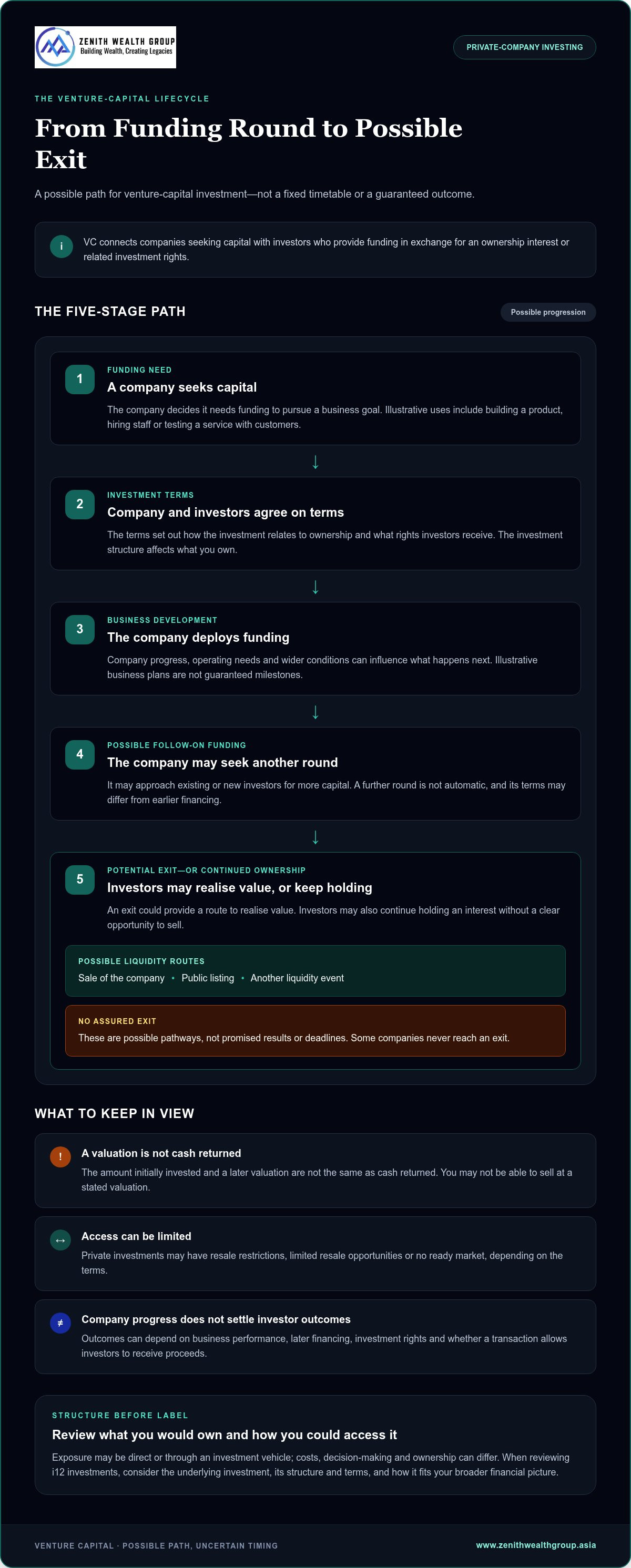
A venture-capital investment follows a possible path, not a fixed timetable. A company may seek funding, use it to develop its business, raise more capital if needed and eventually offer investors a way to realise value. Some companies don’t raise another round, and some never reach an exit. Each investment’s terms and progress can differ.
What happens during a venture-capital funding round?
A funding round is a stage of company financing. The company seeking capital presents its plans and negotiates terms with investors supplying funds. For example, a young business might use funding to build a product, hire staff or test its service with customers. These are illustrative uses, not guaranteed milestones. The company receives capital to pursue its plan; an investor receives an ownership interest or other rights as set out in the investment terms.
The broad lifecycle may look like this:
- Funding need: A company decides it needs capital to pursue a business goal and seeks investors.
- Investment terms: The company and investors agree on the terms of the round, including how the investment relates to ownership and investor rights.
- Business development: The company deploys funding. Its progress, operating needs and wider conditions can influence what happens next.
- Possible follow-on funding: If the company seeks more capital, it may approach existing or new investors. A further round isn’t automatic, and its terms may differ from earlier financing.
- Potential exit or continued ownership: Investors may eventually have a route to realise value, or they may continue holding an interest without a clear opportunity to sell.
These stages describe a framework, not a promise. A company’s fundraising terms don’t determine an investor’s final realised outcome. That outcome can depend on business performance, later financing, the rights attached to the investment and whether a transaction allows investors to receive proceeds. The amount initially invested and a later valuation are not the same as cash returned.
Why timing and exit routes matter to investors
An exit may happen through a sale of the company, a public listing or another liquidity event. These are possible pathways, not assured results or deadlines. Even if a company’s valuation changes, an investor may not be able to sell their interest at that value. The timing and terms of any transaction can affect whether, when and how investors receive proceeds.
Uncertain exit timing makes liquidity needs central: money committed to venture capital may not be available when you need it. When evaluating this type of exposure within alternative investments in Singapore wealth management, look beyond a company’s fundraising story. Consider how an illiquid holding could sit alongside near-term expenses and other financial priorities. A financial consultant or financial planner can help place those questions within a broader wealth plan. You can discuss your wealth-planning priorities in that context.
Venture Capital Risks in Singapore: Liquidity, Uncertainty and Due Diligence
An “alternative” label doesn’t mean an investment automatically diversifies a portfolio or carries less risk. Venture capital can expose investors to the prospects of private companies, but each company, investment structure and set of terms is different. Business plans may change, companies may struggle to secure further funding, and valuations may be uncertain. These are risks to examine, not predictions of a particular outcome.
Liquidity and valuation visibility can differ from listed investments: a private holding may be harder to sell, and its valuation may not be continuously observable. A valuation isn’t necessarily the amount an investor could realise in a sale. Even if an investor wants to exit, a buyer or transaction may not be available on their preferred timetable.
What risks should an investor understand?
A company could fail or develop differently from its original plan. Its valuation may be difficult to assess between funding events, and investors may face an extended holding period. The investment terms and any available resale route also matter. General risk education can help frame questions, but it cannot establish whether a particular fund, company or offer is suitable for an individual.
Use due diligence to understand what you would own and what could affect the value or transfer of that interest. Look for clear explanations of the investment strategy, valuation approach and risks. Where applicable and documented, review the fees, governance arrangements and potential conflicts of interest. If key terms are difficult to follow, pause and seek an explanation before making decisions.
What Singapore-specific checks belong in due diligence?
For Singapore regulatory context, start with current information from the Monetary Authority of Singapore’s capital-markets resources. The relevant rules and disclosures can depend on the investment structure and how an offer is made. Don’t assume that one investor category or offering arrangement applies to every opportunity. Review the current official material relevant to the specific structure, and consider professional guidance where the implications aren’t clear. If your financial life spans Singapore, Indonesia, Malaysia, the Philippines or Thailand, distinguish Singapore requirements from the rules that may apply in other jurisdictions.
- Understand the structure: Identify whether the exposure is direct or through a fund or other vehicle, and read the governing documents.
- Review the strategy: Check what types of companies the investment targets and how decisions are made.
- Study the terms: Understand how valuations are reported, what fees apply and what conditions govern transfers or exits.
- Look at accountability: Where information is provided, examine governance, reporting and potential conflicts.
When assessing i12 investments, focus on the actual opportunity and its documents. Review the assets, structure, terms and risk profile before deciding how it relates to your wider goals. For alternative investments in Singapore wealth management, a financial planner or financial consultant can help connect these questions to your time horizon and liquidity needs. Discuss your wealth-planning priorities as part of that broader assessment.
How to Assess Venture Capital's Role in Your Wealth Plan
There’s no universal profile of someone for whom venture capital is suitable. A useful assessment starts with your goals and financial position, then considers whether the investment’s possible time horizon, limited liquidity and uncertainty fit your circumstances. This is an educational framework, not a recommendation to invest or a guide to a particular allocation.
Which personal factors should shape the assessment?
Work through these questions before considering any illiquid exposure:
- What goal would this investment serve? Connect the decision to a clear objective, rather than choosing it simply because it’s labelled an alternative investment.
- When might you need the money? Consider whether your investment horizon can accommodate delays in accessing capital. A possible exit date isn’t a dependable date for meeting a personal expense.
- What are your cash-flow needs? Account for planned spending and funds you may need to access. If a holding can’t be sold promptly, other resources may need to cover those needs.
- What exposures do you already have? Review your existing investments and any other concentrated exposure to private companies or particular sectors. The full picture matters more than assessing one holding alone.
- How much uncertainty can you tolerate? Consider both your comfort with an uncertain outcome and your financial capacity to withstand one. Those are related, but not the same.
Your broader financial position matters. Income needs, existing commitments, other assets and upcoming goals can all affect how much flexibility you have. A choice that appears manageable in isolation may feel different alongside near-term cash needs or an already concentrated portfolio. Suitability depends on personal circumstances, not a universal investor profile.
How does venture capital compare with other portfolio choices?
Compare broad characteristics, not assumed outcomes. Listed shares, bonds, cash and private-company investments can differ in access, liquidity and the information available to investors. The details vary by holding and structure, so this table is a starting point for questions, not a ranking.
| Category | Access and liquidity | Information and valuation |
|---|---|---|
| Listed shares | Typically traded through public markets; sale depends on market conditions. | Market prices are generally visible during trading. |
| Bonds | Access and ability to sell depend on the instrument and market. | Pricing and information vary by issuer and instrument. |
| Cash | Generally intended for ready access, subject to the account or arrangement. | Value is typically straightforward to observe. |
| Venture capital | Private-company interests may be harder to transfer or sell. | Valuations may be less frequent and depend on available information. |
Use these contrasts to place alternatives beside your goals and existing investments, not outside the plan. A strategic investment-management approach looks at how holdings work together, including their purpose, liquidity and the information available to assess them. Zenith Wealth provides wealth management and financial planning, including investment management, to help clients consider investment decisions in the context of their wider plans. Discuss your investment-planning priorities with the broader picture in view.
Building a Thoughtful Singapore Wealth Plan Around Alternative Investments
Venture capital is one possible consideration within a wealth plan, not a plan in itself. Its long and uncertain timeline may suit some objectives better than others, so weigh it alongside your existing investments, commitments and future needs. A financial consultant or financial planner can help connect investment questions to your wider goals without assuming that venture capital belongs in every portfolio.
Questions to bring into a financial-planning conversation
Start with the purpose of the decision. Clear questions can make a discussion more practical:
- Which financial goal, if any, would this investment support?
- When might you need access to the money, and what if access takes longer than expected?
- How would limited liquidity fit with your cash-flow needs and existing obligations?
- How comfortable are you with uncertain valuations and outcomes?
- How would this exposure sit alongside your existing investments and plans?
Bring the whole picture into the conversation. An investment that appears manageable on its own may affect flexibility when considered alongside planned spending, family responsibilities or other financial commitments. The assessment should reflect your circumstances, not a standard investor profile or a universal allocation. It’s also useful to distinguish what you know about an opportunity from what remains uncertain, including its structure, terms and potential routes to access funds.
How broader wealth planning keeps the decision in context
For alternative investments in Singapore wealth management, the useful question isn’t simply whether venture capital sounds compelling. It’s whether its risks, access arrangements and place in your finances make sense alongside the rest of your plan. When considering i12 investments, apply the same discipline: understand the investment and its role in your portfolio before making a decision.
A financial planner or financial consultant can help organise these questions around your goals, obligations and broader financial position. Start a conversation about your wealth plan.
Make Your Next Investment Decision Part of a Bigger Plan
Before acting on an opportunity, turn your initial interest into a clear planning conversation. What role would it serve? How does it relate to the financial priorities you want to protect over time? These questions can help you decide what information you still need and whether the opportunity belongs in a wider discussion about your wealth.
That perspective is central to considering alternative investments in Singapore wealth management. The next step isn’t to chase a trend or assume a particular outcome, but to connect investment decisions with the goals and commitments that matter to you. Consider i12 investments in the same context, with attention to the underlying investment and its place in your plans. A financial planner or financial consultant can help frame the discussion around your circumstances.
Zenith Wealth Group is a Singapore-based wealth management and financial planning firm. Its representatives operate under finexis advisory Pte Ltd. Discuss your investment questions with our team and take your next step with greater clarity.
Frequently Asked Questions
What are alternative investments in wealth management?
Alternative investments are a broad group of assets or strategies that sit outside conventional public shares and bonds. Examples can include private-company investments, real assets and certain investment funds, but the category varies. In alternative investments in Singapore wealth management, the practical first step is to identify what an opportunity actually holds and how it is structured. The label alone doesn’t tell you its risks, liquidity or suitability.
Is venture capital considered an alternative investment?
Yes. Venture capital is generally considered an alternative investment because it involves financing private companies rather than buying shares traded on a public exchange. The label describes the underlying investment approach, not necessarily how an individual gains exposure. An investor might encounter a direct investment or an investment vehicle, each with its own terms. Read the relevant documents to understand what the investment represents and what rights may apply.
How does venture capital work as an asset class?
Venture capital gives companies access to funding in exchange for an ownership interest or other investment rights. Investors assess the company, the proposed terms and how their interest might change if the company raises more capital. For example, further financing may affect existing ownership, depending on the terms. The asset class is linked to private-company development, but an individual investment’s structure can shape the investor’s experience.
Can venture capital be part of a diversified portfolio?
It can be considered alongside other holdings, but adding a different asset label doesn’t automatically diversify a portfolio. Look at the underlying company, sector and investment structure, then compare those exposures with what you already own. For instance, private-company exposure may overlap with risks already present in your work or other investments. A broader portfolio review can help show whether a holding changes concentration, liquidity or overall risk in a meaningful way.
How risky is venture capital for individual investors?
Venture capital can involve substantial uncertainty because a private company’s development, financing needs and valuation may change. An investor may also have limited ability to sell an interest, and available information can differ from that for listed companies. Consider how these features interact with your finances, including whether you could meet planned expenses without relying on a sale or a particular valuation.
What should Singapore investors check before considering venture capital?
Start with the investment’s legal structure, offering documents, fees, valuation approach, governance and any disclosed conflicts. For Singapore regulatory context, consult current Monetary Authority of Singapore information relevant to the specific offer and structure. Investor eligibility and offering requirements can depend on the circumstances, so don’t infer them from a marketing label. When reviewing i12 investments, examine the underlying assets and investment type in the documents.
How long might an investor's money remain tied up in venture capital?
There’s no single timeframe that applies to every venture-capital investment. The holding period can depend on the company’s development, the investment terms and whether an exit or other opportunity to realise value occurs. An investor may not be able to choose when to sell. Before committing, compare the possible lack of access with your spending plans, cash reserves and the timing of other financial obligations.


