

Singapore is already a preferred destination for Indonesian investors arranging wealth offshore. A considered approach to offshore wealth management for Indonesian investors in Singapore can bring investment decisions, succession planning and cross-border considerations into one clear plan.
It is understandable to look beyond one market when planning family wealth. But an offshore arrangement is more than deciding where to hold assets: it should reflect your goals, family circumstances and the rules that apply to your investments.
This article explains why Singapore features in Indonesian investors’ wealth arrangements, how succession planning and family-office structures fit into the picture, and how equity and fixed-income strategies may be considered. It also explores how local regulation and changing investor behaviour shape those decisions, so you can see what to weigh before planning your next step.
Key Takeaways
- Map business succession and inter-generational wealth transfer together so ownership plans and family priorities stay aligned.
- Balance equity and fixed-income exposure around your investment goals, risk tolerance and cross-border currency considerations.
- Account for Indonesian regulation and changing investor behaviour when shaping an offshore wealth strategy.
- Assess how Singapore-based arrangements, including family-office structures, fit your investment, succession and family needs.
Business succession and inter-generational wealth transfer
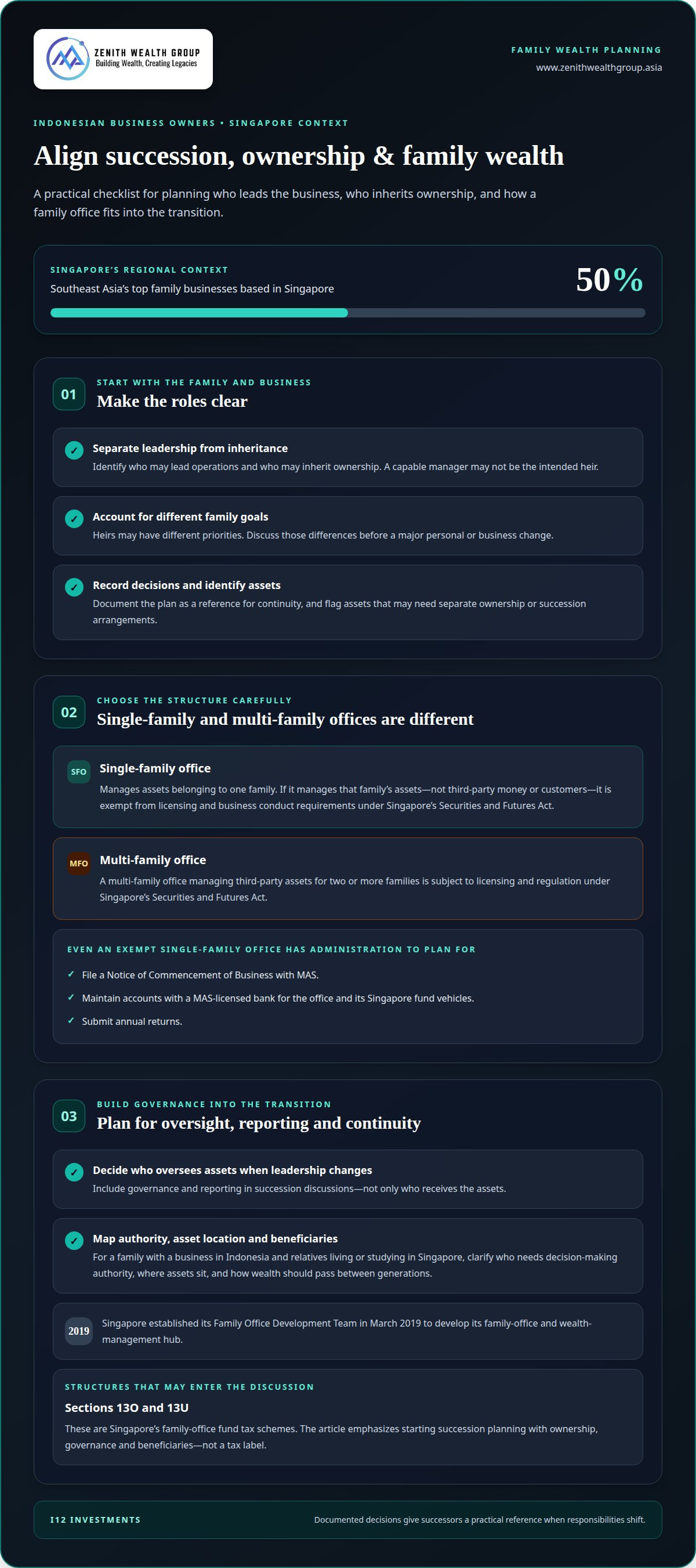
An Indonesian business owner planning a transition should connect company succession with family wealth planning. Start by identifying who may lead operations, who may inherit ownership, and how those roles differ. A capable manager may not be the intended heir, while heirs may have different goals. Recording these decisions gives families a basis for discussing continuity before a major personal or business change. It also clarifies which assets may need separate ownership or succession arrangements, similar to how business owners expanding into new international markets rely on company formation consultants Oman to establish compliant local entities.
Singapore is a relevant setting for regional families: 50% of Southeast Asia’s top family businesses are based there. A family office can help coordinate investment oversight and inter-generational planning, but its structure matters. A single family office manages assets belonging to one family. A multi-family office managing third-party assets for two or more families is subject to licensing and regulation under Singapore’s Securities and Futures Act. These are distinct structures, not interchangeable labels.
Singapore single-family offices managing one family’s assets, rather than third-party money or customers, are exempt from licensing and business conduct requirements under the Securities and Futures Act. They still have administrative obligations, including filing a Notice of Commencement of Business with MAS, maintaining accounts with a MAS-licensed bank for the office and its Singapore fund vehicles, and submitting annual returns. Governance and reporting therefore belong in succession discussions, alongside deciding who will oversee assets when leadership changes.
Equity and fixed-income investment strategies
Singapore financial consultants can discuss equity and fixed-income investments, as well as currency considerations in cross-border planning. A suitable mix depends on your goals, time horizon, risk tolerance and future spending needs. For example, a family expecting expenses in Indonesia may weigh currency exposure differently from one planning regular spending in Singapore. The portfolio’s currency mix should account for both where assets are held and where future liabilities will arise.
Equities can provide exposure to company growth, but their values can fluctuate. Bonds may play a different role by providing income and helping balance portfolio risks. Singapore investors held 17% of their portfolios in bonds, while equities represented 18%. These figures offer local context, not a model allocation for Indonesian investors. A portfolio decision should account for the investor’s own goals and existing holdings.
Indonesian government securities also appear in the fixed-income picture. Yields on short-term Indonesian government paper were reported at over 3%, while Indonesia’s 10-year government bond offered just over 6% yield to maturity. Those yields are not a complete measure of return. Bond prices can change, and the maturity, issuer, currency and investor’s holding period all matter. Compare these factors with the role each bond is meant to play, rather than choosing by yield alone.
A practical review starts by separating the portfolio’s purpose: growth, income, liquidity or diversification. Then consider equity exposure, bond maturity and currency alignment together. For instance, an investor seeking income may assess bond cash flows against expected expenses, while someone with a longer investment horizon may consider how equities fit alongside fixed income. These choices should also sit within a wider cross-border plan, including the investor’s Indonesian assets and family commitments. A portfolio planning discussion can help bring those considerations into one investment framework.
An Indonesian asset manager reported that its balanced absolute-return strategy had outperformed the Jakarta Composite Index by more than 50% cumulatively. That reported comparison may offer a reference point when considering an active approach, but it does not establish that the strategy will suit a particular investor. Its relevance should be weighed against the portfolio’s objectives, risk tolerance and cross-border needs.
Indonesian regulation and client behaviour
Holding assets in Singapore does not, by itself, determine an individual’s Indonesian tax residency. Whether income from those assets falls within Indonesian tax reporting depends on residency status and applicable Indonesian rules. Treat residency, income and asset location as separate planning questions. For example, a Singapore investment account does not replace an assessment of the investor’s Indonesian tax position. This distinction matters when choosing an account structure and considering how investment income fits into a wider plan.
Investor behaviour is changing alongside cross-border planning. The number of Indonesian fund investors rose to over 6 million during the year and a half covered by the figures. A banker also reported that Indonesian retail investors in unit trusts had risen about 90% that year. These figures point to growing participation, but they do not mean every investor has the same goals. A first-time fund investor may focus on access and understanding risk, while a business-owning family may also weigh succession and currency needs.
Indonesian product rules differ by fund type. The figures describe Indonesian Syariah products as able to invest up to 100% outside the country, compared with a 15% constraint for conventional funds. Indonesian insurers faced a 20% cap on investments in offshore investments. These limits apply to different product categories, so they should not be treated as interchangeable rules for an individual’s holdings. Identify the investor and product type first, then consider how the relevant constraint affects the intended allocation.
A practical review connects the rules to an investor’s circumstances without assuming offshore investment is automatically suitable. First, establish the investor’s tax-residency position and identify where income arises. Next, distinguish personal assets from fund or insurance exposures. Then align the investment approach with the investor’s purpose, such as long-term growth, income or family planning. For an Indonesian investor considering Singapore, this sequence keeps jurisdiction, product structure and personal objectives distinct. It also provides a clearer basis for discussing how cross-border assets fit into the broader financial plan.
Indonesian investors’ offshore wealth arrangements, particularly in Singapore
Singapore ranked #2 globally as an international wealth management centre in 2024. It was the preferred offshore financial centre for 32% of Indonesian high-net-worth individuals. Those figures show its appeal, but the choice of structure still depends on personal objectives. A sound approach to offshore wealth management for Indonesian investors in Singapore connects provider selection with family, investment, and currency needs.
When comparing providers, consider their regulatory category, services, custody arrangements and written fee schedules. Singapore banks are regulated under the Banking Act, and investors are protected under the Securities and Futures Act. Each bank sets its own private-banking minimum investment or assets-under-management requirements, so there is no single threshold for every institution.
Private banking fees vary by provider and account arrangement. Review the proposed schedule for advisory, custody, transaction, product and currency-conversion charges. Account opening involves identity, residence, ownership and source-of-funds information. The institution sets the evidence requirements for each client profile.
Tax treatment of interest, dividends, capital gains and other investment income depends on applicable rules and tax residence. Holding assets in Singapore alone does not determine the tax outcome. Keep tax residency separate from account location when assessing an arrangement.
Risks include currency movements between Singapore dollars and rupiah, investment losses and custody arrangements that affect how assets are held. Deposit protection and investment protection are not interchangeable, so understand which applies to each asset and account. Cash deposits and investment securities, for example, have different risk profiles.
To select and open an account, define your investment purpose, compare regulatory status and services, review fees and custody, then prepare identity and source-of-funds documents. Align the account with your tax position and currency needs before investing. For offshore wealth management for Indonesian investors in Singapore, connect these decisions with your wider financial goals. Discuss your cross-border wealth plan.
Zenith Wealth: Investment Management
Zenith Wealth can help connect investment decisions with wider financial goals through Investment Management. This can be useful when you’re weighing how investment choices fit alongside retirement plans, education funding, or wealth protection. If you’re considering i12 investments, place that interest within your overall objectives, time horizon, and risk comfort rather than treating it as a standalone decision.
Start with the goals that matter most, such as future income or education costs. A financial planner can help shape an approach around those priorities and your broader financial picture. For a conversation about your investment planning, contact Zenith Wealth.
Set your next wealth-planning priorities
Use your next planning conversation to define what your offshore arrangements need to support. A clear priority, such as preserving family options or coordinating assets with future goals, can help guide decisions over time. Offshore wealth management for Indonesian investors in Singapore works best as part of a plan that connects investment choices with personal circumstances and longer-term goals, rather than treating each decision in isolation.
Zenith Wealth Group provides retirement planning, education funding and wealth protection. These priorities can frame a discussion about how your investment approach relates to retirement needs, education goals and protecting wealth. Bring the questions you want to resolve first, then build your plan from there.
Contact Zenith Wealth to discuss your plans. A thoughtful conversation is a practical place to begin.
Frequently Asked Questions
What offshore wealth management services are available to Indonesian investors in Singapore?
Planning may cover investment management, retirement planning, education funding, wealth protection, legacy planning and estate planning. For example, an Indonesian parent with future education costs can connect investment decisions with education funding and protection needs. Zenith Wealth Group provides these planning services. An offshore account is a separate banking arrangement, so distinguish portfolio planning from account opening and asset custody.
Which Singapore banks and wealth managers serve Indonesian high-net-worth clients?
Singapore is home to over 40 global and regional private banks, alongside financial consultants serving different client needs. Compare institutions by regulatory status, services, custody arrangements, fee schedules, and onboarding criteria. For an Indonesian client, the right fit also depends on investment goals, currency needs, and family priorities. A financial planner can help organize the wider plan, while each institution sets its own account terms.
What Indonesian foreign-asset reporting and tax disclosure requirements apply to Singapore investments?
Indonesian reporting obligations depend on tax residency and applicable Indonesian tax rules, not solely on where an account is held. Keep records of account ownership, investment income, transactions and residency details to support accurate disclosure. Consider reporting foreign assets separately from the tax treatment of income earned on them. This distinction helps identify which information relates to ownership and which relates to taxable income.
What documents and source-of-funds checks do Indonesian investors need to open a Singapore account?
Account opening involves providing identity, residence, ownership and source-of-funds information. Each institution sets its evidence requirements based on the client’s profile.


