

Your CPF balance isn’t the same as your investible balance. Knowing the thresholds is the first step to understanding what you may be able to invest.
It’s easy to focus on investment choices before checking how much of your CPF savings is available to invest. Start with your eligible balance, then check which account and process apply to the investment you are considering.
This guide explains how to check your investible CPF savings, open a CPF Investment Account and compare CPFIS choices, including ETFs and their fees. You’ll also learn how the options differ, so you can weigh costs and investment risks before deciding what fits your plans.
Key Takeaways
- Learn the steps for opening a CPF Investment Account and the eligibility checks to consider before investing.
- See how CPFIS investment limits shape your choices across shares, property funds and gold.
- Compare ETF expense ratios with transaction and agent bank charges to understand the costs that can add up.
- Explore how different CPFIS investments may fit your plans, and consider how they sit alongside your wider investment approach, including i12 investments.
How do I open a CPF Investment Account (CPFIA)?
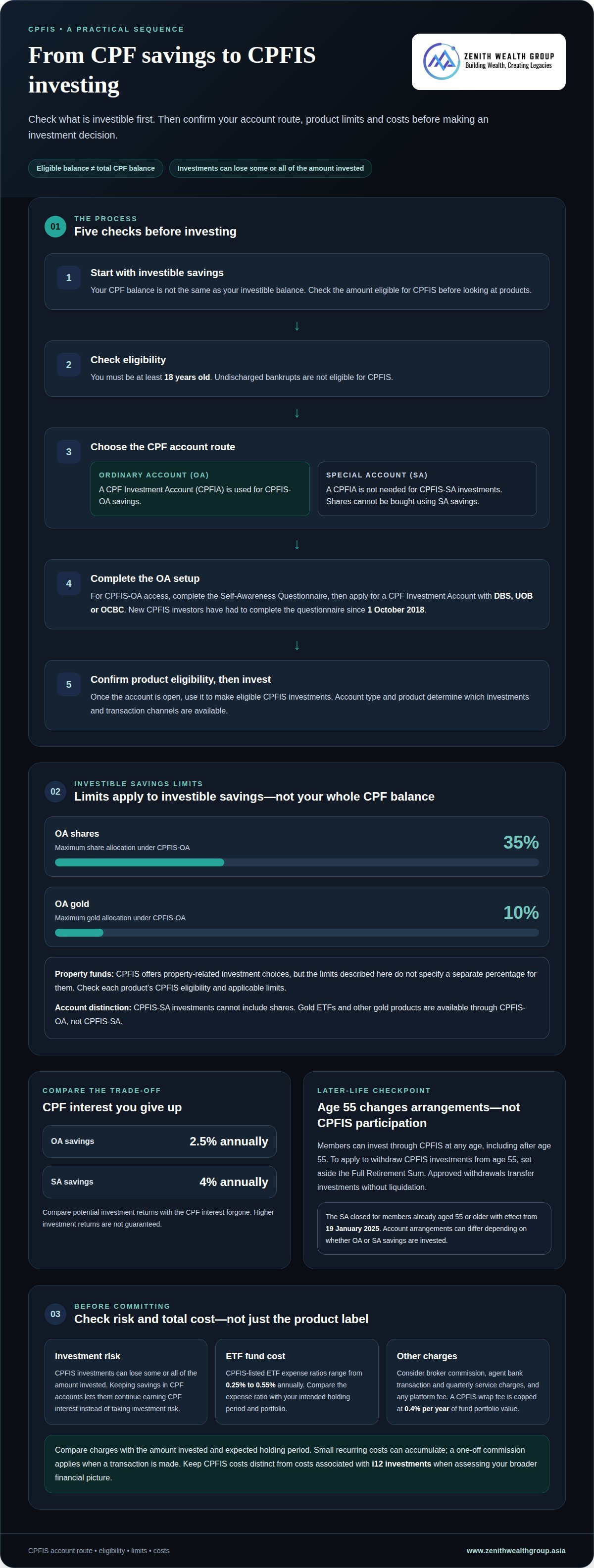
The CPF Investment Scheme (CPFIS) lets eligible members invest savings from their Ordinary Account (OA) and Special Account (SA) in approved investments. Members must be at least 18 years old, and undischarged bankrupts aren’t eligible. OA stock investments are limited to 35% of investible savings, while gold is limited to 10%. SA investments cannot include shares.
A CPF Investment Account (CPFIA) is the bank account used to invest CPFIS-OA savings. You don’t need one for CPFIS-SA investments. To set up CPFIS-OA access, complete the Self-Awareness Questionnaire, then apply for an investment account with DBS, UOB or OCBC. New CPFIS investors have had to complete the questionnaire since 1 October 2018. Once the account is open, use it to make eligible investments through CPFIS.
CPF interest is the return credited to savings held in CPF accounts, which you give up on amounts invested. OA savings earn 2.5% interest annually, while SA savings earn 4% annually. Compare potential investment returns with the CPF interest you would forgo; higher returns aren’t guaranteed.
Age 55 changes account arrangements, but it doesn’t end CPFIS participation. The SA closed for members already aged 55 or older with effect from 19 January 2025, yet members can invest through CPFIS at any age, including after age 55. Account arrangements can differ depending on whether you invest OA or SA savings. Members who prefer to keep savings in CPF accounts can continue earning CPF interest rather than taking investment risk.
What is the CPF Investment Scheme (CPFIS)?
The CPF Investment Scheme (CPFIS) lets eligible members invest CPF savings in approved products for retirement. CPFIS investments can lose some or all of the amount invested. To sell, use the channel for the investment; CPFIS-SA members can buy or sell through product providers. From age 55, members can apply to withdraw CPFIS investments after setting aside the Full Retirement Sum.
Limits for shares, property funds and gold
CPFIS investment limits restrict how much of your investible savings can go into certain asset types. Under CPFIS-OA, shares count toward a 35% limit, while gold counts toward a 10% limit. These limits apply to investible savings, not your entire CPF balance.
Property funds invest in property-related assets. They are among the investment choices available through CPFIS, but the limits discussed here do not specify a separate percentage for property funds. Check the product’s CPFIS eligibility and applicable limits before selecting it. CPFIS-OA investments can include shares; CPFIS-SA investments cannot. Gold ETFs and other gold products are available under CPFIS-OA, but not CPFIS-SA.
Restricted CPFIS investments
Restricted CPFIS investments are products or asset types that members cannot buy using a particular CPF account. CPFIS permits investments only in eligible products, and the account type matters: shares and gold products are not available under both OA and SA.
After age 55, CPFIS withdrawal is subject to setting aside the Full Retirement Sum in the Retirement Account. Members can meet it with cash alone, or with cash and property, but the latter requires at least the Basic Retirement Sum in cash. Approved withdrawal applications transfer investments to the member without liquidation. The investment’s sale or transfer route depends on its product and account channel. If you want to discuss how investment decisions fit your retirement plans, talk through your investment priorities.
ETFs available under CPFIS and their fees
An exchange-traded fund (ETF) is a fund traded on an exchange, with costs that can reduce returns. CPFIS-listed ETFs have expense ratios ranging from 0.25% to 0.55%. The expense ratio is the annual fund cost expressed as a share of its assets. Compare it with your intended holding period and portfolio, not just the amount paid to buy.
Broker commission is the charge for executing an ETF or other exchange-traded product transaction. A minimum commission can weigh more heavily on smaller trades. CPFIS gold ETFs are available through brokers using OA savings; gold products aren’t available under CPFIS-SA.
Agent bank charges are fees for processing CPF investment transactions and servicing the account. A CPFIS wrap fee covers portfolio services and is capped at 0.4% per year of the fund portfolio value.
A platform fee is a separate charge for using a trading service, distinct from brokerage and fund expenses. Include it in the total-cost comparison when it applies. CPF Investment Account (CPFIA) fees can include agent bank transaction and quarterly service charges, so review both alongside the ETF’s expense ratio. The Self-Awareness Questionnaire addresses investment awareness and eligibility, not product fees. Before investing, compare charges against the amount invested and expected holding period. Small recurring costs can accumulate, while a one-off commission applies when a transaction is made. Keep CPFIS costs distinct from costs associated with i12 investments when assessing your broader financial picture.
CPF Investment Scheme (CPFIS) investment options
CPFIS offers several approved investment types, but the choices differ by account. Assess the product, its risks and the route to invest before deciding where to start.
Available CPFIS investment options
CPFIS investment options are approved products members can buy using eligible CPF savings. Choices include unit trusts, government bonds, Treasury bills, fixed deposits, shares, property funds, annuities, endowment insurance policies, investment-linked insurance products and fund management accounts. CPFIS investment options may be subject to eligibility criteria. Singapore Government Securities bonds have maturities ranging from 2 to 50 years, while Treasury bills have six-month or one-year tenures.
Options for Special Account savings
CPFIS-SA options are eligible investments available through Special Account savings. The CPF Board says unit trusts are available for investment from both OA and SA savings, but higher-risk unit trusts are excluded. Shares cannot be bought using SA savings, and gold products are available under CPFIS-OA, not CPFIS-SA. SA investors can approach product providers directly to buy or sell eligible investments.
The channel depends on the product. Members can approach deposit banks for fixed deposits, bond dealers for Treasury bills, and insurance companies for annuities or insurance policies. Fund management companies or investment administrators handle unit trusts; fund management companies also offer fund management accounts. Brokers handle shares, property funds, exchange-traded funds and government-guaranteed bonds. Knowing the relevant channel helps you understand the route before you start investing.
Use your time horizon and comfort with investment risk to assess options. Government bonds and Treasury bills have defined maturities; funds and shares can fluctuate in value. CPFIS investments can lose some or all of the invested money. Fund total expense ratios are capped between 0.35% and 1.75% a year, depending on the fund’s risk category. The CPF Board’s planned new scheme is expected to launch in the first half of 2028, with a small number of options through two to three product providers. For help aligning CPFIS choices with your wider investment plan, discuss your investment priorities.
Zenith Wealth: Investment Management
Zenith Wealth can help you connect investment decisions with your wider financial plan. Consider Investment Management when you’re weighing CPFIS choices alongside other investments, including i12 investments, and want to assess how they fit your goals and comfort with risk.
CPFIS decisions may also affect retirement planning, education funding and wealth protection. A financial planner can help you consider these priorities together rather than viewing an investment choice in isolation. This can be useful when your time horizon, income needs or family plans change.
Bring your questions about CPF savings, investment choices and your financial priorities to a conversation. Contact Zenith Wealth to discuss your next steps.
Make your next investment decision part of a wider plan
Choosing an investment is one decision in a longer financial journey. Your priorities can shift as retirement approaches, education needs change or you reassess how to protect your wealth. Consider how your CPFIS choices fit alongside those goals rather than treating each investment in isolation.
For anyone assessing CPFIS investment options in Singapore, a financial planner can help connect investment decisions with broader priorities. Zenith Wealth Group offers Retirement Planning, Education Funding and Wealth Protection, alongside Investment Management. These areas can help frame a conversation about what you want your savings to support over time.
Bring your questions and the goals you’re working towards. Contact Zenith Wealth to discuss your CPFIS options, and take the next step with clarity and confidence.
Frequently Asked Questions
How do I check how much OA and SA savings I can invest?
Compare each account’s current balance with its CPFIS threshold to estimate investible savings. When reviewing CPFIS investment options in Singapore, remember that eligibility and the amount available can change with account activity and existing investments.
Can I buy ETFs and stocks with my CPF savings?
Yes, eligible members can use CPFIS-OA savings for shares and ETFs, subject to product eligibility and investment limits. CPFIS-SA cannot be used to buy shares, and gold ETFs are available under OA but not SA. For example, before considering an ETF, identify which CPF account will fund it, then check its CPFIS eligibility and applicable costs.
What are the fees for CPF investments?
Costs can include fund expenses, brokerage and agent bank charges, so add them together when comparing investments. CPFIS-listed ETF expense ratios range from 0.25% to 0.55%. Agent bank charges also apply, with GST, and depend on the transaction or service period.
What is CPFIS and how does it work in Singapore?
CPFIS is a scheme that lets eligible CPF members invest savings in approved products. The investment route depends on the account and product: OA savings require a CPF Investment Account, while SA investments can be made directly through product providers. Investment values can rise or fall, and CPFIS investments may lose some or all of the money invested. Consider risk alongside potential returns.
Which CPFIS investment options are available for Ordinary Account savings?
CPFIS-OA options include eligible shares, ETFs, unit trusts, government bonds, Treasury bills, fixed deposits, insurance products and fund management accounts. Property funds and gold products are also among the available choices. To compare CPFIS investment options in Singapore, consider each product’s risks, costs and transaction channel. For instance, members may approach brokers for shares and ETFs, while deposit banks handle fixed deposits.
How much must remain in CPF accounts before investing under CPFIS?
These amounts are account-specific, not a combined CPF balance. Only savings above the relevant threshold may be investible, subject to CPFIS eligibility and product rules. A balance at or below the threshold leaves no amount above it to invest from that account.


