

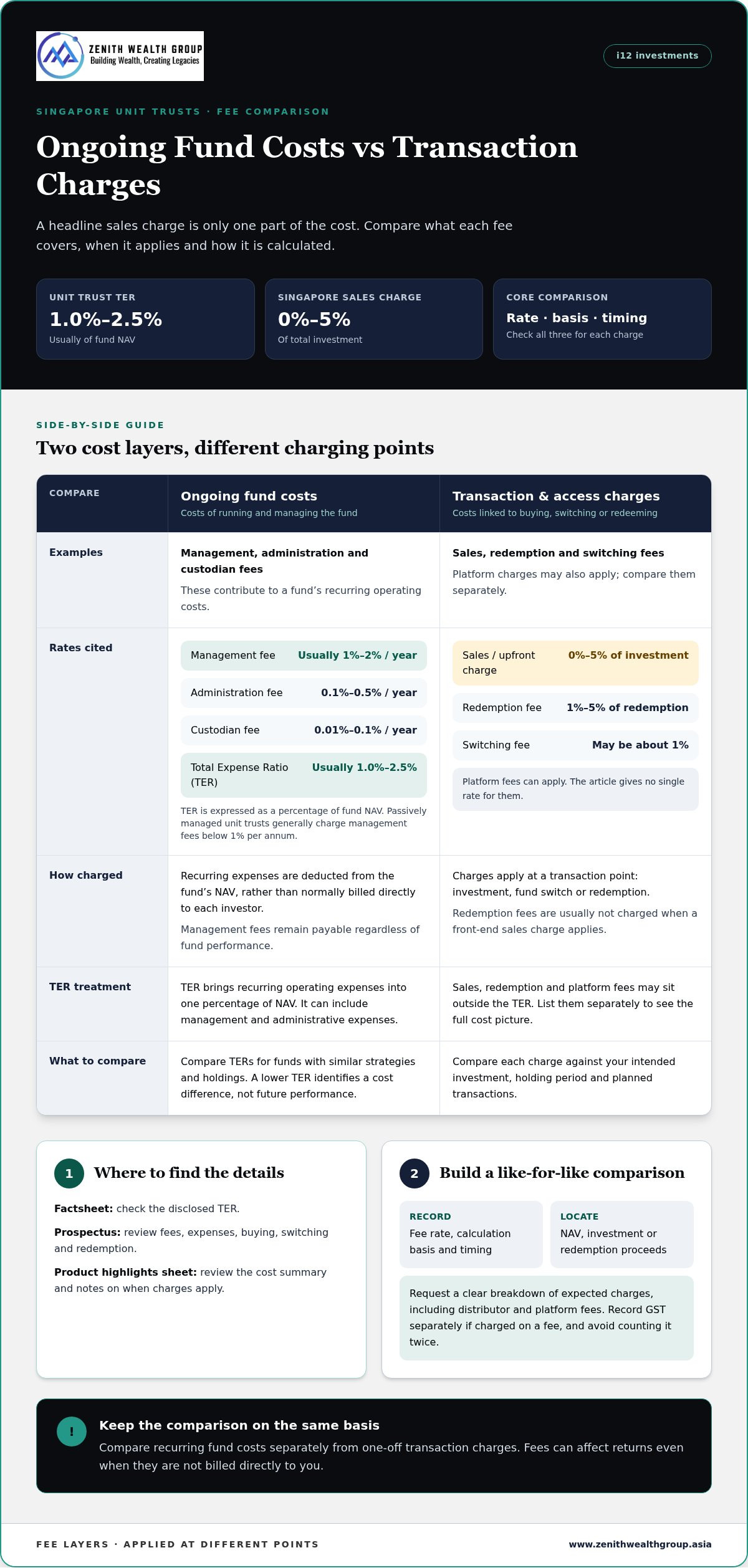
The headline sales charge is only part of the hidden costs of unit trusts in Singapore. Sales charges range from 0% to 5% of the total investment, while a fund’s Total Expense Ratio (TER) is usually 1.0% to 2.5% of its net asset value. The amount you ultimately pay also depends on how fees are applied and which share class you choose.
When investing in unit trusts in Singapore, it’s easy to focus on the amount charged upfront and miss ongoing costs deducted within the fund. Comparing these charges matters because fees can affect your returns even when they aren’t billed to you directly.
This guide explains the main costs to look for, including management, platform and transaction fees. You’ll also learn how NAV pricing and share-class differences affect the price you pay, and how to compare fee structures before investing. Use the criteria table and decision guide to identify the charges that may apply to you and what to look for in a fund’s prospectus or factsheet.
Key Takeaways
- Compare more than the upfront sales charge: management, administration, platform and other ongoing fees can also affect your investment.
- Use the Total Expense Ratio to assess a fund’s operating costs, and look for it in the fund’s factsheet.
- Understand how NAV pricing works before buying or redeeming, since charges may be added or deducted at different points.
- Compare front-load and back-load structures to see when charges apply and how they may affect your investment choices.
- Check share-class details carefully: fee structures can vary, even when classes relate to the same fund.
What are the Investment Fees When You Buy Unit Trusts in Singapore?
Unit trust costs can arise when you invest, hold units, switch funds or redeem. Compare each charge by its amount, timing and calculation basis.
Management and Administration Fees
A fund manager’s management fee pays for managing the portfolio and is usually 1% to 2% of the investment value per year. It is deducted from the fund’s net asset value (NAV), not normally billed directly to each investor, and remains payable regardless of fund performance. Passively managed unit trusts generally charge management fees below 1% per annum.
Trustee and administration fees are separate operating costs. Administration fees generally range from 0.1% to 0.5% per year, while custodian fees commonly range from 0.01% to 0.1% per annum. These recurring charges differ from a sales charge, which applies to a transaction rather than the fund’s ongoing operation.
Upfront, Redemption and Switching Charges
Upfront fees are typically 1.5% to 5% of the investment amount; Singapore sales charges range from 0% to 5% of the total investment. These one-off charges are typically paid to the distributor and may be negotiable between investor and distributor. Redemption fees can be 1% to 5% of the redemption amount, although they are usually not charged when a front-end sales charge applies.
A switching fee may be about 1% of the amount switched. It applies when moving between funds, so its impact depends on how much you switch and how often. Compare these transaction charges separately from ongoing management fees, and include any applicable platform charge in your overall cost comparison.
GST on Unit Trust Fees
GST is separate from the fund’s management fee. If GST is charged on a fee, record it as a separate cost rather than treating it as another investment charge. Its treatment can depend on the fee and how it is charged, so compare the stated GST amount with each listed charge to avoid counting it twice.
Finding Fees in Fund Documents
Start with the prospectus or product highlights sheet, which states the fund’s charges and pricing method. In the prospectus, look for sections on fees, expenses, buying, switching and redemption. In the product highlights sheet, review the cost summary and notes on when each charge applies. The fund’s factsheet should disclose its Total Expense Ratio (TER).
Build a like-for-like comparison: record each fee’s rate, calculation basis and timing, and note whether it is deducted from the NAV, your investment or redemption proceeds. Then request a clear breakdown of expected charges, including distributor and platform fees.
ETFs and robo-advisers use different fee structures, so compare the full cost layers rather than one headline figure. Robo-adviser expense ratios in the cited comparison range from 0.2% to 0.8%; unit trusts may also have sales charges and fund-level costs.
| Fee option | Purpose | Basis or timing |
|---|---|---|
| Management | Fund management | Usually 1% to 2% of investment value per year |
| Administration | Fund administration | Generally 0.1% to 0.5% per year |
| Upfront sales charge | Distribution or purchase | 0% to 5% of total investment in Singapore |
| Redemption | Unit sale | Some funds charge 1% to 5% of redemption amount |
| Switching | Moving between funds | May be about 1% of amount switched |
Choose by comparing the fees that apply to your intended investment, holding period and transactions, not just the sales charge.
Total Expense Ratio (TER)
The TER brings a fund’s recurring operating expenses into one percentage of its net asset value (NAV). In Singapore, unit trust TERs are usually between 1.0% and 2.5% of fund NAV.
Fund Operating Costs in the TER
A TER measures a fund’s operating expenses against its average assets, giving investors a common basis for comparing portfolios. It can include management and administrative expenses, rather than showing each recurring cost as a separate investor bill. The fund’s factsheet should disclose the TER, so use it to compare funds with similar investment objectives and holdings.
TER does not include every possible charge. A sales charge, redemption fee or platform fee may sit outside the fund’s operating expenses. Compare these separately with the TER to understand more than the cost of running the portfolio.
Trustee and Other Fund Expenses
Trustee expenses and other operating costs contribute to a fund’s expenses and may be reflected in its TER. These differ from transaction charges: operating costs relate to running the fund, while a sales charge applies to a purchase or redemption. Read the fees section alongside the TER disclosure to see which costs are included and which are listed separately.
For Singapore context, collective investment scheme assets, including unit trusts, total S$191 billion. At an assumed average TER of 1.75%, fees on those assets would amount to about S$3.34 billion per year. This illustrates how a percentage-based expense applies across pooled holdings.
Ongoing Charges and Long-Term Returns
Because recurring expenses are reflected in NAV, they reduce the value that remains invested, affecting returns over time. Fees are generally payable whether a fund performs well or poorly, so compare the ongoing charge with the service and investment approach it supports. Morningstar reported an asset-weighted average expense ratio of 0.37% for active funds in 2022; this is a broad active-fund benchmark, not a Singapore unit trust quote.
To assess the effect on your plan, compare the TERs of funds with similar strategies, then review separate platform and transaction charges. A lower TER does not prove stronger performance. It identifies one cost factor, not the fund’s future results.
Use this quick review: find the TER in the factsheet, check operating expenses in the prospectus, then list charges outside the TER. Compare each fund on the same basis, including its investment strategy and holdings, before deciding. For a broader discussion of how investment costs fit your financial goals, discuss investment costs and planning.
Liquidity and NAV-based pricing
Most unit trusts in Singapore allow investors to buy and sell units daily. Their net asset value (NAV) is usually calculated daily, reflecting changes in the prices of investments held by the fund.
Daily dealing and daily pricing describe different parts of a transaction. Dealing refers to when investors can submit purchase or redemption instructions. NAV pricing determines the value used to process them. As the NAV changes with the underlying investments, the price applied to a transaction may differ from the most recently published NAV.
Check the prospectus and product highlights sheet for the fund’s pricing method. Singapore unit trusts may use bid and offer pricing or single pricing. The distinction matters because subscription and redemption charges are applied differently. Start a clear comparison with the price used, then trace where each charge is added or deducted.
- Bid and offer pricing: A subscription charge is added to the NAV per unit. A redemption charge is deducted from it.
- Single pricing: A subscription charge is deducted from the investment before units are allocated. Any redemption charge is deducted from redemption proceeds.
For an initial purchase, check whether the stated amount is the NAV per unit or the final subscription price after charges. This shows how much of your investment goes towards allocated units. For a redemption, trace the process in reverse: identify the applicable price, then account for any charge deducted from the proceeds. This helps separate changes in investment value from transaction costs.
NAV-based pricing also affects how you read performance. Annual returns reflect changes in unit value over a period, while the transaction price depends on the fund’s stated pricing method and valuation. A daily NAV is a valuation point, not a promise that you’ll buy or sell at a price published earlier. Compare the document’s dealing and pricing explanations before interpreting returns.
Use this practical review for each fund:
- Find whether the scheme uses bid and offer or single pricing.
- Locate how subscription charges affect the purchase price and unit allocation.
- Check how redemption charges affect the price or proceeds received.
- Compare the stated dealing arrangements with your planned transaction timing.
These steps make pricing easier to compare across unit trusts, even when their NAVs move differently. Focus on the final subscription cost and redemption proceeds, not just the quoted NAV. Keep the pricing method alongside the fund’s fee details when comparing options. This gives you a clearer view of how a charge affects the amount invested, units allocated or proceeds received.
Front loads and back loads
Front-end charges apply when you invest; back-end charges can apply when you redeem. Compare both with ongoing costs before deciding how a unit trust fits your savings plan.
Sales Charges and Trailer Fees
In Singapore, unit trust sales charges range from 0% to 5% of the total investment. Front loads are usually up to 5% or more of the amount invested. Some funds instead charge on redemption, with redemption fees ranging from 1% to 5% of the redemption amount. These charges differ by timing: one reduces the amount invested, while the other can reduce sale proceeds.
Fund managers pay 20% to 60% of management fees to distributors as trailer fees for ongoing advice or service. This payment comes from management fees, rather than appearing as a separate sales charge to the investor. A mutual fund’s documents can help identify charges and distributor compensation. Compare the stated sales charge with the ongoing fee structure, not just the initial deduction.
Negotiating or Avoiding Charges
One-off fees may be negotiable between the investor and distributor. Platform fees also differ between Singapore investment platforms, from 0% to 3% of total fund holdings. The fee basis matters: a transaction charge applies to a purchase or redemption, while a platform fee relates to holdings. Compare both before choosing where to invest.
There’s no single minimum charge across all unit trusts or platforms. Some funds apply a front-end sales charge, while redemption fees are usually not charged when that front-end charge applies. Switching fees may also affect a decision to move funds. In a CPFIS Investment Administrator’s wrap account, switching fees do not apply.
Use these steps to compare the actual impact on your wealth:
- Record the sales charge as a percentage of the investment amount.
- Check whether redemption fees apply, and how they affect proceeds.
- Note any switching fee before planning a move between funds.
- Compare platform fees using the same holdings value and period.
- Ask for a clear breakdown of expected fees and charges.
For example, compare two options using the same investment amount. One has a lower initial sales charge but a platform fee; another has a higher upfront charge and different ongoing costs. Add each applicable charge using its stated calculation basis. This shows how the fee structure affects your savings over time, without treating one headline rate as the full cost.
You may reduce or avoid some sales charges by choosing an option with no sales charge, but other fees may still apply. Platform charges can vary, and one-off fees may be negotiable. Compare the full breakdown, including charges for investing, holding, switching and redeeming. A low initial charge alone doesn’t show which option costs less overall.
Share-class fee differences
Two share classes can provide access to the same unit trust but have different fee details. In Singapore, share classes, fund fees, sales charges and platform fees can vary between investment platforms.
Yes. Banks, financial advisers, brokers and online platforms may offer different share classes or charge different sales and platform fees. Compare the specific fund and share class, then add the platform’s charges to the fund’s own costs.
Compare Like with Like
Start by recording the fund name and exact share-class label shown by each bank, broker or online platform. Then compare the management fee, total expense ratio, sales charge and any platform fee. A familiar fund name alone doesn’t mean two options have identical costs; the share-class details matter.
Use the prospectus and factsheet to distinguish fund-level expenses from distribution or platform charges. The total expense ratio describes fund operating costs, while a platform charge may be listed separately. Keep each item in its own column to avoid counting the same expense twice.
Check Minimums and Fee Basis
Record the minimum investment stated for each share class, alongside its currency and fee basis. These details help you judge whether an option suits your intended investment amount. Don’t assume minimums or charges are the same across classes just because they relate to one fund.
For a dollar comparison, apply each percentage to the same investment amount and holding value. Separate charges taken at purchase from recurring fees based on assets. This makes the difference visible without relying on a headline rate or an unrelated mutual funds example.
Compare Distribution and Platform Charges
Some share-class and platform combinations may have different sales charges or ongoing fees. Compare how each charge is calculated, when it applies, and whether it appears in the fund documents or platform schedule. Include any distributor or platform fee in your total cost comparison.
Active management alone doesn’t explain a share class’s full cost. Compare the actual total expense ratio and transaction charges for the specific option. Also check whether the platform fee is based on your investment, assets held or a transaction.
Use this checklist before choosing:
- Match the fund name and share-class label.
- Compare the total expense ratio and management fee.
- Record sales, platform and transaction charges separately.
- Check the minimum investment amount and fee calculation basis.
- Review the prospectus, factsheet and platform fee schedule together.
For a clear decision, compare the share-class costs against your investment amount and holding plans. Discuss investment fee considerations as part of your broader financial planning.
Zenith Wealth: Retirement Planning
Zenith Wealth offers Retirement Planning to help you consider investment costs alongside your longer-term goals. This can be useful when comparing unit trusts for retirement savings or fitting a fund’s fee structure into a wider financial plan. The discussion may also include Education Funding, Wealth Protection or Legacy Planning when these priorities shape how you allocate savings.
As you review unit trust fees and i12 investments, look beyond a headline charge. Consider how ongoing costs, access to your money and your retirement objectives fit together. A financial planner can help you organise these factors into a clearer plan.
For a conversation about your retirement planning, contact Zenith Wealth.
Make your next investment decision with purpose
Before committing, consider how each investment fits your priorities, time horizon and comfort with costs. The hidden costs of unit trusts in Singapore are part of a wider decision about how you want your money to support future plans. A financial planner can help connect these considerations, so you weigh investments against your goals rather than viewing fees in isolation.
Zenith Wealth offers Retirement Planning, Education Funding and Wealth Protection. These areas can help frame a conversation about what you’re investing for and which financial priorities you want to protect. You don’t need to have every detail settled before taking the next step.
Contact Zenith Wealth to discuss your options. Start with the goals that matter most, and take the next step with clarity.
Frequently Asked Questions
What fees do Singapore unit trusts charge, including sales, platform, and management fees?
Costs can include an upfront sales charge, ongoing fund expenses and a platform fee. In Singapore, sales charges range from 0% to 5% of the investment, while management fees are usually 1% to 2% of investment value per year. Understanding the hidden costs of unit trusts in Singapore starts with matching each fee to when it applies. Note purchase, holding and selling charges separately, then include only those relevant to your chosen fund and platform.
Do Singapore unit trusts charge switching, redemption, or account maintenance fees?
Switching and redemption fees can apply, depending on the fund and how you hold it. A switching fee may be about 1% of the amount moved; some funds charge 1% to 5% of redemption proceeds. Redemption fees are usually not charged when a front-end sales charge applies. Treat account maintenance as a separate platform-level item and include it only if the platform’s fee schedule lists it.
What hidden costs and risks should Singapore investors check before buying unit trusts?
To assess the hidden costs of unit trusts in Singapore before buying, compare the fund’s total expense ratio, platform fees, transaction charges and share class. Also consider how NAV pricing works: the transaction price can differ from an earlier quoted value as the fund’s holdings change. Fees may still apply when performance is weak. Review the prospectus and factsheet together, and consider whether the fund’s risks and access arrangements fit your needs.
How do unit trust costs compare with ETFs and robo-advisors in Singapore?
Robo-adviser expense ratios in the cited comparison range from 0.2% to 0.8%. Unit trusts may also have sales charges and fund-level costs, so compare all fee layers; ETFs use a different fee structure, and the article gives no specific ETF fee range.


