

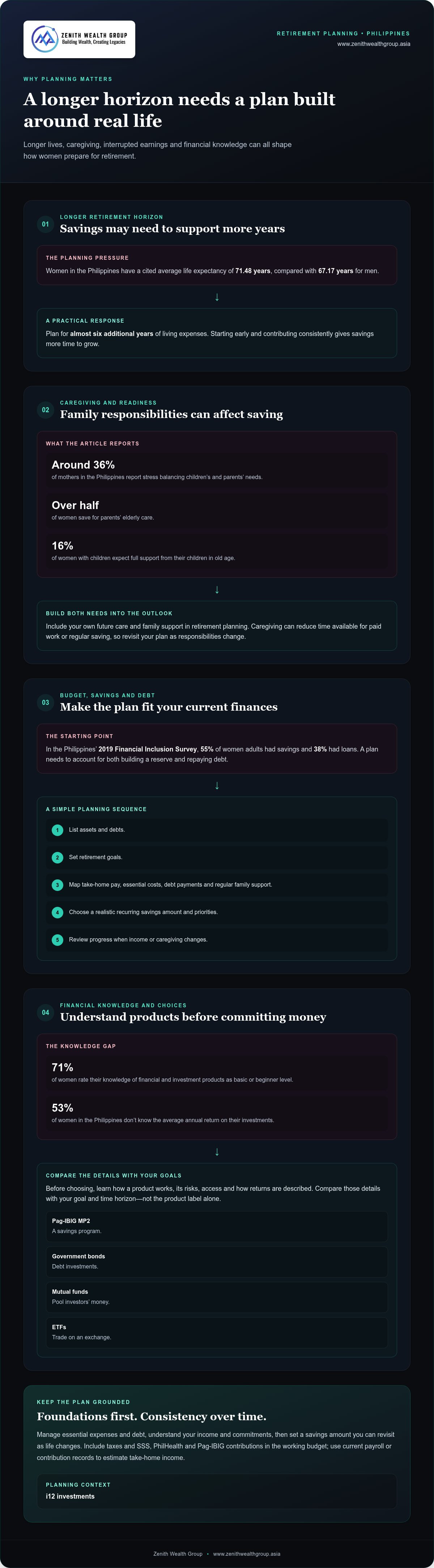
Women in the Philippines have a cited average life expectancy of 71.48 years, compared with 67.17 years for men, almost six additional years of living expenses to prepare for. Financial planning for women in the Philippines can help turn that longer retirement horizon into a clear savings and investing plan. Starting early and contributing consistently gives savings more time to grow.
Balancing your future with family responsibilities can make retirement feel like a distant priority. That pressure is real, but planning does not require having every answer today. Start with the basics: understand your income, regular commitments, savings, and retirement goals.
This guide explains why retirement planning matters, how financial education can support informed decisions, and how to think about saving, investing, and risk over time. You’ll also learn how workplace plans and personalised advice can fit your approach. The aim is a plan shaped around your life, with practical decisions you can revisit as circumstances change.
Key Takeaways
- Account for caregiving responsibilities when setting retirement goals, since they can affect both your earning years and your ability to save.
- Build financial knowledge gradually so you can make more informed choices about saving, investing and retirement products.
- Shape a retirement plan around your income, family commitments, goals and time horizon, rather than relying on a one-size-fits-all approach.
- Review insurance as part of your financial picture and understand how it can help manage risks that could disrupt long-term plans.
- Start investing consistently once your financial foundations are in place, and learn how diversification and employer-sponsored plans may support your retirement strategy.
Why Should Women Plan for Retirement?
Women need retirement plans that account for longer lives, caregiving, and interrupted earnings. In the Philippines, women’s cited average life expectancy is 71.48 years, almost six years longer than men’s 67.17 years, extending the period savings may need to support.
Caregiving and Retirement Readiness
Caregiving and retirement readiness means planning for the effect of family care on income, savings, and later-life needs. Around 36% of mothers in the Philippines report stress balancing children’s and parents’ needs, and over half of women save for parents’ elderly care. Those responsibilities can reduce time available for paid work or regular saving. Only 16% of women with children expect full support from their children in old age. Include both your own future care and family support in your retirement outlook, rather than relying on children to provide for you.
Starting Retirement Savings Early
Starting early means saving and investing consistently while retirement is still years away. Regular contributions give savings more time to grow, and help build a habit that can continue through career and family changes. Women in their 30s can still begin once their financial foundations are in place, such as managing essential expenses and debt. For Filipino investors, Pag-IBIG MP2 is a savings program, government bonds are debt investments, mutual funds pool investors’ money, and ETFs trade on an exchange. Compare how each works, its risks, access, and fit with your time horizon before choosing.
Budgeting, Saving, and Loans
A retirement budget connects current income and commitments with future savings needs. Start by recording take-home pay, essential costs, debt payments, and regular family support. Then set a realistic recurring savings amount and review it when income or caregiving changes. In the Philippines, 55% of women adults had savings and 38% had loans in the 2019 Financial Inclusion Survey. These figures underline why a plan should account for both building a reserve and repaying debt. Basic planning steps are to list assets and debts, set goals, map income and expenses, choose savings priorities, and review progress regularly.
Philippine Taxes and Contributions
Taxes and statutory contributions affect how much income is available to save, so include them in your working budget. In the Philippines, income tax on employees’ taxable compensation follows graduated brackets, while self-employed women follow the rules for their tax regime. SSS, PhilHealth, and Pag-IBIG contributions have separate schedules and serve retirement and other programme purposes. Use current payroll or contribution records to estimate take-home income, since deductions depend on the applicable schedule and employment category. Include these obligations in retirement planning rather than treating them as optional savings.
Gender pay gap and financial education challenges
Women’s financial outcomes reflect earnings, access to financial services, and confidence using financial products. In the Philippines, 71% of women rate their knowledge of financial and investment products as basic or beginner level. Closing knowledge gaps can help women assess choices, plan ahead, and participate more confidently in financial decisions.
Pay differences can affect retirement savings in ways that go beyond salary. Career breaks, reduced hours, and unpaid care can interrupt income and contributions. When comparing jobs, consider total compensation, predictable hours, and how each role supports your long-term goals. Track your personal income and savings separately from household spending to make changes in earnings easier to spot and keep future goals visible.
Account ownership offers one view of access. In the Philippines’ 2019 Financial Inclusion Survey, 34% of women adults had a formal financial account, compared with 24% of men adults. The same survey found 35% of women adults received payments. Since payments commonly include wages and salaries, employment patterns can shape access. Use an account you control to receive income, set aside savings, and review transactions. Account ownership alone, however, doesn’t show whether someone can access useful products or make informed choices.
Financial inclusion policies in the Philippines are gender-neutral. Providers do not apply special gender-based treatment to Know Your Customer or credit collateral requirements, yet access can still differ in practice. Societal, cultural, and behavioural factors contribute to the reverse gender gap in access to financial services. For your own planning, identify practical barriers, such as irregular income or limited product knowledge, and address them with suitable account habits and clearer financial information.
Knowledge gaps also shape decisions. An OECD survey found men had higher financial literacy and economic investment levels than women. In the Philippines, 53% of women don’t know the average annual return on their investments. Before committing money, learn how a product works, what risks it carries, and how returns are described. Compare those details with your goal and time horizon, rather than relying on product labels alone.
Women facing economic hardship can seek public social assistance and livelihood support. Those experiencing financial abuse can seek government social and legal assistance under protections addressing violence against women. To support financial stability, document income and essential expenses, identify safe access to personal funds, and build a recovery budget around immediate needs. These steps help guide practical decisions without assuming every household faces the same barriers.
To turn these considerations into a plan for your circumstances, a personal financial planning conversation can help clarify priorities and next steps.
Seeking personalised financial advice
Personalised financial advice links your choices to your goals, responsibilities, and changing circumstances. For financial planning for women in the Philippines, that means considering income changes, family support, and retirement priorities together. A salaried employee supporting relatives may need a different approach from a self-employed parent with irregular earnings. Explain these circumstances so recommendations reflect your full financial picture.
Prepare a clear financial snapshot before meeting a planner. Gather income records, regular expenses, savings, outstanding loans, workplace benefits, and expected changes. For example, note a planned career break or a parent’s increasing care needs. This information can show where your budget has flexibility and where an unexpected expense might affect another goal.
Describe what you want your finances to make possible. You might prioritise stable retirement income, helping a family member, or flexibility if work changes. Separate essential goals from preferences, then discuss how your resources could support each one. Ask how the plan might adapt if income falls, expenses rise, or your retirement timing changes. Discussing scenarios can make trade-offs clearer.
Ask why each recommendation is being made. Discuss how an investment fits your time horizon, comfort with risk, and need for accessible savings. Clarify how fees, product features, and potential losses affect your decision. If a term is unfamiliar, ask for a plain-language explanation and consider how the recommendation fits with your existing commitments before deciding.
Keep a written record of decisions and the reasons behind them. Note which goals each choice supports, the assumptions it relies on, and what changes should prompt a review. A change in employment, household responsibilities, or debt can affect what is practical. Reviewing your notes helps you make adjustments deliberately instead of reacting to one decision in isolation.
Use advice as an ongoing planning tool, not a one-time instruction. Financial planning for women in the Philippines should reflect your priorities as they evolve. Revisit your goals when circumstances change, then decide which action deserves attention first. A clear next step can make a complex plan easier to manage.
Consider professional financial advice to develop a retirement plan around your needs and goals. Before the conversation, decide which retirement outcomes matter most and explain the circumstances that could shape them. Ask the adviser to link each recommendation to one of your goals and explain the assumptions behind the plan. If the proposed direction does not align with your priorities, say so and ask what alternatives could fit better.
Focus the discussion by identifying the questions you most need answered. For example, ask how the plan reflects your preferred retirement lifestyle and balances your priorities. Take time to consider the advice before deciding, and ask for clarification if the reasoning is unclear. The aim is a retirement plan that reflects your needs and goals, not a direction that feels wrong for your circumstances.
Women’s financial capability and insurance literacy
Financial capability means understanding everyday money choices and using that knowledge to make informed decisions. In the Philippines, nearly two-thirds of women say they feel more financially secure than their mothers’ generation. That confidence is a useful starting point. Build on it by reviewing balances, interest, and policy terms before making financial decisions.
Everyday skills provide practical evidence of what you know. In the Philippines, 66% of women can estimate their credit card debt balance, while 57% can estimate current interest rates. Use those skills together: record each card balance, note its interest rate, and compare the cost of carrying debt with your savings priorities. Clear figures help you decide which commitments need attention first.
Insurance literacy adds another layer. Filipino women were 4 percentage points more likely than Filipino men to understand insurance’s primary purpose as a risk management tool in 2015. Insurance is designed to help manage financial consequences of specified risks, not to serve as a substitute for every savings goal. Before choosing cover, identify the risk you want to address and read what the policy says it covers.
Product fit remains a challenge. In the Philippines, 68% of women report difficulty finding financial products suited to their needs. A policy or financial product can sound attractive but still fail to match your circumstances. Compare its purpose with your responsibilities, existing cover, budget, and ability to maintain payments. For example, someone supporting a dependent may have different protection priorities from someone without dependants.
Make policy reviews practical. Gather your insurance documents and list the following for each policy:
- Purpose: Name the risk or financial need it addresses.
- Coverage: Identify the events and conditions described in the policy.
- Cost: Record the premium and payment schedule shown in your documents.
- People involved: Note who is covered and who may receive benefits, according to the policy.
- Changes: Mark life events, such as a new dependent or a changed household income, that prompt a review.
Keep explanations clear. If a policy term is unfamiliar, write it down and ask what it means before deciding. Compare the explanation with the policy wording. This helps distinguish what you expect from what the document actually provides.
Confidence grows through regular practice, not one complex decision. Review debts and interest rates, understand insurance as a way to manage risk, and check whether products fit your needs. These habits help turn financial knowledge into clearer choices for you and your family.
Financial education for retirement planning
Retirement education helps you understand how savings choices, investment risk, and time horizons work together. In the Philippines, use that knowledge to connect retirement goals with decisions you can explain and review. Compare options by purpose, risk, access to your money, and fit with your timeline, rather than choosing by name alone.
Start with diversification: spreading investments across different types can reduce reliance on one asset. A retirement portfolio might include balanced funds, stocks, and real estate, as the guidance for this topic recommends. These investments behave differently, so compare their potential ups and downs, liquidity, and role in your plan. Several assets do not automatically make a portfolio suitable. Check that each supports your goals and comfort with risk.
Use a simple comparison before investing. Write down what each option is intended to do, how its value might change, and when you may need the money. For example, compare a balanced fund, stocks, and real estate by their roles in your overall strategy, not by one recent result. A financial planner can explain how these choices relate to your retirement horizon and other priorities.
- Goal: State what the investment should help fund, such as retirement income.
- Risk: Consider how you would respond if its value fell.
- Access: Decide whether you may need the money before retirement.
- Fit: Review how it complements the other parts of your portfolio.
Review workplace retirement plans separately. If your employer offers one, understand its contribution structure and available benefits. The guidance recommends contributing as much as possible to employer-sponsored plans to maximise their benefits. Include contributions in your budget, then consider how they fit alongside your other savings and investments. Remember that a career change or unpaid leave can affect contributions.
Build knowledge in manageable steps. Learn basic terms for risk, diversification, and investment returns, then use them to compare actual options. Keep a short record of why you chose each investment and what would prompt a review. Revisit it after changes in employment, family commitments, or retirement goals. This makes financial education a repeatable habit rather than a one-time lesson.
For retirement planning that connects your goals with investment choices, start a conversation about your retirement plan.
Starting to save and invest for retirement early gives money more time to grow and compound, making an early start a useful part of long-term planning.
Zenith Wealth: Retirement Planning
Zenith Wealth helps you connect retirement goals with your wider financial priorities through Retirement Planning. Consider a tailored planning conversation if you’re balancing future income needs with family commitments, education funding, wealth protection, or legacy planning. Bring your current savings, expected retirement goals, and questions about investment choices, including i12 investments, to help focus the discussion. A financial planner can help you understand how these priorities fit together and what decisions to consider next.
Ready to discuss your retirement plans? Contact Zenith Wealth.
Make Your Next Step Count
Your next move does not need to solve every financial question at once. Choose one priority to clarify, such as the retirement lifestyle you want, how family responsibilities shape your plans, or what you need to understand before investing. Then set aside time to review it and decide what information would help you move forward.
Financial planning for women in the Philippines becomes more useful when it reflects your own goals and responsibilities. Zenith Wealth can help connect retirement planning with related priorities, including education funding and wealth protection, so you can consider how these needs fit together. Bring your questions and the financial details you’re comfortable discussing. A focused conversation can help you identify a practical next step.
Contact Zenith Wealth to discuss your plans. Start with the priority that matters most to you, and build from there with confidence.
Frequently Asked Questions
What are typical monthly expenses and cost-of-living benchmarks for women in the Philippines?
Monthly expenses depend on where you live and your household responsibilities, so use your own spending to set a benchmark. Track housing, food, utilities, transport, healthcare, debt payments, and family support separately. For example, compare a month with regular childcare costs with one without them. This shows which expenses are fixed, flexible, or occasional and gives you a realistic baseline for savings goals.
How much should a woman in the Philippines save for an emergency fund?
Set an emergency fund target by adding essential monthly costs and considering how reliably income arrives. A salaried worker with stable earnings may face different risks from a freelancer supporting dependants. Start with a manageable regular contribution, keep the fund accessible for genuine urgent needs, and replenish it after withdrawals. Review the target when housing, work, health needs, or household responsibilities change.
How can women in the Philippines plan for maternity, childcare, and career breaks?
Prepare a separate household budget for expected care costs and reduced income during a career break. List recurring expenses such as childcare, transport, and household help, then identify which costs may change while you’re away from work. Discuss leave arrangements and shared caregiving responsibilities early. Before returning, review your work schedule, childcare plan, debt commitments, and savings contributions to make sure the transition fits your household budget.
How can women in the Philippines plan for retirement, and what monthly income might they need?
Estimate retirement income by mapping the monthly lifestyle you want, then accounting for housing, food, healthcare, transport, and support for dependants. The amount depends on where you plan to live, your health needs, debts, and income sources. For example, compare a budget with a paid-off home against one that still includes rent. Review the estimate as your plans and expected resources change.
How do Pag-IBIG MP2, government bonds, mutual funds, and ETFs compare for Filipino investors?
Pag-IBIG MP2 is a savings program, government bonds are debt investments, mutual funds pool investors’ money, and ETFs trade on an exchange. Compare how each works, its risks and access, and whether it fits your time horizon before choosing.


