

Did you know that over half of the Thai workforce now operates in informal employment? It’s a massive shift that brings incredible freedom, but it often leaves you wondering how to manage a budget when your monthly income fluctuates wildly. Navigating retirement planning for freelancers in Thailand shouldn't feel like a guessing game played against a backdrop of complex tax codes and shifting regulations. Without a corporate HR team to handle the paperwork, the burden of building a safety net falls entirely on your shoulders.
It’s time to change that narrative. You can master your irregular income, optimize your 2026 tax liabilities, and build a secure future with a tailored financial roadmap. Zenith Wealth, an authorized representative of finexis advisory, understands the unique rhythm of the gig economy. In this guide, we’ll show you how to leverage the i12 investments framework to turn lumpy cash flow into a high-performance wealth engine. We'll preview clear tax-saving strategies and diversified portfolios designed for the modern professional. Let’s turn your freelance success into lasting security.
Key Takeaways
- Navigate 2026 tax compliance by distinguishing between Thai Tax Sections 40(2) and 40(8) to protect your hard-earned income and maximize deductions.
- Apply the i12 investments framework alongside the sinking fund method to transform fluctuating freelance earnings into a steady, growth-oriented portfolio.
- Secure your future with a comprehensive roadmap for retirement planning for freelancers in Thailand that prioritizes portable assets and long-term legacy security.
- Partner with a financial consultant to conduct a professional wealth audit, ensuring your cross-border strategy aligns with the rigorous standards of finexis advisory.
The 2026 Freelance Economy in Thailand: Why Planning is Non-Negotiable
The dream of living as a location independent professional in Thailand is more accessible than ever, but the economic landscape of 2026 is unforgiving for those without a plan. DIY financial management often falls short in a high-inflation, post-2025 world where simple savings accounts no longer preserve purchasing power. Relying on your own spreadsheets can lead to significant emotional stress during "lean" months. A professional financial planner provides the structure needed to transform that anxiety into a sense of freedom. Within Thailand's developing mixed economy, professionals who treat their personal finances with corporate-level rigor are the ones who thrive long term.
Risks of the Gig Economy in SE Asia
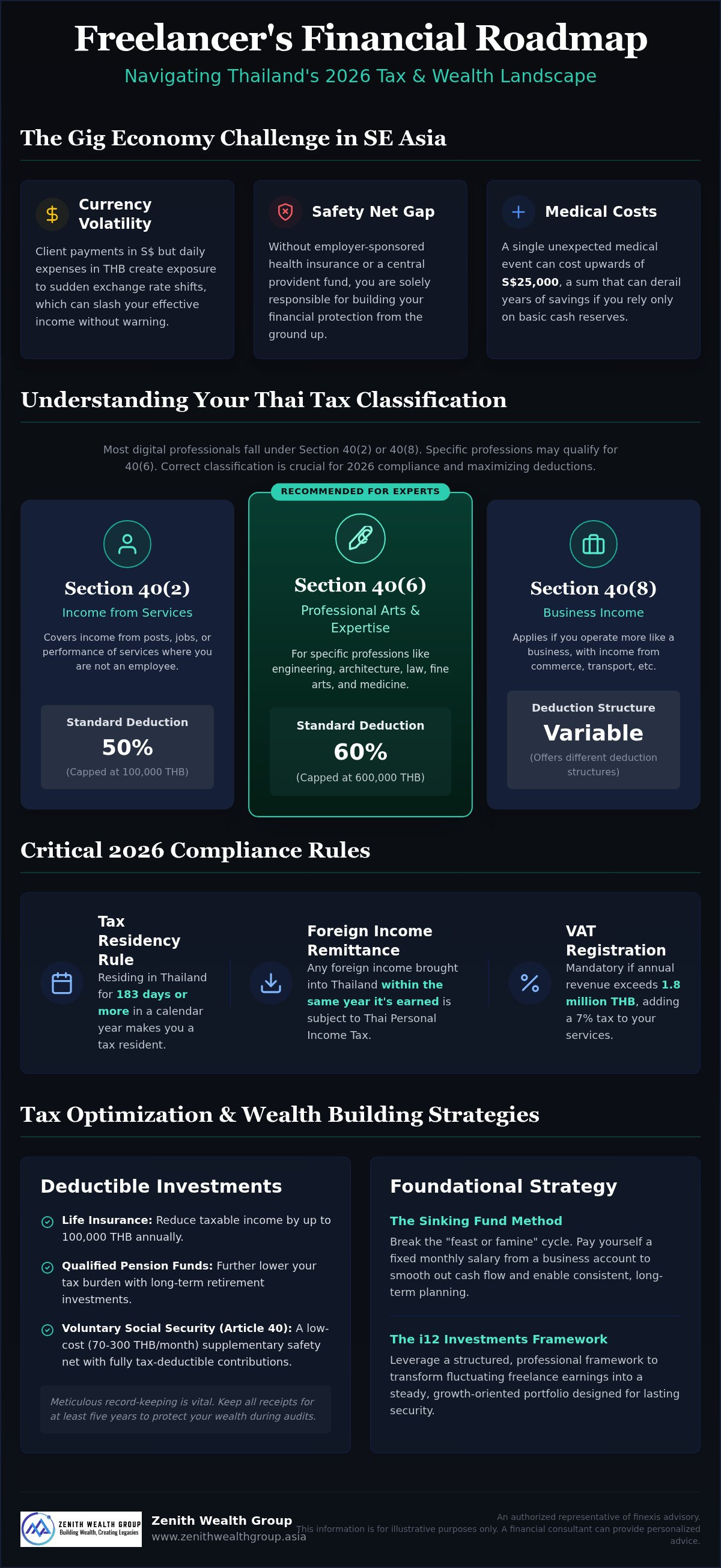
Currency volatility remains a persistent threat for freelancers in 2026. If your clients pay in S$ but your daily life is funded in THB, a sudden shift in exchange rates can effectively slash your monthly budget. There is also a glaring safety net gap. Without employer-sponsored health insurance or a central provident fund, you are solely responsible for your own protection. Relying on basic cash reserves is a risky strategy when a single medical event can cost upwards of S$25,000. This environment requires a much more sophisticated approach than just "saving what's left over" at the end of the month.
The Opportunity: Tax Efficiency for the Self-Employed
While the risks are real, your irregular income is actually a powerful strategic tool. Smart planning allows you to optimize your tax liabilities in ways that traditional employees simply cannot. You have the flexibility to time your earnings and investments to maximize every deduction. Zenith Wealth, an authorized representative of finexis advisory, helps you close the "Freelance Wealth Gap" by engineering a portfolio that matches your specific cash flow needs. Effective retirement planning for freelancers in Thailand ensures that your best working years translate into a sustainable, independent future. You can out-save your corporate peers by focusing on long term wealth engineering rather than just income management.
Navigating Thai Tax Sections and 2026 Compliance
Taxation is the biggest hurdle for anyone focusing on retirement planning for freelancers in Thailand. Understanding your classification is step one. Most digital professionals fall under Section 40(2) or Section 40(8). Section 40(2) covers income from posts or performance of services. It allows a 50 percent standard deduction capped at 100,000 THB. If you operate more like a business, Section 40(8) might apply, offering different deduction structures. The Thai Revenue Department has become increasingly strict about these distinctions in 2026. Misclassification can lead to unexpected back-taxes that drain your retirement fund.
The 2026 rules for foreign income remittance are a game changer. If you reside in Thailand for 183 days or more, you're a tax resident. Any foreign income you bring into the country within the same year it's earned is now subject to Thai Personal Income Tax. Timing your transfers is now essential. Additionally, if your annual revenue exceeds 1.8 million THB, you must register for VAT. This adds a seven percent tax to your services and requires monthly filing. It's a complex landscape that demands a proactive strategy.
Optimizing Deductions and Allowances
Don't leave money on the table. If you qualify under Section 40(6) for professional arts or specific expertise, you can claim a 60 percent standard deduction capped at 600,000 THB. You can also reduce your taxable income by investing in life insurance (up to 100,000 THB) and qualified pension funds. Meticulous record-keeping is vital. In 2026, the Revenue Department uses advanced digital tracking for audits. Keep every receipt for at least five years to protect your wealth.
Social Security and Article 40
Voluntary Social Security under Article 40 is a low cost way to get basic benefits. Contributions range from 70 to 300 THB per month and are fully tax deductible. While it provides small payouts for sickness or disability, it's rarely enough for a comfortable lifestyle. You should view Article 40 as a supplement rather than a primary safety net. For a more robust plan, you might explore Wealth Protection in Singapore to diversify your risk across the region. Integrating these tools with the i12 investments framework ensures your portfolio remains resilient. As an authorized representative of finexis advisory, we help you navigate these regional complexities. If you're unsure how these rules apply to your specific situation, it’s wise to speak with a financial consultant who understands the intricacies of the Thai system.
Cash Flow Management & The i12 Investments Framework
Managing lumpy income is the most critical skill for any self-employed professional. Many digital creators struggle with the "feast or famine" cycle, which makes long term goals feel out of reach. To break this cycle, we recommend the sinking fund method. You pay yourself a fixed monthly salary from a dedicated business account, smoothing out the peaks and valleys of your earnings. This stability is the foundation for effective retirement planning for freelancers in Thailand. Without it, you're constantly reacting to your bank balance instead of building a legacy.
In 2026, banking for location-independent professionals has evolved. Multi-currency accounts are now a standard tool to help you hold S$, THB, and other currencies while avoiding heavy conversion fees. This flexibility is vital when you consider the World Bank analysis on Thailand's economy, which emphasizes the growing importance of the digital and creative sectors. By automating your wealth engine, you ensure that a portion of every invoice goes toward your future, regardless of how much you earned that month. It's about creating a system that works for you, even when you're busy with clients.
Implementing the i12 Investments Strategy
The i12 investments framework is built for consistent growth. It prioritizes broad diversification across various asset classes to ensure your portfolio isn't overly reliant on a single market or sector. We suggest allocating a specific percentage of every invoice, such as 15 to 20 percent, directly into this wealth engine. The i12 investments methodology mitigates market volatility by balancing high-growth assets with stable income generators within a single, cohesive strategy. This disciplined approach, supported by the expertise of finexis advisory, turns your variable income into a reliable growth machine.
Emergency Funds in a Post-Inflation World
The old rule of three months of expenses is no longer enough. In 2026, freelancers should aim for 6 to 12 months of living expenses in a liquid, accessible account. This larger cushion protects you against sudden market shifts or extended dry spells between projects. In Thailand, you might park this cash in high-yield savings accounts or short-term money market funds to maintain liquidity while earning a modest return. Managing debt is equally important as you scale. A financial consultant can help you strike the right balance between aggressive growth and essential wealth protection, ensuring your business and personal life remain resilient against inflation.
Retirement and Legacy Planning: The Freelancer's Long Game
Freelancing is often viewed through the lens of current freedom. However, true independence requires thinking decades ahead. Retirement planning for freelancers in Thailand is unique because you aren't tied to a single geography or employer. You need a portable retirement strategy that moves with you, whether you stay in SE Asia or return to Singapore. By utilizing the i12 investments framework, you can fund multi-generational goals like education or property without being locked into rigid, localized structures. This flexibility is the hallmark of a modern wealth strategy in 2026.
Legacy planning is the final piece of the puzzle for location-independent professionals. It's about more than just money; it's about ensuring your impact lasts. If you hold assets in both Thailand and your home country, you face a complex intersection of international estate laws. A simple will in one jurisdiction may not cover assets in another. You must also consider your digital footprint. Ensuring your heirs can access financial accounts and intellectual property is a modern necessity. Navigating these cross-border complexities alone is a recipe for oversight.
Building a Private Pension
While local Thai options like the Retirement Mutual Fund (RMF) or Super Savings Fund (SSF) offer local tax benefits, they often lack the flexibility required for international lifestyles. Many professionals choose to supplement these with international portfolios that offer broader market access. It's helpful to look at regional benchmarks, such as Retirement Planning in Singapore, to understand how to build a world-class nest egg. Your first step is calculating your Financial Freedom Number. This is the total capital you need to sustain your lifestyle indefinitely. A financial planner can help you reach this target by balancing yield with wealth protection across different currencies.
Legacy Planning for the Modern Professional
Will writing and asset protection require a dual-jurisdiction approach if you're a long-term resident in Thailand. You need to ensure that your Thai-based assets, like property or local bank accounts, are covered by a local will while your global investments remain protected under international law. For a deeper dive into protecting your family's future, see our Legacy Planning Guide. This ensures that your wealth isn't tied up in probate for years across multiple borders. As an authorized representative of finexis advisory, Zenith Wealth provides the technical expertise to align your global assets. Ready to secure your long game? Schedule a consultation with a financial consultant today to begin your legacy audit.
Partnering with a Financial Consultant in 2026
The era of DIY financial management for the self-employed is closing. As you've seen, the intersection of Thai tax residency, international remittance rules, and global market shifts in 2026 creates a landscape too complex for a weekend project. Relying on outdated blog posts or hearsay can lead to expensive compliance errors. A professional financial consultant provides an objective Wealth Audit, identifying gaps in your protection and growth strategy that are often invisible from the inside. This bird's eye view is essential for anyone serious about retirement planning for freelancers in Thailand.
At Zenith Wealth, we don't believe in one size fits all solutions. Your life as a location independent professional is dynamic, and your financial roadmap should be too. We focus on personalized roadmaps rather than pushing specific products. Our role is to act as your Modern Professional Guide, helping you navigate the technical hurdles of cross-border wealth management while you focus on your creative or professional output. Taking the first step is simple. Your initial discovery session is a low pressure conversation designed to map out your current baseline and define your long term aspirations.
The Value of Specialized Advice
Partnering with us gives you access to the finexis advisory platform, a sophisticated and independent ecosystem of financial tools. This independence ensures that your financial planner can select the most appropriate vehicles for your specific goals without being tied to a single provider. In a year like 2026, staying compliant with shifting Thai Revenue Department laws is a full time job. The long term ROI of professional wealth management isn't just about market returns; it’s about the money you save through efficient tax planning and the wealth you protect through robust estate strategies. It's the difference between hoping for the best and engineering a certain outcome.
Your 2026 Wealth Roadmap
Transitioning from a freelancer to a wealth owner is a profound mindset shift. It’s the moment you stop trading time for money and start building a system where your capital does the heavy lifting. You've already done the hard work of building a career that offers freedom. Now, it's time to ensure that freedom is permanent. Don't let another cycle of lumpy income or tax confusion hold you back from the security you deserve. You have the power to take control of your financial future today. Book a discovery session with a Zenith financial consultant to begin building your personalized 2026 roadmap and secure the legacy you're working so hard to create.
Take Charge of Your 2026 Wealth Roadmap
Your freelance journey in Thailand offers unparalleled freedom, but it requires a sophisticated financial foundation to last. We've explored how mastering Thai tax sections and implementing the sinking fund method can stabilize your lumpy income. By adopting the i12 investments framework, you move beyond simple savings toward active wealth engineering. This ensures your retirement planning for freelancers in Thailand is portable, resilient, and ready for whatever the 2026 economy brings.
Zenith Wealth Group, an authorized representative of finexis advisory, specializes in SE Asian cross-border planning. We don't just offer products; we provide the human connection and technical expertise needed to navigate complex regulations. It’s time to stop worrying about next month’s invoices and start building your legacy. Secure your freelance future: consult with a Zenith financial planner today. You’ve built an incredible career, and we’re ready to help you protect it. Let’s start the conversation and grow together.
Frequently Asked Questions
Is freelance income earned outside Thailand taxable in 2026?
Freelance income earned outside Thailand is taxable if you're a tax resident spending 183 days or more in the country. In 2026, the Revenue Department taxes foreign-source income brought into Thailand within the same calendar year it was earned. Timing your transfers is essential to manage liabilities. A financial planner can help you structure these remittances to avoid double taxation while ensuring your retirement planning for freelancers in Thailand remains compliant with local laws.
How much should a freelancer in Thailand save for retirement?
Your target depends on your desired lifestyle, but a common benchmark is 25 times your annual expenses. If you plan to spend S$3,000 monthly, you’ll need a nest egg of S$900,000. Start by calculating your Financial Freedom Number. Because freelancers lack employer contributions, you must be more disciplined. Using the i12 investments framework helps you grow this capital through consistent, percentage-based contributions from every client invoice you receive.
What is the difference between Section 40(2) and 40(8) for Thai taxes?
Section 40(2) applies to income from posts or performance of services, while Section 40(8) covers business, commerce, or industry. For most freelancers, 40(2) allows a standard deduction of 50 percent, but it's capped at 100,000 THB. Section 40(8) might allow for actual expense deductions if you have high overheads. Choosing the wrong category can lead to audits. A financial consultant can review your contracts to ensure you're using the most efficient classification.
Can freelancers in Thailand open a retirement fund like RMF or SSF?
Yes, freelancers with taxable Thai income can utilize Retirement Mutual Funds (RMF) and Super Savings Funds (SSF) to reduce their tax bill. These funds offer significant tax breaks but come with strict holding periods. While they're useful for local tax relief, they shouldn't be your only tool. Supplementing these with international portfolios through finexis advisory ensures your wealth remains portable and diversified across global markets rather than just the Thai economy.
How does the i12 investments framework work for irregular income?
The i12 investments framework stabilizes irregular income by treating every invoice as a growth opportunity. Instead of a fixed dollar amount, you allocate a set percentage of your earnings to different asset classes. This methodology ensures you're always investing, whether it's a high-earning month or a slower period. It mitigates market volatility by balancing your portfolio across distinct investment themes, providing a resilient engine for your long-term financial security and consistent growth.
Do I need a financial consultant if I only earn a moderate freelance income?
Specialized advice is often more critical for moderate earners because there is less room for error. A financial consultant helps you optimize small margins through smart tax deductions and efficient investment choices. Even if you aren't a high net worth individual yet, a professional wealth audit ensures you aren't wasting money on unnecessary fees or inefficient insurance. Starting early with a structured plan is the most effective way to scale your wealth.
What insurance is mandatory for freelancers living in Thailand?
While not all freelancers have mandatory insurance, those on O-A or LTR visas must maintain specific health coverage. For O-A visas, the 2026 requirement is often at least 3,000,000 THB in coverage. Beyond visa rules, wealth protection is vital. You should consider private health and disability insurance to replace the corporate safety net you lack. This ensures that a medical emergency doesn't derail your retirement planning for freelancers in Thailand.
How do I manage multi-currency earnings for tax purposes in Thailand?
To manage multi-currency earnings, you must record the THB equivalent of your income using the exchange rate on the date it was received or remitted. Using multi-currency accounts allows you to hold funds in S$ or other stable currencies until you actually need to spend them in Thailand. This strategy helps you avoid poor exchange rates during volatile periods. A financial planner can assist in setting up a system that tracks these movements for 2026 tax compliance.


