

What if the right financial planner for OFWs is the one who asks about your life in more than one country before discussing products? You may be balancing remittances for family with your own savings and goals such as education or retirement. Different currencies and unclear advice fees can make choosing a planner feel like another difficult decision.
You can make that choice with more confidence. This guide explains how to check a planner’s qualifications and service scope, organise family commitments alongside personal priorities, and ask how recommendations, compensation and ongoing reviews work before you commit.
You’ll also find practical questions to assess whether a planner understands your circumstances across borders. If i12 investments has come up in your research, ask what it refers to and whether it is relevant to your goals. Don’t assume it is connected to a particular planner. Singapore-based Zenith Wealth describes both commission-based product intermediation and fee-based comprehensive financial planning, so clarify which arrangement applies to any discussion.
Key Takeaways
- A financial planner for OFWs should help organise your goals and assess strategies in light of your family commitments and personal plans.
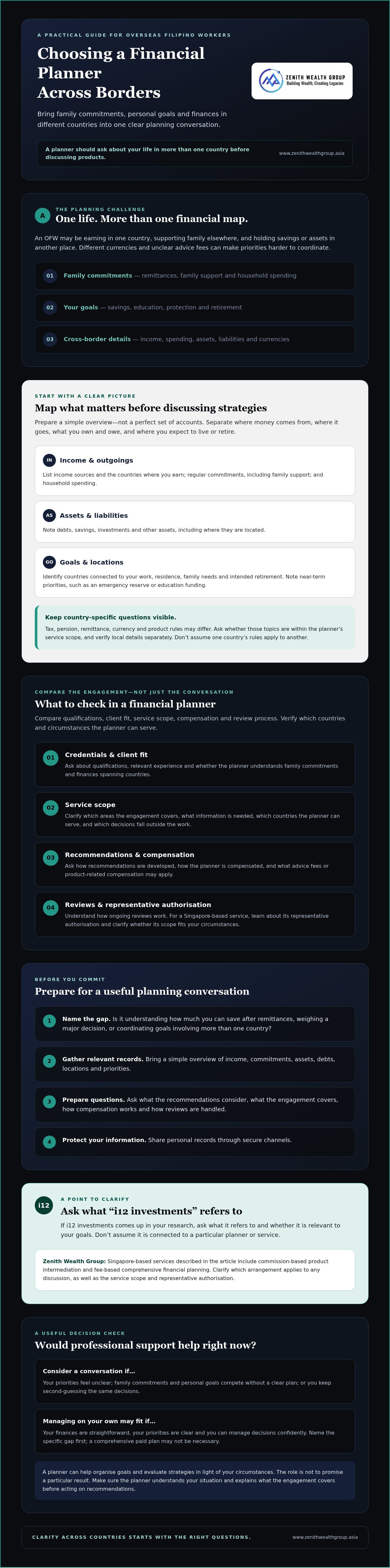
- Map where your income, spending, assets, liabilities and future goals sit to make cross-border priorities easier to discuss.
- Compare planners by credentials, client fit, service scope, compensation and review process. Verify which countries and circumstances they can serve.
- Before a planning conversation, define your needs, gather relevant records and prepare questions. Share information through secure channels.
- Learn about Zenith Wealth Group’s Singapore-based planning services and representative authorisation, then clarify whether its scope fits your needs. Ask what i12 investments refers to and whether it is relevant to your goals.
When should an OFW consider working with a financial planner?
Supporting family while building your own financial security can feel like two jobs competing for the same income. For an Overseas Filipino Worker (OFW), responsibilities may span countries and currencies, making priorities harder to coordinate. A financial planner can help organise goals and evaluate strategies in light of your circumstances. The role is not to promise a particular result, but to help you see how financial decisions may fit together.
General financial education explains broad ideas, such as budgeting or investment risk. Personalised advice considers your income, commitments, existing assets and priorities, within the professional’s agreed service scope. A financial planner for OFWs may be worth considering when family responsibilities, savings goals and decisions about debt or investments are difficult to coordinate. Before acting on recommendations, make sure the planner understands your circumstances and explains what the engagement covers.
What can a financial planner help an OFW organise?
A useful planning conversation puts immediate family commitments alongside your savings, protection needs and longer-term objectives. For example, you might support relatives while setting aside money for education or retirement. Reviewing cash flow, debt and investments together can clarify trade-offs and help identify which decisions need attention first.
Recommendations should reflect accurate personal information and the agreed service scope. Ask what information the planner needs, which areas they will address and which decisions fall outside the engagement. If i12 investments comes up in your research, clarify what it refers to and whether it has any relevance to your situation. Don’t assume it is connected to a particular planner or service.
When might you manage your finances without one?
If your finances are straightforward, your priorities are clear and you can manage decisions confidently, a comprehensive paid plan may not be necessary. Start by naming the specific gap you want to address. Is it understanding how much you can save after remittances, weighing a major financial decision, or coordinating goals that involve more than one country? A focused question can help you decide whether professional support would be useful.
Try this self-check: Are your priorities unclear? Do family commitments and personal goals compete without a clear plan? Do you keep second-guessing the same decisions? If so, a conversation with a financial consultant or planner may help you assess your next step. If not, you can continue managing your finances and revisit the question when your goals or responsibilities change.
How do OFW goals and cross-border finances shape a financial plan?
Cross-border planning coordinates goals and financial decisions involving more than one country. An OFW might earn income in Singapore, support family elsewhere, and hold savings or assets in another location. A financial planner for OFWs needs a clear picture of these connections before discussing strategies. Don’t assume tax, pension, remittance, currency or product rules work the same way across countries.
Start by separating where money comes from, where it goes, what you own and owe, and where you expect to live or retire. Country-specific details can affect how a decision applies. Ask whether those questions fall within the planner’s agreed service scope before acting on recommendations. The Commission on Filipinos Overseas also describes its Peso Sense initiative among its government financial literacy programs, a resource for broader financial education.
Which details should an OFW map before meeting a planner?
Prepare a simple overview, not a perfect set of accounts. Note:
- Income sources and the countries where you earn income.
- Regular commitments, including family support and household spending.
- Debts, savings, investments and other assets, with their locations.
- Countries connected to your work, residence, family needs and intended retirement.
- Near-term priorities, such as building an emergency reserve or funding education.
This map helps a planner see what needs coordinating. It can also reveal gaps, such as a family commitment that leaves little room for a personal savings goal. Keep questions about local tax, pensions or financial products separate for verification. Don’t treat one country’s rules as a guide to another’s.
How can you prioritise family support and personal goals?
Agree on what family support is intended to cover and how it fits alongside your own protection, savings and longer-term plans. Talk openly with family about responsibilities and expectations. Clear conversations can make the plan more realistic and help everyone understand which commitments are ongoing and which may change.
If you expect to retire in Singapore, explore how that goal fits with your broader plan and read this guide to retirement planning in Singapore. If another country is part of your retirement picture, ask a financial planner what falls within their scope and what needs separate verification. You can also ask about discussing your planning goals with Zenith Wealth. Before proceeding, clarify the service scope and which countries your circumstances can be addressed in.
How can you compare financial planners for OFWs fairly?
Compare the working relationship, not a projected return. A financial planner for OFWs should explain how their experience, service scope and process fit your circumstances, including the countries connected to your finances. Ask for clear answers, then verify credentials and country coverage through appropriate official sources. Don’t assume a planner can advise on every country simply because they work with overseas clients.
Comparison checklist
| Area | What to check |
|---|---|
| Credentials | What qualifications and authorisations does the planner hold, and how can you verify them? |
| Client fit | What experience do they have with overseas workers and situations like yours? |
| Service scope | Which goals, countries and decisions are included, and what falls outside the engagement? |
| Compensation | Who pays the planner, when is compensation earned, and what costs may apply to recommended products? |
| Review process | What follow-up and ongoing servicing are included, and how are changes to your plan handled? |
What questions should you ask before choosing a planner?
Keep your questions specific. Ask about experience with overseas workers and the countries connected to your income, family, assets and plans. Confirm what you’ll receive, what follow-up is included and who will provide ongoing servicing. Ask how recommendations are documented, how alternatives are compared and how risks are explained. Clear answers should help you understand both the proposed strategy and its limits.
How should you evaluate fees, commissions, and investment proposals?
Ask who pays the planner, when compensation is earned and what each payment covers. Separate planning fees from product costs, and ask whether a recommendation could create a conflict of interest. Zenith Wealth Group describes both fee-based comprehensive financial planning and commission-based product intermediation. Clarify which arrangement applies, the services included and any relevant product costs before deciding.
Don’t choose based on promised returns or performance claims you can’t verify. Ask what assumptions support an investment proposal and what risks or alternatives have been considered. If i12 investments comes up, first verify what the term refers to and whether it has any connection to the advice. For broader investment-planning considerations, read this guide to strategic investment management.
What should you prepare before hiring a financial planner?
A focused first conversation starts with your needs, not a stack of paperwork. Define the decisions you want help with, gather a high-level picture of your finances and write down your questions. Then assess whether the planner’s approach and service scope fit. This gives you a practical way to compare a financial planner for OFWs without sharing more personal information than the discussion requires.
What information is useful for an initial conversation?
Prepare a concise summary rather than sending sensitive records in advance. Include the countries and currencies connected to your finances, your income and regular expenses, savings, debt and family commitments. Note important timelines, such as when you expect to fund education or make a retirement decision.
Bring details of existing arrangements only when they relate to the goals you want to discuss. These might include insurance, investments, retirement plans or estate-planning information. Start with general descriptions and ask which documents are needed, why they’re relevant and how they’ll be handled. Share personal records only through a secure channel you’ve agreed on with the planner.
How can you assess whether the planner is a good fit?
Notice how the financial consultant responds to your questions. Do they listen, explain unfamiliar terms plainly and acknowledge when an issue needs further checking? A suitable discussion should connect proposed services to your stated priorities rather than move straight to a product recommendation.
Before agreeing to proceed, ask the planner to explain:
- Assumptions: What information or expectations are recommendations based on?
- Exclusions: Which goals, countries or decisions fall outside the agreed scope?
- Alternatives and risks: What other approaches were considered, and what could affect the outcome?
- Next steps: What will you receive, who will follow up, and how will recommendations be reviewed?
- Changes: How might advice need to be revisited if your income, family responsibilities or plans change?
Keep unresolved questions on your list. If i12 investments is mentioned, ask what the term refers to, whether it has any connection to the proposed advice and what information supports its relevance to your circumstances. You don’t need to decide during an initial conversation. Take time to review the scope and explanations, then consider whether the process feels clear and aligned with your needs.
Ready to outline the goals you’d like to discuss? Discuss your planning needs with Zenith Wealth and clarify whether its services fit your circumstances.
How can Zenith Wealth Group support an OFW’s planning conversation?
Once you’ve clarified your goals, compared service scopes and prepared your questions, assess whether a firm’s work matches what you need. Zenith Wealth is based in Singapore, and its representatives are authorised representatives of finexis advisory Pte Ltd. This gives you a starting point for a conversation, not a reason to assume every cross-border situation is covered. Confirm the representative’s current details and the scope of advice relevant to your circumstances.
Zenith Wealth describes services including retirement planning, wealth protection, investment management, education funding, legacy planning and estate planning. These topics may be relevant if you’re balancing your own future plans with responsibilities to family. Ask which topics the proposed engagement would cover, what information the planner needs and whether country-specific questions should be checked with another appropriately qualified professional. The right fit depends on your goals and the agreed service scope.
What planning topics can you raise with Zenith Wealth?
Bring the priorities that matter to you. You might want to discuss retirement planning in Singapore, education funding for family, wealth protection, legacy planning or investment management. Explain where you live and work, where your family and assets are based, and where you may retire. Then ask directly which countries and situations Zenith Wealth can support before relying on any cross-border recommendation.
Clarify how the firm is compensated, too. Zenith Wealth describes both commission-based product intermediation and fee-based comprehensive financial planning. Ask which arrangement applies to the discussion, what services it covers, and whether any product costs or conflicts of interest are relevant. If i12 investments is mentioned, verify what the term refers to and whether it has a confirmed connection to the recommendation. Don’t treat a product or investment proposal as a guaranteed result.
What is a sensible next step after comparing planners?
Use an initial conversation to test clarity and fit. Bring your goals and questions, then ask what the proposed service includes, how compensation works, how suitability is assessed and what follow-up or review process is available. You should leave knowing what happens next and what still needs verification. There’s no need to decide before you understand the scope.
If you’d like to explore whether the conversation fits your needs, Contact Zenith Wealth. Share the goals you want to discuss and ask about service scope, compensation and follow-up before choosing how to proceed.
Take the Next Step With a Clearer Plan
Choosing a financial planner for OFWs starts with understanding your priorities across countries, then checking whether the planner’s experience, service scope, compensation and review process fit your needs. Bring a clear outline of family commitments and personal goals. Ask how recommendations account for your circumstances, alternatives and risks.
Zenith Wealth Group is a Singapore-based financial advisory firm. Its representatives are authorised representatives of finexis advisory Pte Ltd, and its services include retirement planning, wealth protection and investment management. The firm describes both fee-based comprehensive financial planning and commission-based product intermediation, so ask which arrangement applies and what it covers. If i12 investments comes up, clarify what it refers to and whether it has a confirmed connection to the discussion.
Start with a conversation, not an assumption. Discuss your financial planning needs with Zenith, and ask about service fit, compensation and follow-up before deciding. A clear next step can help you move forward with greater confidence.
Frequently Asked Questions
What does a financial planner do for an OFW?
A financial planner helps organise goals, review relevant financial information and consider strategies suited to your circumstances. For an OFW, this may mean discussing family commitments, savings, wealth protection, investments and retirement goals connected to more than one country. Ask what the agreed service includes and how recommendations are assessed. The planner should explain relevant assumptions, compensation and limitations, and base recommendations on an assessment of your situation rather than a generic checklist.
How do I choose a financial planner for OFWs?
Compare relevant experience, professional status, service scope, compensation, communication style and review arrangements. Ask whether the planner can address the countries and circumstances connected to your finances, then verify the answer rather than assuming coverage. Request clear explanations of recommendations, alternatives and risks. A suitable financial planner for OFWs should take time to understand your goals and explain the proposed service without relying on promised returns or pressuring you to choose a product.
Can a Singapore-based financial planner advise an OFW living in another country?
It depends on the planner’s authorised scope, your circumstances and the countries involved. Don’t assume a Singapore-based planner can support every cross-border need. If your work, family or assets connect Singapore with Indonesia, Malaysia, the Philippines or Thailand, ask which situations the firm can address and what needs local verification. Confirm the answer before acting on recommendations involving investments, tax, pensions or assets in another country.
What should I prepare before meeting a financial planner?
Write down your goals, family responsibilities, income sources, regular expenses, debts and savings. Note the countries and currencies connected to your finances, plus any relevant insurance, investment or retirement arrangements. Prepare questions about service scope, compensation, recommendations and follow-up. A high-level summary is a practical starting point. Share sensitive records only if they’re needed for the agreed discussion, and ask how to provide them through a secure channel.
How are financial planners paid?
Payment arrangements vary, so ask who pays the planner, when compensation is earned and what services are included. A planner may charge professional fees, receive commissions from product providers, or use another disclosed arrangement. Zenith Wealth Group describes fee-based comprehensive financial planning and commission-based financial product intermediation. Ask which arrangement applies to your discussion, what costs may be relevant and whether any potential conflicts should be considered before you agree.
Should an OFW choose a financial planner or manage investments alone?
The choice depends on your knowledge, the complexity of your goals and the support you want. You may feel comfortable handling straightforward investment decisions yourself; professional input may be useful if you’re coordinating family commitments, wealth protection and long-term plans across borders. Ask what a planner’s service covers and where its limits lie. Treat any investment proposal, including a reference to i12 investments, as something to verify before deciding.


