

What if the traditional "safe" bets in Singapore are actually the biggest risks to your retirement timeline in 2026? Many people believe that parking everything in local property or cash is enough. However, with the retirement age now at 64 and global markets shifting, over-reliance on a single asset class is a silent threat. It's stressful to watch US Fed rates whip local interest rates around when you're so close to the finish line. You need robust investment strategies for pre-retirees in Singapore that protect your nest egg without sacrificing growth.
We're here to help you turn that uncertainty into a strategic advantage. You'll discover how to safeguard your wealth using a framework designed for the current economic climate. This guide provides a clear roadmap for asset rebalancing and explains how a financial consultant uses the i12 investments framework to prioritize quality and resilience. You'll gain the confidence to face the 2026 economic landscape with a portfolio that's truly built to last. It's time to move from a place of worry to a position of quiet strength.
Key Takeaways
- Understand how global trade shifts and MAS exchange rate policies impact your wealth in the 2026 economic landscape.
- Master proven investment strategies for pre-retirees in Singapore to protect your capital while maintaining growth during global downturns.
- Implement the i12 investments methodology to filter for quality-driven assets that provide stability when traditional markets fluctuate.
- Explore how to use S-REITs and tax-efficient tools like the SRS account to build a defensive anchor for your retirement nest egg.
- Learn why a financial consultant is essential for avoiding emotional decision-making and accessing institutional-grade research.
Understanding Recession Risks in the 2026 Singapore Market
The 2026 economic landscape presents a unique puzzle for those nearing retirement. While Singapore’s GDP growth forecast has been upgraded to a range of 4.5% to 5.5%, external risks remain. A shift in the US trade balance or a spike in global inflation can quickly cool our export-driven economy. Understanding these triggers is vital for refining core investment strategies. You need to know how global pressures translate to local impact.
The Monetary Authority of Singapore (MAS) uses the exchange rate to manage these shocks. By allowing a gradual appreciation of the Singapore dollar, they protect your purchasing power against imported inflation. However, you must distinguish between a temporary market correction and a structural recession. A correction is a dip in a growing market. A recession is a prolonged decline. In 2026, a "cash-only" approach is risky. With inflation hovering around 1.9%, stagnant cash loses value. Effective investment strategies for pre-retirees in Singapore must account for this "inflation tax."
Global Triggers: US Inflation and Fed Rate Cuts
US economic data dictates the rhythm of Singapore's markets. When the US Fed cuts rates in 2026, it directly impacts local interbank rates. This affects everything from your savings account yield to your mortgage. Lower rates can be a double-edged sword. They might boost stock prices but reduce the "safe" income from your cash holdings. This creates a challenging environment for those who rely on interest for income.
A financial consultant helps you interpret these global signals. They look at how US data ripples through SGX-listed companies and REITs. Without this perspective, you might miss the shift from growth-heavy sectors to more stable, quality-driven anchors. Using the i12 investments framework, we focus on assets that can withstand these global shifts. It's about being proactive rather than reactive.
Local Vulnerabilities for Singaporean Investors
Many Singaporeans are over-exposed to local property. While real estate is a favorite, it lacks liquidity during a downturn. High interest rates have also pressured the retail and hospitality sectors. If consumer spending slows, retail REITs could see lower distributions. This concentration risk can be dangerous when you're within a few years of retirement. It's better to diversify before the volatility hits.
In the Singapore context, being recession-proof means maintaining a delicate balance between portfolio resilience and immediate liquidity. Relying solely on local blue-chips or property can leave you vulnerable if the domestic market hits a snag. You need a mix that provides both safety and the ability to access funds when required. This balanced approach is the hallmark of effective investment strategies for pre-retirees in Singapore.
The 4 Pillars of a Recession-Resilient Portfolio
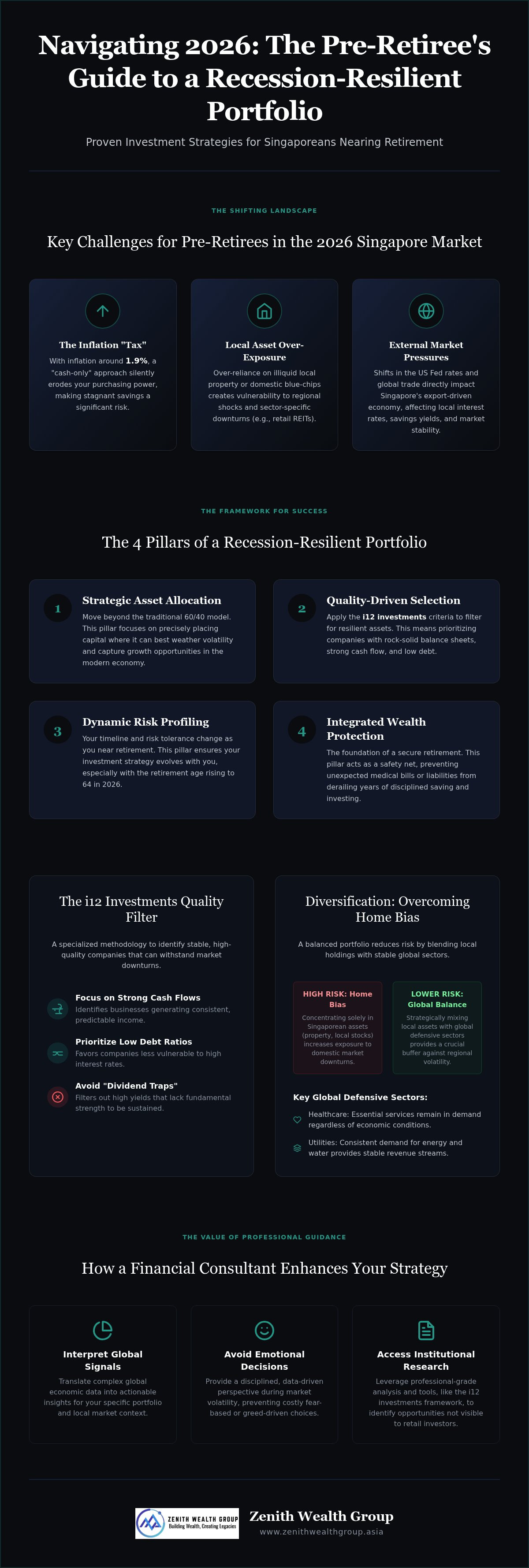
Building a portfolio for 2026 requires more than just picking a few blue-chips. Successful investment strategies for pre-retirees in Singapore rely on a multi-dimensional approach. You need to move beyond the traditional 60/40 stock-bond split. That model often lacks the nuance required for a volatile, modern economy. Instead, focus on four specific pillars: Strategic Asset Allocation, Quality-driven selection, Dynamic Risk Profiling, and integrated Wealth Protection. These pillars ensure you aren't just hoping for the best. You're actively taking steps to recession-proof your finances in Singapore.
Strategic Asset Allocation is about precision. It involves placing your capital where it can actually work. Quality First is the next step. This is where we apply the i12 investments criteria to find resilient assets. Dynamic Risk Profiling is equally vital. With the retirement age rising to 64 in July 2026, your timeline has likely shifted. Finally, Wealth Protection acts as your safety net. It prevents unexpected medical bills or liabilities from derailing years of disciplined saving. It's the foundation of any serious retirement plan.
Leveraging i12 Investments for Stability
The i12 investments framework is a specialized tool for identifying companies with rock-solid balance sheets. We look for strong cash flows and low debt ratios. In the high-interest-rate environment of 2026, these factors are non-negotiable. Institutional-grade analysis helps us filter out "dividend traps." These are companies that offer high yields but lack the fundamental strength to sustain them during a downturn. For a pre-retiree, these filters act as a vital defensive anchor. They keep your capital away from hidden risks.
Diversification: Regional vs. Sectorial
Many local investors suffer from "home bias." While Singapore is stable, holding only local assets exposes you to regional shocks. Effective investment strategies for pre-retirees in Singapore involve reaching into global defensive sectors. Healthcare and utilities often outperform during recessions. Their services remain essential regardless of the economy. A global investment management perspective helps balance your Singapore-centric holdings with international quality. If you aren't sure how your current mix stands up to a stress test, it's a good idea to connect with a financial consultant for a personalized review.
Defensive Assets: Beyond CPF and Blue-Chips
While local blue-chips are often seen as safe havens, the 2026 market requires a more nuanced approach. Singapore REITs (S-REITs) face a complex landscape as interest rates fluctuate. Some sectors, like industrial and data centers, show resilience, while others struggle with higher financing costs. Relying solely on these for income can be risky. You need assets that provide a buffer against volatility without sacrificing long-term growth. Gold and other alternative assets can act as a hedge, but they don't provide the consistent yield that most pre-retirees require.
Comparing traditional annuities to the i12 investments framework highlights a significant shift in how we view safety. Traditional annuities offer a fixed payout, which is comforting but often fails to outpace the 1.9% inflation rate forecast for 2026. In contrast, i12 investments target high-quality companies with the pricing power to thrive even when costs rise. This balance between security and growth is a hallmark of modern investment strategies for pre-retirees in Singapore. It's about ensuring your money retains its value over a decades-long retirement.
The Role of CPF and SRS in a Downturn
Your CPF LIFE scheme serves as your absolute income floor. It's the most reliable foundation for any Singaporean’s retirement. To build on this, your Supplementary Retirement Scheme (SRS) acts as a tactical tool for tax-efficient investing. Integrating your SRS into broader investment strategies for pre-retirees in Singapore allows you to reduce your taxable income while growing your nest egg. For a deeper dive into these benefits, see our guide on Mastering the SRS Account: A 2026 Strategic Guide to Tax Savings. During an economic dip, planning your SRS withdrawals carefully ensures you don't trigger unnecessary tax penalties or lose out on compounding.
I12 Investments as a Core Portfolio Component
The i12 investments methodology offers a way to access global growth while maintaining a defensive posture. It uses institutional-grade filters to identify companies with low debt and high cash flow. This is a critical advantage over retail unit trusts, which often lack the same level of rigorous quality control. While standard retail funds often prioritize broad benchmarks and high volume, the i12 investments approach targets elite, quality-driven assets to safeguard your capital. This focus on quality over quantity helps mitigate risk during market swings. A financial planner can help you determine how to best allocate these quality anchors within your existing portfolio.
5 Steps to Rebalancing Your Portfolio Before a Recession
Rebalancing your portfolio shouldn't be a reaction to a market crash. It's a proactive measure to ensure your retirement remains on track. For those refining investment strategies for pre-retirees in Singapore, 2026 requires a disciplined five-step approach. This process moves your capital away from speculative bets and into resilient, quality-driven anchors. It starts with a hard look at your current holdings and ends with automated systems that remove emotional bias. You don't want to be making big decisions when the headlines are red.
Step 1: The Portfolio Stress Test
Sit down with your financial consultant for a deep dive into your current risk exposure. Ask specific questions: How does a 20% drop in global equities affect my monthly retirement income? How would a spike in local interest rates impact my property-related holdings? Simulating these scenarios helps you visualize the impact on your retirement timeline. You need to know if a downturn would postpone your plans by three years or a decade. A financial planner can then help you adjust your allocation to minimize this potential damage. This level of preparation is a core part of Strategic Investment Management in 2026: A Guide to Growing Wealth in Singapore.
Step 2: Quality Over Quantity
Identify and exit cyclical stocks that typically underperform during recessions. These companies often rely on a booming economy to stay profitable. Instead, reallocate that capital into 'Quality anchors' through i12 investments. We look for companies with high 'moats' and strong pricing power. Think of businesses with proprietary technology or essential services that people can't cut from their budgets. A financial planner is essential for identifying these gems amidst the market noise. They use institutional-grade filters to ensure you're only holding the most resilient assets.
Next, optimize your debt-to-equity ratio. With 2026 interest rates remaining volatile, carrying high leverage is dangerous for anyone close to retirement. Review your mortgages and personal loans; consider paying down debt to reduce your monthly obligations. Simultaneously, bolster your emergency fund. In Singapore, aim for at least 6 to 12 months of living costs (often S$40,000 to S$80,000 for many households). This liquid buffer is your first line of defense. Finally, automate your i12 investments contributions. Using dollar-cost averaging ensures you stay invested through the dips, which is vital for effective investment strategies for pre-retirees in Singapore. Ready to stress-test your portfolio? Book a consultation with our team today to secure your future.
Why a Financial Consultant is Your Best Hedge Against Volatility
DIY investing often feels simple during a bull run. However, 2026 introduces complexities that test even the most seasoned individuals. There is a wide psychological gap between reading about a market correction and seeing your life savings drop significantly in a single week. Many retail investors panic-sell at the worst possible time, locking in losses they can't afford. A financial consultant acts as your emotional circuit breaker. We offer the perspective needed to stick with investment strategies for pre-retirees in Singapore when the news cycle turns negative. It's about staying the course to reach your destination.
Beyond emotional support, professional guidance provides access to institutional-grade research. Most retail investors rely on lagging indicators or social media trends. At Zenith Wealth, we utilize the i12 investments framework to find clarity. This system provides data-driven insights into company fundamentals that are usually hidden from public view. Our role as authorized representatives of finexis advisory ensures you benefit from a partnership built on integrity and professional standards. We focus on building resilient systems rather than just chasing the next hot stock.
The Value of Professional Guidance
Moving from "product buying" to "strategic planning" changes everything. It involves looking at your entire financial life as a single ecosystem. We ensure your investment strategies for pre-retirees in Singapore work in harmony with your legacy and estate planning goals. Professional oversight prevents disjointed decisions that lead to tax inefficiencies or high fees. For a deeper look at protecting your total wealth, explore our Wealth Protection in Singapore: The 2026 Guide to Safeguarding Your Future. It's about ensuring every S$ has a specific purpose.
Next Steps: Securing Your 2026 Financial Roadmap
Starting your journey toward a recession-proof portfolio is straightforward. We invite you to begin a consultation with Zenith Wealth to review your current status. During this session, we'll stress-test your holdings against 2026 economic risks. To make the most of your first meeting with a financial planner, please prepare the following:
- Recent CPF statements and SRS account balances.
- A list of your current investment holdings and insurance policies.
- Your projected monthly retirement expenses in S$.
- Any existing estate planning or legacy documents.
Securing your future requires a proactive partner. Don't wait for a market crash to find out if your portfolio is ready. It's time to build a plan that stands up to any economic weather. Connect with our team to recession-proof your future and take the first step toward quiet confidence today. We're ready to start the conversation whenever you are.
Securing Your Retirement Legacy in 2026
Navigating the 2026 economy requires more than just a defensive posture; it demands a proactive commitment to quality. Throughout this guide, we've explored how to move beyond basic diversification by integrating the specialized i12 investments methodology into your retirement plan. These investment strategies for pre-retirees in Singapore are designed to provide resilience against global trade shifts and fluctuating interest rates. By prioritizing quality anchors and optimizing your SRS and CPF accounts, you ensure that your nest egg remains productive and protected.
At Zenith Wealth, we believe that professional guidance is the ultimate hedge against uncertainty. As authorized representatives of finexis advisory, we draw upon over 20 years of institutional heritage to help you build a legacy that lasts. We don't just manage portfolios; we build long-term partnerships based on transparency and human connection. Our focus is on providing institutional-grade strategies that are accessible and easy to understand.
Ready to build a resilient future? Contact a Zenith Wealth financial consultant today. Let's secure your roadmap and move toward your retirement with quiet confidence. We're ready to start the conversation and grow alongside you.
Frequently Asked Questions
Is it better to hold cash or gold during a Singapore recession in 2026?
Holding a combination is usually safer than choosing just one. Cash provides essential liquidity for immediate expenses, but with Singapore's inflation forecast at 1.9% for 2026, idle cash loses purchasing power. Gold acts as a historical hedge against currency devaluation, yet it yields no income. Effective investment strategies for pre-retirees in Singapore often involve balancing these with quality-driven assets like i12 investments to maintain growth. It's about protection and productivity.
How do i12 investments differ from standard unit trusts available in Singapore?
i12 investments focus on institutional-grade quality filters rather than broad market tracking. While many standard unit trusts aim to mirror an index, the i12 methodology specifically targets companies with low debt and high cash flow. This rigorous selection process helps pre-retirees avoid "dividend traps" and speculative volatility. It's a specialized approach that prioritizes resilience and fundamental strength over the sheer volume or generic diversification often found in retail funds.
Can I rely solely on CPF LIFE for my retirement during an economic downturn?
Relying only on CPF LIFE is risky because it's designed as a foundational income floor rather than a total solution. While CPF interest rates remain stable, they might not fully cover the rising cost of living or medical inflation in 2026. You need a supplementary layer of income to maintain your lifestyle. A financial consultant can help you build this additional buffer using a diversified portfolio that complements your CPF savings effectively.
What is the role of a financial consultant during a market crash?
A financial consultant serves as your strategic partner and emotional anchor during periods of high volatility. They prevent panic-selling by providing data-driven context and simulating how market drops affect your specific retirement timeline. Beyond managing emotions, they execute tactical rebalancing to protect your capital. This professional oversight ensures that your investment strategies for pre-retirees in Singapore remain aligned with your long-term goals despite short-term market noise.
Should I stop my monthly investment plan if a recession is predicted?
You should generally continue your monthly contributions to benefit from dollar-cost averaging. Predicting the exact bottom of a market is nearly impossible, even for professionals. By staying invested, you purchase more units when prices are low, which can significantly boost your returns when the market eventually recovers. Stopping your plan often leads to missing the most profitable days of a rebound. Consistency is your best tool for long-term wealth protection.
How much emergency cash should a Singaporean family keep in 2026?
Aim to keep between 6 and 12 months of your family's living expenses in a liquid account. For a typical household, this might range from S$40,000 to S$80,000 depending on your lifestyle and fixed liabilities. Having this buffer prevents you from having to sell your investments at a loss during a market dip. It provides the financial breathing room needed to handle unexpected medical bills or sudden changes in employment without stress.
How does US inflation specifically affect my Singapore-based investment portfolio?
US inflation dictates the direction of Fed interest rates, which directly influences Singapore's interbank rates. When US rates stay high, it can pressure the valuations of local S-REITs and growth stocks. Additionally, because the Singapore dollar's value is managed against a basket of currencies, US economic data impacts our exchange rate and purchasing power. A financial planner uses these signals to adjust your regional and sector allocations to mitigate potential risks.
Is my SRS account protected if the bank or investment house fails?
Your SRS cash deposits are covered by the Singapore Deposit Insurance Corporation (SDIC) up to S$100,000 per person per bank. For SRS funds that are invested in stocks or unit trusts, those assets are held in custody separately from the bank’s own balance sheet. If the institution fails, your investments remain your property and are generally transferred to another custodian. This separation provides a critical layer of safety for your retirement savings.


