

What if your CPF payouts cover some retirement costs but leave a gap in your monthly budget? Learning how to budget for retirement in Singapore means looking beyond one savings target. You need to connect the lifestyle you want with your expected expenses and the income available to support it.
Start by separating essential spending from discretionary costs, then compare both with expected CPF income and personal savings. This gives you a clearer picture than relying on a single estimate of how much to save.
This guide shows you how to build a starting budget, compare resources with monthly expenses and identify where you may need flexibility. It also explains how to review your plan as circumstances change, including how investment planning and i12 investments may fit into a broader retirement cash-flow picture. A financial planner at Zenith Wealth can help turn your household budget into a tailored retirement roadmap. Begin with a realistic estimate, then refine it over time.
Key Takeaways
- Build a monthly spending estimate from household records, separating essential costs, discretionary spending and irregular expenses.
- Learn how to budget for retirement in Singapore by matching expected spending with CPF income, savings, investments and other resources.
- Consider the access conditions and uncertainty attached to each income source, including SRS and investment planning such as i12 investments.
- Stress-test your plan against changes in retirement timing, healthcare needs and household costs, then revise your assumptions.
- Turn your estimates into a practical roadmap by documenting, matching, testing and revisiting your budget as circumstances change.
Why a retirement budget in Singapore needs more than a savings target
A savings target gives you a number to work towards. It does not show whether your expected income can cover monthly expenses or how much room you will have for the activities that matter to you. Learning how to budget for retirement in Singapore starts with cash flow, not a single balance.
A retirement budget is an estimate of future spending matched against the income you expect to receive. It helps you see how regular costs, occasional bills and lifestyle choices may fit alongside CPF payouts, savings and other resources.
What a retirement budget includes
Start by sorting expenses into three groups:
- Recurring essentials: housing, food, transport and regular healthcare costs.
- Occasional costs: home repairs, larger medical expenses and other bills that do not arrive every month.
- Discretionary spending: travel, hobbies, dining out and other costs you may be able to adjust.
These categories vary by household. Housing arrangements, health, family commitments and preferred lifestyle all affect what to include and how much to set aside. The aim is not to prescribe one version of retirement. It is to make your expected spending visible, including costs that are easy to miss when you focus only on a savings goal.
Why Singapore retirement planning should account for CPF
CPF can form one part of your retirement income, alongside personal savings, investments and any other income you expect. The Central Provident Fund (CPF) provides background on the scheme. For your budget, use your own CPF information to estimate what may be relevant to your plan. CPF LIFE is also worth considering as a potential source of retirement payouts. Review your current CPF details and applicable payout information when building your estimate.
Do not assume CPF alone will match your spending needs. Compare expected income with essential and discretionary costs, then identify any shortfall or flexibility. A financial planner can help connect your household budget to a wider retirement roadmap, including how savings and investment planning such as i12 investments may fit into your approach. Next, estimate your expenses in more detail.
How to estimate your retirement spending in Singapore
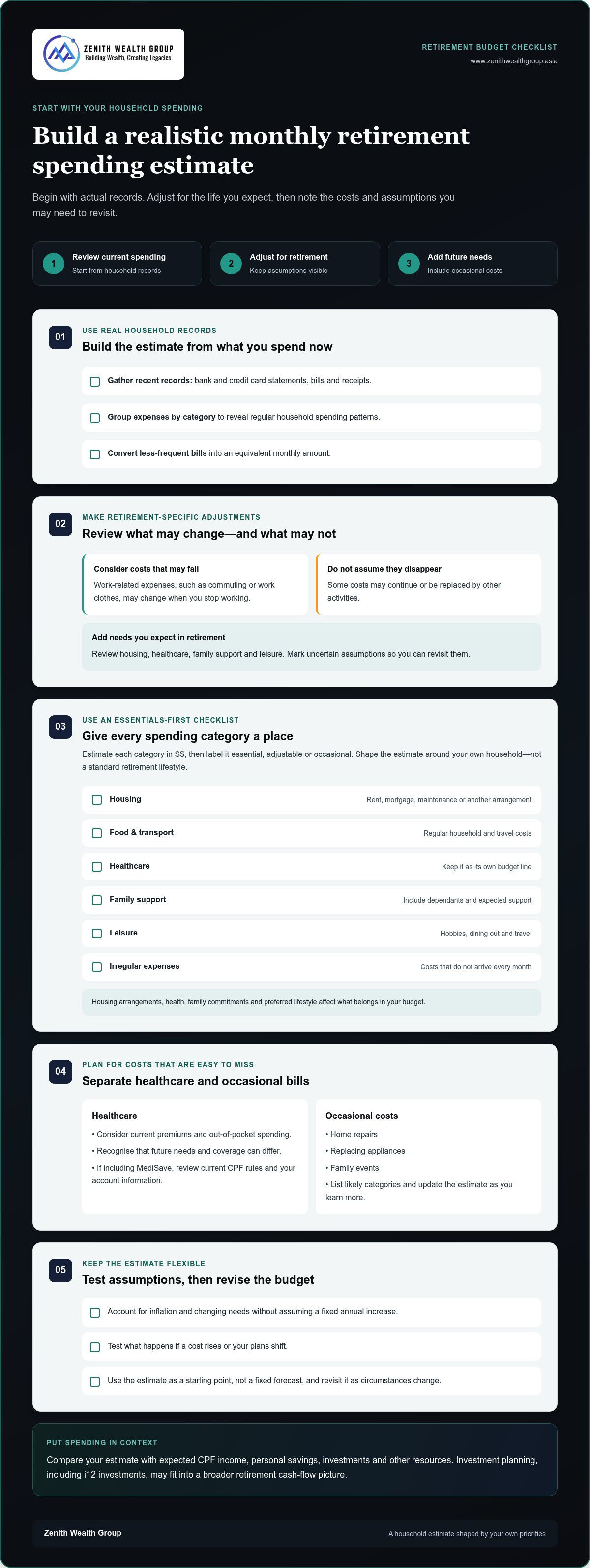
Build your estimate from actual household spending, then adjust it for the life you expect in retirement. Recent bank and credit card statements, bills and receipts can help reveal regular patterns. Use them as a starting point, not a fixed forecast: your housing, health, family commitments and prices may change over time.
Use this sequence to create an initial estimate:
- Review current spending. Gather recent records and group expenses by category. For bills paid less often than monthly, estimate an equivalent monthly amount.
- Remove work-related costs. Consider which expenses may fall when you stop working, such as commuting or work clothes. Do not assume every cost will disappear. Some may continue or be replaced by other activities.
- Add retirement-specific needs. Include expected changes to housing, healthcare, family support and leisure. Note uncertain assumptions so you can revisit them.
Build an essentials-first monthly spending estimate
List regular commitments first, then distinguish needs from preferences. Housing could involve rent, mortgage payments, maintenance or another arrangement, so do not assume every retiree owns a home. Include dependants and expected family support, then add lifestyle choices such as hobbies, dining out or travel. This shows which expenses may be harder to reduce if income changes.
Checklist: review housing, food, transport, healthcare, family support, leisure and irregular expenses. Give each category a monthly estimate in S$ and label it essential, adjustable or occasional. Your estimate should reflect your household, not a standard retirement lifestyle.
Plan for healthcare and irregular expenses
Keep healthcare as its own budget line rather than folding it into a general household figure. Consider your current premiums and out-of-pocket spending, while recognising that future needs and coverage can differ from person to person. If you expect MediSave to contribute, review current CPF rules and your account information before including it in your budget.
Also allow for costs that do not arise every month, such as home repairs, replacing appliances or family events. You do not need to predict every bill precisely. List likely categories and update your estimate as you learn more.
Account for inflation and changing needs without assuming a fixed annual increase. Test what happens if a cost rises or your plans shift, then revise the estimate. If you want help connecting your expense picture to a broader retirement plan, a retirement planning conversation can help you review your assumptions alongside savings and investment considerations, including i12 investments.
How CPF, SRS, and other resources fit your retirement budget
Once you have an expense estimate, compare it with the income you may receive in retirement. A practical way to budget for retirement in Singapore is to list each resource separately and note when it may be available and how dependable it is. Different assets have different access conditions, so do not treat every balance as money you can draw on in the same way.
| Resource | Potential role | What to consider |
|---|---|---|
| CPF | CPF LIFE payouts may contribute to regular retirement income. | Review your CPF information, payout timing and applicable rules. CPF alone may not cover every household’s spending. |
| Personal savings | Can provide a reserve for planned or unexpected expenses. | Access depends on where the money is held. Regular withdrawals reduce the balance available for later years. |
| Investments | May support longer-term income or growth as part of a wider plan. | Values and returns can fluctuate. Do not rely on a particular return as guaranteed monthly income. |
| Other income | Work, rental or other income may supplement retirement resources. | Consider how reliable it is and whether it may change over time. |
Income planning depends on timing, reliability and your household’s needs.
Match expected income sources to spending needs
First compare predictable recurring income with essential expenses such as housing, food and healthcare. Then consider how flexible spending might be supported. Keep income that may vary separate from income you expect to receive regularly. This makes any gap easier to see without assuming investments will deliver a set payout.
CPF LIFE is one part of this picture. Use your current CPF information and official payout details to inform your estimate, and revisit them as your circumstances or applicable rules change. For a wider view of retirement decisions, read the complete retirement planning guide.
Where SRS and investment planning may fit
Include SRS as a separate planning consideration rather than treating it as immediately spendable cash. Its role depends on your circumstances and the rules that apply to contributions and withdrawals. Review current guidance before including SRS in your cash-flow assumptions. The SRS account planning guide covers this topic in more detail.
Investment planning, including consideration of i12 investments, should account for your spending needs, timeframe and ability to manage uncertainty. A financial planner can help connect these factors to your broader retirement roadmap without treating returns as certain.
How to stress-test a retirement budget when the future is uncertain
A useful retirement budget is a plan you can revise, not a precise prediction. It helps you see how changes could affect cash flow without pretending you can know exactly what every future expense or income source will be.
To stress-test your plan, keep essential spending separate from adjustable costs. Housing, food and healthcare may be harder to reduce, while some leisure spending may offer more flexibility. This distinction shows where you have choices if income falls short or costs rise.
Create simple what-if scenarios
Start with your current estimate as the base case, then change one assumption at a time. Do not assign probabilities or treat any scenario as a forecast. The aim is to understand how the change affects your monthly cash flow.
- Retirement timing: Compare the budget if you stop work earlier or later. Note how timing affects expected income and the period your savings may need to support you.
- Household costs: Test a higher housing or family-support expense. See whether flexible spending could absorb the difference or whether it would create a shortfall.
- Healthcare needs: Model a higher healthcare budget without assuming what your future needs will be.
- Income or investments: Consider lower-than-expected income or fluctuating investment values. Do not build essential monthly spending around returns that are not guaranteed, including when reviewing investment planning such as i12 investments.
For each version, record the assumption and the resulting monthly gap or surplus. For example, if an essential cost increases, your estimate shows how much more income or reserve may be needed each month. Keep the base case beside the alternatives so you can see exactly what changed.
Set a review routine that adapts with life
Revisit your assumptions after a major change in work, housing, health or family responsibilities. A yearly review is also a practical prompt to compare your budget with actual spending and update income information. This is a planning suggestion, not a regulatory requirement.
Keep a simple record of the review date, the figures considered and any assumptions changed. That makes it easier to understand why your plan has shifted and what to examine next. Learning how to budget for retirement in Singapore is an ongoing process: update your plan as your circumstances and priorities evolve.
If you want to talk through your scenarios and how they fit into a wider retirement roadmap, discuss your retirement budget with a financial consultant.
Turn your Singapore retirement budget into a practical action plan
You have mapped your spending, considered possible income and tested how changes could affect your cash flow. Now turn those estimates into a working plan. Keep the process simple: document, estimate, match, test and revisit. The goal is not to predict every expense. It is to make your assumptions clear enough to review and adjust.
What to prepare before refining your budget
Gather the information that gives your estimates a solid starting point. A financial planner can use a clear picture of your household’s commitments and expected resources to help refine your retirement plan.
- Spending records: List recurring household expenses and irregular costs, using recent statements and bills as reference points.
- Retirement timing: Note when you expect to reduce or stop work, and flag any uncertainty about that timing.
- Income sources: Record expected CPF income, personal savings, investments and any other income. Use current CPF information and verify applicable rules or figures with official sources.
- Open questions: Write down what you still need to understand about SRS, investment access, healthcare costs and family commitments.
Keep assumptions beside the figures. For example, note whether a cost is based on today’s bill, a planned change or an estimate. This makes it easier to refine your retirement budget without mistaking an early estimate for a fixed promise.
When personalised retirement planning can help
A household budget shows where money may come from and where it may go. A financial consultant or financial planner can help connect that cash-flow picture with investment choices, protection needs and longer-term retirement goals. This can include discussing how i12 investments may fit into the wider plan, without assuming any particular return or outcome.
Retirement planning is Zenith Wealth Group’s primary focus, with a tailored approach for people at different life stages. A financial planner can review your assumptions and bring related planning considerations together in a practical roadmap. Your budget remains a working document that you can revisit as your priorities and circumstances evolve.
Ready to turn your estimates into next steps? Start a retirement planning conversation.
Take the next step towards a retirement plan that fits
A useful budget connects the lifestyle you want with expected spending and income. It starts with household costs, accounts for CPF and other resources, and leaves room to adjust as your needs change. That is the practical foundation of how to budget for retirement in Singapore.
Keep your estimates and assumptions together, then review them when your circumstances shift. Consider how savings, investments and protection fit into the wider plan, including whether i12 investments are relevant to your investment planning. No estimate can predict the future, but a clear budget gives you a stronger starting point for decisions.
Retirement planning is Zenith Wealth Group’s primary service. Its financial consultants and financial planners provide tailored financial planning for different life stages, and the firm operates as authorised representatives of finexis advisory Pte Ltd. If you are ready to connect your household budget with your broader retirement goals, start a retirement planning conversation.
Take it one step at a time. A plan you can revisit can help you move forward with greater clarity.
Frequently Asked Questions
How do I start budgeting for retirement in Singapore?
Start by reviewing household spending records and grouping costs into essential, discretionary and irregular expenses. Note which work-related costs may change and what retirement-specific expenses you expect. Then compare your estimates with current CPF information, savings, investments and other potential income. Treat the result as a working estimate, not a fixed forecast. This gives you a clear first step in how to budget for retirement in Singapore.
How much should I budget for retirement in Singapore?
There is no single amount that suits every household. Estimate your monthly needs in S$ based on housing, food, transport, healthcare, family commitments and the lifestyle you want. Compare those costs with expected income and resources, noting assumptions that could change. Your estimate should reflect your housing plans and personal circumstances, not a universal retirement spending target. Review it as your needs and available information evolve.
Can CPF LIFE cover all my retirement expenses?
CPF LIFE may provide a source of regular retirement income, but do not assume it will cover every expense. Compare your estimated payout information with essential costs and other planned spending. Your household needs, CPF circumstances and preferred lifestyle affect the size of any income gap. Use current CPF information and official sources for applicable payout details, then consider how savings, investments or other income may fit alongside CPF.
What expenses should I include in a retirement budget?
Include housing, food, transport, healthcare, family support, leisure and irregular costs such as home repairs or replacing appliances. Separate essential expenses from costs you could adjust if needed. If you expect to support family or manage financial commitments across Singapore, Indonesia, Malaysia, the Philippines or Thailand, record these separately and consider currency, access and relevant local rules. Your categories should reflect your actual household commitments.
Should I include SRS savings in my retirement budget?
Include SRS as a distinct resource if it forms part of your retirement planning, but do not automatically count the full balance as income available for monthly spending. Consider when funds may be accessible and review current rules before relying on them in your cash-flow estimate. Keep SRS separate from CPF, personal savings and investments so you can see each resource’s potential role, conditions and uncertainties.
How often should I review my retirement budget?
A yearly review is a practical way to compare your estimates with actual spending and update income information. It is not a regulatory requirement. Review sooner after a major change in work, housing, health or family responsibilities. Keep a record of the assumptions you revise, such as an expected retirement date or healthcare costs. This makes it easier to understand how your plan has changed and what needs attention next.
What if my retirement expenses are higher than my expected income?
First, identify the size and source of the gap. Check whether discretionary spending can be adjusted, whether your retirement timing or income assumptions need review, and how savings or investments may fit into the plan. Do not rely on investment returns as guaranteed income. A financial planner can help connect cash flow, protection and retirement goals, including consideration of i12 investments, without promising a particular outcome.


