

What if choosing only the “safer” option leaves your retirement plan short of the growth it needs? If you’re weighing investing in bonds vs stocks for retirement in Indonesia, it’s understandable to want steadier income without missing opportunities to grow your savings. Neither asset needs to carry the whole plan.
Bonds and stocks can play different roles. Bonds may provide income and help steady a portfolio, while stocks offer growth potential alongside market risk. Your time horizon, cash-flow needs, and comfort with volatility all matter. So do inflation and rupiah movements, which can affect what your savings buy over time.
This article explains how each investment may fit into an Indonesian retirement plan and how to compare them against your needs. You’ll find practical questions for balancing income, growth, and wealth preservation, including how i12 investments may fit into a broader investment discussion. A financial consultant or financial planner can help connect these choices to your goals and timeline, including if you expect to spend across Indonesia, Singapore, Malaysia, the Philippines, or Thailand.
Key Takeaways
- Understand how bonds and stocks differ, and why a retirement plan may use them for distinct income and growth roles.
- When investing in bonds vs stocks for retirement in Indonesia, consider how your timeline affects your ability to ride out market movements.
- Compare potential income and price volatility. Bond repayment depends on the issuer and the bond’s terms, not a blanket guarantee.
- Clarify when you plan to retire, what you’ll need to spend, how much risk you can accept, and how much access to your savings you may need.
- Connect investment choices to a broader retirement plan. A financial consultant or financial planner can help assess the trade-offs, including the context for i12 investments.
Bonds vs Stocks for Retirement in Indonesia: What Each Investment Does
A bond is a loan to an issuer. In return, the bondholder may receive interest and repayment of the principal according to the bond’s terms. A stock represents partial ownership in a company. Its market value can rise or fall as the business and wider market change.
These investments can serve different purposes in a retirement plan. Bonds may provide interest income and help support planned cash flow; stocks may offer potential for long-term growth. Neither is risk-free, and neither guarantees that your savings will cover future needs. The right mix depends on your goals, timeline, and ability to withstand losses. This balance is known as asset allocation.
In Indonesia, consider how your future spending relates to the rupiah. Inflation can reduce the purchasing power of money over time, while exchange-rate movements may matter if some retirement costs or assets are tied to another currency. Locally issued government and corporate bonds, alongside shares traded on the Indonesia Stock Exchange, are examples of investments to understand as part of a wider plan. If you have family or financial commitments in Singapore, Malaysia, the Philippines, or Thailand, include the relevant currencies and spending needs in your planning too.
How bonds may contribute to an Indonesian retirement plan
Bond income and repayment depend on the issue’s terms. Government and corporate bonds have different issuers, so they don’t carry identical credit risks or protections. Bond prices can fall when interest rates change; an issuer may fail to meet its obligations; inflation can weaken the value of future payments; and selling before maturity may be difficult or require accepting a lower price. Read the bond’s terms and understand the issuer, rather than comparing investments by stated interest alone.
How stocks may contribute to long-term retirement growth
Owning shares means participating in a company’s fortunes, but the market price can move sharply. A business may face weaker earnings or other challenges, and broad market declines can affect many shares at once. Companies may pay dividends, but payments are not guaranteed. Dividends are distributions to shareholders; capital gains arise if you sell shares for more than you paid. Either outcome can vary.
When investing in bonds vs stocks for retirement in Indonesia, assess how each investment fits the plan instead of looking for a single “safe” answer. Compare the role of each holding with your retirement date, income needs, and ability to accept losses. A financial consultant or financial planner can help connect those factors to your wider goals. Include i12 investments in that discussion by assessing its role alongside your other assets, without assuming a particular product or outcome.
How Bonds and Stocks Behave Across an Indonesian Retirement Timeline
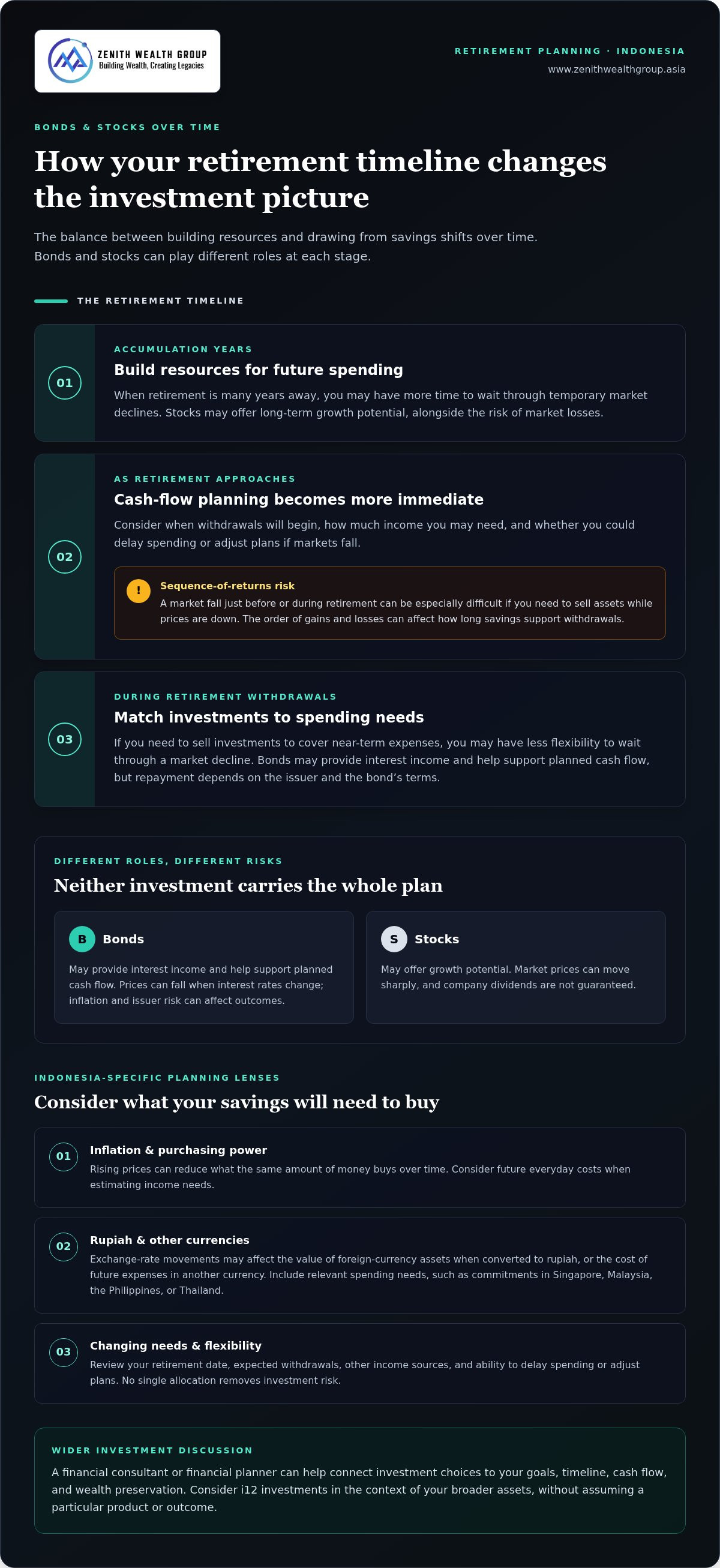
Your investment timeline shapes how market changes may affect your retirement plan. Someone saving for retirement over many years may have more time to wait through temporary declines. Someone already drawing from savings may have less flexibility, especially if they need to sell investments to cover near-term expenses.
What changes as retirement approaches?
During the accumulation years, the focus is generally on building resources for future spending. As withdrawals approach, cash-flow planning becomes more immediate. A market fall just before or during retirement can be especially difficult if you must sell assets while prices are down. This is known as sequence-of-returns risk: the order of investment gains and losses can affect how long a portfolio supports withdrawals.
No single allocation removes that risk, and age alone doesn’t determine a suitable mix. Consider your retirement date, expected withdrawals, other sources of income, and ability to delay spending or adjust plans. DBS Bank’s discussion of allocation by life stage offers another perspective on a retirement mix of bonds and stocks, but your own circumstances still matter.
How Indonesia-related risks can affect retirement assets
Retirement plans need to account for what savings can buy, not just their rupiah value. If prices rise over time, the same amount of money may cover less. Consider the future cost of everyday needs when estimating income requirements, and review whether projected cash flows may keep pace with your spending goals.
Currency exposure can also affect purchasing power. If you hold foreign-currency assets but expect to spend mainly in rupiah, exchange-rate movements may increase or reduce their value when converted. The reverse can matter if some future expenses are in another currency. For example, a retirement plan based in Indonesia may also need to account for family commitments or planned expenses in Singapore, Malaysia, the Philippines, or Thailand. Diversifying across different investments and exposures can spread reliance on any one source of returns, but it can’t guarantee against loss.
Revisit your investment plan as your timeline and withdrawal needs change. A financial consultant or financial planner can help assess the trade-offs alongside cash flow and wealth preservation. A wider investment discussion can also consider i12 investments in context. Retirement planning support can help connect investment choices to your goals.
Bonds vs Stocks in Indonesia: Compare Risk, Income, and Growth
A useful comparison goes beyond asking which asset is “safer.” Look at how each may generate returns, how its value can change, and what could happen when you need to access the money. The table is a starting point for comparing features, not a prediction of results.
| Feature | Bonds | Stocks |
|---|---|---|
| What you own | A debt investment issued by a government or company. | A share of ownership in a company. |
| Potential income | Interest may be paid according to the bond’s terms. | Dividends may be paid, but companies can change or stop them. |
| Value changes | Market prices can move, including when interest rates or perceptions of issuer credit change. | Share prices can rise or fall with company performance and broader market conditions. |
| Key risks | The issuer may not meet its obligations; inflation and difficulty selling can also affect outcomes. | Company setbacks or market declines can reduce share value and lead to losses. |
Which risks matter most when comparing bonds and stocks?
Bond repayment follows the issue’s terms; it isn’t a blanket guarantee. The issuer’s ability to pay matters, as do interest-rate movements and liquidity, meaning how easily you can sell without accepting a lower price. Inflation may also erode the purchasing power of interest and repayment. Government and corporate bonds have different issuers and risks, so don’t treat them as interchangeable.
Stocks carry company-specific and market risks. A diversified fund can spread exposure across multiple holdings, but its value can still fall. An individual security may be more exposed to one issuer or company, while a fund’s actual diversification depends on what it holds and how concentrated those holdings are. Neither listed shares nor government securities are uniformly safe or risky.
Can a mix of bonds and stocks support retirement goals?
A mix may combine different sources of income and potential growth. Losses in one holding may differ from movements in another, which can spread exposure, but it can’t prevent losses or ensure your retirement needs are met. The result depends on the specific holdings, their concentration, your time horizon, and when you need cash.
Compare each holding with the role it needs to play in your retirement plan. Don’t rely on past performance as a forecast: historical results don’t predict future returns. A financial consultant or financial planner can help assess the trade-offs within your wider retirement plan, including any consideration of i12 investments, without assuming particular products or outcomes.
How to Choose a Retirement Mix of Bonds and Stocks in Indonesia
There’s no single bond-and-stock mix that suits everyone. Use this framework to connect investment decisions to the retirement you’re planning, rather than choosing an allocation based on age alone.
- Set your retirement timeline. Estimate when you expect to stop working and when you may need to draw on investments. Separate money likely to be needed soon from assets intended for later years. A longer horizon may give you more time to experience market ups and downs, but it doesn’t remove risk.
- Map spending and income. Separate essential expenses from longer-term goals, then account for other expected income and existing savings. Consider how you would meet near-term needs if investments fell in value. Include emergency liquidity so you’re not relying on selling a volatile asset at an inconvenient time.
- Assess your capacity and comfort with risk. Consider income stability, dependants, investment experience, and how you might respond to losses. Two people retiring at the same age may need different plans: one may have reliable income outside investments, while another may need savings to cover more of their spending.
- Review your full financial picture. Include existing bonds, shares, cash, and other assets. Consider whether future spending will be mainly in rupiah or another currency, and how inflation could affect purchasing power. Foreign-asset exposure may change in rupiah value as exchange rates move.
- Revisit the plan. Review your assumptions when retirement timing, spending, income, or family circumstances change. Rebalancing may help bring investments back in line with your intended plan, but it can’t guarantee returns or prevent losses.
Separate essential income needs from longer-term goals
Start with the costs that matter most, then consider discretionary spending and future goals. This helps clarify which resources need to be accessible and when, without assuming that interest, dividends, or asset sales will provide a fixed income. Match investment decisions to the timing and importance of each need.
Make the framework personal
Risk tolerance isn’t just a number. It includes both the financial ability to absorb a decline and the emotional capacity to stay with a plan through one. A financial consultant or financial planner can help weigh cash flow, risk, and wealth preservation together. A broader discussion can include i12 investments as context, with its role considered alongside your wider financial picture.
For a considered approach to investing in bonds vs stocks for retirement in Indonesia, connect your choices to your wider goals and circumstances. Retirement planning needs are best considered in that broader context.
Build a Retirement Plan Around Bonds and Stocks in Indonesia
Bonds and stocks are only parts of a retirement plan. Their roles depend on how you expect to use your savings, what other resources you have, and how much uncertainty you can accept. A considered approach to investing in bonds vs stocks for retirement in Indonesia connects portfolio decisions to cash flow, purchasing power, and wealth preservation, rather than focusing on asset returns alone.
What a personalised retirement review can cover
A review can bring your expected retirement timing and spending together with existing investments, income sources, liquidity needs, and comfort with market losses. It can also consider how inflation and rupiah movements may affect future expenses. Portfolio choices should be revisited alongside wider financial goals, since changes in family needs or retirement plans may affect how and when you need your assets.
Zenith Wealth provides retirement planning and investment management focused on aligning financial decisions with individual goals. A financial consultant or financial planner can help you examine the trade-offs between potential income, growth, access to funds, and risk. If you are considering investments, assess their role and relevance within your wider plan rather than assuming a particular product or outcome.
Questions to bring to a retirement planning conversation
Use clear questions to make the conversation practical. For example:
- How might bonds and stocks fit the timing of my retirement and planned withdrawals?
- Which expenses need accessible funds, and what liquidity do I want to keep for unexpected needs?
- How diversified are my current holdings, and am I too reliant on a particular issuer, company, market, or currency?
- What fees may apply to the investments under consideration, and how do they affect my overall plan?
- Which Indonesia-specific factors, such as rupiah purchasing power or the terms of a particular investment, should I account for?
- What changes in my goals or circumstances should prompt a review?
These questions won’t produce a guaranteed income figure or eliminate investment risk. They can help clarify what matters most and what trade-offs you’re making. The aim is a plan that reflects your circumstances and can be reviewed as they change.
When reviewing how investments fit your retirement goals, a financial consultant can discuss your retirement planning needs.
Shape a Retirement Plan That Fits Your Life
Bonds and stocks can serve different roles, but neither guarantees retirement income or protects your savings from every risk. The right balance depends on when you’ll need your money, your spending plans, your comfort with market changes, and how inflation or currency movements could affect your purchasing power.
That’s why investing in bonds vs stocks for retirement in Indonesia is best considered within a wider plan for cash flow and wealth preservation. Review your full financial picture, including existing assets and income, and revisit your choices as your goals or circumstances change. A financial consultant or financial planner can help you assess the trade-offs without assuming one allocation suits everyone. Consider i12 investments in the context of your overall investment plan.
Retirement planning is Zenith Wealth Group’s primary focus. The firm provides tailored financial planning and investment management, and operates as an authorised representative group under finexis advisory Pte Ltd. Discuss your retirement planning needs with Zenith Wealth Group to take a clear next step. A thoughtful plan can help you move forward with greater clarity about your options.
Frequently Asked Questions
Are bonds safer than stocks for retirement in Indonesia?
Not automatically. Bonds can face issuer default, interest-rate, inflation, and liquidity risks, while stocks can lose value due to company setbacks or broader market declines. Government and corporate bonds also differ in issuer and terms, just as individual listed companies vary in financial strength and volatility. Compare the specific investment and the risks involved, rather than treating either asset class as risk-free or uniformly safe.
Should I invest in bonds or stocks as I get closer to retirement?
Base the decision on your time horizon, planned withdrawals, and personal ability to handle losses, not age alone. If you’ll need savings soon, a sharp market decline could affect your options, especially if you must sell investments to cover spending. Consider which assets support near-term cash needs and which are intended for later years. Your income sources, emergency liquidity, and comfort with risk all help shape the decision.
Can bonds provide reliable retirement income in Indonesia?
Bonds may provide interest payments, but the amount and timing depend on the bond’s terms and the issuer’s ability to meet its obligations. A payment schedule isn’t a universal guarantee, and an issuer may fail to pay. Inflation can also reduce what future payments buy, while selling before maturity may involve a price loss or limited liquidity. Review the specific terms and risks before relying on bond income.
Can stocks help protect retirement savings from inflation?
Stocks may offer long-term growth potential, which could help a portfolio keep pace with rising costs, but this outcome isn’t assured. Share prices can fall, and company performance can be affected by business or market conditions. Dividends may change or stop. Consider how your retirement spending in Indonesia could change over time, and avoid assuming stock returns will always exceed inflation or protect the value of your savings.
How should I balance bonds and stocks for retirement?
There’s no universal percentage that suits every retirement plan. When investing in bonds vs stocks for retirement in Indonesia, consider when you’ll need your savings, expected spending, other income, liquidity needs, risk tolerance, and existing assets. Account for inflation and any currency exposure too. A financial consultant or financial planner can help assess those trade-offs. Include i12 investments in the discussion as part of your broader investment picture, without assuming a specific product or outcome.
What happens if the rupiah changes in value while I am investing for retirement?
The effect depends on the currency of your assets and the currency of your future expenses. If you hold foreign-currency investments but expect to spend rupiah, exchange-rate changes can raise or lower their value when converted. If you expect expenses in another currency, the impact may differ. Consider where you’ll spend in retirement, including family commitments in Singapore, Malaysia, the Philippines, or Thailand, as well as Indonesia.
Should I review my bond and stock mix after retiring?
Review it periodically and when your spending, income, health, or family circumstances change. Retirement can shift how much cash you need and how much investment risk you can manage, especially if withdrawals are coming from your portfolio. Check whether your holdings still fit your timeline, liquidity needs, and goals. A review doesn’t remove market risk, but it can help keep decisions aligned with your current circumstances.


