

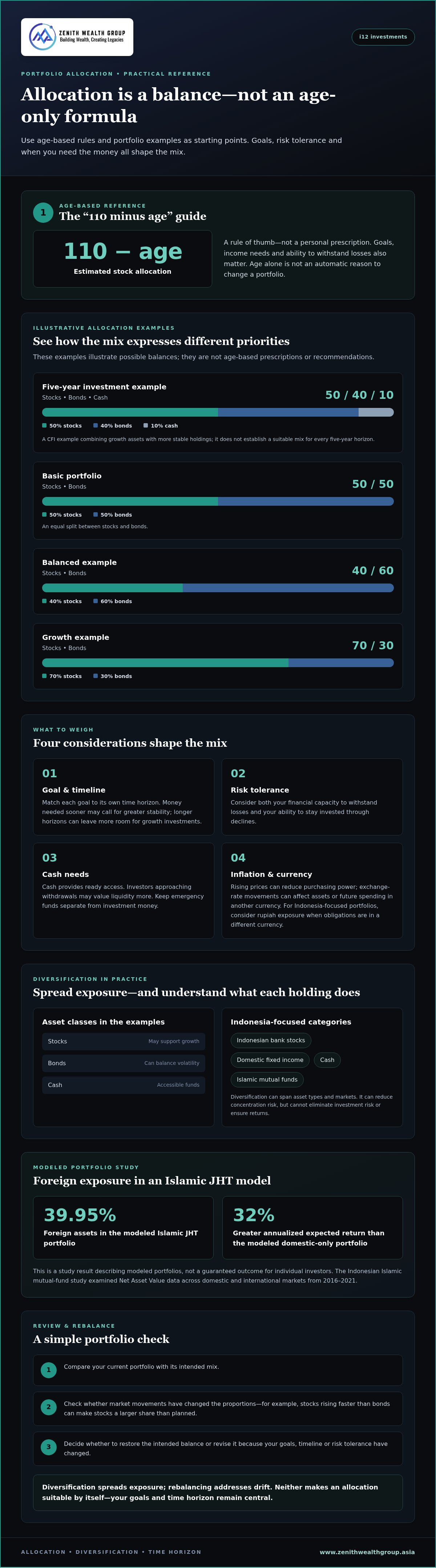
Age alone is a poor portfolio manager. An asset allocation strategy by age in Indonesia can offer a starting point, but for Singapore investors, the mix should also reflect when they’ll need the money and what they’re investing for. One rule of thumb estimates a stock allocation by subtracting your age from 110; it’s a guide, not a personal prescription.
A longer investment horizon can leave more room for growth investments, while money needed sooner may call for greater stability. But age alone does not capture your goals, cash needs or comfort with market ups and downs.
Learn how asset allocation divides investments across asset classes, why diversification matters, and how your time horizon and life changes can shape your mix. This guide explains how to consider age-based approaches for investors in Indonesia, Singapore, Malaysia, the Philippines and Thailand, and which factors to weigh before changing your portfolio.
Key Takeaways
- Use age as a starting guide, then weigh your goals, risk tolerance and when you’ll need the money.
- Spread investments across asset classes to avoid relying too heavily on one part of the market.
- Life-cycle and target-date approaches can help show how an investment mix may change over time.
- Review your portfolio when major life events or market movements shift its balance or your priorities.
- Match each financial goal to its own time horizon so short-term needs and long-term plans can be considered separately.
What is asset allocation?
Asset allocation divides an investment portfolio among asset classes to manage risk. The suitable mix depends on your goals, risk tolerance and the time available to reach each goal.
Cash Holdings Across Investor Ages
Cash is the readily accessible part of a portfolio, and its role can change across life stages. A younger investor saving for a distant goal may choose to hold less cash, while someone approaching withdrawals may value liquidity more. These are planning considerations, not age-based rules. Keep emergency funds separate from investment money when setting your portfolio mix.
Life-Cycle Investing Guidance
Life-cycle investing adjusts the balance between growth and stability as an investor’s horizon changes. Burton G. Malkiel suggests that younger investors with long-term horizons may be more willing to take investment risk than older investors. One age-based rule estimates stock allocation by subtracting an investor’s age from 110. Treat that formula as a starting reference, not a personal target: goals, income needs and ability to withstand losses also matter.
According to CFI, a five-year investment example uses a 50/40/10 mix across stocks, bonds and cash. The example shows how one portfolio can combine growth assets with more stable holdings. It doesn’t establish a suitable mix for every investor with that horizon. A particular goal may call for a different balance, depending on when funds are needed and how much fluctuation the investor can accept.
Inflation, Currency, and Age-Based Risks
Inflation risk is the chance that rising prices reduce what an investment can buy. Currency risk comes from exchange-rate movements affecting assets or future spending in another currency. For an Indonesia-focused portfolio, rupiah exposure matters if your future obligations are in a different currency. Age alone does not remove either risk. Consider whether your portfolio can support the goal’s purchasing power and currency needs.
To assess risk tolerance, consider both your financial capacity to withstand losses and your ability to stay invested during declines. An Indonesian investor can rebalance by comparing the current portfolio with its intended mix, then adjusting when goals, time horizon or risk tolerance change. Age is one consideration, not an automatic trigger. A shorter withdrawal horizon, for example, may call for less exposure to sharp market swings.
Investor profiles can help clarify these trade-offs. A growth-oriented profile accepts greater fluctuation for potential long-term growth, while a more cautious profile places greater weight on stability and accessible funds. A balanced profile falls between these priorities. Use a profile to test whether a proposed mix suits your goal and timeline, not as an allocation formula.
Asset allocation and diversification
Diversification spreads investments across asset classes and holdings, so a portfolio’s results do not depend on a single exposure. Stocks may support growth, while bonds and cash can play different roles in balancing volatility and liquidity. Assets can respond differently to the same market conditions. Diversification can reduce concentration risk, but it cannot eliminate investment risk or ensure returns.
Look beyond the number of asset classes in a portfolio. Owning several stocks may still leave you heavily exposed to one market or sector. A broader mix considers how each holding relates to the others, the goal it serves and the time horizon for that goal. For education funding, for example, money needed soon may call for a different balance from funds set aside for a distant goal.
Portfolio examples show how different allocations express different priorities. A basic 50/50 portfolio splits holdings equally between stocks and bonds. A balanced example uses 40% stocks and 60% bonds, while a growth example uses 70% stocks and 30% bonds. These are illustrations, not age-based prescriptions. The suitable balance depends on the investor’s objectives and willingness to accept market fluctuations.
For Indonesia-focused diversification, investment categories represented in the available research include Indonesian bank stocks, domestic fixed-income assets, cash, and Islamic mutual funds. The Indonesian Islamic mutual-fund study examined Net Asset Value data across domestic and international markets from 2016-2021. These examples show that diversification can involve different asset types and market exposures; they don’t establish that every investor should hold each one.
Consider concentration across both asset classes and geography. A portfolio focused on a small group of domestic stocks may respond differently from one spread across stocks, fixed income and international exposure. A modeled Islamic JHT portfolio included 39.95% foreign assets, and its annualized expected return was 32% greater than the modeled portfolio limited to domestic assets. That study result describes its portfolios, not a guaranteed outcome for individual investors.
Rebalancing brings a portfolio back in line with its intended allocation after market movements change the proportions. If stocks rise faster than bonds, for example, stocks may become a larger share than planned. Reviewing the mix helps you decide whether to restore the original balance or revise it because your goals or timelines have changed. Regular reviews also distinguish deliberate changes from market-driven drift.
To connect diversification choices with your goals, consider a conversation about investment planning. A clear view of each goal, time horizon and existing exposure can help make portfolio decisions more coherent.
Life-cycle and target-date allocation
Life-cycle allocation changes a portfolio as goals approach, while a target-date approach organizes investments around a planned milestone. Neither method determines a suitable mix from age alone.
Allocation Across Life Stages
Age-based life-cycle allocation gradually shifts emphasis from growth toward income and capital preservation as an investor approaches a goal. It matters because a portfolio has less time to recover from losses when withdrawals are near. CFI’s example suggests investors in their 20s focus mainly on growth assets such as equities, with a smaller bond allocation.
That principle is a starting point, not a fixed age chart. A person in their 30s may still have about 30 active working years, according to the supplied life-cycle example, but a home purchase or education goal could require funds sooner. Match each investment horizon to the relevant goal, then decide how much fluctuation is tolerable for that particular pool of capital.
Target-date allocation instead uses a planned date, such as retirement, to frame how the mix may evolve. CFI describes a 50-year-old planning to retire at 60 as holding 50% of the portfolio in stocks in its age-based example. The example illustrates a relationship between the target and allocation; it doesn’t make that percentage suitable for every person with the same retirement date.
Life-cycle adjustments can also respond to changed plans. In CFI’s example, an initial 50/50 mix changes after five years: the investor sells 15% of bonds and reinvests that portion in stocks, reaching a 65/35 mix. The example shows how an allocation can evolve, rather than prescribing that investors make the same trade.
Stocks, Bonds, Deposits, and Cash by Age
Allocating among stocks, bonds, deposits and cash means assigning each a role based on the goal and its timing. Age alone cannot determine whether growth, income or ready access should carry more weight.
For Indonesian investors comparing government bonds, SBN retail bonds and deposits, consider how each fits the goal, access needs and potential price movements. Bonds provide bond exposure, while deposits and cash can serve liquidity needs. Compare their terms and the timing of expected spending before assigning portfolio roles. Products in the same broad category do not necessarily behave alike.
Stocks may suit a longer growth horizon, while bonds can contribute income or balance, depending on the instrument. Deposits and cash can support nearer-term needs. These are functional distinctions, not age brackets. A younger investor with an upcoming expense may need accessible funds, while an older investor with a long retirement horizon may still need growth.
To decide on a mix, first separate your goals: identify each target, when it needs funding, and whether income or access matters most. Then compare proposed holdings with those needs. This makes age one consideration among several, rather than an automatic instruction to buy or sell a particular asset.
Rebalancing after life events or market shifts
Rebalancing restores a portfolio’s intended mix after markets or personal circumstances change it. Review the allocation against its purpose, not just recent returns. A market rally, for example, can leave equities taking a larger share than planned. A new family responsibility can also change the portfolio’s income or stability needs.
Start a review by comparing current holdings with the investment strategy’s target mix. Constant-weight rebalancing uses set proportions and responds when holdings drift from them. Under the approach described by CFI, portfolio proportions should not deviate by more than 5% from the original mix. That threshold is a method, not a universal instruction; the chosen target and review approach should reflect the portfolio’s goals.
Market movements are not the only reason to rebalance. A change in employment, a new education expense, approaching retirement or an inheritance can alter cash needs and risk capacity. Someone facing a near-term expense, for example, may want to reassess how much of the portfolio is exposed to market fluctuations. Distinguish a lasting change in circumstances from a short-lived market swing.
Consider tax implications before selling investments to restore your target allocation. A sale may have tax consequences, so account for the investment’s tax treatment and your circumstances. Rebalancing through new contributions or withdrawals can change portfolio weights without selling holdings. Record the reason for each adjustment alongside the updated target allocation.
A change in your estate plans can also prompt a review. Inheriting assets, revising intended beneficiaries or changing how wealth should pass to family may affect the portfolio’s purpose. Keep investment choices aligned with those plans. Estate considerations do not automatically call for a different allocation, but they can change your time horizon, liquidity needs or intended use of capital.
Follow a clear sequence for a practical review: check the goal, compare the current mix with its target, identify the cause of any drift, then weigh the effects of transactions and taxes. Rebalance when the allocation no longer fits your investment strategy, rather than reacting to every market headline. Briefly record the decision and the life event or market shift that prompted it.
How time horizon and financial goals inform asset allocation
Start with the goal, not an age label. An Indonesian investor saving for a child’s education may need access to funds sooner than someone building retirement capital. Those goals can call for different allocations, even within one household. Separate each target, estimate when you will need the money, and assess how much market fluctuation each plan can absorb.
A time horizon is the period before money must serve its purpose. A near-term target leaves less time to recover from a decline, so an aggressive allocation may conflict with that goal. A distant target can allow greater capacity for investment fluctuations. This distinction helps determine whether growth, stability, income or access should carry more weight.
Consider two goals: funding upcoming education expenses and building retirement savings. Treating them as one pool can obscure their different timelines and risk needs. Assess each goal separately, then consider how the overall financial plan works. The education target may prioritize accessible capital, while the retirement target may need a longer-term growth component.
Risk tolerance depends on your circumstances, not just your willingness to see prices move. Someone with stable income and flexible spending may respond differently to a market decline than someone relying on investments for immediate expenses. Test the proposed mix against a difficult market period: would you need to sell securities, or could you stay invested?
Diversification supports a goal-based approach, but it does not replace matching assets to a timeline. Spreading holdings across securities may reduce reliance on one investment, yet a portfolio can still be poorly suited to a goal if it carries too much volatility near the spending date. Review both the holdings and when each goal requires the capital.
Revisit the allocation when a goal changes, such as a revised education plan, a delayed retirement target or a new family responsibility. Each change can alter the investment horizon, needed income and acceptable fluctuation. Write down the goal, its timing and the reason for any proposed adjustment. To discuss how your financial goals relate to your investment plan, start a financial planning conversation.
Zenith Wealth: Retirement Planning
Zenith Wealth helps connect retirement planning with investment decisions. Its retirement planning service can help you consider how your goals, expected income needs and investment horizon fit together. A financial plan can also take account of education funding, wealth protection or legacy planning where relevant to your wider priorities.
For example, a change in your intended retirement date may prompt a fresh look at how your portfolio supports future income and other priorities. Bringing your goals and current plans into one conversation can help clarify what to review next, including how your investments relate to your wider financial picture.
Contact Zenith Wealth to discuss your retirement planning goals.
Make Your Next Investment Decision Deliberate
Use an asset allocation strategy by age in Indonesia as a starting framework, then shape it around the life you are planning for. Before changing investments, write down what each financial goal needs to accomplish and when you expect to use the money. This reference point helps keep decisions connected to your priorities rather than short-term market noise.
Zenith Wealth’s planning support can bring retirement planning, education funding and wealth protection into a wider financial conversation. Consider how these priorities relate to your investment decisions, including discussions involving i12 investments. A financial planner can help you examine how your goals fit together and what questions deserve attention as your situation evolves.
Take the next step at your pace. Contact Zenith Wealth to discuss your allocation and explore how your financial priorities can guide the conversation. A clearer plan can start with one thoughtful discussion.
Frequently Asked Questions
How should my portfolio shift as I get closer to retirement?
As retirement approaches, review how much of your portfolio may need to fund your early retirement spending. Separate assets intended for near-term withdrawals from investments meant to support later years. Someone planning to reduce work gradually, for example, may have a different income timeline from someone expecting to stop work fully. Revisit the plan if your expected retirement date, income sources or spending priorities change.
What asset allocation is suitable by age in Indonesia?
There is no single suitable allocation for every Indonesian investor of the same age. Use an asset allocation strategy by age in Indonesia as a starting framework, then weigh each investment’s purpose, timeline, income needs and your ability to tolerate losses. Funds for a planned expense need different treatment from long-term retirement savings. Let your financial situation and goals guide the final mix.
What are age-based investment allocation examples for Indonesians in their 20s, 30s, 40s, and 50s?
For an asset allocation strategy by age in Indonesia, treat age ranges as planning prompts, not fixed portfolio recipes. In their 20s, investors may have more time for growth-focused investments; in their 30s, housing or education goals can affect priorities. In their 40s, review whether the retirement target remains on course. In their 50s, map expected withdrawals and income needs before choosing how much market exposure to retain.
How does retirement age in Indonesia affect investment asset allocation?
Your intended retirement date affects how long investments can support growth before withdrawals begin. Estimate when you plan to stop working, whether you expect part-time income and when pension or other income may start. An investor planning to work longer, for example, may have a different withdrawal timeline from someone preparing to leave work earlier. These details connect investments to your planned transition.
How do Indonesian taxes and investment fees affect asset allocation decisions?
Taxes and fees affect the investment return available for your goals. Compare the costs and tax treatment of each investment, account and personal situation before choosing between options. Two investments with similar market exposure, for example, may produce different net outcomes after charges and applicable taxes. Include these effects in your portfolio review, especially when comparing investments held across Indonesia and Singapore.
How should Indonesians adjust asset allocation as they approach retirement?
As retirement approaches, connect each planned withdrawal with its purpose and timing before changing holdings. Someone expecting regular income may assess income-producing assets differently from someone planning a large one-off expense. Consider whether a spouse, dependent or inheritance plan affects how assets will be used. Align allocation changes with your retirement plan instead of reacting to a single market movement.


