

Tech executives need a financial plan that can keep pace with changing careers, complex compensation and long-term goals. A financial consultant for tech executives in Malaysia can help bring investment decisions, wealth protection and future planning into clearer focus. Executives in Singapore, Indonesia, Malaysia, the Philippines and Thailand should also account for the financial rules and circumstances that apply where they live and work.
It’s reasonable to want advice that looks beyond a portfolio and connects wealth decisions with life outside work. This article explains how investment management, private wealth advisory and personal financial planning can support tech executives, what to consider when choosing a financial consultant, and how i12 investments fits into the wider investment conversation. You’ll also see how planning can bring career priorities, family needs and future goals into focus.
Key Takeaways
- See how private wealth advisory can connect investment decisions with long-term goals, wealth protection and legacy considerations.
- Understand how personal financial planning can bring savings, retirement and family priorities into a coordinated plan.
- Learn the distinction between an Approved Financial Adviser and a Financial Planning Company in Malaysia, and what their respective authorisations cover.
- Explore how advisory fees can depend on the scope and structure of the engagement, and when Zenith Wealth’s retirement, education funding, wealth protection and legacy planning may fit your needs.
Private wealth advisory for high-net-worth individuals
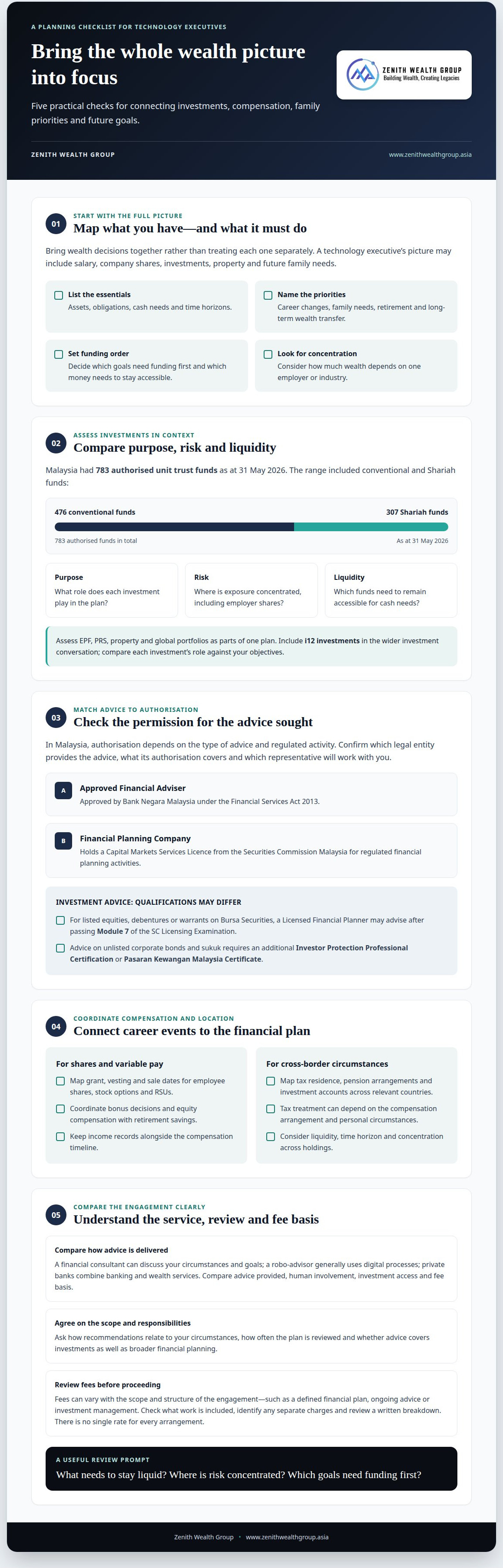
A technology executive’s wealth may include salary, company shares, investments, property and future family needs. Financial planning brings these pieces together instead of treating each decision separately. Start by mapping assets, obligations, cash needs and time horizons. Someone considering a career change, for example, may need accessible funds as well as longer-term investments. The plan should also account for how much wealth depends on one employer or industry, particularly for those leading or advising fast-growing sectors like robotics and autonomous systems seen on defendautonomous.com.
Investment choices need to fit that picture. Malaysia had 783 authorised unit trust funds as at 31 May 2026: 476 conventional funds and 307 Shariah funds. That range makes it important to compare each investment’s purpose, risk and liquidity, rather than choosing by category alone. A financial planner’s permitted advice can also depend on qualifications. In Malaysia, advice on unlisted corporate bonds and sukuk requires an additional Investor Protection Professional Certification or Pasaran Kewangan Malaysia Certificate.
For listed equities, debentures or warrants on Bursa Securities, a Licensed Financial Planner may advise after passing Module 7 of the SC Licensing Examination. The Securities Commission Malaysia framework therefore matters when defining the advice sought. Ask for a clear explanation of the financial consultant’s role, how recommendations relate to your objectives, and how portfolio decisions will be reviewed. These steps help connect investment management with wealth protection and estate planning.
A practical review can start with three questions: what needs to stay liquid, where is risk concentrated, and which goals need funding first? A tech executive with unvested company shares, for instance, can consider how potential compensation affects overall exposure. Planning is most useful when investment decisions, family priorities and long-term wealth transfer are considered together.
Treat EPF, PRS, property and global portfolios as parts of one plan. Assess each by its purpose, risk and liquidity in light of your obligations, time horizons and family goals. Review the overall mix for concentrated exposure, including reliance on one employer or industry, and decide which goals need funding first.
Personal financial advisory in Malaysia
Personal financial planning connects income, investments, family priorities and future goals. For a technology executive, that could mean coordinating bonus decisions with retirement savings and equity compensation.
Comparing Advisory Providers
A financial consultant can discuss your circumstances and goals. A robo-advisor generally uses digital processes, while private banks combine banking and wealth services. Compare the advice provided, level of human involvement, investment access and fee basis. Ask how recommendations relate to your circumstances, how often the plan is reviewed, and whether the advice covers investments as well as broader financial planning.
Checking Licensing and Credentials
In Malaysia, Bank Negara Malaysia approves an Approved Financial Adviser under the Financial Services Act 2013. A Financial Planning Company holds a Capital Markets Services Licence from the Securities Commission Malaysia for regulated financial planning activities. Begin hiring by identifying your needs, reviewing the relevant authorisation, discussing the advice scope, then agreeing on fees and responsibilities before proceeding.
Fees and Typical Rates
Fees can vary depending on whether you need a defined financial plan, ongoing advice or investment management. Compare the fee basis and the work included, and look for any separate charges. There is no single rate for every arrangement. Review a written breakdown before agreeing, and weigh the cost against the service scope rather than choosing on price alone.
Tax and Equity Compensation Planning
For employee shares, stock options, bonuses and RSUs, map grant, vesting and sale dates alongside income records. Tax treatment can depend on the compensation arrangement and personal circumstances, so don’t assume foreign equity is treated like local pay. Executives with cross-border circumstances should also map tax residence, pension arrangements and investment accounts across relevant countries. When reviewing EPF, PRS, property and global portfolios, consider liquidity, time horizon and concentration together. A financial consultant can help organise these details into a financial plan.
A Licensed Financial Planner in Malaysia may advise on investments, savings, tax planning, estate planning and retirement planning, bringing these priorities into one broader discussion.
How can I verify a Malaysian financial consultant's licensing and credentials?
Start by identifying the exact advice you need, then match it to the consultant’s stated authorisation. Malaysia distinguishes financial advisory business from regulated financial planning activities. An Approved Financial Adviser is approved by Bank Negara Malaysia under the Financial Services Act 2013. A Financial Planning Company holds a Capital Markets Services Licence from the Securities Commission Malaysia for regulated financial planning activities.
Ask which legal entity provides the advice, what its authorisation covers and which representative will work with you. Review the relevant documents and compare the stated activity with your needs. For example, an investment discussion involving listed securities calls for relevant permissions, not just a general planning credential.
A Licensed Financial Planner may advise on equities, debentures or warrants listed on Bursa Securities after passing Module 7 of the SC Licensing Examination. Advice on unlisted corporate bonds and sukuk requires an additional Investor Protection Professional Certification or Pasaran Kewangan Malaysia Certificate. These distinctions help you assess whether the professional’s qualifications fit the specific investments under discussion.
Professional designations can be a useful signal, but they do not replace authorisation for regulated work. The Financial Planning Association of Malaysia collaborates with the Financial Planning Standards Board to promote the Certified Financial Planner programme in Malaysia. Ask what a designation represents and how it relates to the advice being proposed.
Before proceeding, get clear answers about the adviser’s role, the scope of advice and how recommendations will be documented. Keep copies of authorisation details and engagement documents. If a proposed service involves several activities, assess each separately. A credential relevant to personal planning does not automatically establish permission for every investment activity.
How do Malaysian financial consultants charge fees, and what are typical rates?
The fee structure matters as much as the amount. A financial consultant may charge a fixed fee for a defined plan, an hourly fee for specific advice, an ongoing fee for continuing support, or a percentage linked to managed assets. These are different arrangements, not interchangeable labels. Before agreeing, ask which structure applies and what work it covers.
A tech executive seeking a one-off review of a bonus and investment plan may need a different scope from someone seeking ongoing portfolio management. Compare the tasks included, such as reviewing goals, preparing recommendations, implementing decisions or monitoring progress. Confirm whether follow-up meetings and plan updates are included or billed separately.
There is no single typical rate for every engagement. The price depends on the circumstances and is provided after a quote request. Scope, complexity, time required and the type of ongoing support all affect the amount. A written proposal should explain the fee basis, what is included and any separate charges. Consider those details alongside the advice you will receive.
Before proceeding, ask for the total fee or calculation method, payment timing and any conditions that could change the charge. If fees relate to investments, clarify how the amount is calculated and whether it continues while assets remain managed. Compare proposals by matching their services and responsibilities, not just their headline amounts. This helps you understand what each arrangement covers.
Want to discuss the financial planning questions behind your decision? Arrange a conversation about your needs.
Zenith Wealth
Zenith Wealth Group is a next step if you want to connect financial decisions with priorities beyond work. A technology executive may be balancing career changes, family goals and future financial security. A planning conversation can help bring those priorities into focus and identify which areas deserve attention first. The aim is to see how different goals fit together, rather than treating each decision in isolation.
Its planning areas include:
- Retirement Planning: consider how your future income goals fit your longer-term plans.
- Education Funding: plan for education costs alongside other family priorities.
- Wealth Protection: consider how to protect the financial foundations you are building.
- Legacy Planning: think through how you want to pass on wealth and provide for loved ones.
These priorities can shift across career and family stages. A change in compensation, for example, could prompt a review of retirement goals, while a growing family may bring education funding into sharper focus. Wealth protection and legacy planning can also become priorities as your responsibilities and assets evolve. Start with the question that matters most, then consider how it connects to your wider financial picture.
Before a conversation, note the goals you want to discuss and the decisions you’re weighing. You might have questions about retirement, education costs, protecting wealth or planning a legacy. This gives the discussion a practical starting point and helps clarify which planning areas fit your circumstances. You don’t need every decision mapped out beforehand. Start with what’s on your mind.
If you’d like to discuss your priorities, contact Zenith Wealth.
Make your next financial decision with greater clarity
Your next step can be a focused conversation about the decision taking most of your attention. It may involve a career change, a family goal or how your financial priorities fit together. Bring the question as it stands, even if you haven’t worked out the answer yet.
A financial consultant for tech executives in Malaysia can help connect financial choices with the goals behind them. If you’re weighing a new role or changing compensation, a financial consultant for tech executives in Malaysia can help frame the discussion around the priorities that matter now and later. At Zenith Wealth Group, Retirement Planning, Education Funding and Wealth Protection can each support a different part of that picture.
Before reaching out, identify the decision you want to discuss and what you hope to understand. That simple starting point can make the conversation more useful and clarify possible next steps. You don’t need to have every detail settled first.
Contact Zenith Wealth to discuss your needs. A clear conversation can help you move forward with confidence.
FAQs
Which financial consultants in Malaysia work with technology executives?
Look for a financial consultant or planner who understands executive compensation, career changes and cross-border circumstances. Zenith Wealth works with senior professionals and provides tailored financial planning around career growth and longer-term goals. Its focus isn’t limited to technology executives, so describe your role and priorities clearly when discussing whether the advice suits your circumstances.
What financial planning services do technology executives in Malaysia typically need?
Technology executives may need to connect variable compensation, investment decisions and family priorities. Map when bonuses or share awards become available, then consider how those funds relate to near-term needs and longer-term goals. A financial consultant or planner can discuss how retirement, education funding, wealth protection and legacy priorities fit together. Include i12 investments in the wider discussion of investment considerations, where relevant.
What risks should Malaysian tech executives consider when managing concentrated employer stock and currency exposure?
Review how unvested and other employer shares affect your overall exposure, including reliance on one employer or industry. When assessing global portfolios, consider liquidity, time horizons, tax residence and investment accounts across the countries relevant to you.


