

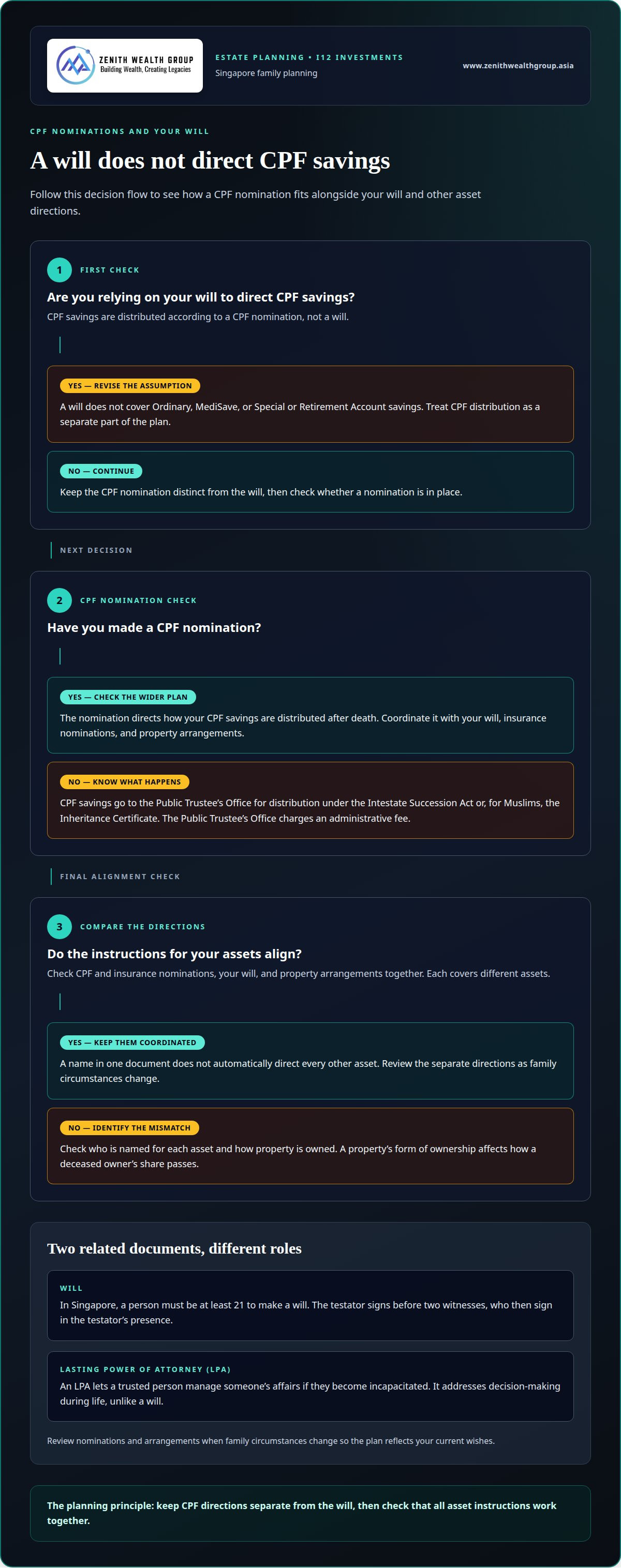
A carefully written will does not direct every asset in Singapore. CPF savings are distributed according to a CPF nomination, not a will, so your family’s plan needs to account for both.
Deciding who receives your wealth is only part of estate planning. You also need to consider who will care for your children and how a vulnerable family member or dependant with special needs will be supported. Effective estate planning strategies for affluent families in Singapore bring these wishes together through arrangements such as a will, CPF nominations and plans for managing assets.
This article explains what estate planning covers and how Singapore’s CPF rules shape your plan. It also explores guardianship, blended households and ways to structure support for dependants with special needs. Use these points to identify where your family circumstances matter and what a coordinated plan should address.
Key Takeaways
- Map assets, liabilities, business interests and cross-border holdings to see what your estate plan needs to address.
- Coordinate CPF nominations with your will and other arrangements, since CPF savings are distributed through a nomination rather than a will.
- Plan for children’s care and consider how structured support can help protect vulnerable beneficiaries’ long-term needs.
- Account for blended-family relationships and dependants with special needs when deciding who receives assets and how support is managed.
What is estate planning?
Estate planning maps what you own, owe and want to pass on. It connects your family’s needs with business interests and assets held across borders.
For affluent households, estate planning strategies for affluent families in Singapore connect ownership, succession and support for intended beneficiaries. A plan may cover property, CPF savings, insurance policies, investments and business interests. Trusts can also hold cash, investments, property or life insurance payouts.
Business Interests and Cross-Border Assets
When planning for business interests and foreign assets, consider how ownership, control and succession fit together. This is especially relevant when your family’s wealth includes a company or property in another country. These holdings need to align with your wider intentions.
Record each business interest and foreign asset, including its ownership, related liabilities and intended successor. For a business, a continuity plan can set out recovery steps and estimate the time and cost of restoring normal operations after a disruption.
Measuring Estate Size and Net Value
Your estate’s net value is the combined value of its assets minus outstanding liabilities. An inventory can include a home, CPF savings, insurance proceeds, investments, debts and retirement benefits. This shows what may pass to beneficiaries and gives you a clearer picture of the estate’s value.
A home, CPF savings and insurance payouts could together make an estate worth S$1 million or more. In 2024, the median resale HDB price was over S$600,000. These estate planning strategies for affluent families in Singapore begin with seeing the whole balance sheet.
Singapore Tax and Estate Rules
Inheritance is distributed under a will or the applicable intestacy rules. Singapore family offices may benefit from the absence of capital gains tax, but this is separate from how an estate is distributed.
For family-office tax incentives, the described Section 13O scheme has a minimum assets-under-management threshold of S$20 million, while Section 13U has a S$50 million threshold. Both schemes have a minimum spending requirement of S$200,000. The stated staffing requirements are two investment professionals for Section 13O and three for Section 13U, with at least one non-family member. These thresholds shape eligibility, not a family’s personal estate value.
CPF nominations
A Singapore estate plan can combine a will, trusts, insurance nominations, CPF nominations and, where suitable, a family office. Each serves a different purpose: a will directs estate assets, a trust can manage distributions, and CPF savings follow a nomination rather than a will.
A CPF nomination directs how a member’s CPF savings are distributed after death. Ordinary, MediSave and Special or Retirement Account savings are not covered by a will. Without a nomination, the savings go to the Public Trustee’s Office for distribution under the Intestate Succession Act or, for Muslims, the Inheritance Certificate. The Public Trustee’s Office charges an administrative fee for this distribution.
Coordinate CPF and insurance nominations with your will and property arrangements. These cover different assets, so naming someone in one document does not automatically direct every other asset to them. A property’s form of ownership also affects how a deceased owner’s share passes. Aligning these directions can help preserve wealth and make your intended legacy clearer for the next generation.
In Singapore, a person must be at least 21 to make a will, and according to Singapore Statutes Online, Attorney-General’s Chambers, the testator must sign it before two witnesses, who then sign in the testator’s presence. Probate makes a will public, while its timeline depends on estate administration and the records involved.
An LPA lets a trusted person manage someone’s affairs if they become incapacitated; it addresses decision-making during life, unlike a will. Review CPF and insurance nominations alongside the will and LPA as family circumstances change. For help coordinating these arrangements, discuss your estate planning needs.
Planning for children and vulnerable beneficiaries
An estate plan can set out who will care for your children and how beneficiaries will receive support. In Singapore, parents can name a guardian for young children in a will, and many owners similarly outline caretaker directives and funding for dependent pets, drawing on guidance from resources such as Canine Longevity Academy to anticipate the lifelong care and wellness needs of aging dogs.
Preparing Successors and Beneficiaries
Preparing successors means clarifying who will take responsibility for family assets and how beneficiaries may use their inheritance. This is particularly important when children are young or someone needs ongoing support.
If a parent has not appointed a guardian in a will, the courts decide who cares for young children. A will can also record wishes for a family business, while a family trust can structure support for education—such as funding early development through Children of Tomorrow Pre-school Singapore—as well as housing, business ventures and medical needs.
Consider how an inheritance should be managed, not just who receives it. A trust can provide assistance as a loan, with repayments returning to the trust for another family member. This can keep capital available for future needs instead of distributing every asset at once.
Life Insurance and Beneficiary Designations
Beneficiary designations identify who should receive specified assets, such as life insurance proceeds, investments or savings accounts. Check them carefully: an intended heir may not receive an asset if its designation names someone else.
Review the beneficiaries named on policies, investment accounts and savings accounts alongside your will. For example, the intended recipient of a parent’s insurance proceeds should align with the family’s broader plan for children and other dependants. Beneficiary designations may help personal holdings pass according to your wishes.
Family circumstances change. A new child, a change in care arrangements or a beneficiary’s death may mean existing designations no longer reflect your wishes.
Think beyond a single lump-sum transfer. Wealth can disappear within one or two generations when heirs receive lump sums and assets are divided or sold. A family trust may instead structure support around education, housing or medical needs. It can also help successors understand what resources are available and why.
Estate planning for blended households and dependants with special needs
Blended households may include a current spouse, an unmarried partner, children from earlier relationships and stepchildren. Your plan should distinguish these relationships and explain who is intended to receive each part of an inheritance.
In Singapore, an unmarried partner has no automatic entitlement to inherit under the law, regardless of how long the relationship has lasted. A stepchild also has no automatic legal status as the testator’s child for succession purposes. If you want a stepchild to inherit, make that intention clear in your estate arrangements rather than assuming family ties determine succession.
Divorce does not automatically revoke a will, although it can make parts of the will ineffective. This matters if a former spouse is still named to receive assets or carry out a role. Review your will after a divorce, and consider how a later marriage, a child’s birth or a beneficiary’s death affects your intended distribution.
For a dependant with special needs, a trust can manage an inheritance over their lifetime instead of transferring a lump sum at age twenty-one. It can provide structured support for needs such as housing, education or medical care. The trust’s terms can specify how assets, investments or savings are used and who manages distributions for the beneficiary.
Make the intended recipients and support arrangements clear across the will, trust and beneficiary designations. Consider whether a direct transfer gives a vulnerable beneficiary suitable control, or whether managed distributions better fit their circumstances. Review the plan when a named executor or trustee cannot carry out their duties, or when family needs change. This gives the arrangements a better chance of matching the family’s wishes as circumstances evolve. Discuss planning for your family’s circumstances.
Zenith Wealth: Estate planning
Zenith Wealth helps families bring estate planning into line with their wishes for children, dependants and future generations. Turn to this support when a will, CPF nomination, insurance beneficiary designation or trust needs to fit into a broader family plan.
Planning can also connect legacy decisions with Retirement Planning, Education Funding and Wealth Protection. For example, parents may want their children’s education needs considered alongside how assets are passed on. Families can also consider how their investments, including i12 investments, fit within their wider intentions for wealth and inheritance.
Start a conversation when a family change or business transition prompts a review, or when separate arrangements need to work together. Contact Zenith Wealth to discuss your estate planning needs.
Give your family plan a clear next step
Your family’s priorities can shift as children grow, responsibilities change and new goals emerge. Treat your estate plan as a living expression of those priorities, not just a set of documents. Start by identifying the decision that feels least settled, such as how future education needs fit alongside support for dependants.
Thoughtful estate planning strategies for affluent families in Singapore connect your legacy intentions with the practical needs of the people who matter to you. Zenith Wealth Group can bring estate planning into the wider picture alongside Retirement Planning, Education Funding and Wealth Protection. The focus is on shaping your plans around your family’s circumstances and the future you want to support.
Start a conversation when you’re ready to shape that next step. Contact Zenith Wealth to discuss your plans. A clear conversation can help you move forward with greater confidence.
Frequently Asked Questions
Can family members still access the money if it is in a Trust?
Yes, if the trust’s terms allow distributions to them. A trustee manages the assets and follows those terms, so a beneficiary may not have unrestricted access. For example, the trust could provide support for education or medical needs, or structure assistance as a loan. Repayments can return to the trust for another family member’s future use.
Are there any risks or drawbacks?
Trusts can involve setup and ongoing administration fees, particularly when professional trustees are used. Transferring residential property into a living trust also has tax consequences: Singapore applies 65 per cent Additional Buyer’s Stamp Duty upfront. A refund may be granted when the trust has identifiable beneficiaries with fixed, unchangeable ownership interests. Existing loans and ownership arrangements also matter before property is transferred.
How can Singapore residents structure trusts for wealth succession and asset protection?
Start by deciding which assets the trust should hold, who may benefit and what support it should provide. A family trust can hold cash, investments, property or sale proceeds, and life insurance payouts. Set out how distributions should serve family needs, such as education or medical support. A corporate trustee can provide neutrality and continuity in managing the arrangement.
How can affluent families plan for minors, vulnerable beneficiaries and succession of a family business in Singapore?
Separate care arrangements from financial succession. For a family business, identify key personnel whose departure could affect operations; planning guidance highlights those directly responsible for at least 5 per cent of firm profits. A continuity plan can be tested every three to six months and include disaster recovery estimates for restoring normal operations. For vulnerable beneficiaries, structure support around their needs rather than relying only on a lump-sum inheritance.
What are the Singapore rules for lasting power of attorney, advance care planning and deputyship?
A Singapore lasting power of attorney lets a trusted person manage someone’s affairs if that person becomes incapacitated. Advance care planning records preferences for future care, while deputyship concerns decision-making arrangements when someone cannot manage their affairs. Treat these as distinct parts of a family plan: an LPA addresses affairs, while care preferences need separate attention.
How should Singapore families plan for cross-border assets, foreign wills and conflicts of succession law?
Begin with an asset map recording each holding’s location, ownership and related liabilities. If your family has overseas property or investments, consider how your documents and intended beneficiaries align across jurisdictions. Coordinate foreign wills with local arrangements so one document does not unintentionally undermine another. Succession rules may depend on the asset and where it is held, so account for each jurisdiction in your plan.


