

Retirement income can be staggered rather than tied to a single maturity date. Building a bond ladder for retirement income in Singapore means holding bonds with different maturity dates; a ten-year ladder could have one bond maturing each year.
The appeal is straightforward: scheduled maturities can provide money to spend or reinvest. But they do not remove investment risk. Bond prices generally fall when market interest rates rise, and bond ETFs can also fluctuate in value. Selling before maturity may mean receiving less than expected.
This guide explains how a bond ladder works, how changing rates can affect bond ETFs, and how to match staggered payments with retirement spending in Singapore. It also covers maturity timing, reinvestment and cash flow, helping you assess whether this approach suits your broader retirement plan.
Key Takeaways
- Understand how maturity proceeds can support planned spending, be held as cash, or be reinvested to extend the ladder.
- Learn how to align staggered maturities with your cash-flow needs and consider the trade-offs between predictable payments and flexibility.
- Explore how Singapore Savings Bonds and other investments, including i12 investments, may fit into a broader retirement plan.
Do I have the flexibility to hold bonds until maturity?
A ladder staggers maturity dates, so principal becomes available at planned intervals. Singapore Savings Bonds (SSBs) offer step-up coupons: the November 2026 issue pays 1.67% in year one and 3.08% in year ten, with a 2.45% ten-year average return.
Staggered maturities and retirement cash flow
A bond ladder spreads an investment across bonds that mature in different years, creating scheduled points when principal may become available. For example, a ten-year ladder could have one bond maturing each year. This structure can align cash flow with planned retirement spending instead of relying on a single maturity date. It spreads interest-rate timing risk, but does not eliminate it.
Using maturity proceeds for spending
When a bond matures, its issuer is expected to return the principal if it can meet its obligations. You can use the proceeds for retirement expenses, hold them in cash or reinvest them in a new bond at the ladder’s far end. The choice depends on upcoming spending needs and available income. A callable bond may return principal earlier than planned.
Individual bonds and target-maturity ETFs
An individual bond has its own maturity date, while a target-maturity ETF or bond fund holds a portfolio of bonds. Holding an individual bond to maturity can make its scheduled principal repayment clearer, subject to the issuer meeting its obligations. ETF units trade at market prices, so selling before the fund’s target date may produce a different return than expected. Rate changes can affect that price.
Ladder structure and maturity dates
Each “rung” represents a bond or allocation assigned to a different maturity date. In a ten-year structure, proceeds from a maturing bond can fund spending or buy a replacement bond at the far end. Reinvestment rates may be higher if rates rise, or lower if they fall. A Treasury ladder follows the same staggered-maturity principle.
A bond portfolio’s contribution depends on its income, costs and maturity schedule, as well as the retiree’s other cash flows.
Age-based ladder and payout examples
An age-based ladder aligns bond maturities with the years when someone expects to rely on portfolio withdrawals. Someone approaching retirement might schedule maturities around the transition from work to retirement, while someone already retired may match them to upcoming expenses. The right structure depends on timing, other income and how much volatility the retiree can tolerate. Coupon payments may support cash flow, but they do not remove issuer default risk.
Worked portfolio illustration
An illustrative Singapore retirement portfolio of S$1,200,000 is estimated to generate S$25,114 in annual income after fund expenses, as of 21 October 2026. This is an example, not a guaranteed return. Inflation can also reduce the purchasing power of fixed payments over time, so the spending plan needs to consider how expenses may change.
Illustrative ladder designs
A separate four-bond illustration has a combined average annual yield of 2.125%. That figure helps show how a ladder’s coupons can contribute to income, but it doesn’t establish what a Singapore portfolio will earn. Yield, bond prices and fund expenses affect the result. A ladder’s principal repayments can also support spending, while reinvestment may change future income if rates move.
For a clearer view of the gap between expected income and spending, map maturities alongside CPF income, cash reserves and i12 investments. A retirement cash-flow planning conversation can help bring those moving parts into one plan.
Building a staggered retirement income ladder
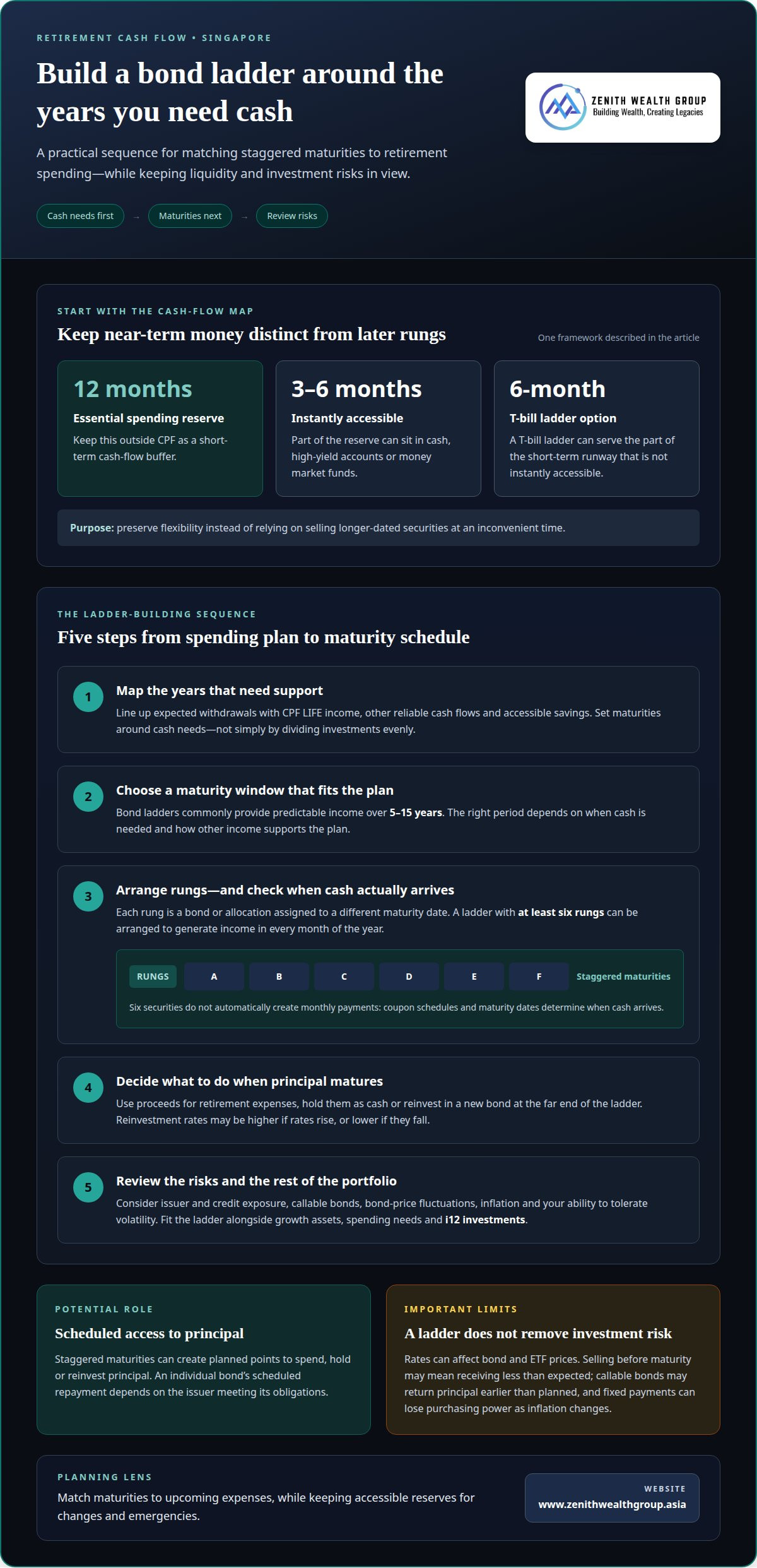
A staggered ladder matches bond maturity dates to planned withdrawals across a defined period. Bond ladders commonly provide predictable income over 5-15 years, but the structure should reflect when you need cash, not simply divide investments evenly. A practical approach to building a bond ladder for retirement income in Singapore starts by mapping expected payments against CPF LIFE income, other reliable cash flows and accessible savings. This shows which years need support from maturing securities and which can tolerate more reinvestment.
For monthly cash flow, a ladder with at least six rungs can be arranged to generate income in every month of the year. That does not mean six securities automatically create monthly payments: coupon schedules and maturity dates determine when cash arrives. Individual bonds may offer more control over payment dates, while a bond fund provides pooled exposure but can fluctuate in market value. Keep near-term liquidity separate from money assigned to later maturities.
A useful Singapore cash-flow framework separates reserve money from the ladder. One approach is to keep 12 months of essential spending outside CPF, with 3-6 months of that runway instantly accessible in cash, high-yield accounts or money market funds. A 6-month T-bill ladder can serve the part of the short-term runway that isn’t kept immediately accessible. This preserves flexibility without relying on selling longer-dated securities at an inconvenient time.
Then consider credit and issuer exposure. Diversifying issuers and choosing suitable credit quality can reduce concentration, but cannot remove default risk. Callable bonds may be repaid before their planned maturity date, requiring earlier reinvestment. Building a bond ladder for retirement income in Singapore also means considering how securities fit alongside growth assets, spending needs and i12 investments. Set maturity dates around expected cash needs while retaining accessible reserves for changes and emergencies.
What Singapore government bonds can retirees use in a bond ladder?
In Singapore, retirees can consider Singapore Savings Bonds (SSBs), Treasury bills and Singapore Government Securities (SGS) bonds. Each serves a different role. Treasury bills suit shorter time horizons, while longer-dated SGS bonds can anchor later maturity points. SSBs offer step-up coupons and redemption flexibility, which may help when cash needs change. Match each security’s maturity and payment schedule to the spending it is intended to support.
A six-month Singapore T-bill auctioned on 8 October 2026 had a cut-off yield of 1.90% a year. That result can illustrate the yield available at one auction, not a rate to assume for future rungs. T-bills mature sooner than longer-term bonds, so they may suit near-term needs. Future purchases face the rates available when each reinvestment occurs.
SSBs can complement fixed-maturity securities because their coupon structure steps up over time, while redemption provides an alternative to selling at a market price. For the November 2026 SSB issue, applications close at 9pm on 27 October 2026. Plan application timing alongside other maturities, and consider whether a particular issue’s payment pattern fits expected expenses.
A practical structure could place a T-bill maturity near a known expense, then use SGS bonds for later cash-flow dates and SSBs for added flexibility. Keep issuer and maturity exposure in view, and avoid treating any single yield as a permanent income forecast. Government securities can still leave reinvestment and inflation risks in the plan. Align the ladder with your wider retirement needs through retirement planning support.
Zenith Wealth: Retirement Planning
Zenith Wealth Group can help connect bond-ladder decisions with your wider retirement plan. Review the maturity schedule alongside expected spending, other income and the cash you want readily available. This can clarify how much of your plan relies on bond payments and where flexibility matters.
Retirement Planning can also account for priorities beyond investment income, including Wealth Protection and Legacy Planning. For example, the right balance may look different if you’re supporting family members or planning how assets will be passed on. i12 investments may be part of the wider investment conversation, alongside your retirement needs and time horizon.
If you’d like to discuss how these pieces fit together, contact Zenith Wealth.
Shape your next retirement decision
A bond ladder is one part of a retirement plan, not a plan on its own. Before deciding how to structure one, consider how your income needs may change, which assets need to remain accessible and how your other priorities fit alongside investment decisions. A financial planner can help bring these considerations together rather than treating each investment in isolation.
Zenith Wealth Group offers Retirement Planning, Education Funding and Wealth Protection. These areas can matter when retirement income decisions also affect family goals or financial resilience. The aim is to make choices with a clearer view of the life they need to support.
If you’re ready to explore how building a bond ladder for retirement income in Singapore could fit your broader plans, contact Zenith Wealth. Start a conversation and take your next step with confidence.
Frequently Asked Questions
What is a bond ladder?
A bond ladder is a portfolio of bonds with maturity dates spread across time. For retirement, each maturity can be assigned to a future cash need, such as covering expenses after work income stops. Coupon payments may contribute between maturities, while principal becomes available on the bond’s due date. Individual bonds and bond ETFs differ: ETF units can be sold at market prices before a target date.
Not in the article’s illustration: a S$1,200,000 portfolio generates estimated annual income of S$25,114 after fund expenses, as of 21 October 2026. The gap would need to come from other income or principal withdrawals. The illustration is not a forecast of future portfolio income.
How Many Years of Expenses Should the Ladder Cover?
Bond ladders commonly provide predictable income for a defined period of 5-15 years. The useful duration depends on when other retirement income begins, how much spending needs scheduled support, and whether the portfolio also needs to fund longer-term growth. For example, someone expecting another income stream later may structure maturities around the years before it begins, rather than tying up assets beyond that point.
How does a bond ladder work for retirement income?
Each bond has a payment schedule and a maturity date. Coupons can provide income along the way; when a bond matures, its principal can fund expenses or be reinvested. This creates planned cash-flow points, but future income depends partly on reinvestment rates. If rates fall before a rung is replaced, the new bond may pay less. The issuer’s ability to meet its obligations also matters.
How to calculate bond ladder size for retirement expenses in Singapore?
Start with your annual spending target, then subtract reliable income expected during the same period. Next, consider which years need bond payments, how much accessible cash you want and whether the remaining portfolio must support growth and changing expenses.
Can SGS Treasury bills and bonds be laddered by maturity, and what are the minimum investment amounts?
Yes. Singapore Treasury bills and Singapore Government Securities bonds can be arranged around their maturity dates, making proceeds available at different times. Minimum investment amounts depend on the specific security and its issue denomination, so there is no single minimum that applies to every instrument.


