

Could a single number be the difference between a stressful old age and the retirement you've actually dreamed of? Many people feel a sense of uncertainty when looking at the 2026 core inflation projections of 1.7 percent. It's natural to wonder if your CPF LIFE payouts and private wealth from i12 investments will truly be enough to sustain your lifestyle for decades. You're not alone in wanting a clearer picture of your financial horizon.
We're here to help you move from confusion to confidence. This guide will show you how to use a retirement planning calculator to accurately project your future needs and turn those figures into a concrete strategy. You'll discover the exact dollar-value goal required to maintain your standard of living. We'll also preview how a professional financial planner can help you bridge the gap between your current assets and your future requirements. By understanding the new 2026 CPF contribution rates and salary ceilings, you can take actionable steps to optimize your wealth today.
Key Takeaways
- Define your specific "Retirement Number" using a retirement planning calculator to replace financial uncertainty with a clear, data-driven roadmap.
- Identify the essential 2026 inputs, including updated CPF salary ceilings and cost-of-living adjustments, for a truly accurate forecast.
- Compare different digital tools to see how government models and bank calculators fit into your broader i12 investments strategy.
- Learn how to bridge the shortfall by determining if you need to adjust your savings rate or optimize your investment returns.
- Discover why a professional financial planner is essential for navigating complex regulatory changes and personal goals that software cannot capture.
Why a Retirement Planning Calculator is Your Critical First Step in 2026
A retirement planning calculator is more than just a digital tool. It's a sophisticated framework designed to project your future capital requirements. By analyzing your current savings, expected lifestyle, and i12 investments, it provides a data-driven look at your financial horizon. Many people live with a vague sense of "retirement anxiety." Seeing your specific "Retirement Number" clearly defined on a screen changes everything. It shifts your mindset from passive worrying to active preparation.
In 2026, the economic environment is moving too fast for traditional, static spreadsheets. With core inflation recorded at 1.7 percent in March 2026, your purchasing power is constantly shifting. A spreadsheet you built three years ago is likely obsolete today. Using a modern retirement planning calculator allows you to stress-test your assumptions against these real-world changes. It helps you identify a "Retirement Gap" while you still have the time and income to fix it. Catching a shortfall today is a minor adjustment; finding it ten years from now is a crisis.
The Difference Between Saving and Planning
Most people focus on accumulation. They watch their bank balances grow and feel successful. However, true planning focuses on decumulation. This is the art of spending your wealth without running out. A retirement planning calculator helps you visualize this transition. It accounts for longevity risk, which is the very real danger of outliving your money. While a calculator provides the math, a financial planner provides the context. They can verify your results and ensure your withdrawal strategy is sustainable for the long haul.
Common Misconceptions When Using Online Tools
The most frequent error is confusing "current dollars" with "future dollars." A million dollars today won't buy the same lifestyle in twenty years. If you use a flat, outdated 2 percent inflation assumption, you're likely underestimating your needs. Many online tools also fail to account for legacy planning. If you intend to leave an inheritance or fund a grandchild's education, those funds cannot be part of your personal retirement spending. A financial consultant can help you separate these goals to ensure your primary fund remains protected. If you're ready to see where you stand, it's time to start the conversation.
Ready to turn your numbers into a strategy? Contact a financial planner today to review your roadmap.
Essential Inputs for a Realistic Retirement Projection
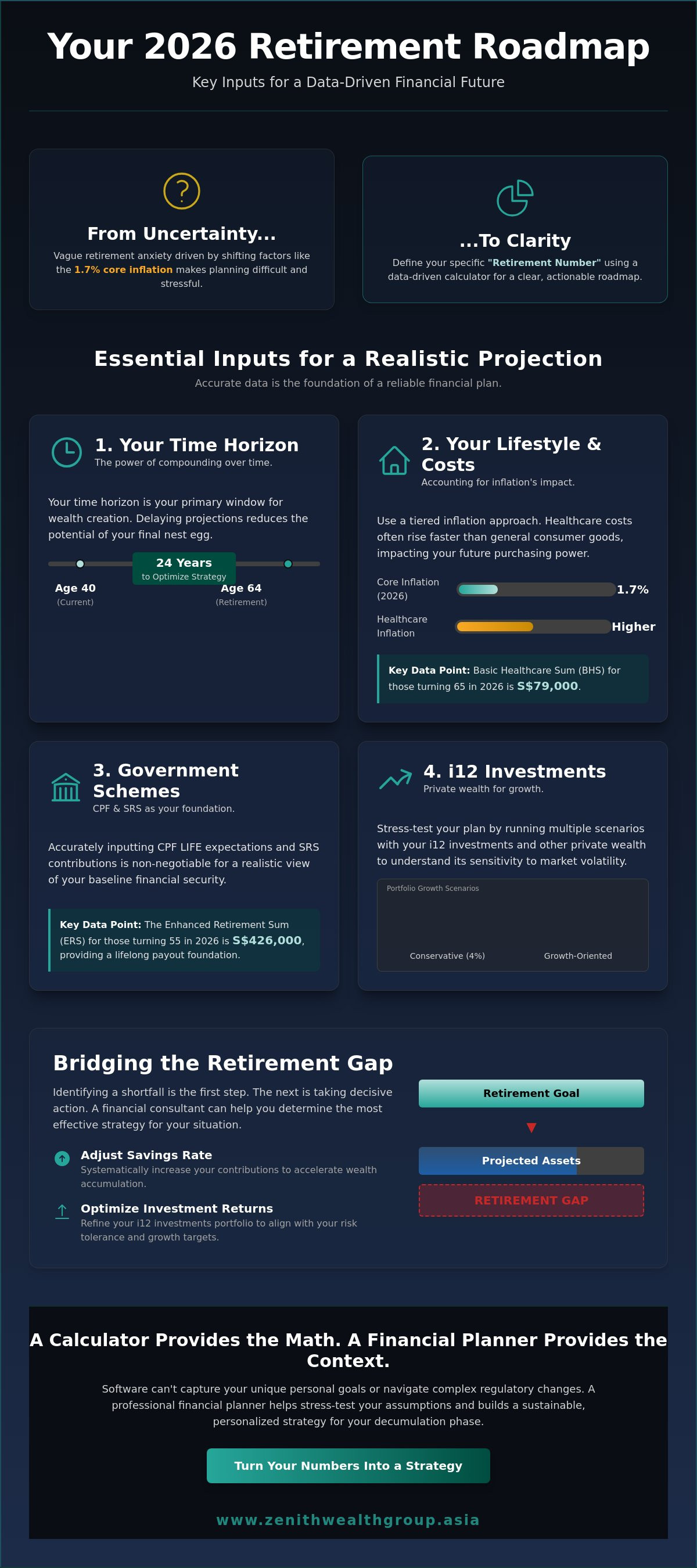
Your roadmap is only as good as the data you feed it. The gap between your current age and your desired retirement age represents your primary window for wealth creation. A retirement planning calculator thrives on this time horizon. It allows you to visualize how compounding works over ten, twenty, or thirty years. If you're 40 today and plan to retire at the new statutory age of 64, you have 24 years to optimize your strategy. Every year you delay starting these projections reduces the potential of your final nest egg.
Don't guess your future costs. Base them on your current 2026 lifestyle while accounting for Singapore's 1.7 percent core inflation rate recorded in March. We recommend a tiered inflation approach. Healthcare costs often rise faster than general consumer goods. Factoring in the Basic Healthcare Sum (BHS) of S$79,000 for those turning 65 in 2026 is a vital data point for your projection. By splitting your expenses into "needs" and "wants," you can see how your plan holds up under different economic conditions.
Accounting for Government Schemes (CPF and SRS)
Integrating government schemes is non-negotiable for a realistic view. You must accurately input your CPF LIFE expectations to understand your baseline security. For those turning 55 in 2026, the Enhanced Retirement Sum (ERS) stands at S$426,000. This provides a significant foundation of lifelong monthly payouts. While looking at government retirement planning tools can offer general methodology, local precision remains the priority. You can explore our detailed guide on how much money to retire in Singapore to refine these figures further. Don't forget your SRS account; it's a powerful tool for tax-efficient growth that complements your mandatory savings.
Integrating Private Wealth and i12 Investments
Private wealth must work in tandem with public funds to ensure a comfortable lifestyle. Your projections should include diversified portfolios like i12 investments to capture market growth beyond CPF interest rates. Different asset classes provide varying levels of protection against rising costs. When using your retirement planning calculator, run multiple scenarios. Compare a conservative 4 percent return against a more aggressive growth rate. This helps you understand the sensitivity of your plan to market volatility. A financial planner can help you stress-test these variables. If you're unsure how to weight your i12 investments alongside your CPF, reach out to a financial consultant for a personalized review.
Comparing the Best Retirement Calculators: CPF vs. Banks vs. Professional Models
Choosing the right retirement planning calculator depends on your specific stage of life. Not all tools are built with the same level of detail. Some focus purely on cash flow, while others look at total net worth. We recommend using several different models to "triangulate" your final number. This helps you spot outliers in your data and ensures your assumptions aren't overly optimistic. Relying on a single source of truth can be risky if that tool uses generic assumptions that don't match your reality.
Bank tools are often the most accessible digital options. They provide a quick estimate of your lifestyle preservation based on current savings. These are useful for a "back of the envelope" sketch of your future. However, be aware that many bank-led tools are designed to lead you toward specific product pitches. They may not offer the deep customization required for a complex portfolio involving i12 investments. For a truly holistic roadmap, you need a model that sees beyond simple savings accounts.
When to Use the CPF Retirement Payout Planner
The CPF portal is the most accurate way to understand your monthly payouts under CPF LIFE. It uses your actual contribution history and the 2026 Basic Retirement Sum of S$106,500 to project your income. It's perfect for seeing your guaranteed floor. However, it doesn't see your private wealth or i12 investments outside the government system. If you're looking to retire before the statutory age of 64, you'll need an early retirement calculator to model the years before CPF payouts begin. This is essential for anyone pursuing financial independence before the official retirement age.
The Advantage of a Professional Financial Consultant's Tool
While the AARP Retirement Calculator provides a great global perspective on longevity, a financial planner uses localized, high-fidelity models. These tools go beyond simple linear growth. They use Monte Carlo simulations to run thousands of "worst-case" market scenarios. This ensures your wealth protection strategy can withstand a sudden downturn during your decumulation phase. It's about building a plan that survives the math, not just one that looks good on paper.
Professional models also integrate complex areas like legacy planning and estate planning. A web app can't tell you how a 1.7 percent core inflation rate affects your specific healthcare needs over thirty years. A financial consultant provides this human context. They help you navigate 2026 regulatory changes that a standard algorithm might miss. If you're ready for a holistic view of your future, connect with us for a strategy session to review your numbers.
Bridging the Shortfall: From Calculator Results to Strategic Action
Once the retirement planning calculator reveals a gap, don't panic. Analyze the cause. Is it a savings problem or an investment return problem? If you're hitting the 2026 CPF Ordinary Wage ceiling of S$8,000 but still seeing a shortfall, you likely have an investment return issue. Your money isn't outpacing the 1.7 percent core inflation rate effectively. Identifying this distinction is the first step toward a solution. It allows you to move from passive observation to tactical execution.
You have several tactical levers to pull. You could choose to delay retirement. From July 1, 2026, the statutory retirement age rises to 64, with a re-employment age of 69. Working longer increases your CPF accumulation and shortens the period you need to fund. Alternatively, you can increase your voluntary contribution rates. For those under 55, the total contribution rate remains 37 percent, providing a strong foundation. However, the most efficient path often involves a strategic shift toward higher-yield options like i12 investments.
Optimizing Your Investment Portfolio
Review your asset allocation today. Does it truly match what the retirement planning calculator says you need for the next thirty years? i12 investments play a critical role here. They provide the sustainable long-term growth required to bridge the gap between CPF LIFE and your desired lifestyle. While growth is essential, don't overlook safety. You must prioritize wealth protection to ensure a sudden market dip doesn't derail your entire roadmap during the final accumulation years.
Tax Efficiency and Withdrawal Strategies
Tax-efficient planning is like finding "free" money for your future self. It can effectively save you 5 to 10 percent of your total retirement fund over time. Consider your 2026 income tax brackets carefully. If you're in a higher bracket, maximizing your SRS contribution cap of S$15,300 is a smart move. The sequence of withdrawals is just as important as the accumulation. Deciding whether to draw from SRS, private cash, or CPF first can significantly extend your portfolio's lifespan. A financial planner can help you model these sequences to find the most tax-advantaged path.
Ready to close the gap and secure your future? Connect with a financial consultant to design your custom withdrawal strategy and optimize your i12 investments.
Beyond the Screen: Why Your Financial Consultant is the Final Piece
A retirement planning calculator provides a destination, but it doesn't offer the compass needed for the actual journey. While the math offers a snapshot of your 2026 financial health, it cannot account for the personal nuances that define your life. Your "number" is just a figure until it's tied to your specific aspirations, like funding a grandchild's education or ensuring your business succession plan is robust. At Zenith Wealth, we believe that true financial security comes from blending these hard numbers with human empathy and strategic foresight. It's about moving from a digital projection to a lived experience.
Digital tools often fail to capture the "what if" scenarios that keep you up at night. What if your healthcare needs change unexpectedly? What if you want to accelerate your gifting strategy for the next generation? A financial planner provides the context and adaptability that a web app cannot. We take the output from your retirement planning calculator and stress-test it against your real-world priorities. This ensures your 2026 roadmap isn't just a static document, but a dynamic plan that evolves as you do.
Human Insight vs. Digital Algorithms
Algorithms are excellent at processing data, but they struggle with the gray areas of estate and legacy planning. A financial planner can spot subtle risks, such as the impact of changing family dynamics on your long-term wealth, which a standard tool would simply miss. We help you align your i12 investments with these deeper goals, ensuring your wealth protection strategy isn't just a calculation, but a shield for your family's future. This personalized approach turns a generic projection into a unique legacy planning roadmap that reflects who you are.
Your Next Steps for a Secure 2026
Ready to move beyond the digital interface? We suggest a clear path forward to secure your future and protect your hard-earned assets:
- Establish your 2026 baseline by running your current figures through an initial tool.
- Review your results to identify any immediate shortfalls in your i12 investments or CPF projections.
- Schedule a discovery session to turn those data points into a resilient, actionable strategy.
Don't leave your golden years to a set of generic assumptions. Connect with a financial consultant at Zenith Wealth today for a personalized review of your roadmap. We're here to help you start the conversation and build the security you deserve.
Take Control of Your Financial Future
You've moved from financial uncertainty to a clear vision of your 2026 roadmap. By leveraging a retirement planning calculator, you've established a solid baseline for your future needs. You now understand how to bridge shortfalls using i12 investments and why professional insight is the final piece of the puzzle. It's time to move beyond the screen and turn those numbers into a secure, actionable strategy.
At Zenith Wealth, we specialize in providing the quiet confidence you need for the years ahead. As authorized representatives of finexis advisory, we offer tailored roadmaps designed specifically for 2026 economic conditions. We're ready to help you finalize your plan and protect your legacy. Book a Consultation with a Zenith Wealth financial consultant today to secure your tomorrow. We look forward to starting the conversation and growing alongside you.
Frequently Asked Questions
How accurate are retirement planning calculators for Singaporeans?
Calculators are highly accurate when you use current 2026 parameters like the S$8,000 Ordinary Wage ceiling. Their precision depends entirely on the quality of your inputs. While they offer a solid mathematical foundation, they're best used as a diagnostic tool. A Zenith Wealth financial planner can help you verify these projections to ensure they align with your actual lifestyle expectations.
Should I include my HDB property in my retirement calculator assets?
Include your HDB only if you have a concrete plan to monetize it through downsizing or the Lease Buyback Scheme. Since your primary residence is first a shelter, counting it as a liquid asset can skew your results. It's often safer to treat property as a separate pillar of your legacy planning rather than a source of daily retirement income.
What inflation rate should I use for a 2026 retirement projection?
Start with the 1.7 percent core inflation rate recorded in March 2026, but don't stop there. We recommend a tiered approach where you budget a higher rate for healthcare and luxury spending. This provides a more resilient roadmap that can withstand rising costs over several decades. A Zenith Wealth financial consultant can help you model these specific scenarios.
How do I factor in CPF LIFE payouts into my private calculator?
Input your CPF LIFE payouts as a fixed, monthly income stream that begins at age 65. You can estimate these figures using the 2026 Enhanced Retirement Sum of S$426,000 for maximum coverage. This helps you identify the exact gap that your private savings and i12 investments must fill to maintain your desired standard of living.
Can a retirement planning calculator account for i12 investments?
Yes, most professional tools allow you to integrate private portfolios like i12 investments alongside your CPF. This provides a holistic view of your wealth and helps you understand how different asset classes perform under various market conditions. It's a critical step for anyone looking to build a diversified and sustainable income stream for their golden years.
What is the 'Safe Withdrawal Rate' I should use for my calculations?
The 4 percent rule is a popular benchmark, but it's not a universal solution for every Singaporean. Your ideal rate depends on your unique asset mix and longevity expectations. A Zenith Wealth financial planner can help you determine a sustainable withdrawal strategy. This ensures you don't deplete your funds while still enjoying the lifestyle you've worked hard to build.
Why do different calculators give me different retirement numbers?
Variation usually stems from different default assumptions regarding life expectancy and investment returns. One tool might assume you'll live to 85, while another projects to 95. These small differences compound over time, leading to very different final numbers. Using a retirement planning calculator with a professional's guidance helps standardize these variables for a more accurate result.
How often should I update my retirement planning calculation?
You should update your calculations at least once a year or after significant life events. With the retirement age rising to 64 in July 2026, staying current is more important than ever. Regular reviews allow you to adjust your strategy for salary changes or new CPF contribution rates. A Zenith Wealth financial consultant can help you keep your roadmap updated and effective.


