

Did you know that medical cost inflation in Singapore is projected to hit 16.9% in 2026? This single figure can derail even the most disciplined savings plan if you're still aiming for yesterday's targets. You've likely spent years wondering exactly how much money to retire in singapore while watching the cost of living climb. It's natural to feel anxious about whether your current nest egg can withstand 2026 price hikes and the rising statutory retirement age of 64. You deserve a strategy that accounts for these shifts without the guesswork.
We understand that the shift to an S$8,000 monthly wage ceiling and new CPF contribution rates for older workers feels like a lot to track. You need a clear, actionable plan that turns confusion into confidence. In this guide, we'll break down the realistic financial targets for a 2026 retirement. We'll show you how to outpace the current 1.8% annual inflation rate by balancing CPF LIFE payouts, SRS contributions, and private wealth strategies. Let's find your number and build a roadmap that lasts as long as you do. Drop us a line if you're ready to start!
Key Takeaways
- Learn why retirement in 2026 is defined by the specific point where your passive income finally exceeds your monthly expenses.
- Identify your target lifestyle among three distinct tiers and see updated 2026 cost estimates for each.
- Calculate how much money to retire in singapore by integrating the 2026 Enhanced Retirement Sum (ERS) and your projected CPF LIFE payouts.
- Master a simple two-step formula to bridge the gap between your guaranteed income and your desired retirement lifestyle.
- Discover how to stress-test your roadmap against market shifts to ensure your financial security remains intact for the long term.
Defining Your Retirement Reality in Singapores 2026 Economy
Retirement isn't a date on a calendar or a gold watch. It's a mathematical crossover point. In the 2026 economy, you've retired the moment your passive income streams reliably exceed your active expenses. Many people still ask how much money to retire in singapore based on old "million-dollar" targets. That round number is officially outdated. With the Monetary Authority of Singapore (MAS) managing a tight exchange rate to combat imported inflation, the purchasing power of your cash is under constant pressure. You aren't just planning for a static cost of living; you're planning for a moving target.
The old "cash-out" strategy where you live off a lump sum is increasingly dangerous. We call this "longevity risk." It's the very real fear of outliving your money while your medical bills climb. To survive in 2026, your strategy must pivot from wealth accumulation to sustainable income generation. Calculating how much money to retire in singapore requires looking beyond today's prices and factoring in the compounding effect of these 2026 costs.
The 2026 Cost of Living Factor
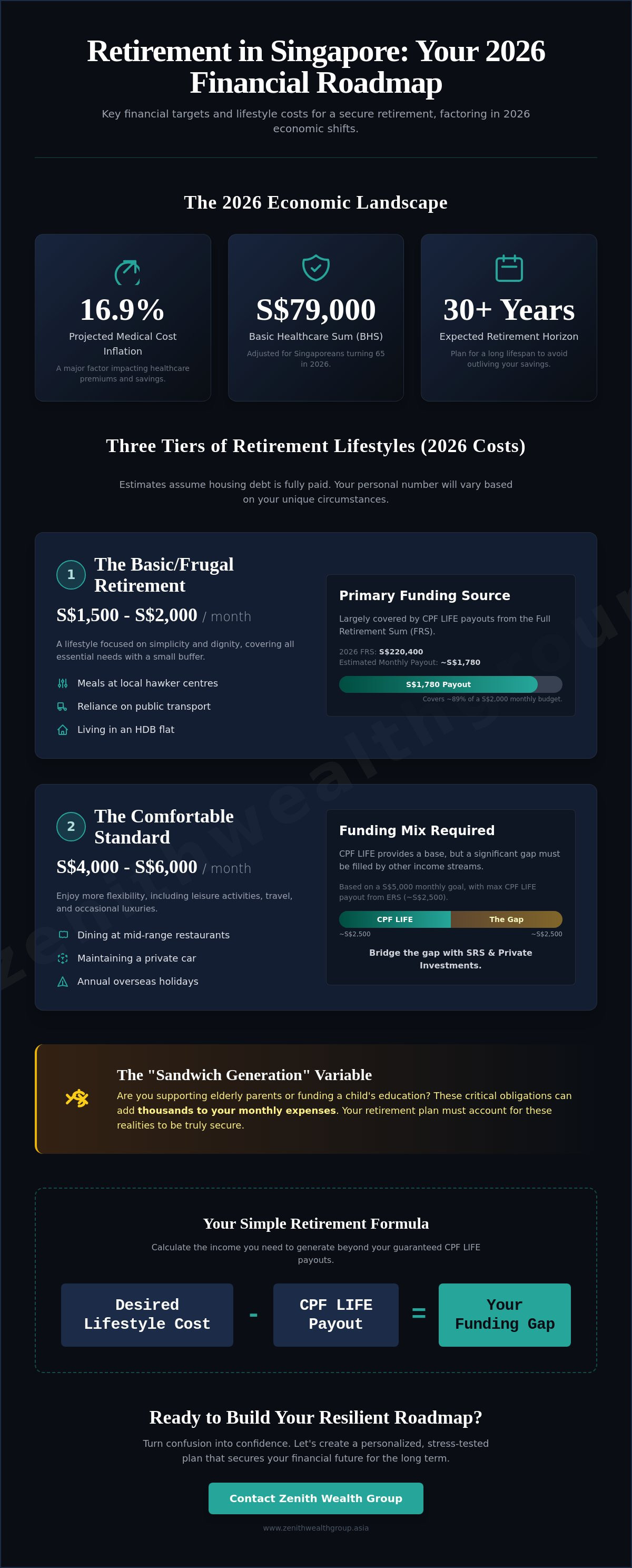
Inflation has shifted the baseline for what we consider "basic needs." While general annual inflation sits at 1.8% as of May 2026, this masks the sharp rise in specific sectors. Healthcare is the primary culprit. Projected medical cost inflation has surged to 16.9% this year, directly impacting the premiums for your Integrated Shield Plans. Even the Basic Healthcare Sum (BHS) has been adjusted to S$79,000 for those turning 65 in 2026 to keep pace with these rising costs.
For a single retiree in 2026, the baseline for a dignified but basic lifestyle requires a minimum monthly income of S$1,650 to cover essential housing, food, and healthcare costs.
Life Expectancy and the 30-Year Horizon
Singaporeans now enjoy some of the longest lifespans globally. You must plan for a 30-year retirement horizon that stretches well into your 90s. Relying solely on the Central Provident Fund (CPF) is a great start, but it's rarely enough for the lifestyle most desire. A long life is a blessing, but only if your bank account can keep up with your heartbeat.
The danger lies in the "cash-out" trap. Spending down your principal too early leaves you vulnerable in your later years when you're most likely to face health challenges. This is where wealth protection becomes essential. It safeguards your horizon by ensuring your assets aren't drained by unforeseen crises. At Zenith, we help you transition to an "income-stream" strategy. This ensures your money works as hard as you did, providing a steady flow that outlasts even the longest lifespan. Drop us a line if you're ready to build yours!
The Three Tiers of Retirement Lifestyles and Their Costs
Your retirement number is deeply personal. It depends on the life you want to lead once the 9-to-5 grind stops. In 2026, we categorize these goals into three distinct tiers. Each tier requires a different strategy for how much money to retire in singapore. These estimates assume you've fully paid off your housing debt, as mortgage payments in your 60s can drastically shift these requirements. You must also factor in a liquid buffer for family emergencies, as unexpected crises often ignore even the best-laid plans.
Tier 1: The Basic/Frugal Retirement
For many, a Tier 1 lifestyle is about simplicity and dignity. In 2026, this looks like a monthly budget of S$1,500 to S$2,000. You'll likely rely on public transport, enjoy meals at local hawker centers, and live in an HDB flat. This tier is largely supported by the CPF Retirement Sum. If you hit your Full Retirement Sum (FRS) of S$220,400 in 2026, your estimated monthly payout of S$1,780 fits perfectly within this bracket. It's a stable floor, but it leaves little room for luxury or rising costs.
Tier 2: The Comfortable Middle-Class Standard
If you envision more than just the basics, Tier 2 targets S$4,000 to S$6,000 monthly. This budget accommodates dining out at mid-range restaurants, maintaining a car, and taking annual overseas trips. Because CPF LIFE payouts are capped by the Enhanced Retirement Sum (ERS), you'll need private investments to bridge the gap. Maximizing your Supplementary Retirement Scheme (SRS) is a smart move here. With 2026 contribution limits at S$15,300 for residents, it's an effective way to build that extra income layer while enjoying tax relief.
The Sandwich Generation Variable
Most retirement guides treat you as an isolated individual. We know that's rarely the case in Singapore. You might still be supporting elderly parents or funding a child's university education as you approach your 60s. These "sandwich generation" costs can add thousands to your monthly outflow. You need to account for these obligations before you can settle on a final number. Using an early retirement calculator helps you visualize how these family loads impact your timeline.
Planning for these variables ensures your roadmap is resilient. If you're feeling overwhelmed by the math, reach out to our team for a personalized chat. We're here to help you navigate these tiers with clarity and confidence. Every dollar you plan for today is a bit of freedom you buy for tomorrow!
Why Your Magic Number Must Account for CPF LIFE and SRS
Calculating how much money to retire in singapore is often mistaken for a simple lump-sum goal. You might think hitting a specific million-dollar milestone is the finish line. In reality, a resilient 2026 retirement plan is built on layers of guaranteed income. CPF LIFE serves as your foundation. It's the national annuity that ensures you never truly run out of cash, regardless of how long you live. However, relying on it alone is a common trap for those aiming for a Tier 2 or Tier 3 lifestyle.
In 2026, the Enhanced Retirement Sum (ERS) has been set at S$440,800. This provides an estimated monthly payout of S$3,440 for members turning 55 this year. While this is a significant "floor," it doesn't reach the S$4,000 to S$6,000 range required for a comfortable middle-class retirement. You need to view CPF LIFE as your safety net, not your entire roadmap. To bridge this gap, you must look toward the Supplementary Retirement Scheme (SRS) and private wealth strategies.
Optimizing the SRS Account
The SRS is one of the most effective tools for high-earning years. By contributing up to the 2026 limit of S$15,300 for Singaporeans and Permanent Residents, you reduce your taxable income immediately. It's a double win. You save on taxes today while building a pot for tomorrow. But don't let your SRS funds sit idle. The base interest rate is a mere 0.05%, which loses value against the 1.8% annual inflation rate. You'll need to move those funds into productive assets like unit trusts or endowments to ensure your savings actually grow. When you eventually withdraw at the statutory age, only 50% of the amount is taxable. This makes it a highly efficient way to boost how much money to retire in singapore.
Bridging the Gap with Private Annuities
CPF LIFE payouts are reliable but fixed. They don't always keep pace with the 16.9% medical inflation we're seeing in 2026. This is where private annuities and investment management become vital. Private plans can be structured to provide increasing payouts or lump-sum injections at specific ages. They act as the "inflation-adjusted" layer of your income stream. At Zenith, we specialize in identifying exactly where your CPF floor ends and where your private wealth needs to take over. We'll help you run a personalized gap analysis to ensure your monthly income stays ahead of rising costs. Drop us a line to see how these layers fit together for your specific goals!
Step-by-Step: Calculating Your Personalized Retirement Target
Ready to move from broad estimates to concrete numbers? Determining how much money to retire in singapore requires a systematic approach. You aren't just looking for a static lump sum. You're building a sustainable cash flow engine. Follow this four-step logic to find your personal 2026 target.
- Step 1: Estimate your 2026 monthly "Dream Lifestyle" expense. Use the lifestyle tiers we identified earlier. If you've targeted a comfortable Tier 2 lifestyle, your goal might be S$5,500 per month in 2026 dollars.
- Step 2: Subtract your projected CPF LIFE monthly payout. Check your latest statement for your specific numbers. For those hitting the 2026 ERS, your estimated monthly payout is S$3,440.
- Step 3: Calculate the "Income Gap." Subtract your CPF payout from your total needs. In this scenario, you have a monthly gap of S$2,060 that private assets must fill.
- Step 4: Apply the "Rule of 25." Multiply your annual gap by 25. If you need S$24,720 annually from private funds, you need a portfolio of roughly S$618,000 at the start of your retirement.
The 4% Rule vs. The Singapore Reality
The traditional 4% withdrawal rule is a popular global benchmark, but it can be too aggressive for the Singaporean context. Local bond yields often sit lower than global averages. Market volatility can also impact your sequence of returns. For a resilient 2026 portfolio, we often suggest a "Safe Withdrawal Rate" of 3% to 3.5%. This conservative buffer ensures your private savings don't run dry during a market dip. It provides the quiet confidence you need to enjoy your golden years without constant ticker-watching.
Factoring in Healthcare Inflation
Medical costs are the most significant threat to your retirement security. They don't follow general inflation. In 2026, medical inflation is projected at 16.9%, which is nearly ten times the general rate of 1.8%. You must allocate a specific "Medical Contingency Fund" within your target. This fund acts as a dedicated reserve for out-of-pocket costs and rising insurance premiums. Comprehensive retirement planning must include robust Integrated Shield Plans to transfer this risk to insurers.
Your retirement number isn't just a goal; it's your future freedom. If the math feels complex, don't worry. Contact Zenith Wealth today for a personalized gap analysis. We'll help you turn these steps into a clear, actionable roadmap. Drop us a line and let's get started!
Beyond the Number: Strategic Wealth Management with Zenith
Calculating how much money to retire in singapore is only the beginning. A number on a spreadsheet doesn't buy peace of mind. You need a strategy that survives real-world turbulence. At Zenith Wealth, we transform these broad estimates into specific, actionable roadmaps. We don't just hope for the best. We stress-test your plan against market crashes and economic shifts. This ensures your confidence remains high even when market volatility strikes. You deserve a partner who looks at the "what-ifs" so you don't have to.
As you approach your target date in 2026, your financial focus must shift. You've spent years in the accumulation phase, building your nest egg through hard work and discipline. Now, it's time for wealth preservation. We help you pivot your portfolio to protect your principal while maintaining the steady income streams discussed in previous sections. This transition is critical. One wrong move during a market downturn can shave years off your retirement horizon. Drop us a line! We're here to help you find your personal zenith in retirement planning.
Tailored Solutions for Different Life Stages
Every life stage requires a unique lens. If you're a young professional, we focus on aggressive growth and early SRS optimization to maximize tax relief. If you're a pre-retiree, we prioritize wealth protection and legacy planning. You've worked hard to build your estate. You want to ensure it benefits your children and grandchildren without being eroded by taxes or legal hurdles. We act as your Modern Professional Guide, stripping away the jargon to provide clear, human-centric advice. We value personal connection over institutional coldness.
Start Your 2026 Planning Today
The cost of delay is the silent killer of retirement dreams. Procrastinating on your plan for just 12 months can significantly increase the final amount you need to save. In an environment with 1.8% annual inflation, every year of waiting compounds the "income gap" your private assets must fill. Your 2026 roadmap shouldn't be a guess. It should be a conviction.
We invite you to a comprehensive financial review. We'll look at your CPF LIFE projections, your SRS balance, and your private investments to see how they align with your 2026 goals. Let's ensure your strategy is as resilient as you are. Book a consultation with Zenith Wealth today and take the first step toward a confident, secure future. Your retirement is a conversation we're eager to start!
Take Control of Your Financial Future Today
Planning for your golden years in a shifting economy requires more than just a guess. You've learned that determining how much money to retire in singapore involves balancing your desired lifestyle tier with the 2026 Enhanced Retirement Sum of S$440,800 and rising medical costs. A resilient strategy isn't built on a single number; it's built on a multi-layered income floor that outpaces inflation. You don't have to navigate these complex 2026 economic forecasts alone.
As authorized representatives of finexis advisory, we specialize in 2026 economic forecasting and holistic retirement strategies. We integrate your CPF and SRS optimization into a personalized roadmap that prioritizes your peace of mind. Our team is ready to act as your Modern Professional Guide through every stage of wealth preservation and income planning. Drop us a line to calculate your personalized 2026 retirement number! We're excited to help you reach your financial zenith. Your future self will thank you for starting this conversation today!
Frequently Asked Questions
Is S$1 million enough to retire in Singapore in 2026?
S$1 million is generally sufficient for a comfortable middle-class retirement in 2026, provided you have a fully paid-for home. However, it may fall short of an "aspirational" lifestyle which DBS Bank suggests can require up to S$1.3 million. Factors like the 16.9% medical inflation rate and your specific spending habits will ultimately determine if this figure holds up over a 30-year horizon.
How much does the average Singaporean couple need for retirement?
An average retiree household in Singapore spends roughly S$1,940 monthly as of July 2021, but adjusted for 2026 costs, a couple should target at least S$3,500 to S$4,000 for a basic lifestyle. For a more "comfortable" tier including travel and dining, couples often need a combined monthly income of S$6,000 to S$8,000. This highlights why knowing how much money to retire in singapore is a household-level calculation rather than just an individual one.
What is the CPF Basic Retirement Sum for 2026?
The CPF Basic Retirement Sum (BRS) for members turning 55 in 2026 is S$110,200. This sum provides an estimated monthly CPF LIFE payout of S$950 starting at age 65. Choosing the BRS usually requires you to own a property with a lease that lasts until you are at least 95 years old, allowing you to pledge the property to meet the Full Retirement Sum requirements.
Can I retire in Singapore with only S$2,000 a month?
Yes, you can retire on S$2,000 a month in 2026, which fits within the "Basic/Frugal" retirement tier. This budget relies heavily on public transport, hawker meals, and a fully paid-for HDB flat. It leaves very little room for luxury or private healthcare, so ensuring you have a robust Integrated Shield Plan is vital to protect this tight budget from medical cost spikes.
How does inflation affect my retirement savings in Singapore?
Inflation erodes the purchasing power of your cash, meaning a dollar today buys less in 2026. While the general annual inflation rate is 1.8% as of May 2026, medical costs are rising at a much faster rate of 16.9%. This disparity means that even if your basic expenses are stable, your long-term healthcare liabilities could double every few years, necessitating a strategy that outpaces these specific price hikes.
What is the best age to start retirement planning in Singapore?
The best age to start is as soon as you receive your first paycheck, ideally in your 20s. Starting early allows you to leverage the power of compounding and maximize your CPF Ordinary Account interest of 2.5% and Special Account interest of 4%. If you're already in your 40s or 50s, focus on aggressive SRS contributions and wealth protection to secure your 2026 roadmap before the statutory retirement age of 64.
Should I rely on my HDB property as a retirement fund?
Your HDB property is a valuable asset that can be monetized through the Lease Buyback Scheme or by downsizing, but it shouldn't be your only source of income. Relying solely on property locks your wealth in an illiquid asset. A balanced plan for how much money to retire in singapore uses property as a safety net while relying on CPF LIFE and liquid investments for monthly cash flow.
How much should I have in my SRS account by age 50?
There is no fixed rule, but aim to maximize your annual contributions of S$15,300 for residents leading up to age 50. By this age, having a significant SRS balance allows you to invest in higher-yield assets that beat the 0.05% base rate. This builds a tax-efficient bridge for early retirement before your CPF LIFE payouts begin at age 65.


