

With private tuition fees hitting RM500,000 in 2026, simply "saving" for your child's future isn't enough. You've likely noticed that standard bank interest can't beat the 2.2% education inflation rate we're seeing today. It's stressful to balance SSPN tax reliefs with private growth assets while worrying if the fund will actually be enough. You want a clear path that guarantees your child’s degree without the constant guesswork. It's a common concern for many parents navigating the current financial climate.
This guide helps you build a modern education savings plan Malaysia families use to stay ahead of rising costs. We'll show you how to calculate a precise target figure and maximize the 4.10% SSPN dividends announced this year. You'll learn how a professional financial planner can help you design a diversified portfolio that protects your legacy. We'll also explore how incorporating i12 investments provides the growth engine needed to outpace inflation. By the end, you'll have a resilient strategy that offers both security and quiet confidence for your family's future.
Key Takeaways
- Learn how to calculate the true cost of university in 2026 by accounting for tuition inflation rates ranging from 3.2% to 6% annually.
- Build a resilient education savings plan Malaysia using a Tri-Pillar strategy that balances tax-efficient savings, guaranteed protection, and growth-oriented assets.
- Discover how to use i12 investments to capture higher growth potential and avoid the high opportunity costs associated with low-yield traditional savings.
- Follow a clear 5-step roadmap to identify your specific funding gap and secure your child's degree, whether at a local private university or an overseas campus.
- Understand how a professional financial planner acts as a guide to navigate complex investment choices and ensure your fund stays on track through unexpected life events.
Calculating the Real Cost of Education in Malaysia for 2026
Planning for your child's university years requires more than just a monthly deposit into a basic bank account. In 2026, parents face a complex reality. While the general education inflation rate was recorded at 2.2% in May 2026, specific tuition fees in the private sector often climb between 3.2% and 6% annually. This means a degree that costs RM100,000 today won't stay at that price for long. To build a successful education savings plan Malaysia families must account for these aggressive price hikes early on.
Beyond tuition, hidden costs often catch parents off guard. You need to factor in accommodation, digital textbooks, and professional licensing fees for fields like medicine or law. Understanding the overview of the Malaysian education system helps clarify how these pathways differ. A static savings account simply can't keep pace with these realities. Without growth-oriented strategies, such as those found in i12 investments, your purchasing power diminishes every year. It’s about building a fund that grows faster than the bills arrive.
Projecting Costs for 2030 and Beyond
The "Rule of 72" is a simple way to see how quickly costs double. If tuition inflates at 6%, your costs will double in just 12 years. Consider a RM50,000 degree today. In 15 years, that same program could cost over RM120,000. For those looking at the UK or Australia, currency fluctuations add another layer of risk. A weakening Ringgit can suddenly turn a manageable plan into a financial burden. This is why a professional financial planner focuses on building a resilient fund that accounts for these shifts before they happen.
Local vs. International: The Price of Choice
Top local institutions like Taylor’s or Sunway offer world-class facilities. However, they come with premium price tags that require careful navigation. Twinning programs are popular, yet they require a multi-currency savings strategy to handle the shift from local fees to international expenses. Your child’s interests might change from arts to engineering. Having a flexible plan is vital for these transitions. Working with a financial planner ensures your portfolio is diversified enough to handle any path they choose. If you're ready to start mapping this out, you can connect with our team to begin your planning journey.
The Three Pillars of a Modern Education Savings Strategy
Relying on a single savings account is a risky move for your child's future. A robust education savings plan Malaysia parents can count on requires a "Tri-Pillar" approach. This framework balances tax efficiency, protection, and growth. No single product can carry the weight of a 20-year horizon alone. You need a cohesive strategy that adapts to market shifts while keeping your capital safe. It's about building a fund that is as resilient as it is productive.
Pillar 1: Maximizing Tax Relief with SSPN
For 2026, the Skim Simpanan Pendidikan Nasional (SSPN) remains the essential tax-efficient foundation. Parents can claim personal income tax relief of up to RM8,000 per year on net savings. This acts as an immediate gain on your contributions. While SSPN-i offers a straightforward savings model, SSPN-i Plus includes affordable takaful coverage. With dividend rates reaching 4.10% in May 2026, it's a competitive starting point. Families in lower-income brackets should also check for government matching grants to further boost their totals.
Pillar 2: The Critical Role of Wealth Protection
Savings only work if you have the time to complete them. What happens if you're no longer there to fund the plan? This is why the protection pillar is vital. By including a "Payor Benefit" rider, the insurance provider takes over the premium payments if the parent faces a total disability or passes away. This ensures the child's degree is funded regardless of life's surprises. Young parents should also prioritize critical illness coverage to prevent medical bills from depleting the education fund. For those with cross-border interests, understanding wealth protection in Singapore offers valuable perspective on regional safety nets.
Pillar 3: Driving Growth with i12 Investments
To beat the 2.2% education inflation rate, you need a growth engine. A portion of your portfolio must reside in equity-based assets to ensure your purchasing power stays intact. This is where i12 investments play a vital role. This philosophy focuses on consistent, long-term wealth accumulation rather than chasing short-term trends. A skilled financial planner will help you balance this risk. As your child nears university age, they'll gradually shift assets from growth to preservation. This proactive management keeps your target figure within reach. If you'd like to see how these pillars fit your specific needs, feel free to start a conversation with our team.
Balancing Growth and Security: i12 Investments vs. Traditional Endowments
Choosing between a guaranteed return and a growth-oriented portfolio is a common dilemma for parents. Traditional endowment plans are often marketed as the safest choice for an education savings plan Malaysia. They offer a specific sum upon maturity, which feels secure. However, these guarantees often come with a high opportunity cost. With education inflation sitting at 2.2% in May 2026, a low-yield plan might barely keep your head above water. You risk having a fund that reaches its numerical target but lacks the actual purchasing power to pay for a degree.
Modern portfolios require a more active approach to handle 2026 market volatility. A financial planner helps you look beyond local market risks by using i12 investments to access global growth. This prevents your entire fund from being tied to the performance of a single economy. It's about finding a balance that protects your capital while ensuring it actually grows. Relying solely on "safe" products can be the riskiest move of all if they don't outpace rising tuition fees.
Understanding i12 Investments in a Portfolio
i12 investments focus on a disciplined asset allocation strategy designed for long-term wealth accumulation. Unlike opaque traditional products, this approach offers clear transparency and regular reporting. You can see exactly how your assets are performing. By harnessing the power of compound interest over a 15 or 20-year horizon, it aims for a much higher "ceiling" than standard bank products. Your financial planner will monitor these assets, making adjustments based on data to keep your education fund on track.
When to Choose an Endowment Plan
Endowment plans still have a place in a broader strategy. They are useful when your child is already in their teens and you have a very short time horizon. In these cases, you can't afford market dips. Many parents now opt for a hybrid approach. They use a traditional plan to create a "floor" of guaranteed funds for basic tuition. Then, they use i12 investments to build the "ceiling" for living expenses or overseas electives. Be careful of the high surrender penalties in traditional plans. Locking your money away for 20 years without flexibility can be a costly mistake if your financial circumstances change. If you're unsure which path fits your timeline, you can reach out for a personalized review of your current strategy.
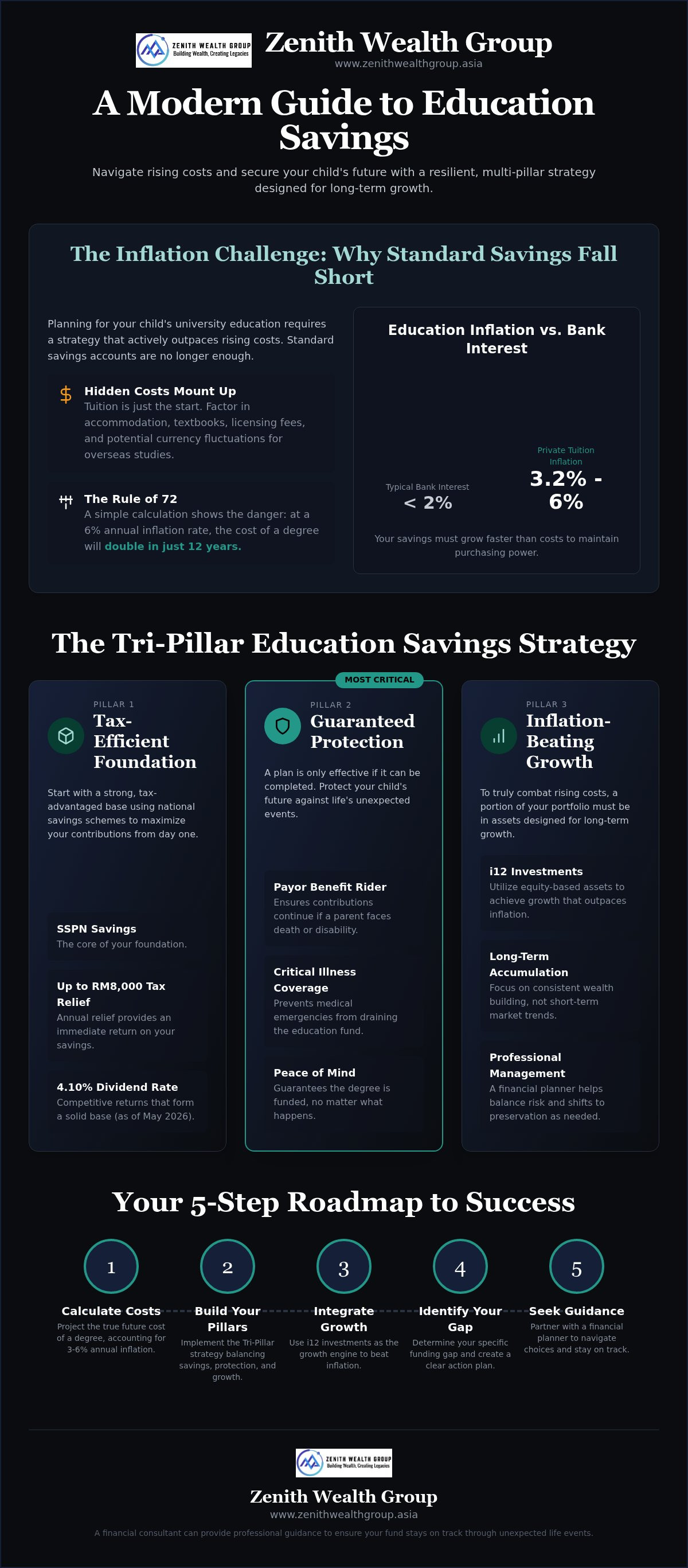
A 5-Step Roadmap to Funding Your Child’s University Degree
Securing a degree requires more than just good intentions; it demands a chronological roadmap. To build a resilient education savings plan Malaysia parents need a structured process that accounts for both today's costs and tomorrow's inflation. This journey begins with a clear vision and ends with a guaranteed fund. By following these five steps, you can move from financial uncertainty to quiet confidence.
- Step 1: Define the Target. Decide if you are aiming for a local private university or an international campus in the UK or Australia. This "Dream Degree" sets your baseline cost.
- Step 2: Calculate the Funding Gap. Use 2026 inflation projections to see what that degree will cost when your child is 18. Subtract your current savings to find the deficit you need to fill.
- Step 3: Allocate Cash Flow. Distribute your savings between the Three Pillars. Maximize SSPN for tax relief, use insurance for protection, and utilize i12 investments for high-growth potential.
- Step 4: Automate Contributions. Set up standing instructions to remove emotional decision-making. Consistency is the most powerful tool in wealth accumulation.
- Step 5: Conduct an Annual Review. Meet with your financial planner once a year to rebalance your portfolio and adjust for life changes.
Calculating Your Funding Gap
The math is simple but often overlooked: (Future Cost) - (Current Savings + Expected Growth) = The Funding Gap. Many parents underestimate maintenance costs, such as rent, groceries, and professional licensing fees. These "hidden" expenses can easily double your total requirement. A professional financial consultant uses specialized calculators to ensure your projections are grounded in the 2026 economic reality. Don't guess your child's future; calculate it with precision.
The Importance of the Annual Review
A "set and forget" strategy is a dangerous gamble in our current economy. Your plan needs to breathe and adapt. New family members, career promotions, or shifts in your child's interests all necessitate a plan adjustment. During these reviews, your financial planner identifies underperforming assets early. This prevents your capital from being trapped in low-yield vehicles that can't beat inflation. Regular check-ins turn a static savings account into a dynamic path to success. If you're ready to see the math behind your child's future, book a strategy session with our team today.
Why Partnering with a Financial Planner Secures Your Child’s Future
Many parents mistake a product agent for a financial planner. A product agent is typically restricted to the offerings of a single brand. This narrow focus can limit your options and result in a plan that lacks flexibility. In contrast, a financial planner at Zenith Wealth Group takes a much broader view. We act as authorized representatives of finexis advisory. This allows us to provide a personalized advisory approach that prioritizes your family's specific needs over any single product. This distinction is essential when designing a robust education savings plan Malaysia parents can rely on for the long term.
Our team specializes in building personalized roadmaps that integrate i12 investments to drive portfolio growth. This is a vital component for outpacing the tuition inflation we see in 2026. Families across SE Asia often face unique cross-border complexities, from managing multiple currencies to navigating regional regulations. A financial consultant acts as your guide through these hurdles. We provide the proactivity needed to ensure your fund remains resilient regardless of market shifts. It's about having a partner who is ready to engage and grow alongside your family.
Holistic Planning Beyond Just Savings
Your child's future shouldn't compromise your own financial security. Holistic planning ensures that education funding fits perfectly with your long-term Retirement Planning goals. We help you avoid the common mistake of over-funding one area while neglecting your own later years. Legacy planning is another vital component we address. We look at how to structure your assets for a smooth family wealth transfer. Through strategic wealth analysis, we identify hidden efficiencies in your current portfolio. This allows us to redirect underperforming capital into more productive growth engines for your child's education savings plan Malaysia.
Getting Started with Zenith Wealth Group
We value personal connection over institutional coldness. Our initial consultation is designed to be welcoming and accessible to every parent. You won't find a heavy, jargon-laden atmosphere here. Instead, we provide a clear, action-oriented path that respects your time and your goals. As your Modern Professional Guide, we focus on an approach that is friendly and action-oriented. We're here to start a conversation and help you make informed decisions with quiet confidence. Taking the first step toward a secure 2026 strategy is simple and stress-free. Connect with our team to begin securing your child's university degree today.
Start Building a Resilient Future Today
Building a successful education fund for 2026 and beyond requires more than just good intentions. It's about taking specific, data-driven actions to stay ahead of rising costs. By adopting the Tri-Pillar approach, you balance tax efficiency with the high-growth potential of i12 investments. This strategy ensures your child's degree is fully funded regardless of market shifts or unexpected life events. You've now seen the roadmap; the next step is implementation.
A resilient education savings plan Malaysia families can trust requires proactive, professional management. Zenith Wealth Group acts as an authorized representative of finexis advisory Pte Ltd. We provide the expertise needed to navigate complex investment choices with quiet confidence. Our team specializes in tailored strategies for families across Malaysia and Singapore. We focus on human interaction and professional integrity to help you reach your goals. Don't let your child's future be left to chance when expert guidance is just a conversation away.
Secure your child’s future—book a consultation with a Zenith Wealth Group financial planner today.
We're ready to engage and grow alongside your family. Your child's dream degree is within reach when you have the right partner by your side.
Frequently Asked Questions
Is SSPN better than a private education insurance plan in 2026?
SSPN and private insurance serve different purposes within a modern education savings plan Malaysia strategy. SSPN offers a guaranteed 4.10% dividend (as of May 2026) and essential tax relief of up to RM8,000. However, it lacks the robust wealth protection riders found in private insurance. Most parents benefit from a hybrid approach. Use SSPN for the tax-efficient foundation and insurance for the "payor benefit" to ensure the fund is completed if life takes an unexpected turn.
How much should I save monthly for a child’s degree in Malaysia?
Your monthly target depends on your child's age and the type of degree. In 2026, private degrees range from RM50,000 to RM500,000. If you have 15 years to save for a RM100,000 goal, you might need approximately RM450 to RM550 monthly, depending on your portfolio's growth rate. A financial planner can help you calculate a precise figure that accounts for the current 2.2% education inflation rate and living expenses.
Can I use my EPF Account 2 to pay for my child’s education?
Yes, you can withdraw from EPF Account 2 to fund tuition fees for your child at local or international institutions. This withdrawal is available for diploma, degree, and postgraduate levels. While this provides a helpful safety net, it's best treated as a secondary source. Relying solely on EPF can impact your retirement goals. A balanced strategy often combines EPF with growth-oriented assets like i12 investments to ensure your retirement stays on track.
What happens to my education savings if I move from Malaysia to Singapore?
SSPN accounts are tied to Malaysian citizenship and tax residency. If you move, you can keep the account, but your tax relief benefits may change. Private portfolios, especially those utilizing i12 investments, offer much higher portability for cross-border families. Zenith Wealth Group specializes in SE Asia wealth management. We help you transition your education fund smoothly between Malaysia and Singapore to ensure your child's degree remains fully protected and accessible regardless of your location.
Are i12 investments suitable for a low-risk education fund?
i12 investments are designed for growth and wealth accumulation rather than being a "low-risk" cash equivalent. They are best suited for the growth pillar of your portfolio over a 10 to 18-year horizon. While they carry more market exposure than a standard bank account, they provide the engine needed to beat education inflation. A financial consultant will balance these assets with safer vehicles as your child approaches university age to preserve your accumulated capital.
How does the payor benefit rider work in a child education plan?
A payor benefit rider is a critical protection feature in insurance-linked education plans. If the parent (the payor) suffers a total disability or passes away, the insurance company takes over all future premium payments. This ensures the education savings plan Malaysia remains intact and the child's university fund reaches its original target. It provides peace of mind that your child's academic future isn't dependent on your continued ability to earn an income or manage savings.
When is the absolute latest I should start an education savings plan?
The best time to start was at birth, but the absolute latest is today. Starting even five years before university is better than not starting at all. However, a shorter timeframe requires much higher monthly contributions and offers less room for compound interest to work. If you've started late, a financial planner might recommend a more aggressive growth strategy using i12 investments to bridge the funding gap quickly before that first tuition bill arrives.
What is the tax relief limit for education savings in Malaysia for the 2026 assessment year?
For the 2026 assessment year, the personal income tax relief for net savings in SSPN remains at RM8,000 per year. Additionally, contributions to a Private Retirement Scheme (PRS) offer a tax relief of up to RM3,000, which has been extended to the Year of Assessment 2030. Maximizing these limits is a core part of an efficient strategy. It's a simple way to get an immediate "return" on your savings through tax savings every year.


