

What if your "magic number" for financial independence is actually a moving target that's leaving you behind? Many Singaporeans find that traditional math doesn't hold up against 2026 inflation rates and shifting lifestyle costs. If you've been staring at a generic early retirement calculator and feeling more anxious than empowered, you aren't alone. It's difficult to feel confident when you're trying to figure out how to bridge the gap between your current savings and the day your CPF Life payouts finally kick in.
We agree that a simple spreadsheet isn't enough to account for the complexities of the local landscape, especially with the 2.8% cost-of-living adjustments we're seeing this year. You deserve a plan that factors in your SRS contributions and investment withdrawals without the fear of outliving your wealth. This guide promises to show you exactly how to use 2026-ready math to calculate your definitive FIRE number and build a resilient exit strategy. We'll explore how to navigate lifestyle creep and create a clear roadmap that connects your private portfolio to your official pension age.
Key Takeaways
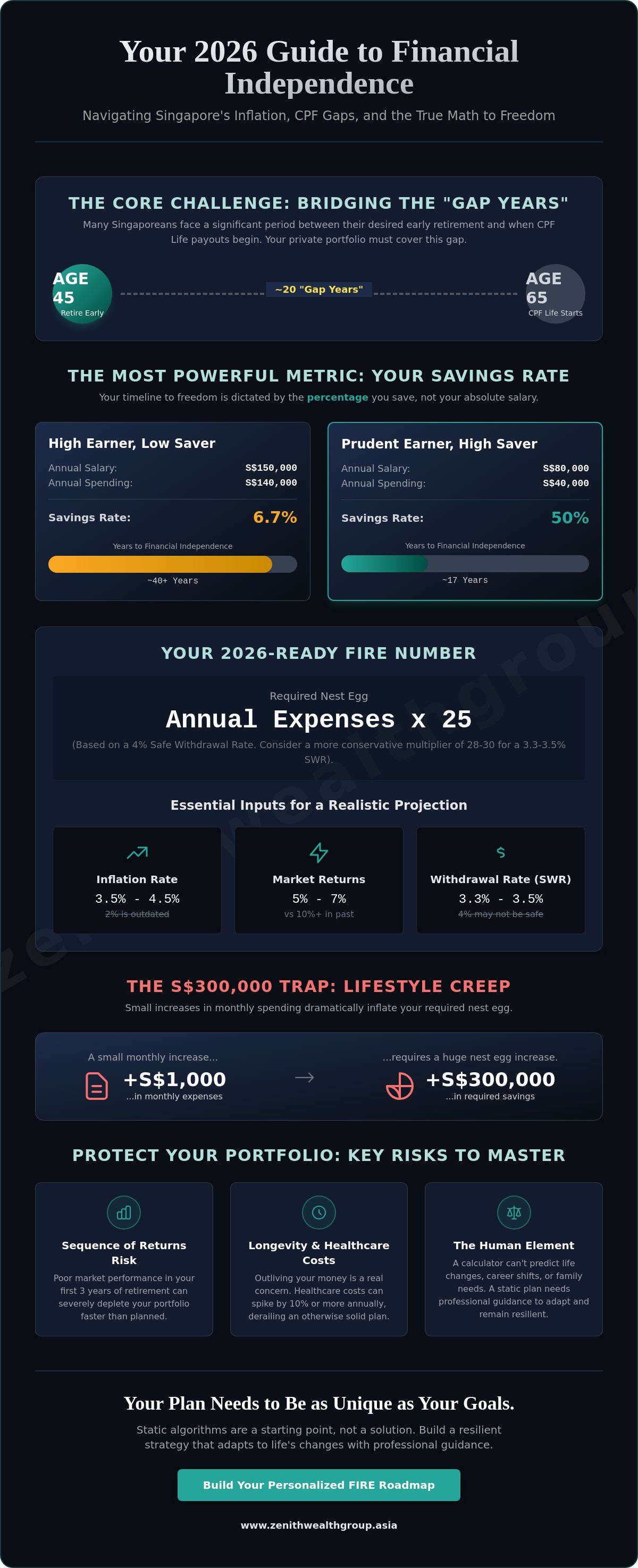
- Prioritize your savings rate over your gross salary to shorten your timeline. This percentage is the most critical driver for reaching financial independence.
- Master the "gap years" by planning for the period between your early exit and your CPF Life eligibility. Use an early retirement calculator that factors in 2026 inflation rates to ensure your savings last.
- Protect your portfolio from sequence of returns risk, a common math-killer for early retirees. Understand why market performance in your first three years of retirement is so critical.
- Audit your true living expenses to determine your precise FIRE number. Factor in non-recurring costs like healthcare and home maintenance to keep your 2026 projections realistic.
- Move beyond static algorithms by incorporating the human element into your strategy. Professional guidance helps you adapt to life changes that a calculator simply cannot predict.
The Math of Freedom: How an Early Retirement Calculator Works
Financial independence isn't a vague dream. It’s a mathematical certainty once your invested assets generate enough income to cover your life. An early retirement calculator serves as your roadmap, estimating exactly how many years you must work before your portfolio can sustain you. While traditional retirement focuses on hitting age 65, the FIRE movement approach prioritizes liquidity and "bridge funding" to cover the decades before your CPF Life payouts begin.
The secret isn't how much you earn, but your savings rate. This is the percentage of your take-home pay that goes toward investments rather than consumption. If you earn S$150,000 but spend S$140,000, you're actually further from freedom than someone earning S$80,000 who saves half. Math doesn't lie. Your savings rate dictates your "time to exit" regardless of your absolute salary. In a 2026 context, many Singaporeans are re-evaluating the classic 4% Rule. While the Trinity Study suggested a 4% withdrawal rate is safe for a 30-year retirement, those retiring in their 40s may need a more conservative 3.3% or 3.5% to account for a 50-year horizon and modern inflation.
The Core Variables: Income, Expenses, and ROI
To get an accurate result from an early retirement calculator, you must use precise data. Your net annual income should include your base salary and bonuses, but also your tax-deductible contributions to the Supplementary Retirement Scheme (SRS). Every dollar saved here reduces your tax burden and accelerates your timeline. When estimating returns, don't be overly optimistic. Current 2026 market projections suggest a cautious 5% to 7% annual return is more realistic than the double-digit gains of the past decade. Using a lower Safe Withdrawal Rate (SWR) ensures your portfolio survives market volatility during your first few years of freedom.
The Savings Rate Multiplier
Small shifts in your habits create massive changes in your timeline. Increasing your savings rate by just 10% can often shave five or more years off your working life. This is because every dollar you save does double duty. It increases your investment pot and simultaneously lowers the annual expense target your portfolio needs to cover. Beware the "Lifestyle Creep" trap. As your career progresses and your salary grows, it’s tempting to upgrade your home or car. However, every S$1,000 added to your monthly spending increases your required nest egg by S$300,000. Your FIRE Number is exactly 25 times your annual expenses. If you're ready to refine these variables with a professional, reach out to a financial consultant in Singapore to build a custom strategy.
Essential Inputs for a Realistic 2026 Retirement Projection
A standard 2% inflation hedge won't cut it in 2026. Core inflation across Southeast Asia is proving stickier than anticipated. When you use an early retirement calculator, inputting a realistic 3.5% to 4.5% inflation rate provides a much safer buffer. This protects you from the rising costs of services and imported goods that define the Singaporean lifestyle. Relying on outdated figures often leads to a shortfall just as you're settling into your new freedom.
The "Gap Years" represent the most significant hurdle for the local FIRE community. If you retire at 45, you face a 20-year window before your CPF Life payouts begin. Your private portfolio must be large enough to sustain full living expenses during this period without exhausting the principal. While you can look at official government retirement planning tools for general frameworks, local nuances like MediShield Life premiums and the loss of corporate insurance require a specialized approach. Healthcare costs often spike by 10% or more annually, making them a "hidden" expense that can derail a poorly planned exit.
Regional Inflation and Cost of Living
Geo-arbitrage is a popular strategy, but it carries inherent currency risk. Retiring in Malaysia or Thailand can stretch your S$1.0 million much further; however, you must account for MAS exchange rate fluctuations. A strong Singapore Dollar helps your purchasing power abroad, but 2026 GST and VAT rates across the region are climbing. Ensure your early retirement calculator projections account for these regional tax shifts to avoid a mid-retirement budget crisis. It’s about more than just the price of a meal; it’s about the long-term stability of your base currency.
Asset Allocation and Tax Efficiency
Optimizing your SRS account is vital for lowering your effective tax rate during the accumulation phase. This locked-in asset becomes a powerful tool once you hit the statutory withdrawal age, but it shouldn't be your only bucket. In the early years, focus on capital gains over dividend yields to manage "tax drag" on international holdings, particularly those subject to foreign withholding taxes. Balancing your CPF, SRS, and private brokerage accounts requires a proactive touch. If you’re unsure how these variables fit your specific situation, it’s often helpful to speak with a professional guide who understands the local landscape.
Why Most Online Calculators Underestimate Your Early Retirement Needs
Most free tools assume the market moves in a straight line. They provide a false sense of security by ignoring the lumpy reality of life in Singapore. While you might use a Forbes Advisor's retirement calculator for a broad baseline, these generic models often fail to capture the 2026 economic reality. They don't account for the fact that a major home repair or a family emergency can suddenly drain S$50,000 from your liquid reserves. Static models treat your spending as a flat monthly bill; however, your expenses will likely shift from active travel years to passive healthcare-focused years. A simple algorithm can't see these nuances.
Generic tools also struggle with the specific tax environment of the Singapore market. They often miss the impact of the 2026 GST levels on your long-term purchasing power. If your early retirement calculator doesn't allow for variable inflation inputs, you're essentially guessing your future. You need a model that accounts for the rising cost of services and the potential for lower-than-average market yields over the next decade. Success isn't just about hitting a number. It's about ensuring that number survives the friction of real-world costs.
Sequence of Returns Risk Explained
The order of your annual returns determines your portfolio's survival more than the average return over 30 years. If the market dips during your first three years of retirement, you're forced to sell assets at a loss to cover costs. This math-killer is why we stress-test projections beyond what a standard early retirement calculator offers. A resilient strategy must include cash buckets or bond ladders. These provide one to three years of liquidity, allowing your stocks time to recover during a downturn. This protection ensures you don't deplete your principal when the market is at its worst.
The Psychological Shortfall
Even when the numbers turn green, "One-More-Year" syndrome often sets in. It’s the fear that your math is wrong or that you’ll lose the social status tied to your corporate title. You also lose perks like subsidized health screenings and dental benefits. Transitioning from a saver to a spender is a massive mental shift that a spreadsheet cannot manage. Check out our guide on wealth protection to see how to safeguard your exit against these unseen variables. Calculations are just the beginning; true readiness requires a plan for the human element. Drop us a line if you're feeling the "One-More-Year" itch!
Step-by-Step: How to Calculate Your FIRE Number
Calculating your exit date requires more than just three variables. While a basic early retirement calculator gives you a rough estimate, a robust plan needs a granular five-step approach to survive the real world. You aren't just solving for a number; you're solving for a lifetime of security.
Step 1: The Expense Audit
Start by auditing your "True Living Expenses" for 2026. This isn't just your rent and groceries. You must differentiate between "Lean FIRE", which covers only the essentials, and "Fat FIRE", which includes luxury travel and premium dining. We recommend adding a 20% buffer to your final annual expense figure. This margin accounts for the unexpected costs that a static spreadsheet often misses, like major dental work or family emergencies. Use your last 24 months of historical data to project future medical and travel costs accurately.
Step 2: Determine Your Safe Withdrawal Rate
Your withdrawal rate depends heavily on your age. If you're retiring at 40, a 4% rate might be too aggressive for a 50-year horizon. Consider a 3.3% or 3.5% rate to ensure your principal remains intact through various market cycles. This conservative shift provides a vital safety net against long-term inflation.
Step 3: Subtract Locked Assets
This is where many Singaporeans stumble. Your CPF and SRS funds are "Locked Assets." You can't use them to fund your "Gap Years" before age 65 or the statutory withdrawal age. When using an early retirement calculator, subtract these amounts from your immediate FIRE number. Your liquid portfolio must be large enough to bridge the decades until these institutional payouts begin.
Step 4: Stress-Testing the Numbers
Run a Monte Carlo simulation. This tool tests your portfolio against 1,000 different market scenarios, including recessions and high-inflation periods. If your simulation shows even a 10% failure rate, it’s a sign to adjust your strategy. You might need to refine your "Glide Path" by shifting your asset allocation toward more stable instruments as your exit date nears. Drop us a line for a professional analysis if you're ready to stress-test your plan!
Step 5: Adjust for 2026 Realities
Finally, factor in the 2026 tax rates and regional healthcare costs. Medical inflation in Singapore is currently outpacing general inflation. Ensure your plan accounts for private hospital coverage and rising insurance premiums. A plan that looks good on paper only works if it survives the friction of 2026 prices. Accuracy now prevents a crisis later.
Beyond the Tool: Why Professional Planning Beats a Calculator
An early retirement calculator is a powerful compass, but it isn't the journey itself. It provides the mathematical "what" without addressing the strategic "how." Life in Singapore is rarely a straight line. Your goals might shift from a quiet life in the heartlands to supporting a child's overseas education or managing a multi-generational household. A static algorithm cannot predict these personal pivots. Professional planning bridges the gap between a digital estimate and a lived reality. It turns a theoretical date into a concrete execution strategy.
Choosing a financial consultant in Singapore who operates independently changes the game. Unlike large institutions that may prioritize their own proprietary product suites, Zenith Wealth takes a boutique approach that focuses on your specific ROI. We look across the entire market to find the right instruments for your wealth protection and investment management. This independence ensures your portfolio isn't just a collection of bank-favored funds. Instead, it becomes a precision-engineered engine designed for your early exit. We prioritize your human connection over institutional coldness.
Early retirement isn't an isolated event. It must integrate with your legacy and estate planning. You need a strategy that protects your family's future while you enjoy your freedom. Moving from "knowing your number" to implementing a portfolio requires a proactive touch. This involves structuring your assets to minimize tax drag and maximize long-term protection. We ensure your FIRE plan doesn't just fund your life, but also secures your family's next chapter. Accuracy matters when your future is on the line.
Tailored Solutions vs. Generic Algorithms
We go beyond the basics to factor in education funding and your family's broader needs. Generic tools often miss the nuances of multi-generational wealth or the benefits of independent product intermediation. Zenith Wealth acts as your Modern Professional Guide in Southeast Asia, ensuring your path to FIRE is both mathematically sound and personally fulfilling. We help you navigate the complexities of 2026 market conditions with quiet confidence. Our goal is to provide a broader perspective that a simple early retirement calculator simply cannot match.
Next Steps: From Calculation to Reality
The best time to start was yesterday. The second best is today. Move from calculation to reality by setting up a "Retirement Roadmap" meeting with a wealth manager. We'll turn your spreadsheet data into a proactive execution strategy that adapts as your life changes. Don't let your dreams stay trapped in a browser tab. Start your journey toward financial independence today. Drop us a line! We are ready to grow alongside you.
Secure Your Financial Independence Today
You now have the framework to bridge the gap between your career and your freedom. Remember that your savings rate and a realistic 3.5% inflation buffer are your most reliable allies. While an early retirement calculator provides a vital baseline, your strategy must survive the "lumpy" expenses of life in Singapore. A spreadsheet cannot account for the human element of your legacy or the specific nuances of your family's future. It won't tell you how to adjust for the 10% medical inflation rates we're seeing in 2026.
As authorised representatives of finexis advisory, we specialise in SEA regional wealth management. We offer a boutique, human-centric approach that prioritises your goals over generic institutional models. Our team is here to help you move from a theoretical number to a high-performing, implemented portfolio. We don't just provide data; we provide a partnership that grows alongside you. Accuracy now prevents a crisis later.
Book a Personalised Retirement Strategy Session and let's start the conversation. Your path to FIRE is unique, and we're ready to help you map it out with quiet confidence. Drop us a line!
Frequently Asked Questions
What is a good savings rate for early retirement in Singapore?
A savings rate of 50% is the gold standard for those aiming to retire within 15 to 17 years. If you save only 10% of your income, your working life could extend beyond 51 years. Increasing your rate by just 5% can shave years off your timeline. It is the most powerful lever you can pull in any early retirement calculator.
Can I include my CPF LIFE payouts in my early retirement calculator?
You should only include CPF LIFE payouts for the years after you turn 65. Since these funds are locked until the statutory age, they cannot fund your early "gap years." Treat your CPF as a safety net for later life. Focus your early retirement calculator on your liquid private portfolio to cover the initial decades of freedom.
How much do I need to retire at 45 in Southeast Asia?
Retiring at 45 typically requires a nest egg of 25 to 30 times your annual expenses. For a modest "Lean FIRE" lifestyle in Singapore, this might mean S$1.2 million in liquid assets. If you plan for a "Fat FIRE" lifestyle with frequent travel, that number can easily exceed S$3.5 million. Always factor in a 20% buffer for currency fluctuations if you plan to live elsewhere in the region.
What is the 4% rule and is it still valid in 2026?
The 4% rule suggests you can safely withdraw 4% of your initial portfolio annually, adjusted for inflation. However, 2026 market projections suggest a more conservative 3.3% to 3.5% rate is safer for retirements lasting 40 or 50 years. This adjustment helps protect your principal against prolonged market downturns and higher cost-of-living shifts.
How do I account for inflation in my retirement planning?
Use an inflation rate of 3.5% to 4% in your projections rather than the historical 2% average. Medical inflation in Singapore has reached nearly 10% in recent cycles, which significantly impacts long-term costs. Adjusting these variables ensures your purchasing power remains intact as you age. Accuracy now prevents a crisis later.
What happens if the stock market crashes right after I retire early?
A market crash early in retirement triggers "Sequence of Returns Risk," which can deplete your portfolio prematurely. To mitigate this, keep 24 to 36 months of cash in a high-yield account or bond ladder. This liquidity allows you to avoid selling stocks at a loss during a downturn. It is a vital safety net for any early exit strategy.
Should I pay off my mortgage before retiring early?
Paying off your mortgage reduces your fixed monthly expenses and provides psychological peace of mind. While keeping a low-interest loan might allow for higher investment returns, a paid-off home lowers your required monthly income. Most early retirees in Singapore prefer the security of owning their home outright before they stop working.
Is health insurance expensive for early retirees in Singapore?
Health insurance is a significant expense that grows as you age. While MediShield Life provides basic coverage, most early retirees require an Integrated Shield Plan for private hospital access. Expect premiums to rise by 10% or more annually based on current trends. Budgeting for these increases is essential to avoid outliving your savings.


