

Did you know that a S$1.35 million portfolio of US stocks could trigger an estate tax bill of roughly S$500,000 for your family? While the US market offers unmatched growth, the tax implications of investing in US stocks from Singapore can be a silent wealth killer if you aren't prepared. It's frustrating to see 30% of your hard-earned dividends vanish before they even reach your brokerage account. You likely feel that the complex web of US tax laws is a barrier too high to climb, especially when worrying about how your beneficiaries will handle "hidden" estate duties on assets exceeding the S$80,000 exemption limit.
This 2026 guide simplifies these hurdles. We'll show you how to protect your global returns by managing dividend withholding taxes and estate duties with precision. You'll gain a clear framework for long-term asset location, discover strategies to minimize tax leakage through options like i12 investments, and learn how a professional financial consultant can help secure your legacy. Let's turn these structural hurdles into a manageable part of your wealth strategy.
Key Takeaways
- Understand the 30% dividend withholding tax and how the lack of a US-Singapore treaty affects your net investment yields.
- Identify the "Situs" rule that triggers US estate taxes on holdings over S$80,000, creating a potential liability for your beneficiaries.
- Learn how to manage the tax implications of investing in US stocks from Singapore by incorporating i12 investments into your portfolio strategy.
- Discover the role of a financial consultant in creating a wealth roadmap that balances US market growth with robust legacy planning.
- Explore asset location techniques to minimize tax leakage and ensure your global assets are structured for long-term efficiency.
The Attraction and Hidden Costs of US Markets in 2026
Singaporean investors continue to flock to US markets for a simple reason: growth. The S&P 500 remains a powerhouse of innovation, offering liquidity that local markets simply can't match. Whether you're targeting tech giants or emerging biotech, the US provides a depth of choice that's essential for any diversified portfolio. However, this access comes with a trade-off. Understanding the tax implications of investing in US stocks from Singapore is vital for protecting your net returns.
You face two primary hurdles: the 30% Dividend Withholding Tax (WHT) and the US Estate Tax. These aren't just minor fees; they're structural costs that can erode decades of compounding if left unmanaged. To plan effectively, you must understand US-situs assets. US-situs assets are property or securities physically or legally located in the US, such as shares in a US-incorporated company. This means even if you hold these stocks through a Singapore-based brokerage, the US government still considers them under their tax jurisdiction.
The Zero Capital Gains 'Hack' for Singaporeans
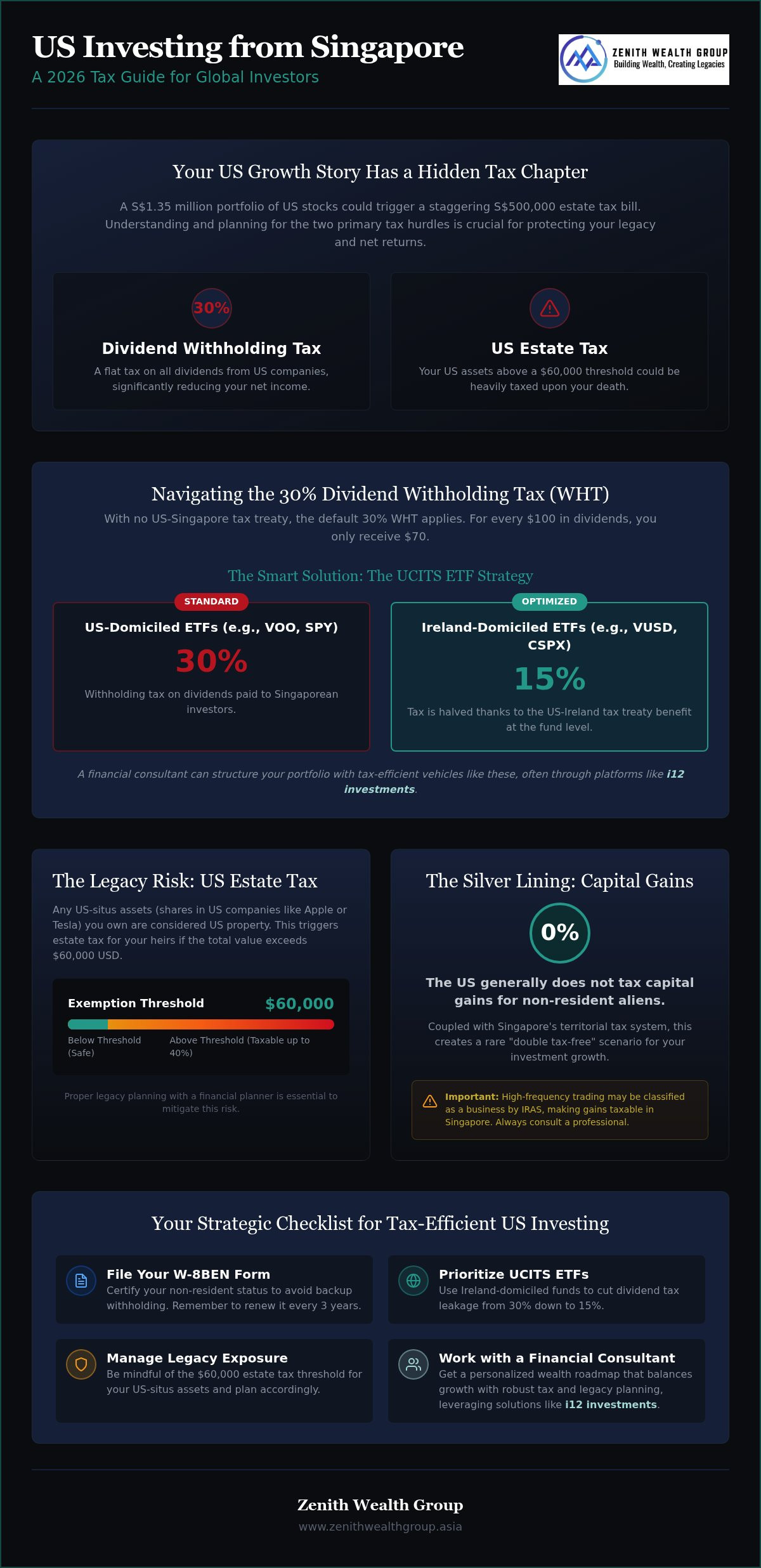
The US Internal Revenue Code generally does not tax capital gains for a nonresident alien who isn't present in the US for 183 days or more during the year. This is a massive win for Singapore residents. Since Singapore operates on a territorial tax system, these profits aren't taxed locally either. It's a rare "double tax-free" scenario for capital appreciation. Be careful, though. If your trading frequency is high enough to be classified as a trade or business by the Inland Revenue Authority of Singapore (IRAS), those gains might be treated as taxable income rather than capital gains. Always consult with a financial planner to ensure your activity remains classified as investment rather than trade.
Why 2026 is a Pivotal Year for Global Portfolios
As we move through 2026, market volatility makes net-of-tax returns more critical than ever. A 10% gross gain looks very different when sliced by withholding taxes or potential estate duties. Working with a financial consultant helps you identify tax-efficient entry points and structure your holdings correctly from the start. We often look at i12 investments as a way to gain managed, strategic exposure while maintaining a clear view of these liabilities. Anticipating shifts in US policy regarding foreign investment is part of proactive wealth management. If you want to review your current exposure and see how these rules apply to your specific portfolio, reach out to us for a strategic analysis.
Navigating the 30% US Dividend Withholding Tax (WHT)
When you receive dividends from US companies, the headline yield isn't what hits your pocket. Because there's no comprehensive income tax treaty between Singapore and the United States, Singaporean investors face a flat 30% withholding tax on all dividends. This is a significant part of the tax implications of investing in US stocks from Singapore. If a stock offers a 2% yield, you actually receive only 1.4% after the IRS takes its share. This tax applies to common stocks, US-domiciled Real Estate Investment Trusts (REITs), and ETFs listed on US exchanges. The tax is withheld at the source, meaning you receive the net amount automatically.
The Ireland-Domiciled ETF Strategy (UCITS)
Smart asset location can cut this tax leakage in half. By choosing Ireland-domiciled UCITS ETFs, you benefit from the US-Ireland tax treaty, which reduces the dividend withholding tax to 15% at the fund level. Instead of buying US-listed ETFs like VOO or SPY, many local investors opt for alternatives like VUSD or CSPX. While these funds sometimes have slightly higher expense ratios, the 15% tax savings often outweighs the cost for long-term holders. We often incorporate these structures when managing i12 investments to ensure our clients keep more of their returns. It's a simple change that makes a massive difference to your compounding over decades.
W-8BEN Forms: Your Essential Documentation
Even without a treaty benefit for dividends, you must file a W-8BEN form to certify your status according to IRS rules for nonresident aliens. This documentation prevents the US from applying "backup withholding" at even higher rates on your sales proceeds. These forms aren't a "set and forget" task. They expire every three years on December 31st. A financial planner can track these deadlines for you, ensuring your portfolio remains compliant without unnecessary administrative stress. Keeping your paperwork in order is the first step toward a professional investment setup. If you're unsure if your current holdings are tax-efficient, it's worth starting a conversation to review your setup.
US Estate Tax: The $60,000 Legacy Risk
While the US market is excellent for building wealth, it presents a significant risk for passing it on. Under the "Situs" rule, any shares you own in US-incorporated companies are considered US property. It doesn't matter if you bought them through a Singapore bank or a local brokerage. This rule is a core part of the tax implications of investing in US stocks from Singapore that many investors overlook until it's too late. Unlike US citizens who enjoy a massive exemption, nonresident aliens only get a S$80,000 (US$60,000) exemption. This threshold hasn't moved in decades, making it a trap for even modest portfolios.
The tax rates are progressive and aggressive. They start at 18% and quickly climb to 40% for the portion of the estate that exceeds the exemption. Beyond the financial cost, your family faces an immense emotional and administrative burden. They'll likely need to go through US probate, which involves hiring US lawyers and dealing with the IRS directly. This process can freeze your assets for months or even years. For a deeper dive into protecting your family, see our guide on Legacy Planning in Singapore.
Worked Example: The Estate Tax Bill
Let's look at the numbers. If you hold a US portfolio worth S$675,000 (approx. US$500,000), the estimated estate tax liability could exceed S$190,000. For a larger portfolio of S$2.7 million (approx. US$2,000,000), the tax bill could skyrocket to over S$1 million. These figures are based on the current rates found in the IRS U.S. Tax Guide for Aliens. Without proper structuring, nearly 40% of your global investment returns could be wiped out during a generational wealth transfer. This isn't just a "rich person's problem"; it's a structural reality for any serious investor in US equities.
Mitigation Strategies for High-Net-Worth Individuals
You don't have to leave your legacy to chance. High-net-worth individuals often use offshore holding companies or specialized trusts to own US assets. These structures can effectively "block" the US estate tax because the individual owns shares in a foreign company, not the US stocks directly. Another common tool is life insurance. A financial planner can help you set up a policy that provides immediate "tax liquidity." This ensures your beneficiaries have the cash to pay the IRS without being forced to sell your stocks during a market downturn. We often integrate these protections when managing i12 investments to ensure your wealth is both grown and guarded. If you're concerned about your current exposure, let's talk about a personalized roadmap.
Tax-Efficient Portfolio Structuring in Singapore
Successful investing in the US market requires more than just picking the right tickers. It demands a strategic approach to asset location. This means deciding which assets belong in your taxable brokerage accounts and which should be held within tax-advantaged structures like the Supplementary Retirement Scheme (SRS). When you manage the tax implications of investing in US stocks from Singapore, you're essentially plugging the leaks in your wealth bucket. For pre-retirees, direct equity trading through a DIY platform often seems cost-effective. However, once your portfolio grows, the administrative burden and estate tax risks we discussed earlier can outweigh the savings on commission.
Optimizing with i12 Investments
We often recommend i12 investments as a cornerstone for clients seeking a more structured, managed approach to global markets. These strategies provide diversified exposure while ensuring your portfolio aligns with professional tax-efficiency standards. Instead of worrying about individual tax filings or the nuances of US-situs rules for every single stock, i12 investments offer a framework where professional management handles the heavy lifting. This is particularly valuable for retirement planning, where the goal is consistent, net-of-tax growth rather than high-frequency speculation. A financial planner can help you integrate these strategies into your broader wealth roadmap to ensure every dollar is working efficiently.
SRS and US Stocks: A Strategic View
Can you use your SRS funds to buy US stocks? While you can't buy Apple or Tesla shares directly with SRS cash, you can invest in SRS-approved unit trusts or ETFs that have heavy US exposure. This is a powerful move because your investments grow tax-deferred within the account. However, you must still consider the 30% withholding tax on the underlying dividends, as the SRS wrapper doesn't magically waive US federal tax laws. The real benefit comes at the withdrawal stage, where only 50% of your withdrawals are taxed after the statutory retirement age. For a deep dive into these mechanics, read our guide on Mastering the SRS Account.
Structuring a portfolio for long-term success requires looking at the big picture of your family’s wealth. If you're ready to move beyond basic trading and build a tax-efficient global portfolio, book a strategic consultation with our team today.
How a Financial Consultant Optimizes Your US Exposure
Moving from a DIY mindset to a professional wealth roadmap is a significant shift for any serious investor. While trading apps offer easy access to the S&P 500, they don't provide the strategic oversight needed for a multi-decade plan. A financial planner helps you manage the tax implications of investing in US stocks from Singapore by looking at your entire financial ecosystem. This includes coordinating your US holdings with local education funding goals and your specific retirement timeline. We ensure that your drive for global growth doesn't create a probate nightmare for your family later. Regular rebalancing isn't just about chasing gains; it's a strategic move to keep your US-situs exposure within manageable limits.
Professional guidance also means staying ahead of the administrative curve. We track the three-year renewal cycles for your W-8BEN forms and monitor any shifts in the US tax code that could impact your net returns. By integrating your US equities into a broader plan that includes Singaporean estate laws, we help you build a legacy that is both robust and liquid. It's about having a partner who understands how a decision in your brokerage account affects your wealth protection strategy in Singapore.
Tailored Solutions for Different Life Stages
Your strategy should evolve as your career progresses. Young professionals often focus on aggressive accumulation and building core positions in innovative sectors. At this stage, we might prioritize long-term growth through i12 investments to capture market upside while maintaining a clear view of future liabilities. As you move toward the pre-retirement phase, the lens shifts toward legacy protection and tax-efficient withdrawals. We analyze your total US exposure to mitigate the 40% estate tax risk before you stop working. You can explore these life-stage transitions in more detail in The Complete Guide to Retirement Planning.
Start Your Strategic Wealth Analysis Today
Don't wait for a market downturn or a tax deadline to discover the gaps in your portfolio. The first step is a comprehensive audit of your current US exposure and potential tax risks. We identify exactly where you're losing yield to withholding taxes and where your family might be exposed to unnecessary estate duties. At Zenith Wealth, we provide a "Modern Professional Guide" experience. We value human interaction and clear, action-oriented communication over institutional coldness. Our goal is to build a proactive partnership that scales alongside your ambitions. If you're ready to secure your global investment returns and protect your family’s future, book a consultation with a financial consultant at Zenith Wealth to begin your analysis.
Take Control of Your Global Wealth Strategy
The US market remains a vital engine for growth, but long-term success depends on how well you manage the structural costs. We've explored how a proactive approach can mitigate the 30% withholding tax and the significant estate tax risks associated with US-situs assets. Understanding the tax implications of investing in US stocks from Singapore is the first step toward protecting your family's financial future. By utilizing strategic asset location and i12 investments, you can effectively minimize tax leakage and keep your wealth compounding on track.
As authorised representatives of finexis advisory Pte Ltd, we bring comprehensive legacy planning expertise to every portfolio we manage. You don't have to navigate these complex cross-border regulations alone. Our team is ready to help you audit your current exposure and build a resilient, tax-efficient roadmap. It's time to stop worrying about hidden liabilities and start focusing on your long-term goals. Secure your global portfolio with a professional tax efficiency strategy at Zenith Wealth. We look forward to helping you grow your assets with confidence and clarity.
Frequently Asked Questions
Do Singaporeans pay capital gains tax on US stocks in 2026?
Singaporeans generally do not pay capital gains tax on US stocks in 2026. Under US federal law, nonresident aliens are exempt from this tax if they are present in the US for fewer than 183 days during the year. Additionally, Singapore does not impose a local capital gains tax. This dual exemption allows you to keep 100% of your stock price appreciation, provided your activity is classified as investing rather than professional trading.
How can I avoid the 30% dividend withholding tax on US stocks?
While you cannot completely eliminate withholding tax on US-sourced dividends, you can reduce it by half. Investing in Ireland-domiciled UCITS ETFs allows you to benefit from the US-Ireland tax treaty, which lowers the rate from 30% to 15% at the fund level. This is a primary strategy used within i12 investments to improve net yields. A financial planner can help you transition from US-listed funds to these more efficient European-domiciled alternatives.
Is US estate tax applicable if I use a Singapore-based broker?
Yes, US estate tax applies regardless of which brokerage platform you use. The IRS follows the "Situs" rule, which focuses on the legal location of the asset itself rather than the location of the account. Because shares in US companies are considered US-situated property, they fall under US tax jurisdiction. If the total value of these assets exceeds the S$80,000 threshold at the time of death, your estate may be liable for taxes.
What is the difference between US-domiciled and Ireland-domiciled ETFs?
The difference lies in tax jurisdiction and treaty access. US-domiciled ETFs are subject to the full 30% withholding tax on dividends and are included in your US estate tax calculation. Ireland-domiciled ETFs pay a reduced 15% withholding tax on dividends from US companies and generally sit outside the US estate tax net. This makes the Ireland-domiciled route significantly more efficient for managing the tax implications of investing in US stocks from Singapore over the long term.
Does the W-8BEN form exempt me from all US taxes?
The W-8BEN form does not provide a total tax exemption. It simply certifies your status as a nonresident alien to ensure you are taxed correctly under the rules for foreign investors. Its main benefit is preventing "backup withholding," which can be as high as 24% on the gross proceeds of your stock sales. While essential for compliance, the form does not grant Singaporeans a lower dividend tax rate because no comprehensive income tax treaty currently exists.
How does the $60,000 US estate tax threshold work for joint accounts?
For joint accounts held by nonresident aliens, the IRS typically applies the "consideration furnished" rule. This means the entire value of the account is included in the estate of the first person to pass away, unless the survivor can prove they contributed their own funds. The S$80,000 (US$60,000) exemption is applied to the individual's portion of the estate. This complexity highlights why proactive legacy planning is vital for couples holding significant US assets.
Can a financial planner help me reduce my US tax liability?
A financial planner at Zenith Wealth can provide a strategic audit of your holdings to identify and fix tax leakage. We don't just pick stocks; we build a structural roadmap that integrates rebalancing and legacy planning to protect your global returns. This ensures the tax implications of investing in US stocks from Singapore don't erode your long-term wealth. By shifting to managed structures like i12 investments, we help you navigate the 40% estate tax risk effectively.
Are i12 investments subject to the same US tax rules as individual stocks?
While individual US stocks are directly subject to federal tax rules, i12 investments offer a managed framework to optimize your exposure. These strategies often utilize institutional structures that help mitigate the direct "Situs" risks associated with personal stock picking. At Zenith Wealth, we use these solutions to ensure your global portfolio remains efficient. This professional approach helps pre-retirees maintain growth while securing their legacy against aggressive US federal tax rates.


