

Did you know that 78% of Singaporeans worry about outliving their savings? It's a valid fear that keeps many "Sandwich Generation" families awake at night. With the 2026 Enhanced Retirement Sum (ERS) reaching $440,800 and inflation eating away at fixed income, deciding between CPF LIFE vs private annuity plans Singapore feels like a high-stakes puzzle. You want the security of a lifelong floor, but you also want the freedom to enjoy your golden years without constant budget stress.
We understand that the shift from earning to spending is daunting. You've worked hard for your money, and now it's time for your money to work for you. This comparison guide promises to clear the fog. You'll discover how to balance the rock-solid security of CPF LIFE with the lifestyle flexibility offered by private alternatives. Our goal is to help you build a retirement that isn't just about survival, but about thriving.
We'll explore how a financial planner can help you craft a hybrid strategy. This includes understanding the role of i12 investments in maximizing your long-term growth and protecting your purchasing power. It's time to build a portfolio that lets you retire with quiet confidence.
Key Takeaways
- Map out your 2026 retirement baseline by understanding the latest BRS, FRS, and ERS thresholds and how they impact your monthly payouts.
- Evaluate the trade-offs of CPF LIFE vs private annuity plans Singapore to balance government-backed security with the flexibility of early payout options.
- Discover how to use private plans to bridge income gaps, allowing you to start receiving retirement funds as early as age 50 or 55.
- Build a resilient "Floor and Ceiling" strategy that integrates i12 investments to protect your purchasing power and provide long-term growth.
- Learn why a financial planner is essential for stress-testing your portfolio against inflation and the pressures of the sandwich generation.
Understanding the Singapore Retirement Landscape in 2026
Singapore's retirement system, anchored by the Central Provident Fund (CPF), is evolving rapidly. By July 2026, the statutory retirement age has climbed to 64. For many in the "sandwich generation," the pressure is mounting. You aren't just planning for your own future; you're often supporting aging parents and growing children simultaneously. This makes the choice between CPF LIFE vs private annuity plans Singapore more than a financial calculation. It's a lifestyle decision.
Standard retirement models often fail to account for the increasing complexity of Singaporean lives. A dedicated financial planner can help you look beyond the basic numbers to see the bigger picture. They act as a guide, helping you assemble a multi-layered portfolio that balances government safety nets with private flexibility. It's about creating a plan that adapts to you, rather than forcing you to adapt to a rigid system.
The 2026 CPF Retirement Sum Thresholds
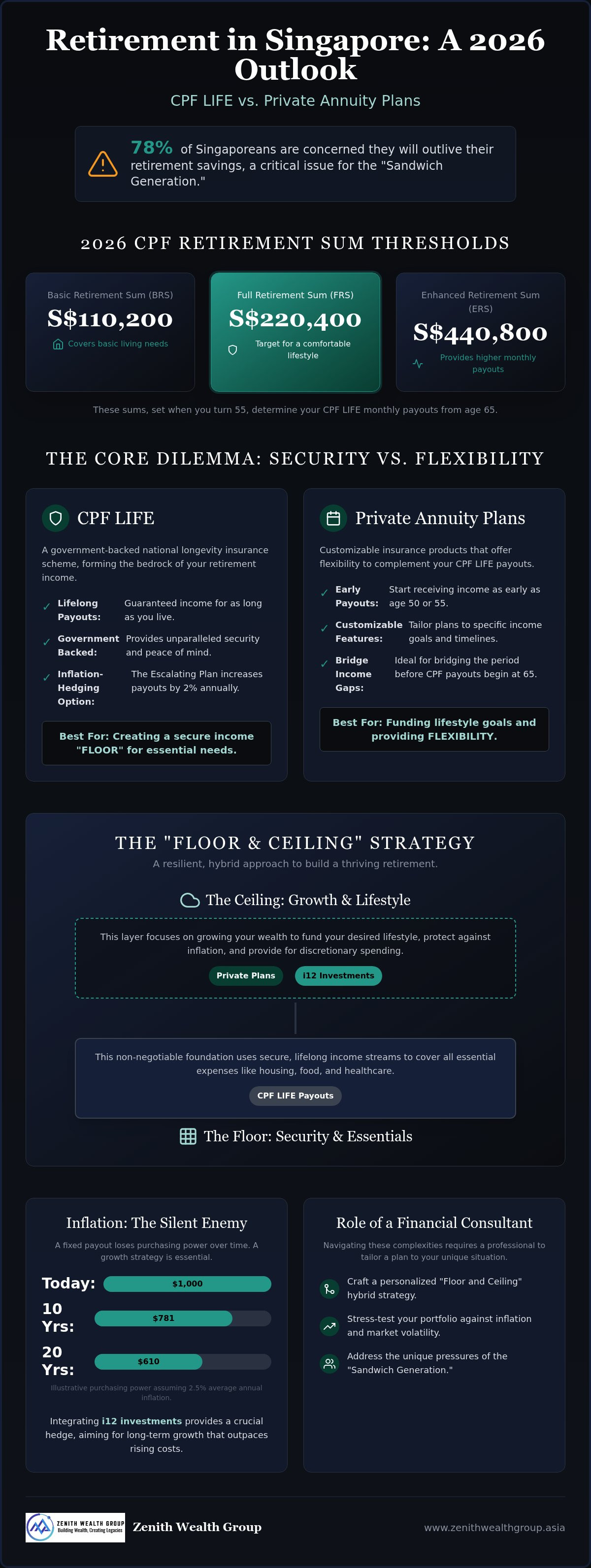
When you turn 55 in 2026, your Retirement Account (RA) is created. This milestone is critical because it determines your future monthly income. The 2026 thresholds are now set:
- Basic Retirement Sum (BRS): S$110,200
- Full Retirement Sum (FRS): S$220,400
- Enhanced Retirement Sum (ERS): S$440,800
The interest rate environment remains a key factor. While your RA earns competitive rates, the 2026 landscape requires a proactive approach. Relying solely on these sums might cover your basic needs, but it often leaves your lifestyle goals unfunded. Understanding the gap between these payouts and your desired lifestyle is the first step in effective planning.
Why Inflation is the Silent Enemy of Fixed Payouts
Inflation is a persistent threat to any fixed income stream. A monthly payout that feels comfortable today might barely cover groceries in twenty years. Over a 30-year retirement, the purchasing power of a static payout can drop significantly. This is where the debate of CPF LIFE vs private annuity plans Singapore becomes vital. You need tools that can grow alongside rising costs.
To stay ahead, your strategy needs growth-oriented components. We often integrate i12 investments into our clients' portfolios for this exact reason. These assets are designed to hedge against long-term inflation, providing the potential for capital appreciation that fixed annuities lack. By layering i12 investments with your CPF payouts, you create a robust shield for your future. A financial consultant can help you determine the right balance, ensuring your portfolio remains resilient even as costs rise. Reach out to our team to start a conversation about your specific needs.
CPF LIFE: The Foundation of Lifelong Income
CPF LIFE stands as the bedrock of retirement in Singapore. It functions as a national longevity insurance scheme. This means it's designed to solve one specific problem: outliving your money. In 2026, as residents reaching 65 can expect to live nearly 87 years on average, this guarantee is invaluable. It provides a monthly check for as long as you live, regardless of how the stock market performs.
When you evaluate CPF LIFE vs private annuity plans Singapore, the primary difference is the government backing. However, you must choose your plan carefully. The three options, Standard, Basic, and Escalating, each serve different priorities. The Standard Plan is the default. It offers high, stable payouts but leaves a smaller bequest. The Basic Plan prioritizes leaving money behind for your family. This results in lower monthly income for you. For many, the Enhanced Retirement Sum (ERS) of $440,800 is the gold standard. It aims for a monthly payout of roughly $3,440. This provides a solid income floor for your golden years.
Choosing Between Standard and Escalating Plans
The 2026 cost of living makes the Escalating Plan an attractive choice. It features a 2% annual increase in payouts. This helps protect your purchasing power over decades. If you prefer a "front-loaded" retirement, spending more while you're healthy and mobile, the Standard Plan is better. It gives you more cash upfront. Conversely, the Escalating Plan is "back-loaded." It starts smaller but provides more when you're older and healthcare costs might be higher. Understanding these nuances is where CPF LIFE vs private annuity plans Singapore becomes a vital strategic conversation. Comparing CPF LIFE vs private alternatives helps you see the full picture of your options.
The Mechanics of the CPF Retirement Account (RA)
Your journey changes at age 55. This is when your Special Account (SA) and Ordinary Account (OA) savings transfer to your new Retirement Account (RA). This total determines your retirement sum. If you're short of the Full Retirement Sum, you can use a property pledge or make cash top-ups to boost your future income. Remember, you don't have to start payouts at 65. You can defer them up to age 70. Each year you wait increases your monthly payout by about 7%. Every choice involves a trade-off between today's comfort and tomorrow's security. If you're unsure how to optimize your RA, a financial planner can model these scenarios for you.
Private Annuity Plans: Customizing Your Golden Years
While CPF LIFE provides a reliable foundation, it isn't built for every unique retirement dream. Private annuity plans fill the gaps where the national scheme stops. When comparing CPF LIFE vs private annuity plans Singapore, the standout feature of private options is flexibility. You aren't tied to a rigid age 65 start date. Many plans allow you to begin receiving payouts as early as age 50 or 55. This is vital for those aiming for early retirement or a career transition in their later years.
Private annuities also offer a smart way to manage your Supplementary Retirement Scheme (SRS) funds. By funneling SRS contributions into these plans, you can enhance tax efficiency while building a predictable income stream. Unlike the stock market's volatility, these plans often include a guaranteed payout component. This is usually coupled with non-guaranteed bonuses derived from the insurer's participating fund performance. This dual structure allows you to benefit from market upside while maintaining a secure floor.
Key Features of Modern Private Annuities
Modern private annuities offer tailored premium terms. You can choose to pay over 5, 10, or 15 years, matching your peak earning years. These plans often go beyond simple income. You can add riders for long-term care or terminal illness, providing an extra layer of wealth protection. It's about building a safety net that covers more than just the bills. This customization ensures your plan stays relevant as your health and family needs evolve over time.
The Role of i12 investments in Private Wealth
At Zenith, we incorporate i12 investments into our broader wealth strategies. The i12 framework prioritizes capital preservation, ensuring your hard-earned savings are protected during market fluctuations. A financial consultant can help match your investment risk profile to your specific retirement timeline. If you plan to stop working at 55, private plans act as a bridge. They provide income for the decade before your CPF LIFE payouts kick in at 65. This integrated approach ensures you never have to dip into your principal savings prematurely. If you're ready to explore these options, connect with us to see how we can customize your plan.
CPF LIFE vs Private Annuity Plans: A Side-by-Side Comparison
Many people think they must choose only one path. This "either/or" mindset is a mistake. When weighing CPF LIFE vs private annuity plans Singapore, it's better to think of them as partners. CPF LIFE provides the ultimate credit security. It's government-backed. Private plans are issued by MAS-regulated insurers. While very safe, they represent a different layer of risk and reward. You're trading a government guarantee for the tailored features of a private institution.
Liquidity is a major differentiator. CPF LIFE is strictly for lifelong income. Once your funds are in the pool, you can't withdraw a lump sum for a medical emergency or a child's wedding. Some private plans allow partial withdrawals or policy loans. This provides a financial "escape hatch" that CPF lacks. Regarding bequests, CPF LIFE returns the balance of your premium minus payouts already made. Private plans can be structured to provide a more substantial legacy. They often pay out the full sum assured plus accumulated bonuses upon death, ensuring your loved ones are well-supported.
Tax efficiency also differs. Cash top-ups to your CPF Retirement Account offer immediate tax relief. However, SRS-funded private annuities allow you to spread your tax liability over a 10-year withdrawal period. This is often more efficient for high earners who want to lower their taxable income during their peak years.
The Security vs. Flexibility Trade-off
CPF LIFE is arguably the most cost-effective "base" layer. Its internal rate of return (IRR) is high because it operates as a large-scale national pool. However, it lacks agility. If you want to retire at 58, CPF LIFE won't help you for seven years. Private plans are superior here. They bridge that pre-65 gap. This allows you to maintain your lifestyle without exhausting your cash savings or dipping into your principal too early.
Strategic Payout Mapping
Think of your retirement income as a ladder. The bottom rungs are your guaranteed CPF payouts. The higher rungs are your private annuities and i12 investments. For a 55-year-old professional with a $1M goal, relying only on the CPF Enhanced Retirement Sum would leave a significant shortfall for travel or luxury. You need more than just the basics to enjoy your time.
The payout gap is the financial deficit between your guaranteed CPF LIFE income and the actual cost of your desired lifestyle, which often requires private supplementation to close. By mapping out these layers, a financial consultant can help you visualize exactly when each income stream starts. This ensures no year is left unfunded. If you want to see how these layers fit your specific numbers, reach out to our team for a personalized stress test.
Designing Your Integrated Retirement Strategy with Zenith
Building a secure future requires more than just picking a product. It's about creating a cohesive system where different assets work together. We often use the "Floor and Ceiling" model to help clients visualize this. In this framework, CPF LIFE acts as your floor. It covers your absolute essentials like housing, basic groceries, and utility bills. Private annuity plans serve as your ceiling. They fund the "wants" that make retirement enjoyable, such as travel, hobbies, and dining out. By balancing CPF LIFE vs private annuity plans Singapore, you ensure that your basic needs are met while your lifestyle remains flexible.
A professional financial planner adds value by stress-testing this integrated strategy. We look at "what if" scenarios. What if inflation stays higher for longer? What if you face unexpected medical costs? We help you move from the accumulation phase, where you're saving, to the decumulation phase, where you're spending. This transition is often the most stressful part of the journey. Optimizing your SRS account to fund private annuities is a key part of this process. It allows you to convert tax-deferred savings into a steady, predictable stream of income that complements your CPF payouts.
Holistic Retirement Planning with Zenith Wealth Group
Our approach is grounded in the power of choice. As authorized representatives of finexis advisory, we have access to a wide range of private annuity providers. This means we don't just push a single brand. We find the plan that fits your specific timeline and goals. We believe in a layered wealth roadmap that includes i12 investments. These frameworks are designed to provide capital preservation and growth, acting as a buffer against market volatility. If you're looking for a deep dive into the broader context, explore The Complete Guide to Retirement Planning in Singapore.
Start Your Conversation Today
2026 is a pivotal year for Singaporeans. With the retirement age rising to 64 and new CPF thresholds in effect, your legacy and retirement goals deserve a fresh look. Don't wait until you're at the doorstep of retirement to make these decisions. Proactive planning today leads to quiet confidence tomorrow. Here is a quick checklist for pre-retirees:
- Verify your projected Retirement Account balance for 2026.
- Calculate the "gap" between your CPF LIFE payout and your desired monthly budget.
- Review your SRS balance for potential annuity conversion.
- Identify which i12 investments can help hedge your portfolio against inflation.
We are ready to help you navigate these choices. Our team values personal connection and straightforward communication. Let's work together to ensure your retirement is exactly what you've imagined. Book a consultation with a Zenith financial consultant to start building your resilient retirement strategy today.
Take Control of Your 2026 Retirement Roadmap
The 2026 landscape demands a dual approach to wealth. You've seen how CPF LIFE provides the lifetime safety net you need. Private plans offer the early access and flexibility you want. By evaluating CPF LIFE vs private annuity plans Singapore as a combined strategy rather than a choice between two sides, you build a portfolio that survives inflation. It supports your actual lifestyle goals. It is about creating a floor for your needs and a ceiling for your aspirations.
As authorized representatives of finexis advisory, our team specializes in these complex transitions. We integrate a strategic focus on i12 investments to ensure your capital remains resilient against rising costs. You deserve a tailored legacy and retirement roadmap. We are here to guide you through every milestone with clarity. The path to a worry-free future starts with a single conversation.
Ready to move from uncertainty to quiet confidence? Secure your retirement future—contact a Zenith financial consultant today. Your ideal Singapore retirement is well within reach. We are eager to help you start building it.
Frequently Asked Questions
Can I use a private annuity plan to replace CPF LIFE entirely?
No, you cannot replace CPF LIFE if you are a Singapore Citizen or PR. Participation is mandatory once you meet the eligibility criteria at age 65. Instead, view private plans as a way to enhance your lifestyle. They bridge the gap for those wanting to retire early or provide higher payouts that the national scheme alone might not reach. It is about building a ceiling over your government-backed floor.
How much should I top up my CPF Retirement Account before considering private plans?
Most pre-retirees aim for the 2026 Full Retirement Sum (FRS) of $220,400 as a baseline. If you have excess cash, you might consider reaching the Enhanced Retirement Sum (ERS) of $440,800 for maximum payouts. Once you've secured this foundation, a financial planner can help you evaluate if private plans offer better flexibility for your specific "wants" or early retirement needs. This ensures your essential costs are always covered.
What happens to my private annuity if the insurance company goes bust?
Private annuities in Singapore are protected under the Policy Owners' Protection Scheme (PPF Scheme). This is managed by the Singapore Deposit Insurance Corporation (SDIC). It provides a safety net for policyholders if an insurer fails. While the likelihood of a major insurer failing is low due to strict MAS regulations, this protection ensures your retirement savings have a layer of security. It gives you peace of mind regarding your private wealth.
Is it better to top up CPF or invest in SRS for retirement?
The choice depends on your tax bracket and liquidity needs. CPF top-ups provide high, guaranteed interest and lifelong income. SRS contributions offer immediate tax relief and more investment freedom, including the ability to fund private annuities. A financial consultant often recommends a balanced approach. You can use CPF for your foundational needs and SRS-funded plans to manage tax efficiency and lifestyle flexibility as you age.
Can I withdraw my private annuity as a lump sum at age 65?
This depends on the specific terms of your private plan. Unlike CPF LIFE, which is strictly for monthly income, some private annuity plans allow for partial withdrawals or have a surrender value. However, the primary goal of an annuity is providing steady income. If you anticipate needing a lump sum, you should discuss flexible payout structures with your financial planner during the setup phase to ensure the plan fits your liquidity needs.
How does the i12 investments framework change my retirement outlook?
The i12 investments framework shifts the focus from simple saving to strategic capital preservation. It helps you manage the CPF LIFE vs private annuity plans Singapore balance by identifying where your portfolio is most vulnerable to inflation. By integrating these frameworks, you ensure your retirement income isn't just fixed. It is actively managed to protect your purchasing power over a 30-year period, allowing you to maintain your standard of living regardless of rising costs.
What is the best age to start a private annuity plan in Singapore?
Starting in your 40s or early 50s is often ideal. This allows you to take advantage of longer compounding periods and lower premium costs. Many private plans allow payouts to start as early as age 50 or 55. This is perfect for bridging the decade before your CPF LIFE payouts begin at age 65. Early planning gives your financial consultant more time to optimize your legacy and income goals effectively.
Are CPF LIFE payouts taxable in Singapore?
No, CPF LIFE payouts are currently not taxable in Singapore. This makes them a very efficient source of retirement income. Similarly, payouts from private annuities purchased with cash are generally not taxed. If you use SRS funds to buy a private annuity, only 50% of the withdrawals are taxable after the statutory retirement age. This can lead to significant tax savings if your total annual withdrawals stay below the taxable threshold.


