

The fastest way to clear your debt might actually be to stop putting every spare cent toward it. If you're living in Bangkok or Phuket, you probably feel the weight of high interest rates on your international student loans. It's easy to think that you must be debt-free before you can even look at the Thai market. However, managing student loan debt while investing in Thailand is about understanding the spread between what you owe and what you can earn. With UK Plan 1 repayment thresholds for Thailand sitting at approximately S$18,000 for the 2025-2026 tax year, the math often favors a balanced approach rather than total debt avoidance.
You want to build a life here without falling behind on your long-term retirement goals. It's a common fear, especially with Thai inflation hitting 2.53% in late 2026. This guide provides a clear framework to help you decide when to pay down principal and when to pivot toward wealth creation. You will learn how to leverage regional strategies like i12 investments to build a portfolio that works as hard as you do. We'll look at the latest regulations for 2026 and how a financial consultant can help you find security in a complex landscape.
Key Takeaways
- Understand the mathematical framework for managing student loan debt while investing in Thailand, focusing on the interest rate spread to maximize your net worth.
- Discover how i12 investments can serve as a core component of a modern Southeast Asian portfolio to help you outpace 2026 inflation rates.
- Apply the 5% Rule to determine exactly when you should prioritize aggressive debt repayment versus strategic market participation.
- Learn why wealth protection and insurance are non-negotiable safeguards to prevent a health crisis from turning into a debt trap.
- Find out how a qualified financial consultant can create a personalized roadmap that balances current debt obligations with long-term retirement goals.
The Dilemma: Student Loan Repayment vs. Investing in Thailand
Many graduates feel trapped by their balance sheets. They believe every spare S$ must go toward their loans before they can even think about the stock market. This mindset creates a massive opportunity cost. If you wait until your balance hits zero, you're missing years of market growth. Managing student loan debt while investing in Thailand requires a shift in perspective. It's not about choosing one over the other. It's about finding the right balance between clearing the past and building the future.
2026 is a pivotal year for the Thai market. New regulations have increased transparency and expanded exemptions for foreign business activities. This makes it an inviting time for regional growth. Strategies like i12 investments allow you to enter the market with a rule-based, data-driven approach. This helps manage the emotional weight of debt. You don't have to choose between the safety of repayment and the excitement of wealth building. Instead, you can adopt a strategy of Balanced Wealth Acceleration to grow your net worth while staying responsible.
The Cost of Delay: Why Compounding Matters
Time is your most valuable asset. A five-year delay in starting your investment journey can cost you hundreds of thousands of S$ by the time you reach retirement. In Southeast Asia, where headline inflation reached 2.53% in August 2026, cash sitting idle is losing its purchasing power. You must account for the Time Value of Money. Compounding is the primary tool for debt-burdened investors to bridge the gap between their current liabilities and their long-term financial security.
Understanding Your Debt Profile
Not all debt is created equal. A foundational step involves understanding student loans and how their specific interest structures compare to potential market returns. It's crucial to distinguish between local Thai student loans and international debt obligations. For instance, if you hold international debt like UK Plan 1 loans, understanding how their specific repayment thresholds apply to your financial situation – especially when considering income or assets linked to Thailand – is vital. These thresholds can change annually, and in 2026, they remain a critical data point for your monthly budget when investing in Thailand.
Identify "toxic" debt first. If your loan interest is higher than 8%, paying it down is a guaranteed return on your money. If it's lower, like many government-backed loans, your investment capacity in Thailand might offer better long-term gains. Your debt-to-income ratio will dictate how much you can safely allocate to i12 investments. A professional financial consultant can help you map out these ratios to ensure you don't overextend your budget while pursuing growth.
The Math of Arbitrage: When to Invest and When to Pay Debt
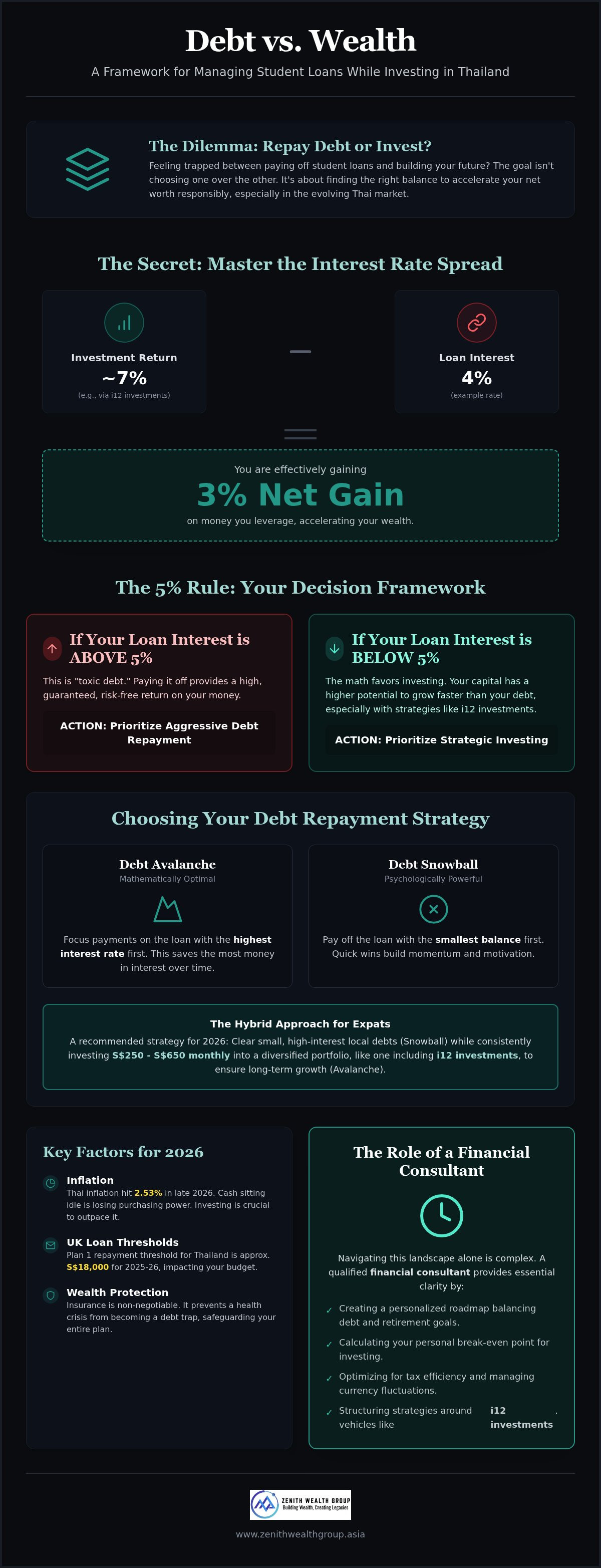
Arbitrage is the secret to building wealth while owing money. It sounds complex, but it's just the gap between your loan interest and your investment returns. This is known as the "Interest Rate Spread." When you focus on managing student loan debt while investing in Thailand, you want this spread to be positive. If your debt costs you 4% but your portfolio earns 7%, you are effectively gaining 3% on money you don't even "own" yet. It's a powerful way to leverage your current situation into future security.
The 5% Rule is a simple guide for your strategy. If your loan interest is above 5%, paying it off is usually your best move. It's a guaranteed return. However, if your interest rate is below 5%, the math shifts. Historical performance of i12 investments often makes a compelling case for putting your S$ toward growth instead of overpaying low-interest debt. This is especially true in 2026, as the Thai market modernizes its digital reporting and transparency, making it easier to track your progress in real time.
Living overseas adds layers of complexity. You have to navigate currency fluctuations and specific repayment rules. For many, managing student loans from abroad requires a strategic look at income-driven plans and foreign earned income exclusions. A financial consultant can help you calculate your personal break-even point. They ensure your S$ works as hard as possible while you meet your obligations. This clarity removes the guesswork from your monthly budget.
Debt Avalanche vs. Debt Snowball in 2026
The Avalanche method is the mathematical winner. You target the loan with the highest interest first to save the most S$ in the long run. The Snowball method focuses on the smallest balances first for psychological wins. In 2026, a hybrid approach is often best for expats. Secure those mental wins by clearing small local loans while carving out S$250 to S$650 for monthly i12 investments. This ensures you don't reach the end of your debt journey with a zero-dollar investment balance.
Tax Efficiency and Debt in Thailand
Thai tax residents can use specific deductions to subsidize their debt strategy. If you stay in Thailand for 180 days or more, you are a tax resident. This means your remitted foreign income is subject to local tax. Before you overpay any debt, look at your Provident Fund (PVD). It's a "must-do" because of the employer match and tax benefits. Leveraging these regional tax-advantaged accounts can free up more S$ for your repayment plan. This holistic approach turns your tax bill into a wealth-building tool.
Strategic Wealth Creation: Exploring i12 Investments
Building a portfolio doesn't mean ignoring your past obligations. For those managing student loan debt while investing in Thailand, i12 investments offer a structured, data-driven approach to growth. This strategy serves as a core component of a modern Southeast Asian portfolio. It removes the guesswork that often leads to emotional decision-making. By focusing on rule-based entries and exits, you can grow your wealth while staying consistent with your monthly debt commitments. It's about making your S$ work harder in the background while you focus on your career.
A regional focus is essential if you live and work in Thailand. Your daily expenses are local, but your long-term goals are often global. Diversification is your best defense against market shifts. You shouldn't limit yourself to just Thai equities. i12 investments allow you to branch out across the region while staying grounded in local market trends. This approach aligns perfectly with Strategic Investment Management. It ensures your portfolio remains resilient against local volatility and provides a clear path toward financial independence.
Why i12 Investments Suit the Young Professional
Young professionals often struggle with limited surplus cash. Accessibility is a major advantage here. You don't need a massive windfall to start. In the 2026 economic climate, finding a balance between growth and stability is vital. When deciding whether to invest or pay down debt, the ease of entry makes i12 investments a practical choice. It allows you to start small, perhaps with just S$200 a month, and scale as your income grows. This flexibility is key when you're managing student loan debt while investing in Thailand, as it keeps your retirement goals on track without straining your budget.
Asset Allocation While Carrying Liabilities
If you carry liabilities, your risk tolerance is naturally different. You should avoid high-volatility "moonshots" that could jeopardize your ability to make loan payments. Liquidity is your best friend in a Thai-based portfolio. You need assets that you can access if your financial situation shifts unexpectedly. i12 investments provide a structured path to growth by focusing on quality assets rather than speculative bets. A financial consultant can help you determine the right mix of liquid and growth-oriented assets. This ensures your investment journey supports your debt repayment rather than competing with it for resources. You can build a safety net while still participating in the market's upside.
Protecting Your Path: Wealth Protection for Debtors
Investing is about offense, but protection is your defense. If you're managing student loan debt while investing in Thailand, you have a monthly obligation that doesn't care if you're sick or unemployed. Insurance isn't optional in this scenario. It's the only way to ensure your wealth-building journey doesn't end in a "Debt Trap." A critical illness could derail years of progress by forcing you to liquidate your portfolio just to stay current on loan payments. You should review our Wealth Protection Guide to understand how to shield your assets effectively.
Without a plan, your student loans could even become a burden for your family. Proper Legacy Planning ensures your liabilities are covered. This preserves the wealth you've worked so hard to build through i12 investments. You want to pass on assets, not debts. Securing the right coverage means your financial strategy remains intact regardless of life's surprises. It allows you to focus on growth with the confidence that your foundation is secure.
The Emergency Fund: Your First Line of Defense
You can't invest money you might need next month. Your emergency fund is your first priority. Aim for three to six months of total expenses. This must include your student loan installments. In Thailand, keep these funds in high-yield savings accounts or money market funds for liquidity. With inflation hitting 2.53% in August 2026, you want your cash to at least keep pace with rising costs. A financial planner can help you size this safety net based on your specific debt-to-income ratio and lifestyle needs.
Term Life and Disability Coverage
Most young professionals focus on growth and forget about the risk of being unable to work. Disability income protection is vital. It replaces your salary so you can keep managing student loan debt while investing in Thailand even if you're sidelined. Match your term life coverage to your total outstanding debt balance. This is "insuring your debt." It gives you the peace of mind to take calculated risks with your portfolio. If something happens, your loans are cleared, and your investments remain untouched for your future.
Ready to secure your strategy? Contact a financial planner today to review your coverage and protect your path to wealth.
Your 2026 Roadmap: Working with a Financial Consultant
Generic online calculators are helpful for surface-level math, but they often fail to account for the unique variables of an expat lifestyle. When managing student loan debt while investing in Thailand, you are navigating more than just interest rates; you are managing tax residency, currency risk, and regional regulations. A financial consultant provides the nuanced perspective needed to turn these challenges into a cohesive strategy. At Zenith Wealth, we focus on moving beyond the spreadsheet to understand the human side of your financial journey.
Our approach is grounded in creating a synergy between your past obligations and your future potential. We tailor i12 investments to fit your specific debt timeline, ensuring that you aren't sacrificing long-term growth just to clear a balance. This holistic view is what sets a professional roadmap apart from a self-service tool. By integrating debt restructuring with wealth creation, Zenith Wealth helps you build a net worth that grows even as you pay down what you owe.
What to Expect in Your First Advisory Session
Your initial consultation is a deep dive into your current financial health. You will need to gather your loan statements, current investment holdings, and monthly budget. We then work together to set realistic milestones for your first year in Thailand. This involves more than just picking funds; it's about identifying leaks in your cash flow. Finding an extra S$350 to S$700 through efficiency can significantly accelerate your participation in i12 investments. We focus on these small, actionable wins that build momentum toward your larger goals.
Long-Term Vision: From Debt-Free to Retirement-Ready
The transition from a debtor to a wealth builder is a strategic shift. Once your student loans are cleared, you can redirect those monthly installments toward aggressive Retirement Planning. Because you chose the path of managing student loan debt while investing in Thailand simultaneously, you won't be starting from zero. You will already have a functioning portfolio benefiting from years of compounding. This continuity ensures that the day you make your final loan payment is also the day your retirement engine hits top gear.
Your debt is a manageable variable, not a permanent barrier. With a structured plan, you can enjoy your life in Thailand while securing your financial future. Schedule your consultation with a Zenith Wealth financial planner today to start building your 2026 roadmap.
Build Your Wealth with Confidence
Clearing your student loans and building a regional portfolio are not mutually exclusive goals. By applying the mathematical frameworks and protection strategies discussed, you can turn a period of liability into a foundation for lifelong security. The key is to stop viewing your debt as a barrier and start seeing it as a variable to be managed within a broader wealth creation strategy. This shift in perspective allows you to participate in market growth while staying responsible to your past commitments.
Managing student loan debt while investing in Thailand is a journey that requires both local insight and global perspective. Zenith Wealth provides the holistic planning and technical expertise needed to navigate this path effectively. As an authorized representative of the finexis advisory network, we specialize in rule-based i12 investments that remove the guesswork from your financial future. We help you balance debt repayment with wealth protection so that your progress remains uninterrupted.
Start your journey toward debt-free wealth with a Zenith Wealth financial consultant. We are ready to help you design a plan that reflects your unique ambitions and respects your current obligations. Let's start a conversation today and build a future you can be proud of.
Frequently Asked Questions
Is it better to pay off student loans or invest in i12 investments first?
The decision depends on your loan's interest rate compared to your expected market returns. If your student loan interest is below 5%, the long-term compounding power of i12 investments typically outweighs the benefit of early repayment. However, if you're facing high-interest private debt, clearing that balance first provides a guaranteed return. A financial consultant can help you run the numbers to ensure your S$ works effectively for your future.
How does living in Thailand affect my US or UK student loan repayments?
Residing in Thailand significantly changes your repayment obligations, especially for UK borrowers. For the 2025-2026 tax year, the UK Plan 1 repayment threshold for Thailand is £10,430, which is roughly S$18,000. For US citizens, the Foreign Earned Income Exclusion can often reduce your adjusted gross income to zero, potentially lowering your monthly payments on income-driven plans. It's vital to update your loan servicer with your current Thai address and income details.
Can a financial consultant help me consolidate my international debts?
While a financial consultant doesn't provide direct lending or consolidation products, they play a critical role in debt restructuring. They analyze your total liabilities and cash flow to find more efficient ways to manage your monthly payments. By reviewing your debt-to-income ratio, a financial planner can identify opportunities to redirect funds toward i12 investments. This holistic approach ensures your debt management strategy supports your broader wealth protection and retirement goals.
What are the best low-risk investments in Thailand for 2026?
In 2026, low-risk options in Thailand include government bonds and money market funds, which provide liquidity and stability. For those looking for a more structured approach, i12 investments can be configured with a focus on wealth accumulation while managing volatility. These strategies use pre-set buy and sell points to remove emotion from the process. This is especially helpful for debt-holders who need to ensure their core capital remains protected while seeking growth.
Do i12 investments offer better returns than the interest on a typical student loan?
i12 investments are designed to capture market growth through a rule-based, data-driven strategy. While market returns are never guaranteed, these investments aim to outpace the low interest rates found on many government-backed student loans. By focusing on regional opportunities and tactical timing, you can potentially grow your net worth faster than your debt accrues. This positive "interest rate spread" is a key part of managing student loan debt while investing in Thailand successfully.
What happens to my student loan debt if I move between Singapore and Thailand?
Moving between Singapore and Thailand changes your tax residency status and your loan repayment thresholds. The UK Student Loans Company, for example, uses different cost-of-living multipliers for each country, which affects your required monthly installments. Managing student loan debt while investing in Thailand requires a flexible plan that accounts for these regional shifts. A financial planner can help you adjust your budget and investment contributions to remain compliant and efficient in both jurisdictions.
How much of my income should I allocate to debt vs. investing?
Most professionals should aim to follow a hybrid model that prioritizes both obligations. After covering your essential living costs, try to allocate at least S$250 to S$650 monthly toward i12 investments to benefit from early compounding. The remainder of your surplus should go toward your highest-interest debt. This balanced approach ensures you don't reach the end of your debt repayment journey with a zero-dollar investment balance or no progress toward retirement.
Are there specific tax breaks in Thailand for student loan holders who invest?
Thailand doesn't offer direct tax deductions for foreign student loan payments, but you can create indirect "subsidies" through smart investing. By contributing to a Provident Fund (PVD) or taking advantage of 2026 retail investor tax incentives, you reduce your overall taxable income. These tax savings can then be redirected toward your student loan principal. A financial consultant can help you maximize these local benefits to free up more S$ for your debt repayment.


