

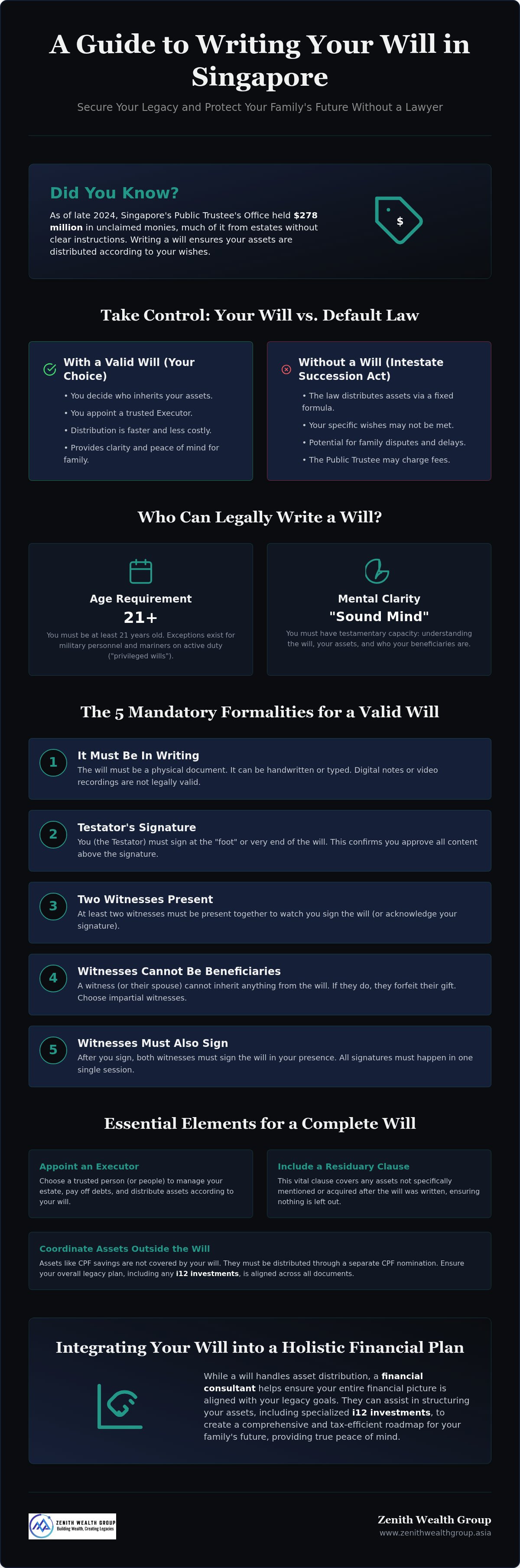
Did you know that as of late 2024, there was $278 million in unclaimed monies sitting with the Public Trustee's Office? Much of this stems from un-nominated CPF savings and estates where no clear instructions were left behind. It's a stressful reality, and you're right to want a better outcome for your family. You likely want to protect your assets without spending thousands on legal fees for a straightforward estate. Learning how to write a will in Singapore without a lawyer is an empowering way to start your legacy planning journey today.
This guide provides the clarity you need to create a legally binding document on your own terms. You'll learn the specific legal requirements under the Wills Act and the step-by-step formalities to ensure your wishes are respected. From identifying executors to coordinating your i12 investments and consulting a financial consultant for holistic legacy planning, we'll walk through everything needed to secure your family's future and provide lasting peace of mind.
Key Takeaways
- Learn how to write a will in Singapore without a lawyer by following the specific legal requirements of the Wills Act to ensure your document is valid.
- Discover the five mandatory formalities, including correct signature placement and witness rules, that protect your estate from being contested.
- Identify why assets like CPF savings require separate nominations and how to coordinate them with your broader legacy planning goals.
- Understand the role of an executor and the importance of a residuary clause in capturing assets you might acquire in the future.
- Learn how a financial consultant can help you integrate your will with strategic frameworks like i12 investments for a complete financial roadmap.
The Legality of DIY Wills: Understanding the Singapore Wills Act
Can you legally draft your own will? Absolutely. Singapore law is clear on this. You don't need a legal professional to make your final wishes binding. Understanding how to write a will in Singapore without a lawyer starts with the Wills Act 1838. This legislation serves as your roadmap. It ensures your assets, from your family home to your i12 investments, go exactly where you intend.
A self-drafted document holds the same legal standing as one prepared by a law firm. The court doesn't prioritize a lawyer's letterhead over your own handwritten or typed instructions. What matters is strict adherence to the legal "rules of the game." In this context, you act as the Testator, the person making the will. You'll appoint an Executor, a trusted person responsible for managing your estate and applying for the Grant of Probate. Finally, you'll name Beneficiaries who will inherit your legacy.
Who Can Write a Will in Singapore?
Most adults can start this process today. You must be at least 21 years old to create a valid will under normal circumstances. There are rare exceptions for "privileged wills," which apply to military personnel or mariners on active duty. These individuals may create valid wills even if they are under 21, provided they are in actual naval or military service. This flexibility exists to support those serving in high-risk environments where formal legal help might be unavailable.
Mental clarity is the most vital requirement for any testator. In legal terms, this is called testamentary capacity. You must understand the nature of the document, the extent of your assets, and the claims of potential beneficiaries. If there's any doubt about being of "sound mind" during the signing, the will could face expensive legal challenges later. This is where a financial consultant can help. They ensure your legacy planning remains robust and coordinated with your broader financial roadmap. If you're unsure about how your current portfolio fits into your long-term goals, you can always connect with a financial planner to review your roadmap.
The Legal Framework: The Wills Act Explained
A will and testament is a legal document that must follow the Wills Act to be enforceable. This act distinguishes between your real estate, such as your HDB flat or private condo, and personal estate, like cash, stocks, or heirlooms. It provides the "rulebook" for how these assets are distributed. If your DIY document fails to meet these rules, it may be declared invalid. In that case, the Intestate Succession Act takes over.
The Intestate Succession Act distributes your wealth according to a fixed formula. This often leads to outcomes you might not want. For example, if you die without a will, your assets are split between your spouse and children in specific proportions that you didn't choose. If your estate is valued at $50,000 or less, the Public Trustee's Office may handle the administration, charging sliding scale fees that start at 6.50% for the first $5,000. Writing your own will allows you to bypass these defaults and keep control within your family. Taking the time to understand these boundaries is the first step toward true peace of mind.
5 Mandatory Formalities for a Valid Will in Singapore
Creating a will is an act of love for your family. However, even the most heartfelt intentions can fail if you miss the technical markers required by law. When you're learning how to write a will in Singapore without a lawyer, these five formalities are your non-negotiables. If any of these are missing, the court may declare the document invalid, leaving your estate to be distributed by default government rules.
- The Writing Requirement: Your will must be a physical document. It can be typed or handwritten, but a video recording or a digital note on your phone won't suffice.
- The Testator's Signature: You must sign the document at the "foot" or end of the text. This prevents others from adding unauthorized clauses after you've signed.
- Two Independent Witnesses: You need at least two witnesses to watch you sign. They must both be present at the same time.
- The Beneficiary Rule: Your witnesses cannot be people who will inherit from the will, nor can they be the spouses of your beneficiaries.
- Witness Signatures: After watching you sign, both witnesses must sign the will in your presence.
Proper Execution and Signing Procedures
The placement of your signature is more than a formality. It signals that you've reviewed every word above it. If you have multiple pages, it's a good practice to initial the corner of every page to prevent tampering. If a testator is physically unable to sign due to illness or injury, Singapore's Wills Act 1838 allows for a "proxy" signature. In this case, another person signs on your behalf, at your direction, and in your presence. This ensures that your legacy planning remains on track even during health challenges. Common errors, such as witnesses signing in a different room or at different times, are the leading causes of probate delays. Avoid these by gathering everyone around the same table for a single signing session.
Choosing Your Witnesses Wisely
Choosing the right witnesses is just as important as choosing your executor. The law is strict: if a beneficiary witnesses the will, they forfeit their entire inheritance. This is designed to prevent coercion. The ideal witness is a reliable, reachable person who has no financial interest in your estate. Think of a trusted friend or a colleague. While it's not a legal requirement for witnesses to outlive you, it certainly helps if they can be found easily when the time comes to verify the document.
A will is the foundation, but it's only one part of a complete financial roadmap. While you handle the distribution of your physical assets, a financial consultant can help you manage the growth of your wealth, including strategic frameworks like i12 investments. This ensures that what you leave behind is as substantial as possible. If you want to ensure your DIY will aligns perfectly with your broader goals, you might want to speak with a financial planner to bridge the gap between your legal documents and your investment strategy. This proactive approach turns a simple document into a powerful tool for generational wealth.
Strategic Limitations: What a DIY Will Does Not Cover
Writing a will is a powerful step. However, it isn't a magic wand that controls every cent you own. Many Singaporeans are surprised to learn that some of their largest assets bypass the probate process entirely. If you're focused on how to write a will in Singapore without a lawyer, you must understand these "will-proof" assets to avoid leaving your family with a legal mess.
Jointly-held assets are a prime example. Under the "Right of Survivorship," property or bank accounts held in joint names automatically pass to the surviving co-owner. Your will cannot redirect your share of a joint-tenancy HDB flat to someone else. Similarly, insurance policies with valid nominations go directly to the named beneficiaries. These proceeds don't enter your estate, meaning your executor has no control over them. A financial consultant can help you review these nominations to ensure they align with your broader legacy planning goals.
The CPF Nomination Trap
Your CPF savings are legally separate from your estate. This is a common trap. As of February 2025, roughly 64% of CPF members have not made a nomination. If you die without one, the Public Trustee’s Office distributes your funds according to the Intestate Succession Act. This isn't free. The office charges sliding fees, starting at 6.50% for the first $5,000. Even if you satisfy all formal legal requirements for a will, that document cannot touch your CPF. You must complete a separate nomination through the CPF Board’s online portal to ensure these funds reach your loved ones quickly.
Handling Complex Assets and i12 Investments
A modern legacy often includes more than just cash and property. If you have diversified holdings like i12 investments, your executor needs a clear map to find them. This is where an "Asset Schedule" becomes essential. It’s a document you keep with your will that lists account numbers, investment platforms, and contact details for your financial planner. Without this, your heirs might never know these assets exist. In 2026, this also extends to digital assets. Crypto-portfolios and digital accounts require specific instructions and access keys. By integrating i12 investments into your overall roadmap, you ensure your wealth protection strategy is visible and actionable. This proactive coordination is what transforms a simple DIY document into a robust shield for your family's future.
Practical Steps for Drafting and Storing Your Will
Once you understand the rules, it's time to put pen to paper. Selecting a reliable executor is your first big decision. This person handles the administrative heavy lifting, from applying for a Grant of Probate to distributing your i12 investments to beneficiaries. Choose someone organized and trustworthy. You should also include a "Residuary Clause." This acts as a legal safety net. It captures any assets you might have forgotten or those you acquire after the will is signed, ensuring nothing falls into the trap of intestacy.
Life changes, and your will should too. If you get married, your existing will is usually revoked automatically. For smaller updates, you can use a "codicil," which is a supplementary document. However, for major changes like new children or a significant shift in your wealth protection strategy, writing a brand new document is often cleaner. This ensures there's no confusion about your latest intentions. If you feel overwhelmed by these moving parts, you can start your legacy planning journey with professional guidance to ensure every detail is covered.
Drafting Your Content: A Logical Flow
Start your document with a clear "Revocation Clause." State that you revoke all previous wills and codicils. This prevents old versions from causing legal friction. For young parents, naming guardians for minor children is the most critical step. It’s a core part of legacy planning that provides certainty for your children’s upbringing. When listing assets, distinguish between specific bequests, like a family heirloom, and the general distribution of the remainder of your estate. This logical flow helps your executor follow your instructions without ambiguity.
Safe Storage and the Will Registry
A perfectly drafted will is useless if your family can't find it. Don't hide the document in a secret safe or a bank locker that requires a court order to open. Instead, store the original in a secure, accessible place and give a copy to your executor. You should also use the Wills Registry maintained by the Singapore Academy of Law. While it doesn't store the actual document, it records where the will is kept and who the witnesses are. As of late 2025, over 158,000 wills were recorded in this registry. This simple step ensures that when the time comes, your family can locate your final wishes quickly. Tell your executor exactly where the physical copy is located to avoid unnecessary stress during a difficult time.
Ready to secure your family's future? A will is the foundation, but a complete roadmap includes much more. To see how your legal wishes align with your financial goals, connect with a financial consultant today. We can help you integrate your DIY will with a robust strategy for your i12 investments and long term wealth.
Securing Your Legacy with Holistic Financial Planning
A will is a powerful legal tool, but it's just one piece of the legacy planning puzzle. While you now know how to write a will in Singapore without a lawyer, the document itself doesn't grow or protect your assets. That's where wealth protection comes in. Without a strategy to safeguard your future, there might be less of an estate to leave behind than you planned. A robust financial roadmap ensures that your family doesn't just receive instructions, but a meaningful inheritance. This involves looking at your current lifestyle and ensuring your assets are shielded from unnecessary risks before they pass to the next generation.
The Value of a Financial Consultant
A financial consultant helps bridge the gap between your legal wishes and your current wealth. They review your entire portfolio to ensure it aligns with your testamentary instructions. This includes looking for tax efficiencies and identifying potential liquidity needs. A financial consultant ensures your asset distribution is supported by sufficient liquidity for estate duties and debts. This prevents your executor from being forced to sell property or liquidate i12 investments at an inopportune time just to pay off outstanding liabilities. By coordinating your investments with your will, you create a seamless transition of wealth that minimizes stress for your beneficiaries during a difficult time.
Next Steps: Beyond the DIY Will
Your final wishes should live within a comprehensive retirement plan. This holistic approach looks at how you use your wealth today and what remains for tomorrow. It's about finding the balance between enjoying your retirement years and securing your family's future. Legacy planning isn't a "one and done" event. Life milestones like marriage, the birth of a child, or significant growth in your i12 investments require a plan update. Regular reviews with a financial planner keep your strategy relevant and your family protected. These check-ins allow you to adjust for changes in regulations or personal circumstances, ensuring your document remains as effective as the day you wrote it.
Don't leave your family's future to chance. To ensure your DIY will works in harmony with your financial goals, contact a Zenith financial consultant for a holistic legacy review. We're ready to help you build a roadmap that lasts for generations.
Take Control of Your Family's Future Today
Writing your own will is a significant step toward protecting your loved ones. You've learned that understanding how to write a will in Singapore without a lawyer is about more than just a signature. It's about meeting the strict formalities of the Wills Act and accounting for assets like CPF and insurance that often fall outside the document. A well-crafted will provides the legal foundation, but it truly excels when it's integrated into a broader, holistic financial roadmap.
As authorized representatives of finexis advisory Pte Ltd, we specialize in bridging these gaps. Our team brings specialized expertise in legacy planning and the strategic use of i12 investments to ensure your wealth is both grown and protected for the next generation. Don't leave your estate to chance or rigid government defaults. Instead, ensure your legal wishes and your financial reality work in perfect harmony. We're ready to help you build a legacy that lasts for generations.
Secure your family’s future with a professional legacy review from Zenith Wealth Group.
Frequently Asked Questions
Is a handwritten will (holographic will) valid in Singapore?
Yes, a handwritten will is valid in Singapore provided it meets the mandatory formalities under the Wills Act. It must be in writing, signed by you at the foot, and signed by two independent witnesses who are both present at the same time. While handwritten documents are legal, they must be legible to avoid future probate disputes. A financial consultant can help you ensure your legacy planning stays organized regardless of the format you choose.
Can I use a will template from the internet for my Singapore will?
You can use a template, but ensure it complies with Singapore's legal framework. Many generic templates found online ignore specific local requirements like the "Beneficiary Rule" for witnesses. When you learn how to write a will in Singapore without a lawyer using a template, remember to include specific details about your i12 investments. A financial planner can review how these templates fit into your overall wealth protection and retirement roadmap.
How much does it cost to write a will in Singapore without a lawyer?
Writing a will yourself is technically free, though online platforms in 2026 often charge around $179 for guided drafting services. You should also consider the small fee for depositing information with the Wills Registry to ensure discovery. While DIY saves on legal fees, the real cost lies in potential errors. Coordinating your will with your retirement planning ensures you don't leave expensive legal complications or unclaimed monies for your family later.
What happens if I die in Singapore without a will?
Your assets are distributed according to the Intestate Succession Act. This fixed formula often ignores your personal wishes, such as specific bequests for friends or charities. For estates under $50,000, the Public Trustee's Office manages the distribution and charges sliding fees starting at 6.50% for the first $5,000. Without a will, your family faces more paperwork and higher administrative costs, which can significantly delay the distribution of your wealth protection assets.
Does a will cover my HDB flat if it is jointly owned?
A will does not cover an HDB flat held under joint tenancy. In these cases, the Right of Survivorship applies, and the property automatically passes to the surviving co-owner regardless of what your will says. If you own the flat as tenants-in-common, your specific share can be distributed via your will. A financial consultant can help you verify your property holding status to ensure your legacy planning is accurate and legally effective.
How often should I review or update my DIY will?
Review your will every three to five years or after major life milestones. Events like marriage, the birth of a child, or significant changes in your i12 investments portfolio require an immediate update. Marriage usually revokes an existing will automatically, so a new document is essential. Regular reviews with a financial planner ensure your final wishes always reflect your current assets and your long-term retirement strategy, providing peace of mind for your loved ones.
Can my executor also be a beneficiary in my will?
Yes, your executor can also be a beneficiary. It's common for Singaporeans to name a spouse or adult child as both the executor and a primary heir. However, remember that your executor or their spouse must not act as a witness to your signature. If they do, they will lose their entire inheritance under the Wills Act. Careful witness selection is a critical part of how to write a will in Singapore without a lawyer successfully.
What is the Wills Registry and is it mandatory to register my will?
The Wills Registry is a voluntary database maintained by the Singapore Academy of Law. It doesn't store the actual document, but it records where the physical copy is kept and who the witnesses were. Registration isn't mandatory for a will to be valid, but it's highly recommended. It helps your family locate your final wishes quickly, preventing assets from being treated as unclaimed monies or distributed under the default Intestate Succession Act rules.


