

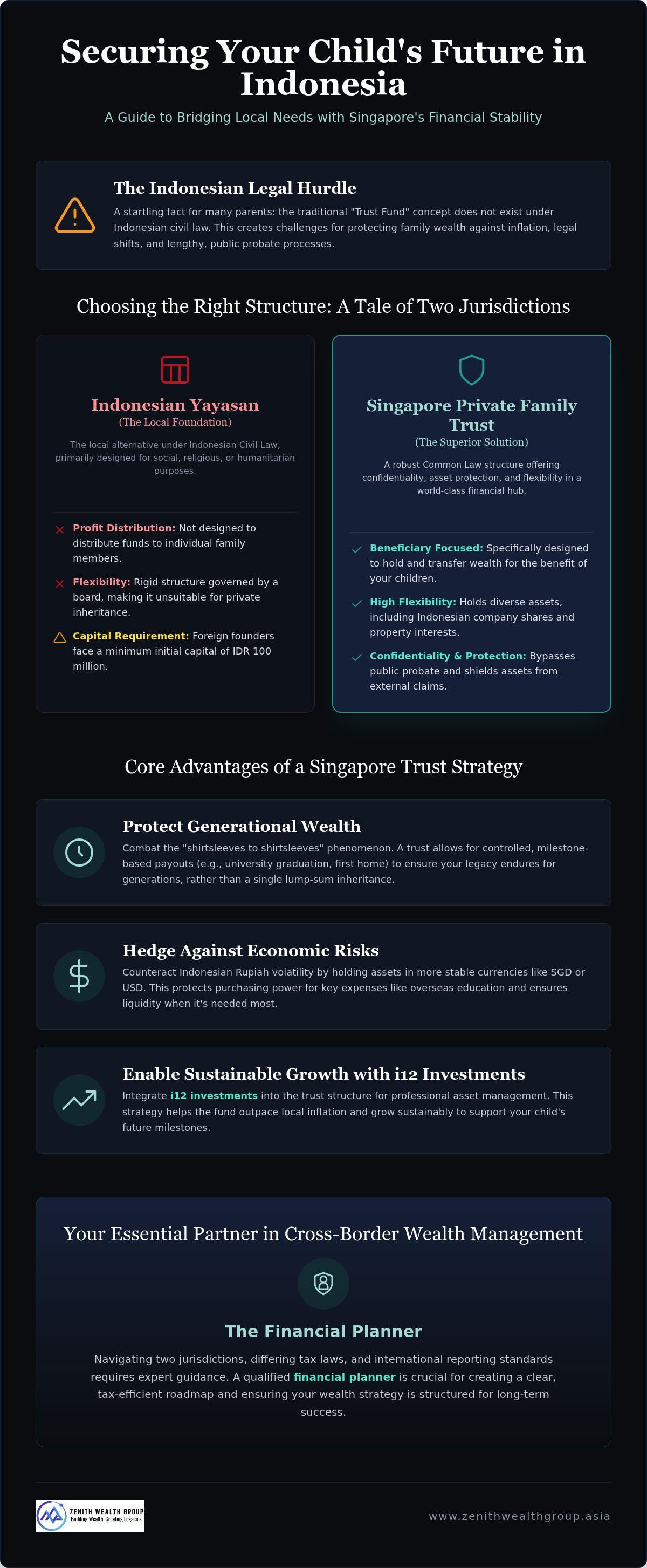
Did you know that the traditional trust fund doesn't actually exist under Indonesian civil law? It's a startling realization for parents who want to protect their family wealth against high inflation and legal shifts. You want the absolute best for your children. You want to know the assets you build today will be there for them tomorrow. If you've been searching for the best way of setting up a trust fund for my child in Indonesia, you've likely noticed that the path forward feels blurry. Local regulations and cross-border complexities can make even simple goals feel out of reach.
We believe your child's security shouldn't be left to chance. This guide simplifies that journey. You'll discover the exact steps to establish a secure structure that protects your child's future by bridging Indonesian needs with Singaporean financial expertise. We'll explore the legal landscape of 2026, look at how i12 investments can strengthen your strategy, and show you how a financial planner creates a clear roadmap for tax-efficient wealth transfer. It's time to build a legacy with confidence and clarity.
Key Takeaways
- Understand the critical legal differences between an Indonesian Yayasan and a Singapore Private Family Trust to choose the best protection for your family.
- Follow a clear, five-step roadmap for setting up a trust fund for my child in Indonesia to secure their inheritance today.
- Learn how i12 investments provide a vehicle for sustainable growth that helps your child's fund outpace local inflation.
- Discover why a financial planner is your essential partner in navigating the complexities of cross-border wealth management and tax efficiency.
Why Establish a Trust Fund for Your Child in Indonesia?
Protecting your family's future starts with a clear, actionable plan. If you're considering setting up a trust fund for my child in Indonesia, you're looking for more than just a simple savings account. You're building a financial fortress. A trust is a fiduciary relationship where one party holds the legal title to assets for the benefit of another, effectively separating legal and beneficial ownership. To understand the global foundations of these structures, you can read more about What is a Trust Fund? and how it defines the roles of the settlor, trustee, and beneficiary.
In Indonesia, where probate can be a lengthy and public process, a trust offers a private and efficient way to transfer wealth. It bypasses the delays of the local court system and ensures that your assets are managed exactly how you intended. This level of control is essential for parents who want to prevent large lump-sum distributions to children who may not yet have the financial maturity to handle them. By working with a financial planner, you can create a structure that provides for your child while keeping the capital protected from external claims or mismanagement.
Protecting Generational Wealth
Most families struggle to maintain wealth beyond three generations. This is often referred to as the "shirtsleeves to shirtsleeves" phenomenon. A well-structured trust prevents this decline by implementing specific milestone payouts. Instead of a single inheritance, your child might receive distributions for a university graduation, a 25th birthday, or a first home deposit. This controlled approach ensures the longevity of your legacy. Incorporating i12 investments into this strategy allows for professional management of the underlying assets, ensuring they continue to grow and support these future milestones.
Addressing Indonesian Economic Factors
The Indonesian Rupiah has historically faced periods of volatility. For parents, this creates a significant risk, especially regarding education funding for children planning to study abroad. Holding assets in SGD or USD denominated accounts within a trust helps hedge against currency fluctuations. It ensures that when the tuition bill arrives, your purchasing power remains intact.
Liquidity is another critical factor. A trust ensures that funds are available exactly when needed without waiting for estate settlement. This is a core component of wealth protection for Indonesian families. By bridging local needs with the security of Singaporean financial frameworks, you can secure your child's lifestyle regardless of local economic shifts. If you're ready to start this process, you can connect with our team to discuss your specific goals.
Indonesian Law vs. Singapore Trusts: Choosing the Right Structure
Choosing the right legal home for your family's wealth is a pivotal decision. Indonesia follows a civil law system, which means it doesn't formally recognize the concept of a "trust" in the same way common law jurisdictions do. If you've been researching setting up a trust fund for my child in Indonesia, you've likely realized that the local equivalent is a foundation, or Yayasan. While both structures aim to manage assets, they operate on entirely different legal engines. Understanding these differences is the first step toward a secure legacy.
The Yayasan: The Local Alternative
A Yayasan is an Indonesian legal entity primarily designed for social, religious, or humanitarian purposes. It is the most common local vehicle for managing large pools of capital. According to the Indonesian Non-Profit Law, these foundations are governed by a board of patrons, executives, and supervisors. This structure offers a way to manage assets within Indonesia, but it comes with significant limitations for private families. For instance, as of 2026, foreign founders must meet a minimum initial capital requirement of IDR 100 million. Crucially, a Yayasan is not designed to distribute profits to individuals. This makes it a rigid and often unsuitable choice for parents who want to provide a direct, flexible inheritance for their children.
The Singapore Trust Advantage
Because of the limitations of local foundations, many Indonesian residents turn to Singapore. Singapore's common law framework provides a robust environment for private family trusts. These structures offer a level of confidentiality and asset protection that is difficult to achieve elsewhere in Southeast Asia. A Singapore trust can hold diverse assets, including Indonesian company shares or property interests, through specialized holding structures. This flexibility is a core pillar of modern legacy planning. By incorporating i12 investments into a Singapore-based trust, you ensure your child's future is backed by professional management in a stable, world-class financial hub.
Navigating these two jurisdictions requires precision. Indonesia's tax landscape in 2026 is increasingly transparent, with authorities actively monitoring offshore holdings through the Common Reporting Standard. A financial planner acts as your essential guide here. They help you weigh the local compliance of a Yayasan against the superior protection of a Singapore trust. They ensure that your strategy respects Indonesian tax rules, including Controlled Foreign Company regulations, while maximizing the growth of your family's capital. If you're ready to explore which structure fits your family's needs, you can reach out to us for a personalized roadmap. We're here to help you bridge the gap between local needs and international security.
5 Steps to Setting Up a Trust Fund for Your Child
Building a legacy requires a structured approach. If you are serious about setting up a trust fund for my child in Indonesia, you need a roadmap that balances legal precision with your family's personal goals. It is not just about the money. It's about the intent behind it. Following a clear process ensures that your hard-earned assets are protected and used exactly as you envisioned.
First, identify your core objectives. Are you prioritizing education funding for an overseas university degree, or is this a long-term inheritance strategy? Second, you must appoint a reliable trustee. This person or entity will manage the assets according to your rules. Third, work with a financial planner to draft a comprehensive trust deed. This document is the legal heart of your arrangement. Fourth, fund the trust. You might use cash, life insurance policies, or property interests. Finally, commit to a regular review. Your family's needs will change, and your trust should evolve with them.
Choosing Your Trustee
You have two main paths: an individual or a professional corporate trustee. While a family member might seem like the easy choice, a corporate trustee offers neutrality. This is critical for preventing family disputes and ensuring the trust lasts for generations. Your financial planner helps you evaluate these options to ensure the management remains professional and unbiased. They act as the bridge between your family's needs and the technical requirements of the trustee's role.
Drafting the Trust Deed
This document defines how your child interacts with the wealth. We often recommend including 'Spendthrift Clauses.' These protect your child from creditors or poor financial choices during their youth. You can also set age-based triggers for asset distribution. For example, your child might receive 20% of the fund at age 21, 30% at age 25, and the remainder at age 30. This staged distribution encourages financial responsibility. By integrating i12 investments into the deed's mandate, you ensure the assets are managed for sustainable, long-term growth. This also ensures the structure remains compliant with both Singaporean and Indonesian reporting standards, such as the Common Reporting Standard.
Every family's situation is unique. If you're ready to take the first step toward setting up a trust fund for my child in Indonesia, our team is here to help. You can reach out to us today to begin your personalized planning process. We'll help you navigate the complexities so you can focus on what matters most: your child's future.
Optimizing the Trust: i12 investments and Tax Efficiency
Setting up a trust fund for my child in Indonesia is a powerful first step. But a trust is only as strong as the assets it holds. A legal structure alone won't protect your family from inflation or economic shifts. To ensure your child's future remains secure, the fund must grow. This is where professional investment management becomes essential. It transforms a legal shell into a thriving legacy that outpaces local price increases.
The Role of i12 investments
We use i12 investments to provide a vehicle for sustainable, long-term growth. The primary goal here is diversification. By holding assets beyond Indonesian borders, you mitigate local economic risks and Rupiah volatility. Compounding is your greatest ally over a 15 to 20 year horizon. We carefully align the investment risk with your child's age. A younger child's fund can focus on aggressive growth. As they approach their 21st or 25th birthday, we shift the strategy toward capital preservation. This ensures the capital is ready for university tuition or a first home deposit exactly when needed.
Tax Compliance and Reporting
Being a Wajib Pajak (Indonesian tax resident) means you're taxed on worldwide income. In 2026, transparency is the global standard. The Common Reporting Standard (CRS) ensures that Indonesian tax authorities have visibility into financial accounts held in Singapore. You must be aware of the 'deemed dividend' rules. These regulations can treat undistributed profits from offshore entities as taxable income. While gifts from a parent to a child are currently tax-free in Indonesia, the reporting must be flawless to avoid complications.
Proactive tax planning can prevent double taxation on trust distributions. A financial planner acts as your bridge between these two jurisdictions. They ensure your i12 investments are structured to respect Indonesian tax laws while maximizing growth. They help you navigate the complexities of cross-border asset management so you don't have to do it alone. It's about staying compliant without sacrificing your child's potential inheritance.
Your child's future deserves a strategy that is both secure and growth-oriented. Don't let your legacy be eroded by taxes or inflation. If you want to see how we can optimize your family's wealth, speak with our financial planners today. We'll help you build a roadmap that lasts for generations.
How a Financial Planner Can Secure Your Child's Future
Attempting a DIY approach to cross-border wealth management often leads to expensive mistakes. While the internet provides plenty of information, it can't replace the nuanced strategy required for setting up a trust fund for my child in Indonesia. A professional financial planner does more than just fill out forms. They act as the architect of your family's financial future. They understand how Indonesian civil law interacts with Singaporean common law, ensuring your structure is both legal and effective. This professional guidance is the difference between a plan that looks good on paper and one that actually performs when your child needs it most.
Your financial planner coordinates a team of experts on your behalf. They speak the language of tax lawyers, trust officers, and investment managers. This ensures everyone is moving in the same direction. By centralizing this communication, you avoid the contradictions that often arise when dealing with multiple firms independently. This collaborative approach is vital for maintaining the integrity of your i12 investments and ensuring they remain compliant with current reporting standards in both jurisdictions. We take the technical burden off your shoulders so you can focus on being a parent.
A trust is not a static product you buy and forget. It is a living document. As your family grows, your goals might shift. Perhaps you decide on a different university or your child shows a particular talent that requires specific funding. Regular reviews with your financial planner allow you to adjust the trust's terms or investment strategy. This proactive management keeps your legacy aligned with your evolving reality.
Holistic Financial Roadmapping
We believe that your child's future shouldn't come at the expense of your own. A financial planner integrates your trust strategy into your broader retirement planning. It's essential to ensure you remain financially secure while funding your child's legacy. We help you find the right balance, ensuring that your i12 investments support both your lifestyle today and your child's opportunities tomorrow. This holistic view provides peace of mind that every part of your financial life is working in harmony.
Next Steps for Parents
Ready to start the journey? Begin by gathering your basic financial documents, including asset statements and existing insurance policies. During an initial consultation, you should ask your financial planner specific questions about asset protection. Ask how they handle the transition of assets if regulations change. Inquire about the specific benefits of i12 investments for your child's age group. This clarity helps you move forward with quiet confidence. We invite you to book a discovery call with a financial planner today to begin crafting your personalized roadmap. Let's start a conversation about protecting what matters most.
Building Your Family Legacy Today
Your child's future is far too important to leave to chance. We've explored how a hybrid approach bridges the gap between Indonesian legal requirements and the robust security of Singaporean trust structures. By understanding these nuances and leveraging i12 investments, you ensure your family's assets grow and remain protected against inflation and economic shifts. Setting up a trust fund for my child in Indonesia is a significant commitment. It's a journey that requires precision, but it doesn't have to be overwhelming when you have the right partner by your side.
As authorized representatives of finexis advisory, we specialize in cross-border legacy planning. We focus on human-centric, professional guidance that prioritizes your family's unique needs over institutional coldness. We don't just build financial plans; we build lasting relationships that grow alongside your children. It's time to move from anticipation to action and turn your vision for their future into a secure reality. You've done the research. Now, let's build the roadmap together.
Secure your child's legacy—speak with a financial planner today. We're ready to start the conversation whenever you are.
Frequently Asked Questions
Is it legal for an Indonesian citizen to have a trust fund in Singapore?
Yes, it is entirely legal for Indonesian citizens to hold assets in a Singaporean trust. If you are setting up a trust fund for my child in Indonesia, you must fulfill all reporting obligations under the Common Reporting Standard to remain compliant. Since Indonesia taxes residents on their worldwide income, transparency with tax authorities is essential. A financial planner can help ensure your offshore structure is efficient and respects all current 2026 regulations.
How much money do I need to start a trust fund for my child?
The amount required depends on the specific structure you choose. For an Indonesian Yayasan, foreign founders need a minimum initial capital of IDR 100 million as of July 2026. Private family trusts in Singapore usually require a larger sum to justify the administrative and legal setup costs. We recommend a significant starting balance to fully leverage the growth potential of i12 investments for your child's future.
What is the difference between a Will and a Trust in Indonesia?
A Will only takes effect after your passing and must go through a public probate process in Indonesia. This can be slow and expensive. A trust, or a Yayasan, is a separate legal entity that manages assets while you are still alive. It provides immediate protection and allows for controlled distribution. This ensures your child is provided for without the delays or costs of the court system.
Can I include my Indonesian property in a Singaporean trust?
You cannot hold Indonesian land titles directly within a Singaporean trust due to strict local ownership laws. Instead, the trust can hold shares in an Indonesian legal entity, such as a PT PMA, which then holds the property title. This is a sophisticated cross-border arrangement. It requires a financial planner to coordinate with legal experts to ensure the property remains protected and compliant with Indonesian law.
How are trust distributions taxed for beneficiaries living in Indonesia?
Indonesian tax residents are generally taxed on distributions from foreign trusts as part of their worldwide income. However, as of July 2026, direct gifts from parents to children are non-taxable in Indonesia. It is vital to report these distributions correctly to avoid complications with Controlled Foreign Company rules. Your financial planner can help you structure these payments to maximize tax efficiency while staying fully compliant.
Can I change the terms of the trust after it is set up?
Yes, if you establish a revocable trust, you can change the terms or beneficiaries at any time. This flexibility is helpful when setting up a trust fund for my child in Indonesia, as your family goals often evolve. An irrevocable trust is much harder to alter but offers superior protection against external claims. Your financial consultant will help you decide which level of control fits your family's needs.
What happens to the trust if the parent (Settlor) passes away?
The trust continues to operate according to the specific instructions laid out in your Trust Deed. Because the assets are legally held by the trust, they do not form part of your personal estate. This allows your child to receive financial support immediately without waiting for the probate process to conclude. The trustee continues managing the i12 investments to ensure the fund's longevity for the next generation.


