

University fees are projected to rise by 3% to 5% annually, meaning a local degree could cost well over $100,000 by the time your child is ready to enroll. This rate consistently outpaces general inflation, leaving many parents worried that their current savings won't be enough to support their child's career dreams. It's a common concern, especially when the gap between traditional bank interest and actual tuition costs keeps widening every year. You want the best for your child, but the sheer variety of education funding options can feel overwhelming.
You deserve a clear path forward. This guide explores the most effective financial vehicles available in 2026, from capital-guaranteed endowment plans to the rule-based i12 investments strategy. We'll help you understand the pros and cons of each option so you can make informed decisions with quiet confidence. You'll discover how to leverage the latest government bursaries alongside private growth strategies to build a fund that stays ahead of rising costs. We'll preview exactly how a professional financial planner can help you coordinate these pieces into a protected, reliable roadmap for your child's future.
Key Takeaways
- Understand why 2026 tuition projections make early planning mandatory for both local and overseas degrees.
- Compare the forced savings benefits of traditional endowments with the data-driven growth potential of i12 investments.
- Identify the optimal risk-return profile for your education funding strategy based on your child's current age and time horizon.
- Follow a practical five-step checklist to accurately calculate your savings gap using inflation-adjusted figures.
- Learn how a professional financial planner uses institutional-grade insights to build a secure and flexible roadmap for your child's future.
The Reality of Education Costs in 2026: Why Early Planning is Mandatory
Effective education funding isn't just about putting money aside in a generic savings account. It's a dedicated capital accumulation strategy designed to meet the specific, high-cost demands of tertiary education. In 2026, the financial landscape for parents has shifted. Passive saving is no longer a viable option because tuition fees are rising faster than general inflation. You need a proactive roadmap to ensure your child has every career choice available to them without the burden of massive student debt.
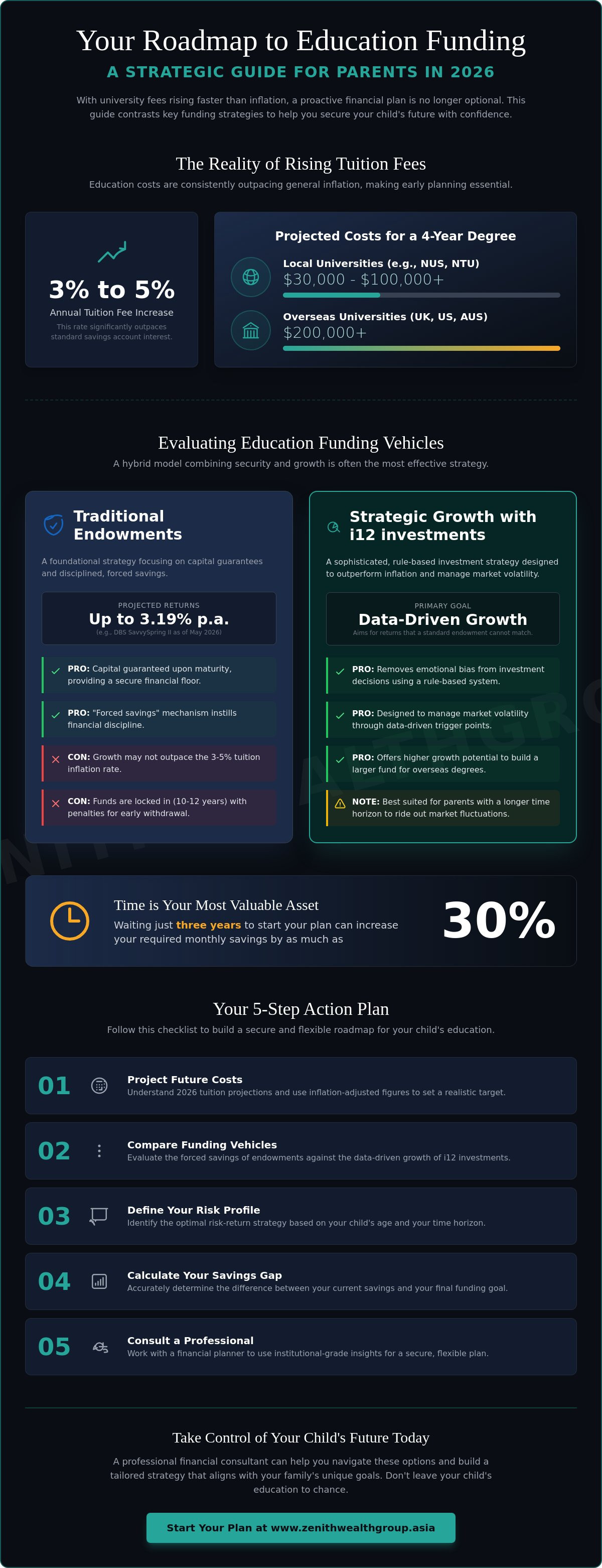
Current projections for 2026 show that a four-year degree at local institutions like NUS or NTU can range from $30,000 to over $100,000 depending on the course. If you're looking at overseas options, the numbers are even more stark. Degrees in the UK, US, or Australia can easily exceed $200,000 once you factor in international student premiums. With tuition inflation currently sitting between 3% and 5% annually, the target you're aiming for today will be significantly higher in a decade. Waiting just three years to start your plan can increase your required monthly savings by as much as 30%. Time is either your greatest ally or your most expensive enemy.
Projecting Tuition for Singapore Universities and Global Hubs
For most Singaporean families, local universities remain the primary goal. However, even with government subsidies, the out-of-pocket costs for specialized degrees like medicine or law are climbing. If your child's path leads to an international campus, you must prepare for a different scale of investment. Australia and the UK remain popular hubs, but their fee structures are sensitive to policy changes and global demand. For expatriate families or those considering international tracks early on, planning for Singapore American School costs is a vital first step in a long-term financial strategy. These early education investments set the stage for the tertiary costs that follow.
The Hidden Costs: Beyond Just Tuition Fees
Tuition is only one part of the equation. You also have to account for "lifestyle inflation" for a student living abroad. This includes accommodation, travel, and mandatory health insurance. Currency exchange rates can also create sudden gaps in your budget. If the Singapore Dollar weakens against the British Pound or US Dollar, your tuition bill effectively increases overnight. This is why a financial planner will often suggest a multi-layered approach. By understanding investment funds and how they balance risk, you can build a more resilient portfolio. Incorporating sophisticated tools like i12 investments helps manage these market volatilities. This rule-based strategy focuses on data rather than emotion, helping your fund stay on track even when global markets or currency rates fluctuate. Only an inflation-adjusted target provides the peace of mind that your child's future is truly secure.
Evaluating Education Funding Vehicles: Endowments vs. i12 investments
Choosing the right vehicle for education funding in 2026 requires more than just a standard savings account. In the past, many parents relied solely on guaranteed products. Today, that isn't always enough to outpace the 3% to 5% annual tuition inflation. The most effective strategies now favor a hybrid model. This approach combines the security of traditional plans with the growth potential of modern, rule-based strategies. It's about balancing safety with the need for a larger final pot.
Traditional Education Endowments: Pros and Cons
Endowment plans remain a popular bedrock for many portfolios because they provide a "forced savings" mechanism. These plans, such as the DBS SavvySpring (II), offer capital guarantees upon maturity with projected returns reaching up to 3.19% per annum as of May 2026. This provides a clear sense of security. You know exactly what the minimum payout will be when your child reaches university age. However, there are trade-offs. Your funds are generally locked in for 10 to 12 years, and early withdrawal usually results in a financial loss. Endowments are excellent for covering the "base" of your fund, but they may lack the growth needed for expensive overseas degrees. It's always helpful to check the latest Singaporean government financial assistance options first to see which subsidies apply to your family before calculating the remaining gap.
Strategic Growth with i12 investments
For parents with a longer time horizon, i12 investments offer a sophisticated alternative. This is a rule-based investment strategy from iFAST designed to remove emotional bias from the decision-making process. Unlike traditional funds that rely on a manager's intuition, i12 investments use data-driven trigger points to manage market volatility. This focus on objective growth makes it a powerful tool for outpacing rising costs. By diversifying your portfolio through this systematic approach, you aim for returns that a standard endowment simply cannot match. You can use an investment calculator singapore to see how even a 1% or 2% increase in annual returns can significantly impact your total savings over 15 years.
Aligning these choices with your child's age is critical. If your child is under five, you have the luxury of time to lean more heavily into growth-oriented strategies. As they approach their teenage years, a financial planner can help you shift those gains into safer, guaranteed vehicles. This ensures that market dips right before enrollment don't derail your child's future. If you want to see how these different vehicles fit into your specific budget, you can start a conversation with a professional to build a personalized roadmap.
Comparing Risk, Returns, and Flexibility in Your Funding Strategy
Designing your education funding plan requires a clear-eyed look at the balance between risk and reward. It isn't just about picking one product. It's about building a portfolio that evolves as your child grows. In the early years, specifically from ages 0 to 5, you have a long time horizon. This allows you to lean into more aggressive growth assets like equities and i12 investments. These vehicles aim to outperform the tuition inflation rates we discussed. However, you must also be mindful of management fees. High fees can quietly erode your final pot over 15 to 20 years. Choosing cost-effective strategies is vital for long-term success.
Guaranteed vs. Non-Guaranteed Returns: Finding the Balance
Every robust plan needs a "Safety Floor." This is the portion of your capital that is guaranteed to be there, regardless of market conditions. It's usually dedicated to covering basic local tuition costs. On top of this floor, you build your "Growth Engine" using non-guaranteed assets. This is where i12 investments play a major role. By using a rule-based approach, these investments seek higher returns to fund more ambitious goals, such as an overseas degree. Before finalizing your allocation, review the Singapore government financial assistance schemes. Knowing what bursaries are available in 2026 helps you determine exactly how much risk you need to take. As your child nears graduation, a financial planner will help you rebalance. This means shifting funds from volatile equities back into safer bonds to lock in gains.
Liquidity and Withdrawal Flexibility
Life is unpredictable. Your child might win a full scholarship, or your family might face an unexpected financial emergency. Maintaining flexibility within your education funding strategy protects you against these "what-ifs." Traditional locked-in plans can be dangerous if you need cash suddenly. Modern investment-linked options often include partial withdrawal features. These allow you to access a portion of the fund without cancelling the entire policy. You also need to ensure funds are liquid exactly when the first tuition bill arrives. Some plans have rigid maturity dates that might not align with university intake cycles. A proactive financial planner ensures your withdrawal strategy is timed perfectly. This ensures you aren't forced to sell assets during a market downturn just to pay for the first semester.
Your 2026 Education Funding Checklist: 5 Steps to Get Started
Securing a child's future requires more than just good intentions. It demands a disciplined, step-by-step approach. In 2026, the complexity of global markets and rising costs means you can't leave education funding to chance. Use this checklist to build a resilient plan that adapts as your family grows.
- Step 1: Define the target. Decide early if you're aiming for a local degree or an overseas hub like London or Melbourne. Be specific about the degree type, as specialized courses often carry higher premiums.
- Step 2: Calculate the gap. Use the 3% to 5% inflation figures discussed earlier. Project what your target costs will be 10 or 15 years from now, not what they are today.
- Step 3: Select the mix. Create a hybrid portfolio. Use traditional endowments for a guaranteed safety floor. Integrate i12 investments to capture market growth and outpace tuition hikes.
- Step 4: Automate contributions. Set up standing instructions to leverage dollar-cost averaging. This removes emotional bias and ensures you stay consistent regardless of market noise.
- Step 5: Review annually. Meet with your financial planner every year. Life changes, and your plan should reflect your current career path and financial health.
Integrating Wealth Protection into Education Planning
A common mistake is focusing only on the "growth" of the fund while ignoring its "protection." What happens if the breadwinner can no longer contribute? This is where a payor benefit or waiver of premium becomes critical. These features ensure that if a parent faces a critical illness or disability, the insurance company takes over the premium payments. The education fund continues to grow as planned, securing your child's degree even in your absence. Linking your strategy to broader wealth protection ensures your legacy remains intact regardless of life's uncertainties. It provides a level of continuity that generic bank accounts can't match.
Tax Efficiency and Account Selection
Smart parents look for "found money" through tax efficiency. Maximizing your srs account is a powerful way to do this. The tax relief you gain from SRS contributions can be directly reinvested into your child's education fund. This effectively uses government-backed savings to boost your private education funding efforts. Opening these accounts early allows you to maximize the power of compounding interest over a longer horizon. Every dollar saved in taxes is an extra dollar available for your child's university living expenses. If you're ready to see how these pieces fit your specific budget, reach out to a financial planner today to start building your customized roadmap.
How a Zenith Wealth Financial Planner Secures Your Legacy
Building a fund is only half the battle. Protecting it for two decades is where the real work begins. Generic online calculators often fail to account for the nuanced shifts in Singapore's 2026 financial landscape. They provide a static number. Life is dynamic. A Zenith Wealth financial planner provides a personalized roadmap that evolves with you. We move beyond simple math to create a strategy that considers your family's unique goals and financial DNA. It's about quiet confidence. You'll know that your child's future isn't left to chance or market whims.
Our team provides access to institutional-grade insights that aren't typically available to the retail public. This includes the strategic use of i12 investments. As a rule-based, data-driven approach, i12 investments help remove the emotional bias that often leads to poor timing in the markets. By operating under the finexis advisory umbrella, we offer independent-minded advice that prioritizes your interests. We don't just set up a plan and walk away. We provide ongoing monitoring to ensure your education funding goals remain on track even as global economic conditions shift. This includes regular rebalancing of your portfolio to protect gains as your child nears university age.
Why Professional Guidance Trumps DIY Saving
The biggest threat to a long-term fund is emotional decision-making. When markets become volatile, the temptation to "do something" can lead to costly mistakes. A professional financial planner acts as a steady hand. We keep you focused on the university timeline. We also ensure your child's degree doesn't come at the expense of your own future. We specialize in integrating these goals into your overall retirement planning singapore. This holistic view ensures you can support your child's dreams while maintaining your own financial independence. It's a delicate balance that requires sophisticated portfolio tailoring and a long-term perspective.
Start Your Journey with Zenith Wealth
We believe in human-centric, jargon-free financial advice. You won't find a cold, institutional atmosphere here. Instead, we offer a friendly, open-door policy that encourages immediate connection. During your first consultation, we'll listen to your aspirations. We map out your current financial health. We'll identify the gaps in your education funding and explain exactly how different vehicles can work for you. We might discuss how i12 investments fit into your specific risk profile. There's no pressure. It's just a clear, professional conversation about what's possible. Take the first step toward your child's legacy today. We're ready to engage and grow alongside your family. Connect with us to start your journey.
Take the Lead on Your Child's Future
The shift from passive savings to a strategic hybrid model marks the difference between a fully funded degree and a missed opportunity. You've seen how inflation-adjusted targets and rule-based i12 investments provide a more resilient path than traditional bank accounts alone. It's about building a fund that doesn't just grow but survives market shifts and life’s uncertainties. By coordinating your savings with the right protection riders, you ensure that your child's academic dreams remain a priority regardless of what the future holds.
Every child’s educational path is unique. Your education funding strategy should be just as personalized. By aligning your time horizon with the right mix of protected capital and growth engines, you create a legacy of choice and opportunity. This proactive approach gives you peace of mind while your child focuses on their academic journey. We're here to help you navigate these choices with quiet confidence and clarity.
Secure your child's future—speak with a Zenith Wealth financial planner today. As an authorized representative of finexis advisory, we’re ready to help you map out these 2026 cost projections and build a roadmap that lasts. Let's start the conversation.
Frequently Asked Questions
How much should I save for a child's university education in Singapore?
You should aim for a target between $30,000 and $100,000 for local degrees, while overseas options often exceed $200,000 in 2026. These figures must include inflation-adjusted estimates for living expenses, books, and travel. A financial planner can help you calculate a precise monthly contribution based on your child's current age and your specific choice of institution to ensure you don't underfund their future.
Can I use my SRS account for my child's education funding?
You cannot use SRS funds directly to pay for tuition fees without incurring a 5% penalty and taxes if withdrawn before the statutory retirement age. However, the tax relief generated from your SRS contributions can be reinvested into a separate education funding plan. This strategy effectively uses your tax savings to boost the capital available for your child's tertiary needs without locking up all your liquidity.
What is the difference between an education endowment and i12 investments?
Education endowments provide a guaranteed maturity value and a "forced savings" mechanism, while i12 investments offer a data-driven, rule-based strategy for higher potential growth. Endowments act as a secure safety floor for basic costs. In contrast, i12 investments help you outpace tuition inflation by removing emotional bias from market decisions, making them a powerful growth engine for more expensive overseas degrees.
Is it better to save for education or my own retirement first?
You should ideally fund both simultaneously, but retirement must take priority because there are no "retirement loans" available. Students have access to various tuition loan schemes and government bursaries that can bridge a funding gap. A financial consultant can design a balanced roadmap that secures your child's degree through education funding while ensuring your own financial independence remains intact and fully protected.
What happens to my education fund if I am unable to work?
Your fund can remain protected through a "waiver of premium" or payor benefit rider if you face a critical illness or disability. These features ensure the insurance company takes over the premium payments so the plan continues to grow toward its maturity target. This provides peace of mind that your child’s education remains secure even if the family's primary breadwinner is no longer able to earn an income.
When is the best time to start an education funding plan?
The best time to start is as soon as your child is born to maximize the benefits of compounding interest over a 15 to 20 year horizon. Starting just three years late can increase your required monthly savings by as much as 30% to reach the same target. An early start also allows you to take a more aggressive growth stance with i12 investments before shifting to safer assets later.
Are education funding plans in Singapore tax-deductible?
Direct contributions to private education savings plans or endowments are not tax-deductible in Singapore. However, you can achieve significant tax efficiency by using the tax reliefs from your SRS account or CPF top-ups to offset your taxable income. Reinvesting those specific tax savings into your child's fund is a smart way to grow their university pot more effectively while lowering your overall annual tax burden.


